

TL;DR:
- Multi-purpose stamps are versatile tools suitable for branding, administrative, and creative uses.
- Key features include interchangeable text plates, logo capacity, multi-ink compatibility, and various sizes.
- Proper design and customization maximize their effectiveness across surfaces and projects.
Multi-purpose stamps: 5 smart uses for branding & beyond
Most people picture a rubber stamp as a dull, ink-smudged tool sitting forgotten in an office drawer, used only to mark documents with “Paid” or “Received.” That picture is outdated. Today, a well-designed rubber stamp is a compact, versatile tool that can carry your brand identity, personalise customer packaging, support creative projects, and handle admin tasks all in one go. This article covers what makes a stamp genuinely multi-purpose, the key features to look for, practical uses for businesses and individuals, and a clear guide to designing one that works hard across every context you throw at it.
Table of Contents
- What is a multi-purpose stamp?
- Common uses of multi-purpose stamps in business and personal projects
- Features that make a stamp truly multi-purpose
- How to design and choose your own multi-purpose stamp
- Why the future of multi-purpose stamps is creative, not just practical
- Find your ideal multi-purpose stamp solution
- Frequently asked questions
Key Takeaways
| Point | Details |
|---|---|
| Versatile tool | A multi-purpose stamp adapts to business and creative uses alike, from paperwork to branding. |
| Customisation is key | Choosing flexible text, imagery, and layout ensures your stamp serves more than one purpose. |
| Business benefits | Using one stamp for branding and admin tasks saves time and creates a unified professional image. |
| Design smartly | A well-designed multi-purpose stamp is clear, memorable, and adaptable to various surfaces. |
What is a multi-purpose stamp?
Before exploring the possibilities, it helps to understand exactly what we mean by the term. As Collins Dictionary defines it, a rubber stamp is “a small device that transfers ink onto a surface (typically paper, packaging, or fabric) to show that a document has been officially dealt with or to imprint messages, dates, addresses, or logos.”
That definition covers the basics. But a multi-purpose stamp goes further. Where a single-use stamp is designed with one fixed job in mind, a multi-purpose stamp is intentionally built to adapt. It can carry a business logo alongside contact details, switch between ink colours for different tasks, and fit comfortably into both formal paperwork and creative projects without needing a redesign.
A multi-purpose stamp is not simply a stamp that does more things. It is a stamp whose design has been considered from the outset to remain useful across a wide variety of contexts, surfaces, and audiences.
The distinction matters because it changes how you approach the design. A single-use “Confidential” stamp only needs clear text in a suitable font. A multi-purpose version, by contrast, must balance visual clarity with brand consistency, legibility at small sizes, and compatibility with multiple surfaces.
The core elements that define a multi-purpose stamp include:
- Customisable text: The ability to set your business name, tagline, address, or any short message in your chosen font and layout.
- Image or logo capability: Space to incorporate a logo, icon, or decorative element alongside text.
- Flexible layout: A design that reads well whether stamped on a kraft paper bag, a loyalty card, or a formal invoice.
- Ink and size choice: Compatibility with different ink colours and pad types, plus a size that suits the broadest range of applications.
When you are choosing the right rubber stamp for your needs, the multi-purpose approach often delivers the best long-term value because one well-considered design replaces several narrowly focused ones.
Common uses of multi-purpose stamps in business and personal projects
Understanding the concept is only the starting point. It is equally important to see how multi-purpose stamps are applied in real life, because the practical variety is wider than most people expect.
Stamps imprint messages, dates, addresses or logos for a broad range of uses, and this versatility is precisely what makes them valuable to such a wide audience. A small bakery, a freelance illustrator, a school administrator, and a crafting enthusiast can all benefit from the same category of product, albeit with very different designs.
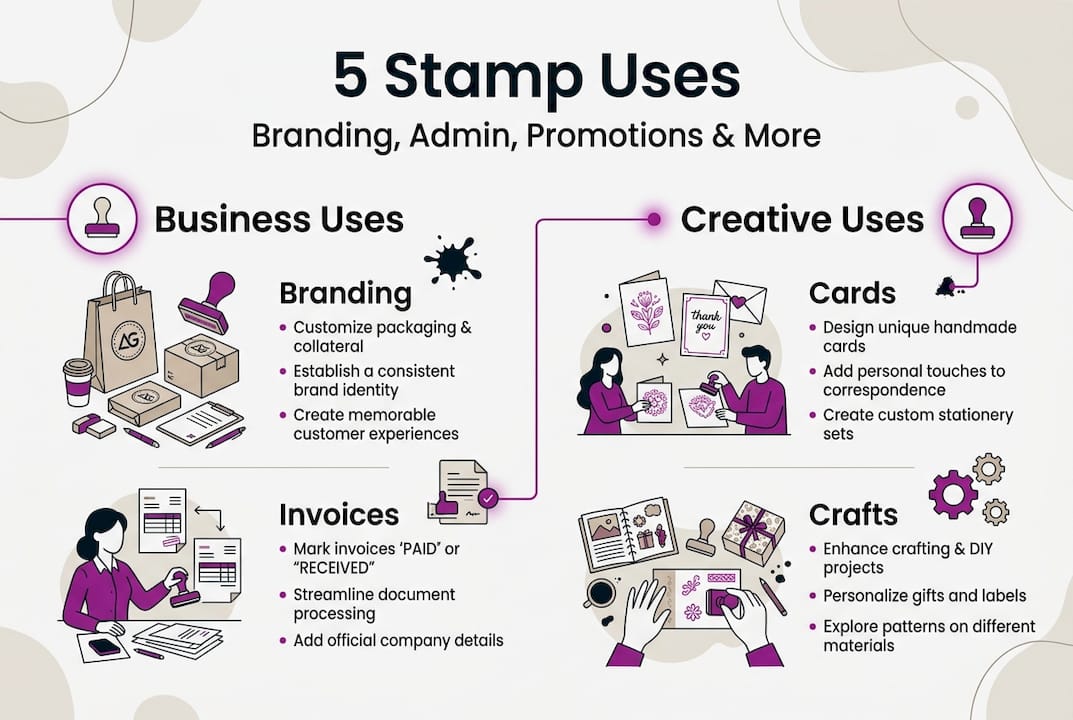
Business uses tend to cluster around four main areas. First, branding on packaging: stamping a logo or business name onto plain tissue paper, paper bags, cardboard boxes, or envelopes instantly elevates the unboxing experience and reinforces brand recognition without the cost of custom printed packaging. Second, loyalty schemes: a simple repeat-visit stamp on a loyalty card is a tactile, memorable alternative to digital punch cards, and customers genuinely respond to the physical interaction. Third, administrative marking: date stamps, “Approved,” “Invoice,” and similar marks streamline paperwork handling in a consistent, professional way. Fourth, legal and authorisation uses: stamps bearing a business name and registration number carry weight on formal correspondence and contracts.

Personal uses are equally varied. Crafters use custom stamps to add personalised motifs to handmade greeting cards, gift wrap, and fabric projects. Scrapbookers use them for decorative borders and journalling elements. Individuals use address stamps on envelopes to speed up mailing and give correspondence a polished, distinctive appearance. Event hosts stamp invitations, favour bags, and table settings with a consistent motif that ties the theme together.
| Use | Example | Benefit |
|---|---|---|
| Packaging branding (business) | Logo stamp on kraft paper bags | Low-cost, consistent brand presence |
| Loyalty card marking (business) | Visit-per-stamp card | Encourages repeat customers |
| Administrative marking (business) | “Invoice” or date stamp on documents | Speeds up office processing |
| Return address (personal) | Home address on envelopes | Saves time, looks professional |
| Craft decoration (personal) | Motif stamp on handmade cards | Adds personalised creative detail |
| Event personalisation (personal) | Theme stamp on invitations | Consistent visual identity across materials |
Pro Tip: A small change in ink colour is often all it takes to shift a stamp from an admin tool to a branding asset. Use black ink for formal paperwork and switch to your brand colour for packaging and marketing materials. These custom stamp tips can extend a single stamp’s usefulness significantly, and pairing your stamp with the right pad is covered thoroughly in office stamp essentials.
Features that make a stamp truly multi-purpose
The range of applications a stamp can cover depends directly on the features it offers. Not every stamp is built equally, and understanding what separates a standard single-use stamp from a genuinely flexible multi-purpose tool will save you from buying something you quickly outgrow.
As described by StampedWithLove, rubber stamps transfer ink using a raised rubber design to imprint a message, logo, or design on various surfaces. That mechanism is consistent across all types. What differs is how the stamp is engineered around that mechanism.
Here are the key features that distinguish a genuinely multi-purpose stamp:
- Interchangeable or replaceable text plates: Some stamp models allow you to swap out the rubber plate when your address, phone number, or branding changes, meaning you replace only the plate rather than the entire stamp unit.
- Dual text and logo capacity: A stamp that can combine a logo with multiple lines of text in a single impression is far more versatile than one that handles only text or only graphics.
- Multi-ink compatibility: Stamps that work with a range of pad types, including water-based, oil-based, and archival inks, can be used on paper, cardboard, fabric, and some plastics without quality loss.
- Ergonomic design and handle quality: A well-constructed handle reduces hand fatigue and delivers a more consistent impression, which matters when you are stamping large batches of packaging or documents.
- Size and shape variety: Rectangular stamps suit address blocks and multi-line text. Square or circular stamps often work better for logos. Having the right shape keeps impressions clean and legible.
| Feature | Standard stamp | Multi-purpose stamp |
|---|---|---|
| Text capacity | Fixed single line | Multiple lines plus logo |
| Ink compatibility | One pad type | Several pad and ink types |
| Replaceable components | No | Often yes |
| Size/shape options | Limited | Wide range available |
| Surface range | Paper only | Paper, packaging, fabric, card |
Pro Tip: When selecting your layout, aim for a design that leaves a small amount of clear space around text and logos. Overcrowded impressions lose detail on textured surfaces. The custom stamp best practices guide covers this in detail, and exploring custom logo stamp uses gives you real examples of how spacing decisions affect the final result.
How to design and choose your own multi-purpose stamp
Knowing which features to look for makes it considerably easier to design or buy the right stamp. The process is straightforward when you follow a clear sequence of decisions.
A rubber stamp imprints messages, dates, addresses, or logos via a press using a raised rubber design, and each of those elements can be combined or arranged to serve your specific needs. Here is how to approach the design process:
- Define your intended uses first. Write down every context in which you plan to use the stamp. Packaging? Correspondence? Craft projects? Admin? The list of uses determines which features matter most and helps you avoid designing something too narrow.
- Select your text and images carefully. Keep text concise. A business name, a short tagline or web address, and a logo mark are usually sufficient. Avoid cramming in phone numbers, social handles, and full addresses unless the stamp is large enough to keep everything legible.
- Choose your size and ink type. A 60mm x 40mm stamp comfortably fits a logo plus three to four lines of text. Smaller stamps suit single-line addresses or simple motifs. For ink, water-based pads suit paper and card; fabric-specific inks are needed for textile applications.
- Contact a specialist custom stamp provider. A good provider will review your artwork, advise on layout, and confirm that your design will reproduce cleanly at the chosen size. Look for logo stamp examples for inspiration before submitting your design.
Beyond the steps above, there are several creative ideas that work equally well for business and personal use:
- A logo combined with a short URL for packaging stamps that drive web traffic.
- A decorative border framing a return address for correspondence that stands out.
- A rotating date wheel paired with a business name for daily administrative marking.
- A simple seasonal motif alongside a brand name for limited-edition packaging runs.
Avoiding common customisation mistakes is equally important. The most frequent errors include using fonts that are too thin (they lose detail in the rubber), choosing a stamp size too small for the level of detail in the design, and failing to test the impression on the intended surface before ordering in bulk. Understanding the stamp design workflow from concept to finished product helps you sidestep these problems early, and specific guidance on personalising stamp text covers font selection and layout in practical detail.
Why the future of multi-purpose stamps is creative, not just practical
There is a tendency to frame rubber stamps purely as efficiency tools, things that save time on repetitive tasks. That framing undersells what they have become. The more interesting development is how multi-purpose stamps are now central to brand storytelling for small businesses.
Consider what happens when a small independent candle maker stamps each order box with a hand-designed logo in deep green ink. The customer’s experience of opening that parcel changes. The stamp communicates care, intentionality, and a consistent visual identity without requiring an expensive printed packaging run. The stamp is the brand at that moment.
Small businesses using stamps for branding with custom logo stamps report that customers frequently comment on the packaging itself, not just the product inside. That is the power of a thoughtfully applied stamp. It turns a functional surface into a brand touchpoint.
The conventional wisdom says stamps are practical and photography is creative. We think that distinction is less useful than it sounds. A well-chosen stamp design, applied with the right ink on the right surface, produces something genuinely beautiful. The tools are simple. The results do not have to be.
Find your ideal multi-purpose stamp solution
If you are ready to put multi-purpose stamps to work in your own projects, the range at Stamp Design 4U covers everything from compact personal stamps to professional multi-line business options.
For businesses needing a logo combined with several lines of contact or branding text, the multiline logo stamp offers a 60mm x 40mm impression area with up to nine lines of customisable content. If you run a loyalty scheme or want a simple, repeatable mark for repeat customers, the loyalty and recycle stamps are a compact, purpose-built option. Browse the full catalogue of custom rubber stamps to find the right size, format, and design for your specific needs.
Frequently asked questions
What materials can multi-purpose stamps be used on?
Most multi-purpose stamps can be used on paper, packaging, fabric, and some plastics, depending on the ink selected. Choosing the correct ink type for your surface ensures a clean, lasting impression.
How do I customise a multi-purpose stamp for my business?
Choose a stamp layout, add your desired text or logo, select your ink colour and size, then place your order with a specialist provider. A good provider will advise on font choices and layout before production begins.
What makes a stamp truly multi-purpose?
A truly multi-purpose stamp can be easily customised and used for branding, admin, promotions, and creative tasks, adapting to different projects without needing a separate stamp for each function.
Can I use one stamp for both business paperwork and marketing?
Yes. As long as the stamp is designed with flexible text and compatible ink options, one stamp can cover admin marking, packaging branding, and promotional uses across a range of surfaces and contexts.