

Personalised rubber and logo stamps are bought and kept because they deliver consistent branding, repeatable admin tasks, and affordable craft customisation in a single reusable tool.
- Branding and packaging: stamp a logo onto boxes, bags, and tissue paper without minimum print runs.
- Office admin: replace repetitive handwriting on invoices, approvals, and correspondence with a single impression.
- Craft personalisation: add custom marks to cards, gift tags, and fabric with precision and speed.
Trodat notes that stamps continue to offer organisation, efficiency, and a personal touch, with logo and text stamps used directly on packaging and business documents. Stampdesign4u supplies a wide range of these, including the Trodat 4927 (60 x 40mm, logo and text) and the compact Traxx 9021 (14 x 14mm, loyalty, and functional use).
Key takeaways
Personalised rubber stamps are a cost-effective, reusable tool for branding, office admin, and craft personalisation, with UK custom orders typically delivered within 3–5 working days.
| Point | Details |
|---|---|
| Core reason to buy | Stamps deliver consistent branding, admin efficiency, and craft customisation from a single reusable tool. |
| Best type for offices | Self-inking stamps suit high-volume repetitive tasks; they re-ink automatically and produce uniform impressions. |
| Design rule | Submit bold, simplified artwork as vector or 600 DPI monochrome; always request a proof before production. |
| UK cost and lead time | Single custom stamps typically cost £10–£40; standard turnaround is 3–5 working days. |
| Stampdesign4u | Supplies personalised logo, packaging, and loyalty stamps for UK crafters and small businesses, with proof options before production. |
Table of Contents
- Why do people buy and keep personalised stamps?
- What stamp types are available and which suits your needs?
- How to choose the right stamp for your situation
- Design guidance: what to send and what to avoid
- What do custom stamps cost in the UK, and how long do they take?
- How to maintain your stamps and extend their working life
- Practical use-cases and creative ideas
- A note on choosing stamps with confidence
- Stampdesign4u: order your custom stamp today
- Sources
Why do people buy and keep personalised stamps?
The practical case is straightforward. A stamp removes the need to write the same information by hand dozens of times a day, and it does so with consistent output every time.
Branding and customer experience. A logo stamp on kraft paper bags or shipping boxes raises brand visibility without the cost of pre-printed packaging. Small businesses use personalised packaging stamps to make every parcel feel considered, which matters when competing with larger retailers.
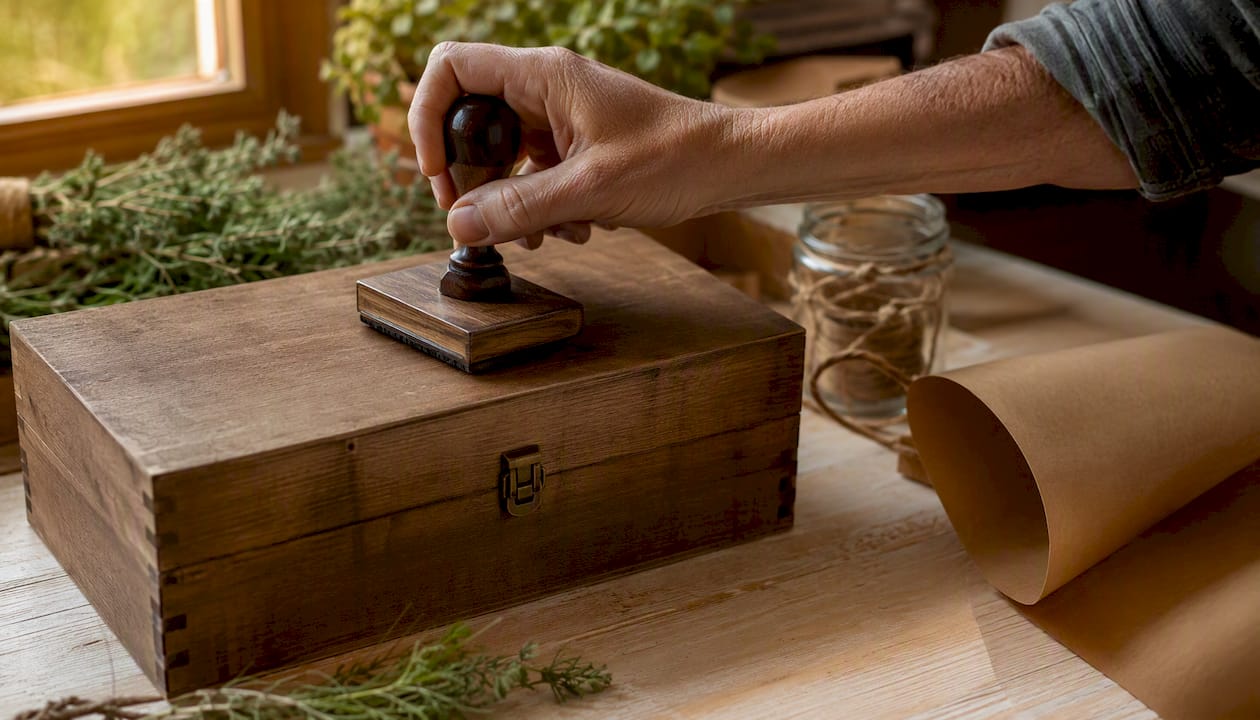
Office efficiency. Rubber stamps reduce handwriting errors and keep documents uniform. Date stamps, “Paid” stamps, and return-address stamps handle the bulk of repetitive paperwork quickly. This is especially useful for sole traders and small teams processing invoices or stock paperwork daily.
Cost-effectiveness for small runs. Custom print runs carry minimum quantities and setup costs. A single custom stamp costs a fraction of that and produces thousands of impressions. For short-run product labelling or seasonal packaging, stamps are often the most practical option.
Creative and craft value. Crafters use rubber stamps for cards, tags, and small-run branding, combining hand-carved prototypes with professionally made stamps for mixed workflows. The result is personalised output at low unit cost.
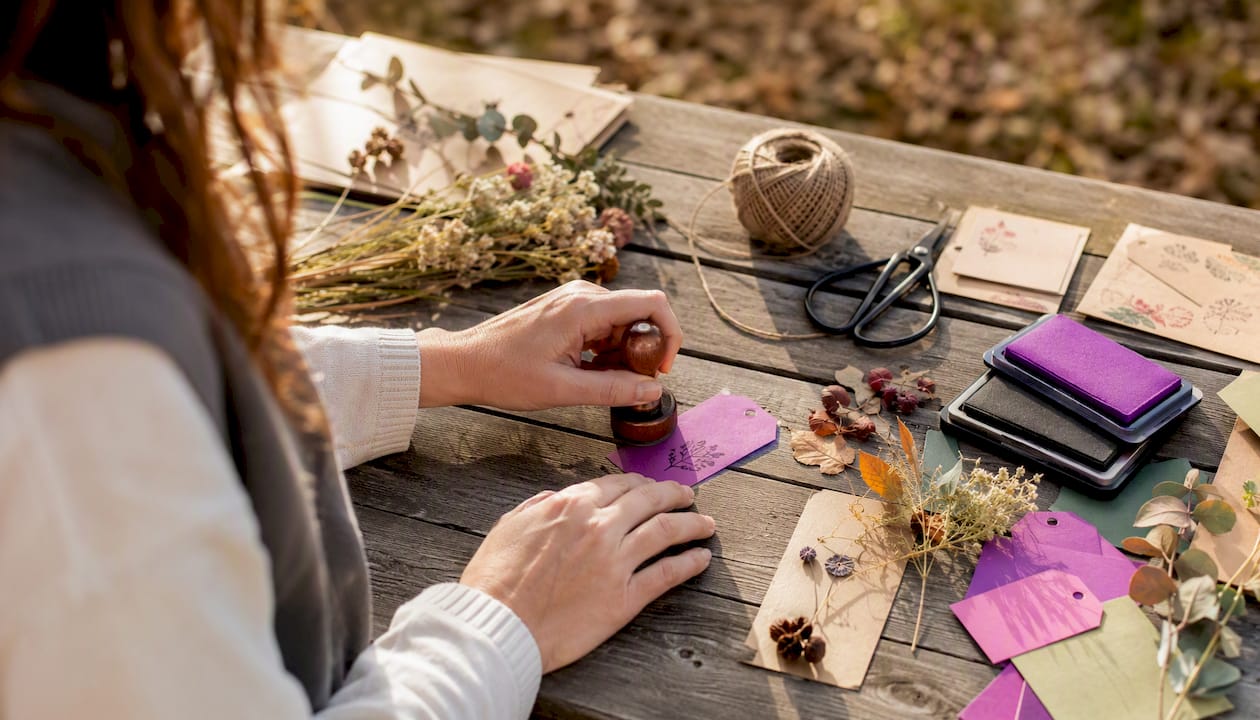
Pro Tip: Pair a logo stamp with plain kraft tape on your parcels. The contrast between unprinted tape and a clean ink impression draws the eye and lifts the perceived quality of the packaging without adding significant cost.
What stamp types are available and which suits your needs?
Self-inking stamps
Self-inking stamps are the standard choice for office admin. Office5Star recommends self-inking models for repetitive tasks because they are easy to use and produce consistent impressions without a separate ink pad. The ink pad is built into the body and re-inks automatically after each impression. Suitable for invoices, approvals, and date marking.
Pre-inked stamps
Pre-inked stamps hold ink within the rubber itself, producing sharper, finer impressions than self-inking models. They suit logos with fine detail or multi-line text. Refilling requires specific ink and a little care, but the impression quality is noticeably crisper.
Traditional mounted rubber stamps
A rubber die mounted on a wooden or acrylic block, used with a separate ink pad. Crafters favour these because the pad can be swapped for different colours, and the rubber can be replaced independently. The Trodat 4927 (60 x 40mm) is a practical example for logo and text use, offering a generous impression area for branding on packaging or documents.
Date, number, and loyalty stamps
Compact and functional. The Traxx 9021 (14 x 14mm) is a loyalty-stamp model suited to paper-based reward schemes and small mark-off tasks. Date and number stamps handle stock rotation, invoice dating, and sequential numbering. Stampdesign4u’s personalised logo stamp range covers all of these categories.
How to choose the right stamp for your situation
Work through these questions before ordering:
- How many impressions per day? High daily volume (50+) points to self-inking. Occasional use suits mounted rubber or pre-inked.
- What surface will you stamp? Porous surfaces (paper, card, kraft) accept most inks. Non-porous surfaces (plastic, coated card) need permanent pigment ink.
- Do you need portability? Pocket-style and compact models travel easily. A pocket stamp guide covers the options.
- Will you need replaceable pads? Self-inking and mounted rubber models both allow pad replacement, extending working life significantly.
- What impression size do you need? Measure your logo’s bounding box in millimetres. Allow clear space around the design. Fine detail requires a larger impression area to reproduce legibly.
- Which ink type suits your use? Dye inks are vibrant on paper but fade on non-porous surfaces. Pigment inks are slower-drying but more durable and water-resistant.
- What to tell your supplier: impression area in mm, preferred ink colour, expected daily run length, file format for artwork, whether you need a proof, and your required delivery date.
Use the stamp order checklist to confirm these details before submitting artwork.
Design guidance: what to send and what to avoid
Bold, simplified shapes reproduce best as stamps. Fine gradients, thin strokes, and photographic detail are lost in the rubber-making process.
- File format: submit vector artwork (AI, EPS, SVG) where possible. If not, provide a high-resolution monochrome PNG or TIFF at 600 DPI minimum.
- Line weight: keep all strokes at 0.5pt or thicker. Thinner lines may not transfer to the rubber die.
- Clear space: leave at least 1.5mm of clear space around the design edge and between elements.
- Fonts: choose sans-serif or slab-serif typefaces for small text. Convert all text to outlines before submitting so the supplier sees exactly what you intend.
- Proof checklist: request a size mock-up at actual dimensions, a digital proof showing the design in single colour, and confirm detail reproduction before approving production.
The step-by-step stamp customisation guide covers artwork submission in detail.
What do custom stamps cost in the UK, and how long do they take?
Cost depends on stamp type, impression area, ink colour, quantity, and whether you need expedited production.
- Single custom stamp: typically £10–£40 for a standard self-inking or mounted rubber model, depending on size and complexity.
- Small bulk orders: per-unit cost falls with quantity; ordering five or more units of the same design usually reduces the unit price.
- Factors that raise cost: larger impression area, multi-colour dies, rush production, and premium models.
- Standard turnaround: most UK suppliers produce custom stamps within 3–5 working days. Expedited options can reduce this to 1–2 working days, usually at a surcharge.
- Ordering advice: order a spare ink pad at the same time as your stamp. Replacement pads are inexpensive and having one on hand avoids downtime when the original runs dry.
How to maintain your stamps and extend their working life
Routine care keeps impressions consistent and reduces replacement frequency.
- Clean after long runs. Wipe the rubber die with a damp cloth or a stamp cleaner after extended use. Avoid solvent-based cleaners, which degrade rubber over time.
- Re-ink correctly. Use the manufacturer’s recommended ink for self-inking and pre-inked models. Wrong ink types can clog the pad or damage the die.
- Store correctly. Keep stamps away from direct sunlight and heat. Store self-inking models impression-side down to keep the pad in contact with the die. Store mounted rubber stamps impression-side up to prevent the rubber from deforming.
- Replace pads on schedule. A faint impression usually means the pad needs re-inking or replacement, not that the die is worn.
- Weekly: wipe the die and check ink coverage.
- Monthly: inspect the pad for saturation, check the die for residue build-up, and test on scrap paper.
The custom stamp care guide covers these steps with model-specific notes.
Practical use-cases and creative ideas
For small businesses:
- Stamp a logo and address on kraft mailers and tissue paper for branded unboxing.
- Use a “Paid” or “Approved” stamp on invoices and purchase orders to speed paperwork sign-off.
- Run a simple paper loyalty scheme with a compact Traxx 9021 loyalty stamp.
- Date-stamp incoming stock with a rotating date stamp for accurate rotation records.
For crafters:
- Stamp personalised thank-you messages on card inserts for handmade product orders.
- Create limited-edition product labels using a logo stamp on coloured card stock.
- Use fabric-safe ink with a mounted rubber stamp to mark cloth bags, tote bags, or stitched items.
- Combine hand-carved lino prototypes with a professionally made stamp once a design is finalised.
One practical example: a small soap maker used a 60 x 40mm logo stamp on plain brown paper wrap, combined with a length of unprinted kraft tape. The result was a consistent, professional-looking parcel that required no pre-printed packaging at all. For stamp-related craft ideas, the range of applications extends well beyond basic labelling.
A note on choosing stamps with confidence
The most common mistake when ordering a custom stamp is submitting artwork that is too detailed for the impression size. A logo that looks sharp on screen at 300 x 200 pixels will lose its fine lines when reproduced at 30 x 20mm in rubber. The fix is simple: simplify the design, increase the impression area, or both.
A second overlooked point: keeping separate stamps for packaging and admin tasks avoids ink cross-contamination and makes re-inking straightforward. A black pigment stamp for office paperwork and a coloured dye stamp for packaging each stay in their lane, and replacement pads are ordered by type rather than guessed.
Stampdesign4u: order your custom stamp today
Stampdesign4u supplies personalised rubber stamps for UK crafters and small businesses, covering logo stamps, packaging stamps, loyalty models, and stock options. The process is direct: upload your artwork, select your impression size and ink colour, choose your delivery speed, and request a proof before production begins.
The Trodat 4927 (60 x 40mm) is a practical starting point for logo and text use. For loyalty and compact admin tasks, the Traxx 9021 loyalty stamp handles small-format marking reliably. Browse the full range and submit your artwork to get a proof and confirmed lead time.
Sources
- The creative joys of rubber stamps — Inky Square - calligraphy & bookbinding
- Office 5Star Group | News & Views Which Custom Rubber Stamp is Best UK