

TL;DR:
- A pocket stamp is a compact, self-inking tool designed for on-the-go document marking or branding. It uses a patented mechanism to prevent leaks and fits in a pocket or bag, suitable for various professional labeling tasks. Proper surface testing and selecting the right size, refillability, and casing ensure reliable, high-quality impressions on paper or other materials.
A pocket stamp is a compact, self-contained, self-inking stamp designed for on-the-go document marking. It fits in a jacket pocket, bag, or briefcase and delivers consistent impressions without the need for a separate ink pad. Typical uses include marking invoices, delivery notes, approval marks, contact details, and quick logo or return-address impressions. A pocket stamp is hardware; it is not the same as a pocket letter, which is a paper-crafting concept using a nine-pocket trading-card sleeve filled with letters and small items.
Table of Contents
- What is a pocket stamp and how does it work?
- What types of pocket stamps are available?
- Who uses pocket stamps and what for?
- Which surfaces do pocket stamps work on?
- How to buy a custom pocket stamp in the UK
- How to maintain and refill a pocket stamp
- Key takeaways
- Selecting pocket stamps for professionals
- Order a custom pocket stamp from Stampdesign4u
- Useful sources
What is a pocket stamp and how does it work?
A pocket stamp encloses all its working parts inside a single moulded case. There is no separate pad to carry or cap to lose mid-job. The patented self-inking mechanism keeps the ink pad out of contact with the rubber die until the stamp is pressed against a surface, which is why pocket stamps resist leaking in transit.
The core components, in order of operation:
- Protective casing and cap — the outer shell that seals the stamp when not in use
- Spring mechanism — holds the stamping member in the resting position
- Inking pad — pre-loaded with ink, housed inside the casing
- Rubber die or embossed plate — carries the text, logo, or mark
- Stamping member / push mechanism — depresses against the spring to bring the die into contact with the pad, then onto the paper
When you press the stamp down, the spring compresses, the die rotates or descends to pick up ink, then transfers the impression in one motion. Release the pressure and the spring resets everything. Patented designs focus on simple construction and anti-leak catch-and-spring systems, which is why many reliable pocket stamps have only a handful of moulded parts and a long service life when maintained correctly.
Pro Tip: Before carrying a new pocket stamp in a pocket or bag, press it once on scrap paper to confirm the cap locks securely. A loose cap is the most common cause of accidental ink transfer on fabric.
What types of pocket stamps are available?
Three broad categories cover most professional needs.
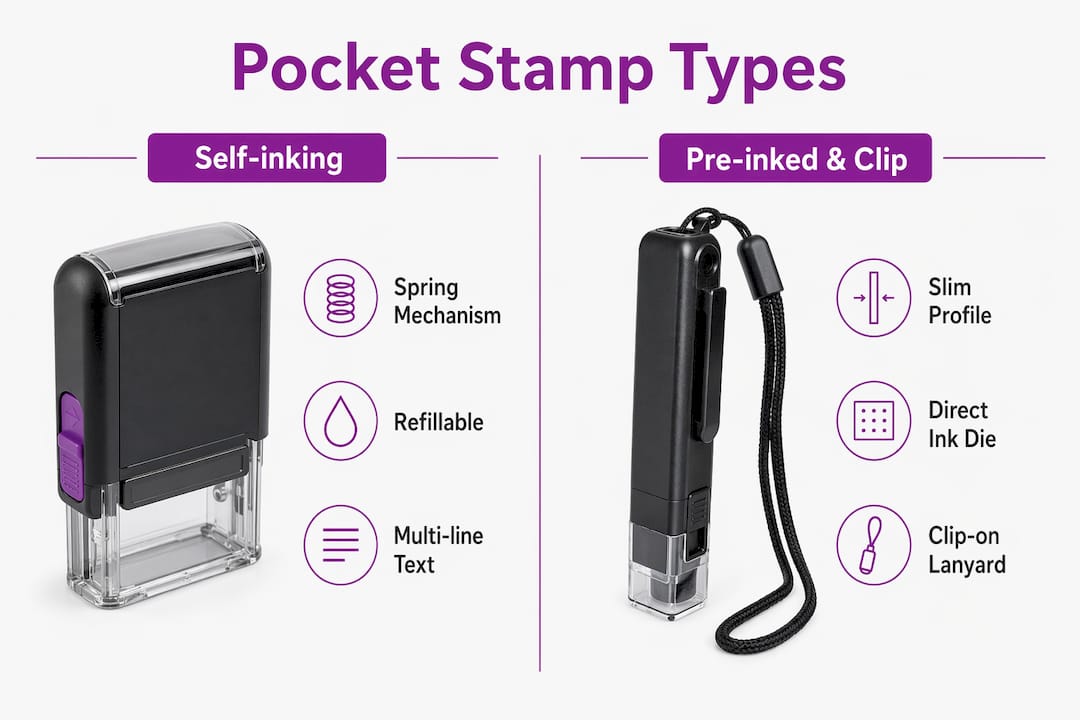
Compact self-inking pocket stamps are the most common. They use a spring-and-pivot mechanism, accept multi-line text or a small logo, and refill via a replacement pad or ink bottle. This is the standard choice for office and field use.
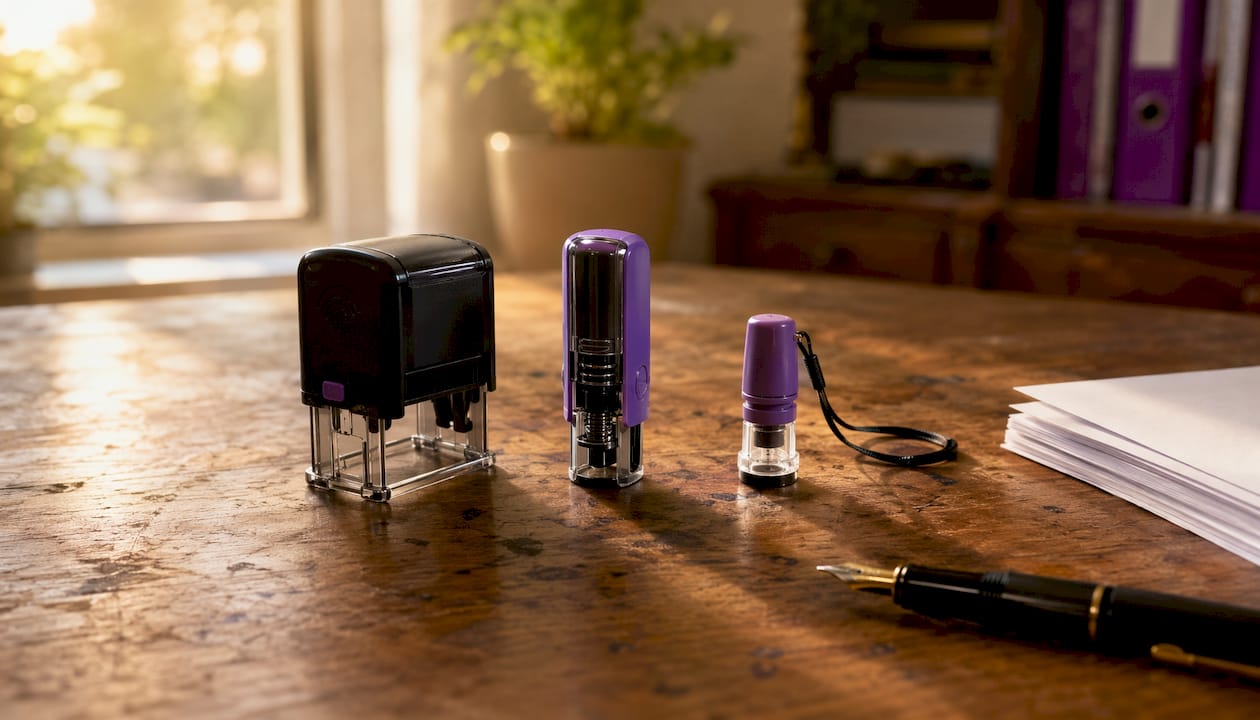
Slim pre-inked pocket stamps carry ink directly in the die material rather than a separate pad. They are thinner still, suited to light-duty use, and typically not refillable in the same way. Impression counts per fill tend to be lower.
Mini clip or lanyard stamps attach to a badge reel or lanyard. They suit inspectors, nurses, or event staff who need hands-free carry and fast access.
When choosing between them, the three decisive criteria are imprint area (does it fit your text or logo), refillability (total cost of ownership over time), and protective casing (does it prevent accidental inking in a bag). For a broader look at types of business stamps used across UK workplaces, the full category breakdown is worth reviewing.
Representative technical specification
| Feature | Compact self-inking model | Notes |
|---|---|---|
| Impression area | 3.6 × 1.4 cm | Fits 3–4 lines of text or a small logo |
| Outside dimensions | — | Slips into a shirt pocket |
| Weight | 16 g | Lighter than most pens |
| Ink colours | Black, red, blue, green (typical) | Varies by supplier |
| Refillable | Yes (pad or ink) | Extends service life significantly |
Feature checklist when choosing a pocket stamp:
- Imprint area large enough for your full text or logo
- Protective cap or sealed casing confirmed before purchase
- Ink colour available in your preferred option
- Refill pads or ink available from the same supplier
- Dimensions confirmed against the pocket or bag compartment you plan to use
Who uses pocket stamps and what for?
Professional uses span a wide range of field and office roles. Common examples:
- Couriers and delivery staff — stamp delivery notes or proof-of-delivery paperwork on the doorstep
- Inspectors and quality-control teams — mark passed or rejected items on worksheets without returning to a desk
- Sales representatives and market traders — add contact details or a return address to receipts and order forms
- Office administrators — apply “Received”, “Approved”, or “Processed” marks to incoming documents; stock word stamps cover the most common office text options
- Events and loyalty-card staff — stamp attendance cards or loyalty sheets at the point of interaction
A courier arriving at a commercial address can stamp multiple delivery notes quickly without uncapping a pen or finding a separate pad. A quality inspector walking a production line can mark numerous check sheets per shift without returning to a fixed workstation. These are the workflows pocket stamps are built for.
One limitation: pocket stamps are not suitable for high-security authorised seals, notarial marks, or any impression that carries legal weight under UK statute. Those require certified hardware and controlled processes.
Which surfaces do pocket stamps work on?
Paper is the primary intended surface. Porous, uncoated papers give the clearest, most legible impressions. Standard office paper, delivery note stock, and receipt paper all perform well.
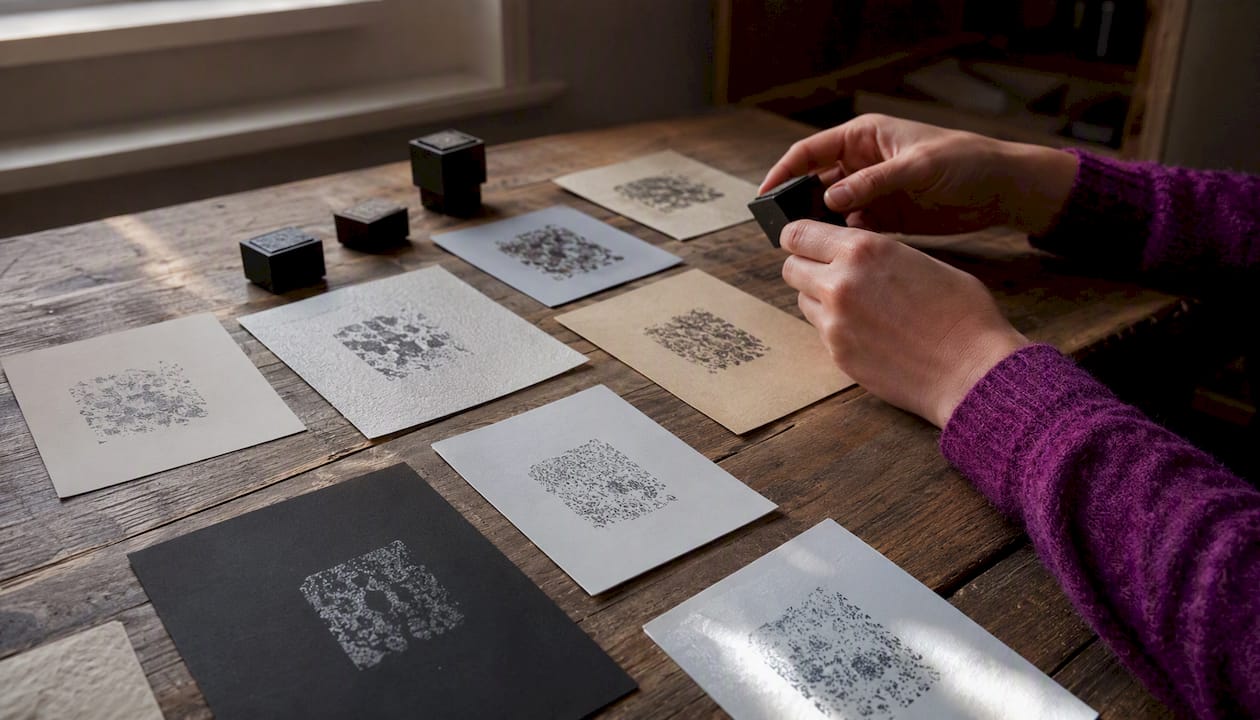
Glossy, coated, or non-porous surfaces are a different matter. Pre-inked and self-inking pocket stamps produce faint or smeared impressions on these materials without specialised inks or surface preparation. Always test on the actual stock before committing to a bulk run.
Fabric stamping requires a separate approach entirely. Durable textile impressions need fast-drying, permanent fabric inks such as StazOn, and often different stamp hardware. Standard pocket stamps are not optimised for fabric and will produce impressions that wash out or bleed.
Surface quick-reference:
- Do use on uncoated office paper, delivery note stock, receipt paper, card
- Test first on coated or semi-gloss paper, kraft card, envelopes
- Do not rely on for glossy labels, acetate, or non-porous plastics without specialist ink
- Use dedicated hardware and fabric ink for any textile application
A pocket stamp used on the wrong surface wastes ink and produces unusable impressions. Matching the stamp to the stock is as important as the design itself.
How to buy a custom pocket stamp in the UK
Ordering a custom pocket stamp involves a few straightforward steps. Getting each one right avoids reprints and delays.
Ordering checklist:
- Artwork supplied as a high-resolution file (vector preferred: .ai, .eps, or .pdf)
- Maximum imprint lines confirmed against the stamp’s impression area
- Preferred ink colour specified at order stage
- Proof reviewed and approved before production begins
- Delivery address confirmed, including any site-access requirements for couriers
On price, compact self-inking pocket stamps with custom text or a logo sit at the lower end of the business-stamp range. Slim pre-inked models can cost less upfront but may carry a higher cost per impression over time if pads are not refillable. Lead times at UK suppliers typically run from a few working days for standard text orders to slightly longer for logo artwork that requires design approval.
Pro Tip: Check the stated impression area in millimetres before uploading artwork. A 3.6 × 1.4 cm imprint area fits roughly three to four lines of small text or a simple logo mark; anything more complex will be illegible at that scale.
Stampdesign4u offers custom personalised stamps with logo and text options, proof approval, and UK delivery. For readers comparing imprint size and artwork requirements for mail and packaging, the guide on choosing stamps for business mail covers the key decisions clearly.
| Consideration | What to check |
|---|---|
| Imprint area | Confirm mm dimensions match your text/logo |
| Artwork format | Vector file preferred for clean reproduction |
| Ink colour | Confirm availability before ordering |
| Lead time | Ask for production and dispatch timelines |
| Refill availability | Confirm pads or ink are stocked by the supplier |
How to maintain and refill a pocket stamp
Consistent impressions depend on basic upkeep. A neglected stamp produces light, patchy marks within weeks.
Maintenance steps:
- Clean the die periodically with a damp cloth or stamp cleaner; dried ink on the rubber surface reduces impression quality
- Re-ink or replace the pad when impressions become faint; most compact self-inking models accept a replacement pad or a few drops of stamp ink directly onto the existing pad
- Store sealed when not in use; leaving the cap off dries the pad and the die
- Apply moderate, even pressure when stamping; excessive force distorts the impression and accelerates wear on the die
- Avoid heat and direct sunlight during storage, both of which degrade ink and rubber over time
UK suppliers commonly advertise refillable pads and thousands of impressions per refill for self-inking pocket-stamp models. That figure assumes correct ink type and moderate stamping pressure.
Troubleshooting:
- Light impression — re-ink the pad; if that does not resolve it, the die may be worn
- Smeared impression — check that the surface is suitable and that you are not moving the stamp during the downstroke
- Ink on the casing — inspect the cap closure; a worn cap seal needs replacing
For transport, keep the stamp in a small zip pouch or dedicated compartment to prevent the cap being knocked loose. A duffle bag with internal organiser pockets is a practical option for field workers carrying multiple tools.
Key takeaways
A pocket stamp is the right tool when you need portable, repeatable document marking on paper-based stock without carrying a separate ink pad.
| Point | Details |
|---|---|
| Primary use case | Mobile document marking on uncoated paper: invoices, delivery notes, approval marks |
| Impression area | A compact self-inking model typically offers a small imprint area suitable for several lines of text or a small logo |
| Surface suitability | Uncoated paper works best; test on coated stock; use specialist ink for fabric |
| Three selection criteria | Imprint area, refillability, and protective casing determine long-term value |
| Stampdesign4u | Offers custom pocket stamps with logo/text options, proof approval, and UK delivery |
Selecting pocket stamps for professionals
The most common mistake when ordering a pocket stamp is prioritising size over imprint area. A stamp that fits neatly in a shirt pocket but cannot accommodate four lines of text is the wrong tool for the job, regardless of how portable it is.
The practical framework is straightforward: start with the information you need to stamp, calculate the minimum imprint area that makes it legible, then find the smallest casing that accommodates that area. Refillability comes third, but it matters more than most buyers expect. A stamp used fifty times a day will exhaust a standard pad in weeks; a model with readily available refill pads costs far less over a year than one that requires full replacement.
Protective casing is the detail most often overlooked in product listings. A stamp without a reliable cap lock is a liability in any bag or uniform pocket.
Order a custom pocket stamp from Stampdesign4u
Custom pocket stamps with your logo, return address, or business text are available directly through Stampdesign4u, a UK-based stamp customisation and ordering platform.
Key service points:
- Upload your logo or enter your text using the online designer
- Proof approval before production begins
- Choice of ink colours including black, red, and blue
- Refill supplies available alongside the stamp
- UK customer support and delivery
For a larger imprint, the Trodat Printy 4927 logo stamp at 60 × 40 mm accommodates up to nine lines of text or a full logo. Browse the full range of personalised logo stamps to find the right imprint size for your workflow, then place your order with proof approval included.
Useful sources
The following sources support the technical, craft, and buying details covered in this article.
- EP0364072A2, Google Patents — the original pocket-stamp patent; useful for understanding the anti-leak spring-and-catch mechanism and construction principles
- Tradeprint UK pocket stamp specification — concrete dimensions (3.6 × 1.4 cm imprint area, 16 g weight) and UK ordering details
- What the heck is a pocket letter? — Heartfelt Crafts — explains the craft concept of pocket letters; clarifies why search results for “pocket stamp” sometimes return craft content
- Intro to pocket letters — Swap-bot — additional background on the craft community’s use of the term “pocket”, useful for distinguishing hardware from hobby items
- Denim pocket sew project — Deep Red Stamps — practical guidance on fabric stamping and why specialist inks such as StazOn are required for textile durability