

TL;DR:
- Stamp design requirements vary by country due to legal, administrative, and cultural rules.
- Compliance must be prioritized by identifying mandatory fields and approval processes before designing.
- Properly designed stamps enhance trust, professionalism, and brand consistency across global operations.
Ordering a custom stamp and assuming it will work across every country you operate in is a costly assumption. A single overlooked requirement — a missing title, an incorrect format, a prohibited symbol — can result in rejected documents, delayed shipments, and compliance penalties that far outweigh the cost of getting the design right from the start. This article explains what makes stamp design country-specific, what legal and administrative rules drive these differences, and how to approach the process so your stamps work correctly whether you are operating in the UK, Vietnam, the United States, or anywhere else.
Table of Contents
- What makes stamp design country-specific?
- Legal and administrative drivers for stamp design
- How to approach country-specific stamp design for your business
- Beyond compliance: Branding and the strategic value of stamps
- Brand insights: What most businesses get wrong about country-specific stamp design
- Get country-specific stamp designs that work for your business
- Frequently asked questions
Key Takeaways
| Point | Details |
|---|---|
| Country rules shape design | Stamp designs depend on legal and administrative requirements in each country. |
| Ignoring details risks errors | Using a non-compliant stamp can cause document rejection or delays. |
| Follow a clear workflow | Defining mandatory fields first ensures both compliance and efficiency. |
| Branding brings extra value | A custom, country-specific stamp supports trust and business identity internationally. |
What makes stamp design country-specific?
Most small business owners assume that a company stamp is just a stamp. A logo, an address, perhaps a registration number. The design goes to print, and the job is done. That assumption falls apart quickly once you start operating across borders.
Stamp design requirements are largely driven by local legal and administrative rules, which vary by jurisdiction and can include mandatory wording, required design elements, and formal approval processes. What is perfectly acceptable in the UK may be non-compliant in Vietnam, and what works for a US professional seal may not translate to a European context at all.
The business stamp roles a stamp fulfils also shift depending on the country. In some jurisdictions, stamps carry legal weight — they authenticate documents, confirm identity, or signify regulatory approval. In others, they are primarily administrative or operational tools. That distinction matters enormously when choosing what to include in your design.
Three key forces shape these differences:
Legal mandates. Many countries specify exact wording, required elements, or approved layouts for official stamps. Vietnam, for example, has formal government regulations governing what an official postage stamp design must contain, including the issuing authority and precise visual standards. Businesses operating there cannot simply design a stamp to their own preference.
Administrative approval. In some countries, certain stamps must be registered or approved before use. Solicitor stamps in the UK, for instance, carry specific professional obligations. Architect seals in several US states must meet board-approved design criteria before they can be used on official documents.
Cultural and institutional expectations. Even where no law dictates the exact design, cultural norms influence what looks credible. A stamp that appears too informal or lacks recognised conventions may be treated with suspicion by officials or partners in that country.
| Country | Mandatory elements | Approval required | Legal weight |
|---|---|---|---|
| Vietnam | Issuing authority, official format, national symbols | Yes, government-regulated | High |
| United Kingdom | Company name, registration details (profession-dependent) | Profession-specific | Medium to high |
| United States | State-specific seal elements, professional board details | State board approval (professionals) | Varies by state |
“Country-specific stamp designs are largely driven by local legal and administrative requirements, which vary by jurisdiction and can include mandatory wording, required elements, and approval processes.” — LawNet Vietnam
Understanding the stamp layout regulations for your target jurisdiction is not optional. It is the foundation of the entire design process. Knowing the types of business stamps in use across different contexts also helps you identify which category your stamp falls into — and which rules apply.

Legal and administrative drivers for stamp design
With a sense of the broad landscape, let’s break down exactly what kinds of rules shape stamp design and how they affect daily operations.
Country requirements can mandate several distinct elements, each of which forces design decisions you cannot make on aesthetic grounds alone.
Required text or format. Some jurisdictions specify the exact wording that must appear. A company stamp in the UK for a registered limited company typically needs the full registered name and company number. A Vietnamese official stamp must include the issuing authority’s full title in a prescribed format.
Precise placement of stamps. Placement is not just a postal concern. For international mail, the USPS International Mail Manual specifies that destination-specific requirements affect what stamps and markings are permitted and where they appear on the item. Placing a marking incorrectly can cause the item to be held or returned.
Permitted imagery and symbols. Some countries restrict which symbols, emblems, or imagery can appear on stamps used for official purposes. Using a government-style seal when you are not an official body, for example, can create legal exposure. Conversely, some professional contexts require specific seals that must meet precise visual standards.
Registration or approval processes. In regulated professions such as law, architecture, and engineering, stamps often need to be approved by a governing body before use. Skipping this step means the stamp has no official standing, regardless of how well it is designed.
| Country | Mandated elements | Placement rules | Approval body |
|---|---|---|---|
| Vietnam | Issuing authority, format, national symbols | Government-specified | Ministry of Information and Communications |
| United Kingdom | Registered name, number, profession-specific text | Profession-dependent | Relevant professional body |
| United States | State, board, licence number (professionals) | USPS-specific for postal | State licensing boards |
The practical consequences of ignoring these requirements are significant:
- Documents rejected by official bodies or courts
- International shipments returned or held at customs
- Compliance penalties from regulatory authorities
- Wasted costs from reprinting non-compliant stamps
- Reputational damage when clients or partners notice the error
Following custom stamp best practices from the outset protects against all of these outcomes. If you are uncertain which category your stamp falls into, guidance on choosing a rubber stamp for your specific business context is a practical starting point.
Pro Tip: Always verify the current country-specific guidelines for stamp design before approving any final artwork. Regulations change, and a design that was compliant two years ago may no longer meet the current standard.
How to approach country-specific stamp design for your business
Knowing the rules is just step one. Here is how to put this understanding into action for your next stamp order.
The most common mistake is starting with the visual and working backwards to compliance. The correct approach is the reverse. Define every mandatory field first, confirm which approval process applies, and then build the design around those fixed requirements. Aesthetics and branding come after compliance, not before.
The USPS DMM 300 guidance for small businesses frames this well: treat the stamp as a compliance artefact. Define mandated fields first, then design for legibility and production constraints, and validate with a sample impression before committing to full production. This workflow applies regardless of which country you are designing for.
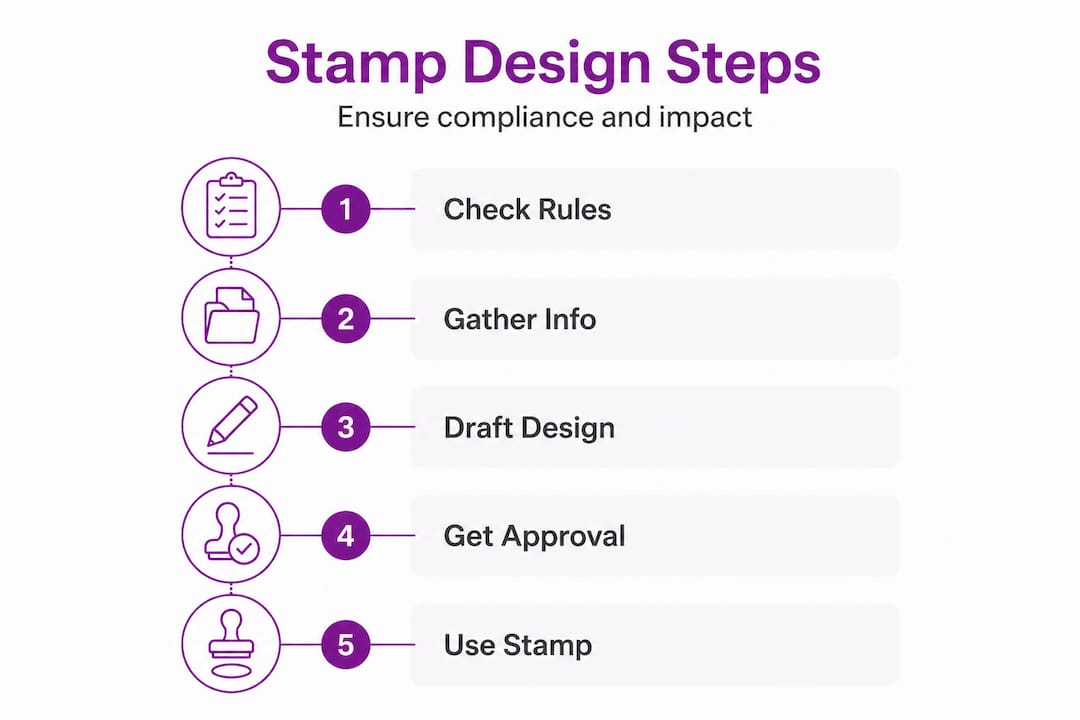
Here is a practical five-step process:
-
Identify mandatory fields and approval bodies. Research the specific requirements for the country and stamp type. Confirm whether registration or approval is required before production begins.
-
Draft the design for clarity and legibility. Work with the mandatory elements locked in. Ensure all required text is legible at the stamp’s intended size. Avoid decorative choices that obscure critical information.
-
Validate with a sample impression. Before approving the final design, test a proof. A physical sample impression will reveal legibility issues, ink spread, and alignment problems that are invisible on screen.
-
Get final approval or register if required. If your profession or jurisdiction requires formal sign-off, complete that process before ordering a production run. Do not assume approval is retrospective.
-
Begin production and use. Once everything is confirmed, proceed with production. Keep a record of the approved design file in case you ever need to reorder or demonstrate compliance.
Following a structured stamp design workflow removes guesswork from the process. If you are starting from a logo or existing brand asset, the logo to stamp steps guide walks through the conversion process in practical detail.
Pro Tip: Build a short compliance checklist into your design brief for every new stamp order. Include fields for: mandatory wording confirmed, placement rules checked, approval body contacted, and proof impression reviewed. This prevents costly reprints and keeps your process consistent.
Beyond compliance: Branding and the strategic value of stamps
Once you are set for compliance, the next consideration is standing out. Stamps are visible marks. Every impression made on a document, envelope, or package is a small act of brand communication. Getting that right matters beyond the legal minimum.
Country requirements set the floor, not the ceiling. Within the permitted design space, there is often room to incorporate your logo, brand colours, and distinctive visual elements. A compliant stamp that also looks professional and consistent with your broader brand identity communicates something valuable: that your business is organised, credible, and detail-oriented.
For businesses operating across multiple jurisdictions, brand consistency through stamps is a practical advantage. Clients and partners in different countries encounter a familiar visual identity, reinforcing trust even when the specific design elements vary to meet local requirements.
The brand benefits of well-designed custom stamps in an international business context include:
- Trust and legitimacy. An official-looking, well-designed stamp signals professionalism. It reassures clients that they are dealing with an organised business.
- Cohesive brand identity. Consistent use of logos, typefaces, and colours across stamp designs strengthens recognition across touchpoints.
- Customer experience. For retail or postal businesses, a distinctive stamp on packaging creates a tangible brand moment that customers remember.
- Credibility in formal contexts. In legal or administrative settings, a professionally designed compliant stamp avoids any doubt about authenticity.
Brand impact of professional stamp design: Research consistently shows that perceived professionalism in business communications directly influences client confidence and willingness to engage. A stamp is a small but visible signal of how seriously a business takes its operations.
Exploring business stamp branding options and artistic custom stamps can help you understand the full range of design choices available within your compliance boundaries.
Brand insights: What most businesses get wrong about country-specific stamp design
Here is a direct observation from working across international stamp requirements: most businesses treat stamp design as an administrative afterthought rather than a functional business tool with real consequences.
The typical approach is to hand a generic template to a printer, add a name and address, and approve the first proof. That approach works just fine in low-stakes contexts. It fails the moment a document needs to hold up in a foreign court, pass through international customs, or satisfy a professional regulator.
The shortcuts that cause the most trouble are predictable. Businesses reuse designs from one jurisdiction in another without checking whether the requirements differ. They skip the approval stage because it seems bureaucratic. They prioritise visual appeal over legibility of mandatory text. Then they are surprised when a document is rejected or a shipment is held.
The smarter approach is to invest a modest amount of time and resource upfront. Work with a designer or supplier who understands both the compliance requirements and your brand. Ask specific questions about mandatory fields before the design process begins. Request a proof before full production. These are small steps that prevent significant problems.
The most useful reframe is this: every stamp is a public mark of your business. It appears on official documents, correspondence, and parcels. It represents your organisation in contexts where you may not be present to explain or correct any impression it creates. Treating it as a compliance and brand asset rather than a throwaway administrative item changes how carefully you commission and approve it.
A well-made, compliant stamp does not just pass inspection. It removes friction, signals competence, and quietly reinforces your credibility every time it is used.
Get country-specific stamp designs that work for your business
Ready to get your stamp design right the first time? Stampdesign4u.co.uk provides custom stamp solutions tailored to country-specific requirements, covering branding, legal use, and professional contexts across a wide range of territories.
Whether you need a precise professional seal or a branded logo stamp, the platform guides you through design options and proof samples before production begins. Products such as the Trodat 4927 logo stamp offer generous space for text and logo elements, making them well-suited for multi-field compliant designs. For loyalty and promotional uses, the loyalty recycle stamp is a compact, practical option. Browse the full range of personalised stamp solutions and get in touch if you need guidance on requirements for a specific country or professional context.
Frequently asked questions
Do I need a different stamp design for every country I operate in?
Yes, each country has its own legal and administrative requirements for stamp design, so a one-size-fits-all approach frequently fails. Country-specific requirements can include mandatory wording, required elements, and approval processes that differ significantly between jurisdictions.
What happens if my stamp design doesn’t meet another country’s requirements?
Documents may be rejected, shipments delayed, or you could face compliance penalties and the cost of reordering. Destination-specific requirements affect what stamps and markings are permitted and where, making non-compliance a practical and financial risk.
How can I check the stamp requirements for a specific country?
Review the local postal and business regulations for that jurisdiction before commissioning a design. The most reliable approach is to define mandated fields first, then build the design around those requirements and validate with a sample impression before full production.
Can stamp designs for branding also be legally compliant?
Yes, it is possible to combine brand elements such as logos and colours with mandated fields, provided all official requirements are met first. Compliance sets the boundaries; brand design works within them.
Recommended
- Custom Logo Stamps: Why They Matter for your Brand Identity – Stamp Design 4U
- Why Custom Stamps Matter for UK Businesses – Stamp Design 4U
- Role of Stamps in Business – Branding, Compliance, Trust – Stamp Design 4U
- Personal vs Business Stamps: Choosing For UK Branding – Stamp Design 4U
- DTF Printing for Business Branding: How Custom DTF Transfers Boost Small Business Apparel and Merchandise – Transfer Kingz