

TL;DR:
- A stamp die cutter uses a custom-shaped die and pressure to produce precise, repeatable shapes in various materials. The die’s quality and design are more critical than the machine for achieving accurate results and high output consistency.
A stamp die cutter is a custom-engineered cutting tool that uses a shaped die and applied pressure to cut, shape, or emboss flat materials into precise stamped forms. The die itself is the critical component. It defines the final shape and performs the cutting action, whether the material is paper, cardstock, thin metal, adhesive sheet, or foam. The industry term for this process is die cutting, and the shaped tool at its centre is simply called the die. Understanding what a stamp die cutter is means understanding the die first, because the machine is secondary to the tooling.
What is a stamp die cutter and how does it differ from a standard cutter?
A stamp die cutter differs from a standard craft knife or guillotine in one fundamental way: it produces the same shape repeatedly, at speed, without manual tracing or cutting. Die cutting applies across paperboard, plastics, rubber, adhesives, foams, and thin metals, which explains why the same underlying technology appears in greeting card production, packaging lines, and automotive component manufacturing. The die is custom-engineered to a specific geometry. Once made, it cuts that geometry identically on every stroke.
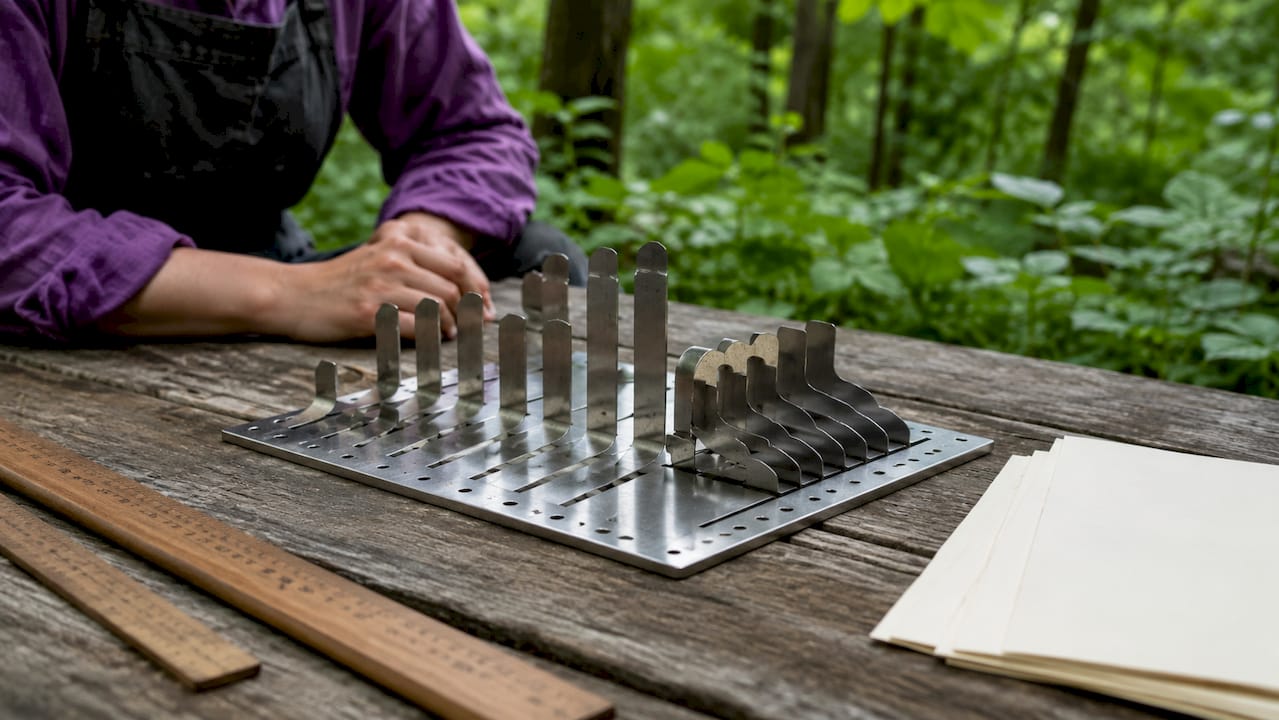
Steel rule dies are the most common type for paper and cardstock work. They consist of bent steel blades embedded in a die board, functioning much like a shaped cookie cutter pressed into material sheets. Flatbed presses drive the die vertically in a single stroke, making them practical for sheet-fed work with economical tooling changeovers. Rotary dies, by contrast, are mounted on a cylinder and cut continuously as material feeds through on a web. Rotary machines suit high-volume label and packaging production where speed matters more than tooling cost.
The die is not a single blade. Dies include cutting blades, punches, scoring rules, perforation rules, and ejector rubber components, all working together in one press stroke. This means a single die can cut an outer shape, score a fold line, and perforate a tear strip simultaneously. That multi-function capability is what separates die cutting from simpler cutting methods.
Types of stamp die cutters and dies compared
Die cutters divide broadly into two categories based on machine type: flatbed and rotary. Within those, the dies themselves vary by function and complexity.
| Die type | Key feature | Best application |
|---|---|---|
| Steel rule (flatbed) | Bent blades in a die board | Paper, cardstock, short runs |
| Rotary die | Cylindrical, continuous feed | Labels, packaging, high volume |
| Single-station die | One operation per press stroke | Simple shapes, low complexity |
| Progressive die | Multiple operations across stations | Complex metal parts, high output |
| Transfer die | Parts moved between stations manually | Mid-complexity metal stamping |
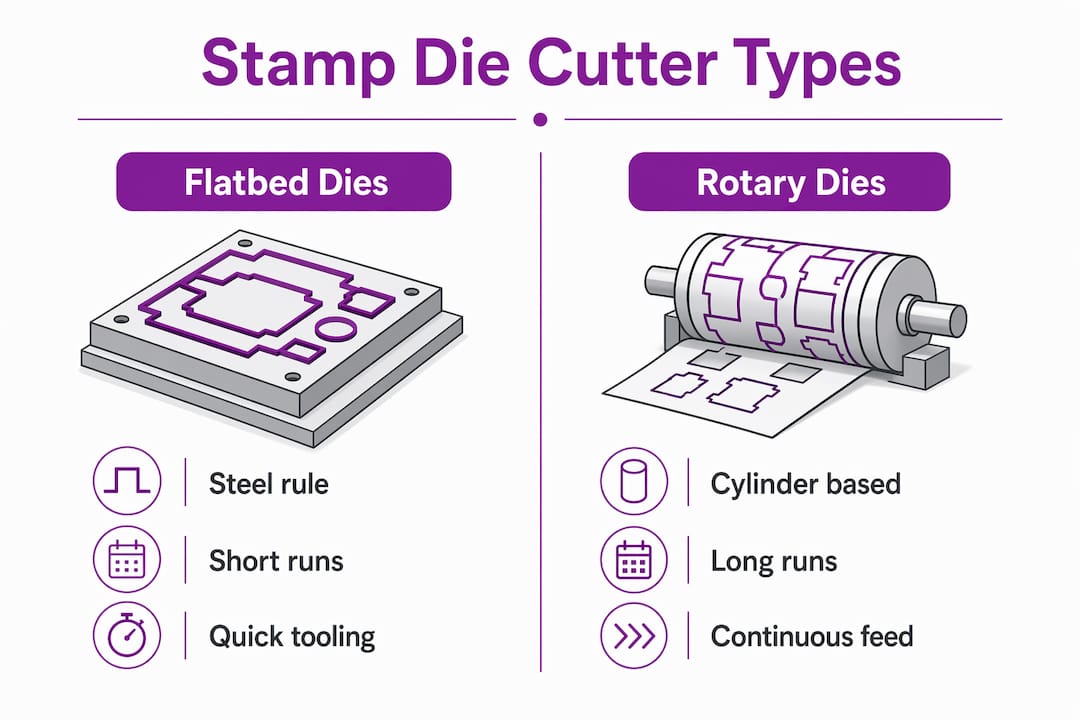
Single-station dies perform one operation per stroke, while progressive dies combine multiple operations across several stations in sequence. Progressive setups are common in metal stamping, where a strip of sheet metal advances through the die with each press stroke and exits as a finished component. Transfer dies sit between the two: parts move between stations but are handled individually rather than remaining on a strip.
For crafters and small businesses working with paper and cardstock, the steel rule flatbed die is the standard choice. The tooling is affordable, changeovers are quick, and the die board can be replaced without replacing the press. For businesses producing labels or packaging at volume, rotary dies offer the speed advantage, though the tooling cost is higher and setup requires more precision.
Pro Tip: In steel rule dies, varying the edge profile of each blade controls whether it cuts, creases, or perforates. A single die board can carry all three rule types, giving you a finished, folded, and perforated product in one press stroke.
How does a stamp die cutter work in practice?
The die cutting process follows a consistent sequence regardless of machine type or material. Understanding each step helps you set up correctly and avoid the most common output problems.
- Die design. The required shape is drawn and the die is manufactured to that geometry. For steel rule dies, blades are bent and set into a laser-cut board. For rotary dies, the cylinder is machined or etched.
- Material preparation. Sheets or webs of material are cut to feed size and checked for consistent thickness. Uneven material causes inconsistent cut depth.
- Press setup and registration. The die is mounted in the press and aligned to the material feed. Rotary machines use eye registration systems) to maintain automatic alignment between printed graphics and cut shapes, which is critical for premium labels and packaging.
- Pressure application. The press drives the die into the material. Flatbed presses apply pressure in a single vertical stroke. Rotary presses apply pressure continuously as the material web passes through.
- Stripping and ejection. Ejector rubber components physically push cut parts away from the blades after each stroke. Without proper ejection, parts stick to the die, causing misfeeds and quality failures.
- Post-cut finishing. Cut parts are separated from waste matrix, inspected, and stacked or wound depending on the application.
In metal stamping, the process adds a matched punch component. A die alone cannot produce the final shape without a punch forcing material into the die cavity. The punch and die are matched tooling, and their clearance determines cut quality and tool life.
Pro Tip: Material sticking is the most common cause of misfeed and wasted output. Check that ejector rubber is correctly positioned around every blade and replace compressed rubber before it loses its push-back force.
What are the best stamp die cutting tools for various applications?
Selecting the right die cutting tool depends on three factors: material type, batch size, and required precision. No single machine suits every application.
For paper, cardstock, and adhesive-backed materials, flatbed die cutters from established manufacturers are the standard starting point. The stamp making methods used in craft and small business environments typically rely on flatbed presses because tooling is affordable and changeovers take minutes rather than hours. Rotary machines become the better choice when production volumes are high and downtime between jobs must be minimised.
Key factors to weigh when choosing stamp die cutting tools:
- Material compatibility. Confirm the machine and die are rated for your material thickness and type. A die designed for 300gsm cardstock will not perform correctly on 0.5mm adhesive foam without adjustment.
- Tooling cost and lifespan. Steel rule dies are cheaper to produce but wear faster on abrasive materials. Solid machined dies cost more upfront but last significantly longer in high-volume runs.
- Changeover time. For businesses running multiple designs, quick-change die systems reduce downtime between jobs.
- Registration accuracy. If your stamped shape must align with printed artwork, choose a machine with a registration system rather than relying on manual alignment.
- Die quality over machine brand. The quality of the die determines final product quality more than the machine itself. Custom die geometry, edge profiles, and ejection design are the real variables in stamping accuracy.
The last point is the one most buyers overlook. Spending more on a premium press while cutting costs on die manufacture produces poor results. The die is where precision lives. For guidance on choosing stamp materials that work well with die cutting, the material’s density and surface finish both affect blade wear and cut quality.
Uses and benefits of stamp die cutters for individuals and businesses
Die cutting enables rapid, repeatable cutting of complex shapes that are impossible to achieve manually at any useful scale. That single fact explains its adoption across crafts, packaging, labels, and industrial manufacturing.
For individual crafters, stamp die cutters produce consistent shapes for greetings cards, scrapbooking, gift tags, and decorative paper projects. The repeatability means every cut piece matches the last, which matters when producing multiples for events or retail sale. For a practical overview of stamp-related crafts that benefit from die cutting, the range extends from cardmaking to fabric appliqué and leather work.
For businesses, the advantages are more directly financial. Custom packaging stamps, branded labels, and promotional inserts all benefit from die cut precision. A small business producing 500 branded tissue paper inserts per week cannot achieve that output manually without significant labour cost. A die cutter reduces that to a single operator running a press.
| Factor | Manual cutting | Stamp die cutting |
|---|---|---|
| Shape consistency | Variable | Identical every cut |
| Output speed | Slow, labour-intensive | High, single operator |
| Complex shapes | Difficult, error-prone | Straightforward once die is made |
| Setup cost | Minimal | Die manufacture required |
| Unit cost at volume | High | Low |
Die cutting processes materials) as varied as paperboard, rubber, adhesives, and thin metals, which means the same investment in tooling knowledge transfers across product types. A business that starts with paper packaging inserts can extend the same equipment to adhesive labels or foam padding without learning an entirely different process. For businesses considering digital versus traditional stamping, die cutting sits firmly in the traditional camp but delivers results that digital printing alone cannot replicate in three-dimensional form.
Key takeaways
A stamp die cutter produces consistent, precise shapes through a custom die and applied pressure, making it the most reliable method for repeatable custom stamping at any scale.
| Point | Details |
|---|---|
| Die quality determines output | Invest in precision die manufacture before upgrading the press machine. |
| Flatbed suits small runs | Steel rule flatbed dies offer affordable tooling and fast changeovers for paper and cardstock. |
| Rotary suits high volume | Rotary die cutters with eye registration are the right choice for label and packaging production at scale. |
| Ejection prevents waste | Correctly positioned ejector rubber stops parts sticking and reduces misfeed downtime significantly. |
| Die cutting beats manual cutting | Repeatability, speed, and complex shape capability make die cutting the practical choice for any volume above small one-off quantities. |
Why die quality matters more than the machine
I have seen businesses spend considerable sums on a new flatbed press and then order the cheapest possible steel rule die to go with it. The results are always the same: ragged edges, inconsistent cut depth, and parts sticking after every few strokes. The machine is not the problem. The die is.
The geometry of the cutting blade, the depth of the rule, the placement of ejector rubber around every blade segment: these are the variables that determine whether your output is clean or compromised. A well-made die on a modest press outperforms a poor die on an expensive one, every time. That is not a theoretical claim. It is what the tooling data consistently shows.
The other mistake I see regularly is ignoring registration until it becomes a crisis. If your stamped shape needs to align with printed artwork, you need a registration system from the start. Retrofitting alignment solutions after the fact is expensive and rarely as accurate as building it into the setup from day one. For businesses new to custom stamp design, getting the die specification right before ordering is the single most valuable step you can take.
Start with the die specification. Get the material thickness confirmed. Test the ejection system before committing to a production run. Those three steps prevent the majority of problems I have seen in stamp die cutting setups.
— Steven
Custom stamping solutions from Stampdesign4u
Stampdesign4u offers a range of personalised rubber stamps built for both individual crafters and businesses that need consistent, professional results from every impression.
The personalised logo stamps collection covers custom business branding, from small desk stamps to larger format logo impressions. For packaging applications, the personalised packaging stamps range provides ready-to-use solutions for branded boxes, tissue paper, and mailer bags. Products like the Trodat Printy 4927 offer nine-line logo and text capacity in a 60 x 40mm format, making it a practical choice for businesses that need both a logo and contact details on a single impression. Stampdesign4u ships internationally, with options suited to hobbyists, small businesses, and organisations across the UK and beyond.
FAQ
What is a stamp die cutter used for?
A stamp die cutter cuts, shapes, or embosses materials like paper, cardstock, adhesives, and thin metals into precise, repeatable shapes. Common applications include custom packaging, labels, greetings cards, and branded promotional inserts.
How does a die cutter work?
A die cutter works by pressing a shaped die against material under controlled pressure, cutting the material to the die’s geometry. Flatbed machines apply pressure in a single vertical stroke; rotary machines cut continuously as material feeds through on a web.
What is the difference between a flatbed and a rotary die cutter?
A flatbed die cutter uses a steel rule die pressed vertically into sheet material, suited to short runs and quick tooling changeovers. A rotary die cutter uses a cylindrical die for continuous web-fed production, suited to high-volume labels and packaging.
Does die quality affect stamping results?
Die quality is the primary factor in stamping accuracy. Custom die geometry, blade edge profiles, and ejection design determine cut consistency, and a well-made die on a modest press outperforms a poor die on an expensive machine.
What materials can a stamp die cutter process?
Stamp die cutters process paperboard, cardstock, plastics, rubber, adhesives, foams, and thin metals. Material type and thickness determine which die and machine combination is appropriate for the job.