

TL;DR:
- Digital stamping offers rapid, remote application with significant time and cost savings, making it ideal for modern, high-volume workflows. Traditional rubber stamps provide tactile branding benefits and authenticity on physical materials, suited for artisanal or premium branding. Many businesses benefit from a hybrid approach, leveraging digital for documents and physical for packaging to maximize efficiency and brand impact.
Choosing between digital and traditional stamping might sound like a minor operational detail, but it directly shapes how your brand appears on documents, packaging, and client communications. When digital stamps save up to 70% of document processing time compared with physical stamps, the choice becomes a genuine efficiency question. Whether you run a small retail operation, a creative studio, or a consultancy, understanding the practical differences in digital vs traditional stamping will help you make a decision that fits your workflow, budget, and branding goals.
Table of Contents
- Understanding digital and traditional stamping methods
- Key advantages of digital stamping for modern businesses
- Traditional stamping: enduring benefits and practical considerations
- Comparing digital and traditional stamping: cost, speed, and sustainability
- How to choose the right stamping method for your small business
- Our perspective: the hybrid approach is not a compromise, it is a strategy
- Find the right stamp solution for your business
- Frequently asked questions
Key Takeaways
| Point | Details |
|---|---|
| Efficiency boost | Digital stamping significantly reduces document processing time versus traditional stamping. |
| Remote workflow fit | Digital stamps enable instant approvals anywhere supporting modern remote business operations. |
| Cost-effectiveness | Digital stamps often cost less over time due to one-time design fees and no ink replacements. |
| Physical branding value | Traditional rubber stamps offer tactile, premium impressions that enhance brand recognition. |
| Sustainability advantage | Digital stamping reduces paper waste and carbon footprint aligning with environmental goals. |
Understanding digital and traditional stamping methods
To decide which stamping method suits your business, it is vital to first understand what each entails. The two approaches serve the same core purpose, but operate in very different ways.
A physical rubber stamp is a traditional stamp made of rubber or polymer, usually mounted on wood or plastic. You press it onto an ink pad and then onto paper, creating a physical impression. These stamps have been a staple of office administration and product branding for well over a century, and the underlying technology has changed very little. You can explore the uses of customised logo stamps to get a clearer picture of where physical stamps still perform exceptionally well.
Digital stamping, by contrast, involves a PNG image file of your stamp design, which you insert directly into a digital document. No ink. No paper. No scanning. The stamp appears within the file itself and can be applied to invoices, contracts, approval forms, and branded templates instantly.
Here is a quick breakdown of the defining features of each method:
- Traditional stamping: Physical rubber or polymer stamp on a wooden or plastic mount; requires ink pad; leaves a tactile impression on paper; needs physical presence to apply
- Traditional stamping: Best suited to printed documents, packaging, and physical branding materials
- Digital stamping: PNG or vector image file applied within a digital document; no physical materials required; applied in seconds from any location
- Digital stamping: Ideal for remote teams, digital approvals, and high-volume document workflows
- Both methods can carry your logo, business name, or approval mark, but differ entirely in application and context
Understanding these fundamentals is the foundation for any meaningful stamping methods comparison.
Key advantages of digital stamping for modern businesses
Having defined each method, we can now explore why digital stamping is gaining traction among small businesses and creative professionals.
The speed advantage is difficult to overstate. Digital stamps are applied in seconds by inserting a PNG image file, saving up to 70% of document processing time. For a business handling dozens of invoices or approvals each week, that reduction compounds quickly into hours saved per month.

Procurement speed is another significant factor. Traditional stamps require you to visit a supplier or wait for an order to arrive. Digital stamping reduces procurement time from 24 to 72 hours down to under five minutes online, with 24/7 availability. You can design, purchase, and deploy a digital stamp before your next meeting.
The advantages of digital stamping for modern businesses include:
- Instant application across any digital document format, including PDF, Word, and Google Docs
- Remote accessibility so any team member can apply the stamp from any location without needing to be in the office
- One-time design cost with unlimited reuse, meaning no recurring ink pad or replacement mount expenses
- No deterioration over time as a digital file does not wear out, fade, or develop uneven impressions
- Easy customisation allowing you to maintain multiple stamp variants for different document types or clients
Considering cost efficiency with custom stamps over a 12-month period, digital stamps consistently come out ahead on total expenditure for businesses processing more than a moderate volume of documents.
Pro Tip: Store your digital stamp file in a shared cloud folder so every team member can access the most current version instantly. This removes the risk of outdated branding appearing on client documents.
Traditional stamping: enduring benefits and practical considerations
While digital stamping leads in speed and flexibility, traditional stamping holds unique branding strengths worth considering.
The most obvious benefit is tactility. A well-designed rubber stamp on kraft paper packaging, a thank-you card, or a product label creates a physical impression that digital simply cannot replicate. Custom rubber stamps cost between £15 and £80 and produce thousands of impressions, delivering a tactile, premium feel that strengthens brand recognition on physical materials. For independent retailers, craft businesses, and food producers, this physical quality signals authenticity and care.
That said, traditional stamping does carry ongoing considerations that can affect its practicality:
- Initial and recurring costs: You pay for the stamp itself, ink pads, and eventual replacements as the rubber wears down
- Physical presence required: Someone must be on site to apply the stamp, which creates a bottleneck for distributed or hybrid teams
- Technique matters: Alignment, pressure, and ink saturation must be consistent to avoid uneven prints or ghosting
- Storage and maintenance: Stamps and ink pads require proper storage to prevent drying out or contamination
- Limited digital compatibility: A physical stamp cannot be applied to a PDF without first printing and then scanning the document, adding unnecessary steps
Self-inking rubber stamps reduce mess in high-volume use, but over-inking remains a common issue that can result in smudged impressions affecting the professional appearance of outgoing materials. Reviewing guidance on choosing the right rubber stamp before purchasing helps avoid these common pitfalls.
Pro Tip: For physical stamping on packaging, always do a test impression on scrap material before stamping your final product. Ink saturation and surface texture vary significantly across different paper and card stocks.
Comparing digital and traditional stamping: cost, speed, and sustainability
With these core benefits clear, a direct comparison helps you decide which approach fits your operation.
Digital stamps have a one-time cost and unlimited reuse, while physical stamps wear out over time and require replacement of both the stamp mount and ink supplies. This makes the long-term cost trajectory quite different for the two methods.
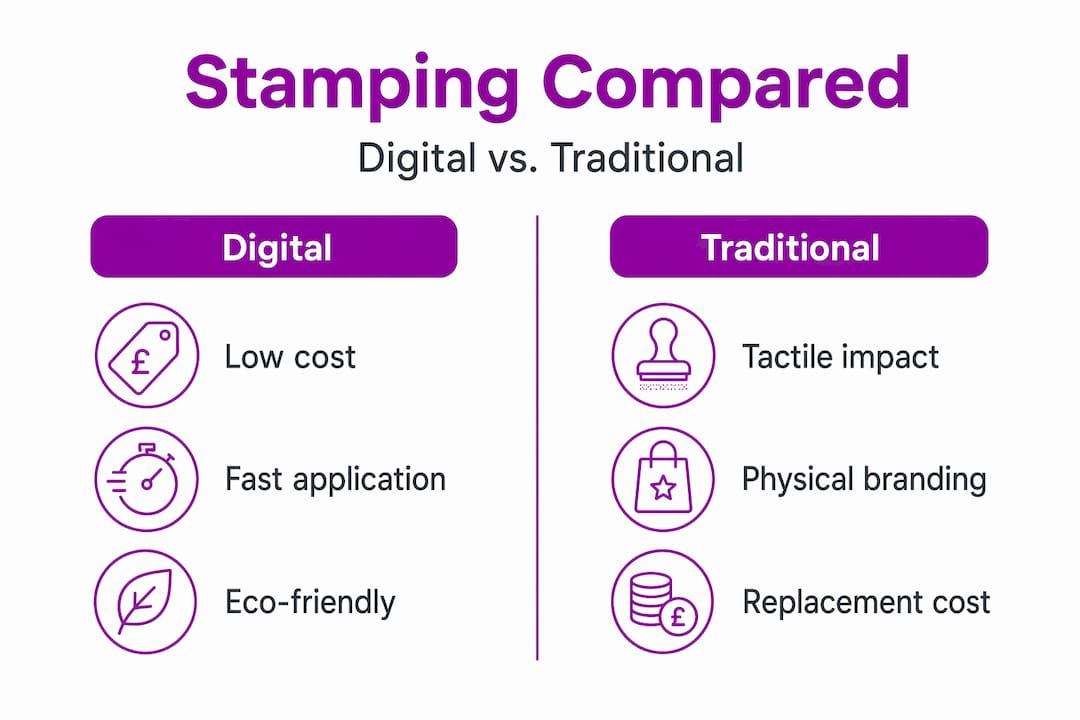
| Factor | Digital stamping | Traditional stamping |
|---|---|---|
| Initial cost | Low (design fee only) | Low to moderate (stamp + ink pad) |
| Ongoing cost | None | Ink pad replacements, stamp replacements |
| Application speed | Seconds | Minutes (inking, aligning, pressing) |
| Remote use | Fully supported | Not possible without printing |
| Physical impression | No | Yes |
| Customisation | Instant file edit | Requires new stamp order |
| Document storage | Digital file only | Physical storage needed |
| Sustainability | Reduces paper and ink use | Ongoing ink and material consumption |
The sustainability angle is worth noting specifically. Digital stamping reduces paper use and logistics costs, which supports ESG (Environmental, Social, and Governance) goals that are increasingly relevant for businesses of all sizes in 2026. You can also review the custom stamps cost efficiency breakdown to see how digital and physical options compare over a typical business year.
Additional points to consider in this stamping methods comparison:
- Digital stamping integrates directly with document management systems and e-signature platforms
- Physical stamps carry a charm and premium quality perception that works particularly well in gifting, artisan retail, and personalised packaging
- Hybrid approaches, using digital stamps for internal approvals and traditional stamps for customer-facing packaging, are increasingly common among growing small businesses
How to choose the right stamping method for your small business
Now that you understand the differences and benefits, here is a practical guide to choosing the right approach for your business.
-
Assess your document mix. If 80% of your documents are digital, meaning contracts, invoices, and approvals that never need to be printed, a digital stamp will cover the vast majority of your needs without any physical workflow at all.
-
Consider your team structure. Remote or hybrid teams cannot share a physical stamp efficiently. A digital stamp sits in a shared folder and is accessible to everyone simultaneously, regardless of location.
-
Evaluate your branding context. If your brand is built around a handcrafted, artisanal, or premium physical product, a traditional rubber stamp on packaging material adds genuine brand texture that customers notice and respond to positively.
-
Calculate total cost over 12 months. Factor in the stamp itself, ink pads, any replacement costs, and the staff time spent on manual stamping. Compare this against the one-time fee for a digital stamp design.
-
Consider legal and compliance requirements. Combining digital stamps with digital signatures improves compliance and security in contracts, particularly for businesses operating across multiple jurisdictions.
-
Think about volume. For very low-volume physical paperwork, a traditional self-inking stamp remains a perfectly practical and affordable choice. For anything exceeding a few dozen documents per week, digital stamping is objectively more efficient.
Once you have a clear picture of your workflow, boosting your branding with logo stamps becomes a much more straightforward decision to execute.
Pro Tip: If you are undecided, start with a digital stamp for document workflows and add a physical stamp specifically for outgoing physical materials such as packaging, thank-you cards, or compliment slips. This hybrid approach costs very little and covers both contexts well.
Our perspective: the hybrid approach is not a compromise, it is a strategy
Most discussions about digital vs analog stamping treat the choice as binary, as if selecting one method means abandoning the other. That framing is misleading.
The businesses that handle stamping most effectively tend to be those that have stopped asking which method is better and started asking which method is right for each specific task. Digital stamps genuinely outperform physical ones for anything involving remote work, document approvals, or high-volume processing. The stamping technology advancements in digital tools over the past few years have made setup straightforward even for non-technical users.
But there is a category of branding work where physical stamps hold a meaningful advantage that digital simply cannot touch. When a customer receives a parcel with a hand-stamped logo on the tissue paper inside, or opens a card with a clearly stamped return address, there is a sense of human effort and intention that lands differently from a printed graphic. In a world where most brand touchpoints are digital, that physical detail carries disproportionate impact.
The uncomfortable truth is that many small businesses default to one method out of habit rather than strategy. They use physical stamps because that is what they have always done, or they switch entirely to digital because it feels modern. Neither instinct is a sound basis for a branding decision.
Evaluate both methods on their actual merits for your specific operation. Then use each one where it performs best.
Find the right stamp solution for your business
If this comparison has clarified what you need, the next step is straightforward. Whether you are looking for a high-quality physical rubber stamp for packaging and client materials, or guidance on the right stamp design for digital use, having a well-designed stamp file is the starting point for both methods.
At Stamp Design 4U, you can create a fully customised stamp design tailored to your logo, brand colours, and intended use. The platform serves businesses across the UK and internationally, with options for both physical stamp orders and downloadable design files. Browse the full range of custom stamp options and get your branding sorted quickly, without unnecessary back and forth.
Frequently asked questions
What is the main advantage of digital stamping over traditional stamping?
Digital stamping offers instant application and remote access, and saves up to 70% of document processing time compared with physical stamps that require manual inking and handling.
Are digital stamps legally valid like traditional stamp papers?
Yes. Digital stamping is legally equivalent to traditional physical stamp paper under relevant legislation including the Information Technology Act and various State Stamp Acts, provided the digital stamp carries a unique identification number and audit trail.
Can traditional rubber stamps provide branding benefits?
Absolutely. Custom rubber stamps produce thousands of impressions with a tactile, premium feel that reinforces brand recognition on physical packaging and promotional materials in a way digital graphics cannot replicate.
How quickly can I get a digital stamp compared to a traditional one?
A digital stamp can be created and deployed in under five minutes at any time of day. Traditional stamp procurement typically takes 24 to 72 hours depending on vendor availability and delivery times.
Is digital stamping better for sustainability?
Yes. Digital stamping cuts paper and logistics costs, reducing both material waste and carbon emissions, which helps businesses align with current sustainability expectations heading into 2026.
Recommended
- Business branding with stamps: Practical steps for small businesses – Stamp Design 4U
- Choosing the best stamp materials for quality and durability – Stamp Design 4U
- Types of document stamps: Choosing the best fit for your business – Stamp Design 4U
- Multi-design stamping: boost your branding today – Stamp Design 4U