

TL;DR:
- A stamp sheet is a full pane of stamps printed on a single sheet, used for postage, collecting, or business mailing. Its condition, authenticity, and type significantly affect its value, with collectors emphasizing mint, never-hinged sheets and proper storage. In business, digital postage sheets with serial numbers track usage and prevent fraud, differing from philatelic sheets in purpose and handling.
A stamp sheet is a full pane of stamps printed on a single sheet of paper, used for postage, philatelic collecting, or business mailing purposes. The term covers everything from the standard Royal Mail booklet pane to the ornate souvenir sheets issued by postal authorities worldwide. Understanding the stamp sheet definition matters whether you are a serious philatelist, a casual collector, or a business owner managing outgoing post. This guide covers types, collecting conditions, modern postage applications, and practical handling advice to give you a thorough grounding in the subject.
What is a stamp sheet and how does it differ from other formats?
A stamp sheet, in philatelic terms, is defined as a full pane of stamps containing four or more individual stamps printed together on one piece of paper. Regular sheets issued by postal authorities such as Royal Mail or the United States Postal Service (USPS) typically contain 20 or more stamps and are designed primarily for functional postage use. These sheets are printed in bulk, perforated for easy separation, and sold at face value.
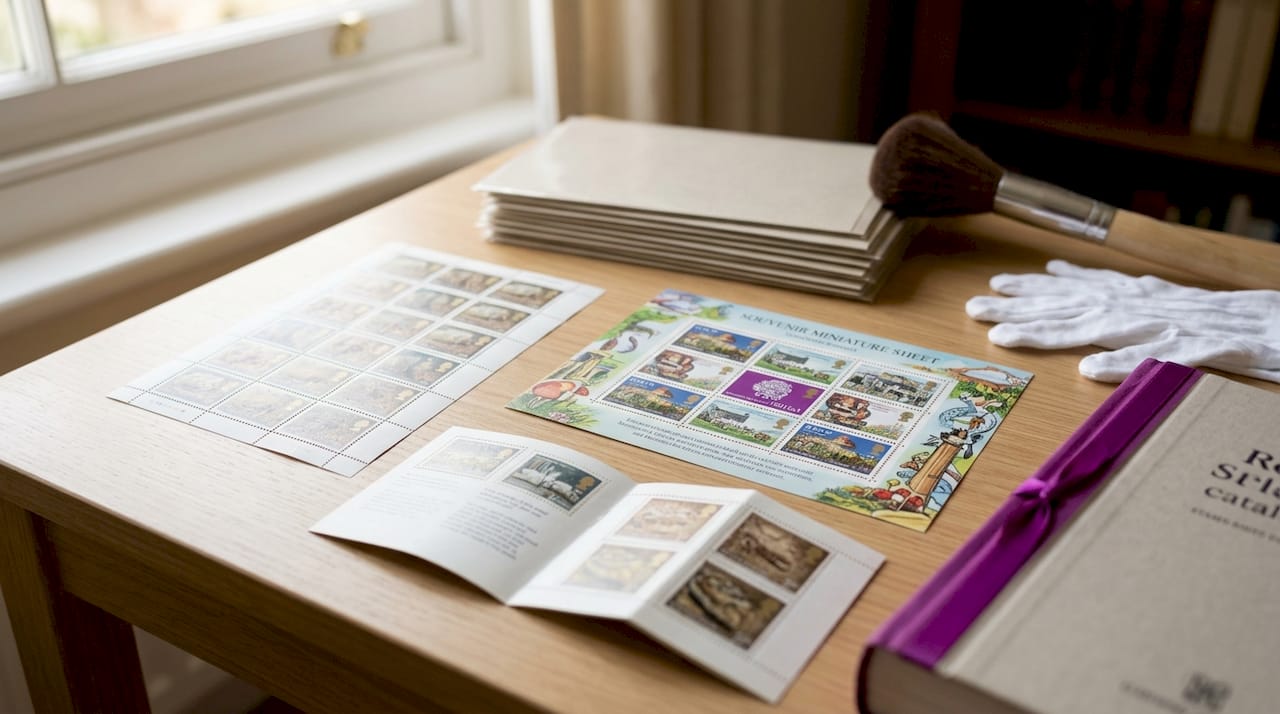
The souvenir sheet, also called a miniature sheet, is a distinct format. It contains between one and 25 stamps, often surrounded by illustrated margins carrying commemorative artwork, text, or historical imagery. Postal authorities issue souvenir sheets for special occasions, anniversaries, or cultural events. Collectors typically retain them intact rather than separating the stamps for postage, and they are frequently sold above face value.
A third category worth noting is the booklet pane, a smaller strip of stamps designed to fold into a cardboard or self-adhesive booklet. Royal Mail and USPS both produce booklet panes as a convenience format for everyday postal customers. These are less prized by collectors than souvenir sheets but still form part of a complete philatelic record.
Comparing the main stamp sheet formats
| Format | Stamp count | Primary use | Collector value |
|---|---|---|---|
| Regular sheet | 20 or more | Postage | Low to moderate |
| Souvenir or miniature sheet | 1 to 25 | Commemorative collecting | Moderate to high |
| Booklet pane | 4 to 10 | Everyday postage convenience | Low to moderate |
| Coil strip | 5 or more | Machine dispensing | Low |
Pro Tip: When buying souvenir sheets for your collection, always check whether the sheet has been folded. A fold crease through the margin significantly reduces catalogue value, even if the stamps themselves appear undamaged.

How do stamp sheets function in collecting and what makes them valuable?
Fresh-from-sheet condition is the benchmark for mint stamp quality. A stamp separated directly from a full sheet retains its original gum, shows no hinge remnants, and carries fewer handling marks than stamps sold individually. Collectors and dealers at organisations such as Mystic Stamp Company use this designation to indicate the highest available condition for a given issue.
Several condition markers determine value when collecting stamp sheets:
- Original gum (OG): The adhesive on the reverse must be intact and undisturbed.
- Never hinged (NH): No hinge or hinge remnant should be present on the gum.
- Perforations: All perforations must be complete, even, and free from short or missing teeth.
- Centring: The design should sit centrally within the perforations, with even margins on all sides.
- Paper quality: No thins, tears, creases, or stains should be present on the front or reverse.
The Worldwide Numbering System (WNS), administered by postal authorities including the Macao Postal Administration, assigns unique codes to philatelic products. These codes help collectors verify the authenticity and completeness of their holdings. A WNS code such as “MO xxx yy” confirms that a souvenir sheet is an officially issued product rather than a forgery or unofficial reprint.
Souvenir sheets present a particular challenge for mounting. Because they come in non-standard sizes, standard stamp mounts rarely fit without modification. Collectors must measure each sheet individually and source or cut mounts accordingly. The breathing space principle recommends leaving 1.5 to 2 mm of clearance between the stamp edges and the mount walls. This prevents the perforations from catching on the mount material and avoids pressure damage to the gum over time.
Pro Tip: For souvenir sheets larger than 100 mm on any side, use a full-page archival sleeve rather than a cut mount. Sleeves distribute pressure evenly and make it easier to view both sides of the sheet without handling it directly.
How are stamp sheets used in modern business postage systems?
In business shipping, the term “stamp sheet” takes on a different meaning. Stamp sheets for digital postage printers are blank sticker sheets, typically containing 20 to 25 adhesive labels, loaded into franking machines or postage printers. Pitney Bowes models such as the SL-SPM01 and SL-SPM11 use these sheets to produce printed postage labels on demand. This is a functional, logistics-focused application that shares the name but little else with philatelic stamp sheets.
The process for using stamp sheets in a business postage environment follows a clear sequence:
- Load the sheet: Insert the blank stamp sheet into the compatible printer tray, label side facing the correct direction for your specific model.
- Enter the serial number: Each sheet carries a unique serial number that must be entered into the postage software before printing begins. This number links the physical sheet to a specific account and transaction record.
- Print the postage: The system prints the required postage value onto individual labels. The serial number tracks which labels have been used.
- Handle errors correctly: If a stamp prints incorrectly, USPS regulations require the faulty print to be destroyed before a replacement is printed. Reprinting is limited to one per sheet within any 24-hour period.
Serial number tracking and fraud prevention
| System element | Purpose |
|---|---|
| Unique serial number per sheet | Links physical sheet to account for audit trail |
| Reprint limit (one per 24 hours) | Prevents duplicate postage generation |
| Destruction of faulty prints | Removes fraudulent or duplicate labels from circulation |
| Software account linkage | Enables USPS to verify postage authenticity |
Digital postage systems integrating serial number tracking represent a convergence of traditional philately and modern logistics, redefining what a stamp sheet does in a commercial context. For businesses processing high volumes of outgoing mail, understanding these controls is as relevant as knowing the face value of a postage stamp.
What should collectors and users know about handling and storing stamp sheets?
Proper handling is the single most important factor in preserving stamp sheet condition and, by extension, value. The most common and costly mistake collectors make is using PVC-based mounts or sleeves. PVC damages stamp gum through a chemical process that causes yellowing, sticking, and irreversible adhesion between the stamp and the mount material. Always use archival-quality, PVC-free mounts and sleeves.
Key handling and storage practices include:
- Use cotton gloves or stamp tongs: Never handle stamps or sheets with bare fingers. Skin oils transfer to the paper and gum, causing long-term staining.
- Store flat in acid-free albums: Vertical storage in ring binders causes sheets to bow and perforations to catch on adjacent pages.
- Control humidity and temperature: Aim for 45 to 55 per cent relative humidity and a stable temperature below 20 degrees Celsius. Fluctuations cause paper to expand and contract, weakening perforations.
- Mount souvenir sheets with care: Custom cutting of mounts for non-standard sizes requires a sharp blade and a metal ruler. Score the fold line lightly before bending to avoid cracking the mount material.
For collectors building a catalogue or inventory, digital record-keeping adds a practical layer of organisation. Experienced collectors recommend linking images externally via folder URLs rather than embedding them directly into spreadsheet cells. Embedded images using functions such as Google Drive IMAGE tend to break when files are moved or shared, leaving gaps in the catalogue record. A stable, externally linked image system keeps the inventory reliable over time.
Pro Tip: When cataloguing stamp sheets, record the WNS code alongside the Scott or Stanley Gibbons catalogue number. Having both references makes it significantly easier to verify authenticity and cross-reference values across different cataloguing systems.
The cultural dimension of stamp sheet collecting is also worth noting. The USPS Stamp Encore contest, which saw the Mister Rogers 2018 stamp and its accompanying souvenir sheet return in 2026, demonstrates that public engagement and cultural relevance drive collector interest as much as rarity does. Sheets tied to popular cultural figures or events consistently attract broader audiences beyond traditional philatelists.
For personalised stamp uses that extend beyond postage, rubber stamps and custom marking tools complement a collector’s or business user’s toolkit in practical ways.
Key takeaways
A stamp sheet is a full printed pane of stamps serving dual roles: a functional postage supply in business settings and a collectible philatelic item whose condition, authenticity, and cultural significance determine its value.
| Point | Details |
|---|---|
| Stamp sheet definition | A full pane of four or more stamps on a single sheet, used for postage or collecting. |
| Types vary significantly | Regular sheets, souvenir sheets, and booklet panes each serve different purposes and carry different collector values. |
| Condition drives value | Fresh-from-sheet, never-hinged stamps with original gum represent the highest collectible grade. |
| Business use is distinct | Digital postage stamp sheets use serial numbers and reprint limits to prevent fraud in commercial mailing. |
| Storage materials matter | PVC-free, archival mounts and acid-free albums are the minimum standard for preserving sheet condition. |
Why stamp sheets deserve more attention than they typically receive
Most collectors I encounter treat stamp sheets as a secondary format, something to break up for individual stamps or store loosely in a box. That approach misses the point entirely. A complete souvenir sheet in original condition tells a story that a single separated stamp cannot. The margin artwork, the printing details, the WNS code on the reverse: these elements together create a document of postal history that has genuine research value beyond market price.
What I find particularly interesting is the crossover between traditional philately and modern logistics. The Pitney Bowes serial number system is, in structural terms, not so different from the WNS code system used by postal authorities for commemorative issues. Both exist to verify authenticity and prevent duplication. The underlying logic of stamp sheet tracking has not changed in 150 years; only the technology has.
The condition obsession in philately is real and sometimes excessive, but it is grounded in a practical truth. A stamp sheet that has been stored in a PVC sleeve for 20 years may look fine to the naked eye and be chemically compromised in ways that only become visible under ultraviolet light. Investing in proper archival materials from the start costs far less than discovering damage after the fact.
Cultural relevance is the factor that most catalogue systems fail to capture. The return of the Mister Rogers souvenir sheet in 2026 through the USPS Stamp Encore contest is a reminder that public sentiment shapes collector markets in ways that rarity alone does not predict. Sheets tied to cultural moments hold their appeal across generations of collectors, not just specialists.
— Steven
Explore custom stamp solutions from Stampdesign4u
Whether you collect philatelic sheets or manage outgoing business post, a quality rubber stamp complements both activities in practical ways. Stampdesign4u offers a range of personalised marking tools suited to business branding, craft projects, and mailing workflows.
The Trodat 4927 rubber stamp accommodates up to nine lines of text and logo artwork on a 60 x 40 mm plate, making it well suited for return address marking, business correspondence, and catalogue labelling. For loyalty or promotional use, the Traxx 9021 loyalty stamp offers a compact 14 x 14 mm format ideal for card marking and repeat-use applications. Both products are available with custom designs through Stampdesign4u, with options for individuals and businesses across the UK and internationally.
FAQ
What is a stamp sheet in philately?
A stamp sheet in philately is a full pane of stamps printed together on one piece of paper, typically containing four or more individual stamps. Regular sheets from postal authorities such as Royal Mail or USPS usually contain 20 or more stamps and are used primarily for postage.
What is the difference between a stamp sheet and a souvenir sheet?
A souvenir or miniature sheet contains between one and 25 stamps and features illustrated margins, making it a commemorative collectible rather than a functional postage item. Regular stamp sheets contain 20 or more stamps and are designed for everyday postal use.
How do I store stamp sheets without damaging them?
Store stamp sheets flat in acid-free albums using PVC-free archival mounts. Avoid bare-hand contact, keep humidity between 45 and 55 per cent, and never store sheets vertically, as this causes perforations to weaken over time.
What does fresh-from-sheet mean in stamp collecting?
Fresh-from-sheet describes a mint stamp separated directly from a full pane, retaining its original gum and showing minimal handling marks. It is considered the highest condition designation for mint stamps, above examples that have been individually handled or stored loose.
How are stamp sheets used in business postage systems?
In business mailing, stamp sheets are blank adhesive label sheets loaded into digital postage printers such as Pitney Bowes models. Each sheet carries a unique serial number entered into postage software to track usage and prevent fraudulent reprinting.