

TL;DR:
- Getting stamp sizing correct ensures that your design fits, reads clearly, and applies evenly on surfaces.
- Choosing the appropriate size involves measuring available space, understanding design complexity, and considering the surface type for optimal results.
Getting stamp sizing wrong is one of the most common and costly mistakes in custom rubber stamp design. What is stamp sizing, exactly? It is the process of selecting precise die or impression dimensions for your stamp so that the design fits correctly, reads clearly, and applies cleanly to its intended surface. Whether you are ordering a logo stamp for your business or a personalised address stamp for home use, understanding how sizing works will save you time, money, and frustration before you place an order.
Table of Contents
- Key takeaways
- What is stamp sizing? Definition and dimensions
- Common stamp shapes, sizes, and typical uses
- The stamp sizing process: choosing the right dimensions
- Large custom stamps: special sizing considerations
- Why correct stamp sizing matters
- My experience with stamp sizing mistakes
- Order the right stamp from Stampdesign4u
- FAQ
Key takeaways
| Point | Details |
|---|---|
| Stamp sizing defines impression dimensions | Sizing determines the width and height of the stamped area, measured in millimetres or fractional inches. |
| Standard sizes vary by shape | Rectangular, square, and round stamps each have common size ranges suited to specific applications. |
| Size affects legibility and fit | Choosing the wrong size reduces text clarity or causes the design to overflow the available space. |
| Large stamps need alternative inking | Stamps exceeding 10 x 15 cm require a brayer roller rather than a standard ink pad for even coverage. |
| Early sizing decisions prevent waste | Deciding on dimensions before finalising artwork avoids reprints and operational problems later. |
What is stamp sizing? Definition and dimensions
Stamp sizing is the selection of specific die or impression dimensions that determine how large the stamped image will appear on a surface. The die is the rubber or polymer plate that carries your design; the impression is what transfers to paper, packaging, or another material when you apply the stamp. These two measurements are closely related but not always identical, so it is worth knowing the difference.
Dimensions are expressed in millimetres for most European manufacturers and in fractional inches for many American and catalogue-based products. Catalogue sizes for self-inking stamps are typically specific fractional-inch measurements such as 1/2" x 1-5/8" or 1" x 2 1/2". In millimetre terms, a popular business stamp size such as 48 x 18mm gives you roughly the area of a standard address label, which is enough room for a logo and three lines of text.
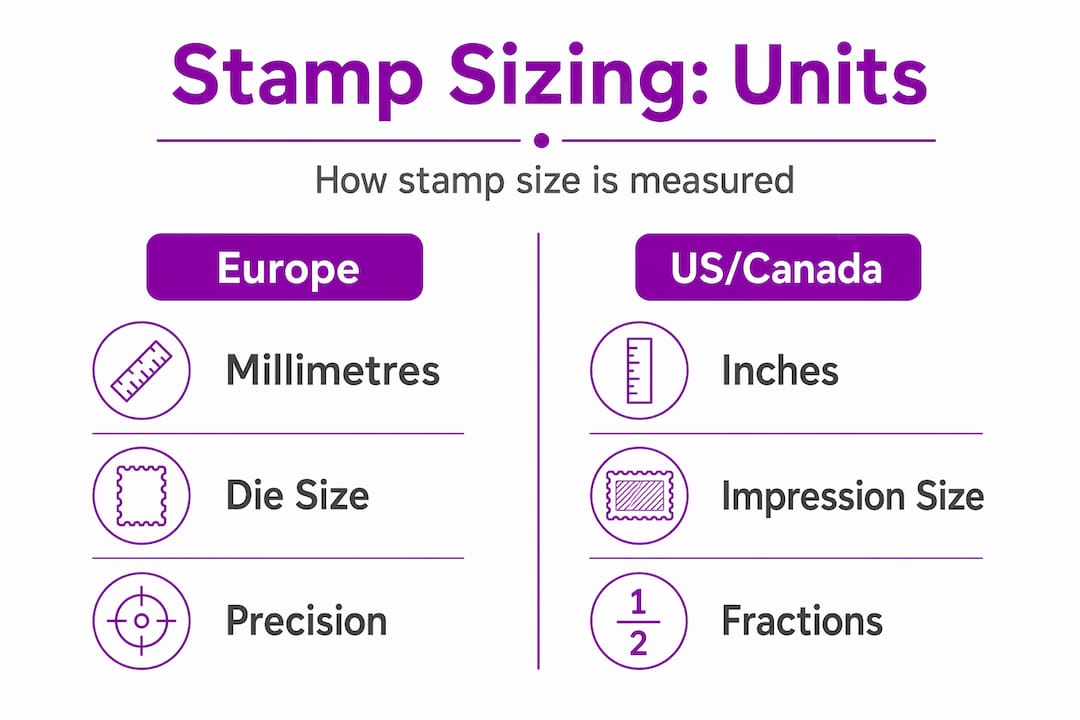
Three terms come up repeatedly during the stamp sizing process. The die size refers to the physical dimensions of the rubber plate. The impression size is the area that actually transfers ink to your surface, which may be marginally smaller than the die. The stamp size is the general catalogue reference used by manufacturers to categorise their products. When ordering, always confirm which measurement the supplier is quoting.
Pro Tip: Ask your supplier whether the quoted size refers to the die or the impression area. A 2mm difference may seem minor, but it can push text outside the printable area on a small stamp.
Size directly affects whether your design is legible. Smaller stamps can hinder detail clarity, while larger stamps increase ink coverage demands and may not fit the available space on a document or package. Getting this balance right is the core purpose of understanding stamp sizing explained in full.
Common stamp shapes, sizes, and typical uses
The shape of a stamp is as significant as its dimensions. Different shapes suit different applications, and manufacturers have settled on standard size ranges that reflect real-world usage patterns.
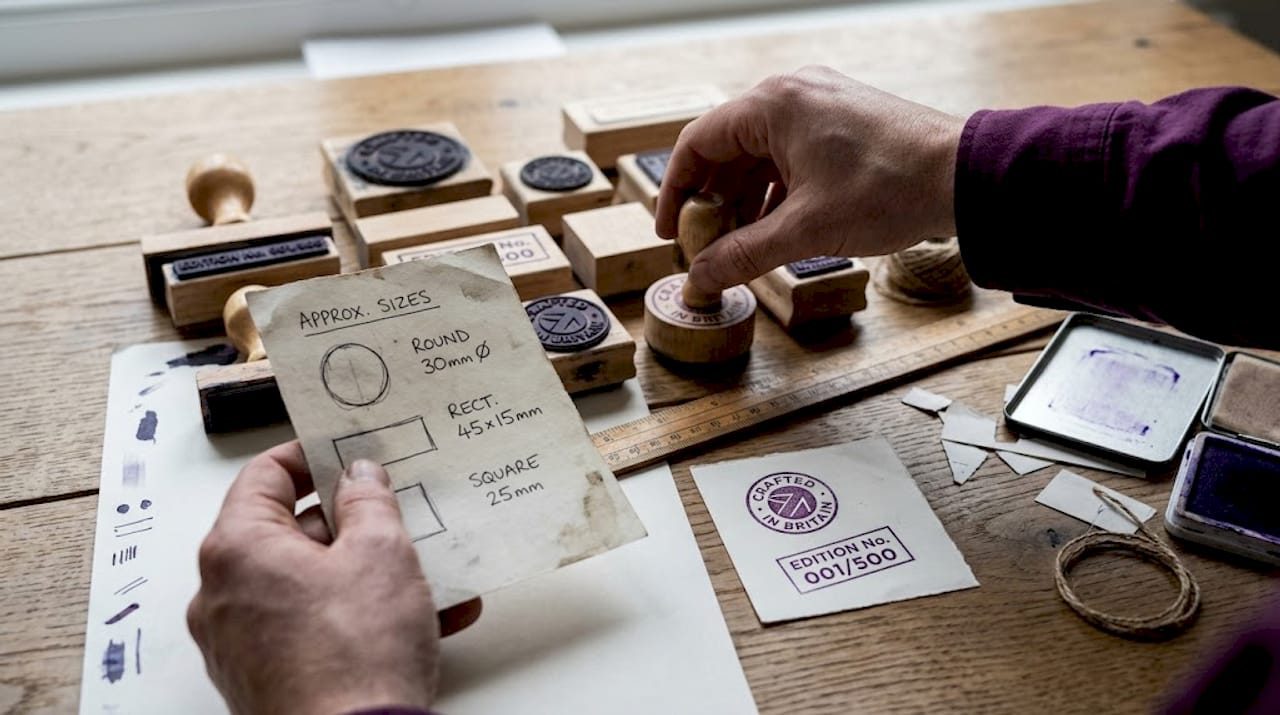
Rectangular stamps are the most widely used format. They accommodate multi-line text, logos with straplines, and address information. A common address stamp measures 58 x 22mm, while a standard logo stamp for correspondence often falls in the 48 x 18mm range. Ideal/Trodat alone offers 15 standardised sizes in precise fractional-inch measurements for rectangular and square formats, covering everything from a compact 3/8" x 1 1/2" to larger multi-line options.
Square stamps work well for compact logos, approval marks, and loyalty card designs. Sizes typically range from 12 x 12mm up to 40 x 40mm. A small 12 x 12mm square stamp is ideal for loyalty card boxes where space is tightly constrained. A 40 x 40mm square, by contrast, suits a decorative or brand mark that needs presence on a document.
Round stamps are traditionally associated with official company seals and certification marks. Round stamps used for company seals are commonly 40 x 40mm, providing enough room for a border, organisation name, and central motif.
The table below shows common stamp sizes alongside their recommended applications.
| Size | Shape | Recommended use |
|---|---|---|
| 12 x 12mm | Square | Loyalty cards, small approval marks |
| 47 x 17mm | Rectangle | Logo stamps, single address line |
| 48 x 18mm | Rectangle | Business logos with tagline |
| 58 x 22mm | Rectangle | Full address stamps |
| 40 x 40mm | Round or square | Company seals, brand marks |
| 70 x 30mm | Rectangle | Multi-line text, complex designs |
Customisation offers flexibility beyond these standards, but constraints do exist. Most self-inking mechanisms are built around fixed internal dimensions, so a custom size may require a different stamp body or a traditional rubber stamp mount rather than a self-inking unit.
The stamp sizing process: choosing the right dimensions
Deciding on the right stamp size is a practical exercise that combines measurement, design awareness, and an understanding of where and how the stamp will be used. Working through the following steps will help you avoid the most common sizing mistakes.
-
Measure your application area. Before considering artwork, measure the space where the stamp impression will appear. If you are stamping invoices, check the footer or header space. For packaging, measure the flat surface available. This sets your maximum impression dimensions.
-
Assess your design complexity. A design with fine text, thin lines, or small graphic elements needs a larger impression area to remain legible. Correct sizing balances design clarity with fitting the application area and optimises ink usage. A logo with a tagline in 6pt text will not reproduce well at 30 x 15mm.
-
Consider the surface type. Smooth paper accepts fine detail well, even at smaller sizes. Cardboard, kraft paper, and fabric are more absorbent and cause ink to bleed slightly, which means designs need slightly more spacing between elements and often a marginally larger impression area.
-
Match the stamp to the inking mechanism. Self-inking stamps have a built-in pad sized to match the die. Traditional rubber stamps rely on a separate ink pad, and the pad must be at least as large as the stamp. A mismatch here results in partially inked impressions.
-
Check catalogue standards before going custom. Businesses often fail to consider the balance between design detail and functional impression size, which leads to wasted resources. A standard size close to your requirements is usually cheaper and faster to produce than a fully custom dimension.
Pro Tip: Print your design at the intended stamp size on paper and physically place it on the target surface before ordering. This simple step reveals whether the proportions work in practice.
The importance of stamp sizing becomes clear when you realise that a stamp ordered at the wrong dimensions cannot easily be corrected. Unlike a digital file, a rubber die cannot be scaled after production.
Large custom stamps: special sizing considerations
Once a stamp exceeds approximately 10 x 15 cm in impression area, the standard ink pad approach breaks down. Standard ink pads simply cannot cover that surface area evenly, and the result is a patchy, inconsistent impression. This is where stamp sizing techniques for large-format work diverge from standard practice.
The recommended solution is a brayer roller. Roll an inked brayer over the rubber stamp in multiple directions to achieve even coverage across the entire die surface. This method takes more time per impression but produces consistent results across large areas.
Several practical considerations apply specifically to large stamps.
- Large dies are typically mounted on wooden blocks or acrylic handles rather than self-inking bodies, because the internal mechanics of self-inking units cannot accommodate oversized dies.
- Design elements for large stamps should use bolder lines and larger text. Fine detail that works at 48 x 18mm can become blurred or lost when scaled to 150 x 100mm due to ink spread.
- Flat, stable surfaces are necessary. Large custom stamps exceeding 10 x 15 cm need even pressure across the entire impression area, which is difficult on curved or uneven surfaces.
- Alignment guides or jigs are useful for repeat applications. Without them, large stamps are difficult to position consistently across multiple items.
Understanding these constraints before ordering a large stamp prevents significant operational difficulties down the line.
Why correct stamp sizing matters
Getting stamp sizing right from the start produces measurable benefits across both aesthetic and operational areas. Here is where the benefits of stamp sizing become concrete.
- Legibility. A correctly sized stamp reproduces text and graphic elements at a scale that is easy to read, even after multiple impressions from a re-inked pad.
- Professional appearance. A stamp that fits its application area neatly signals attention to detail and reinforces brand credibility.
- Operational consistency. A stamp sized to fit a standard ink pad requires no special inking method, which keeps the stamping process fast and repeatable.
- Reduced material waste. Ordering the right size first time avoids the cost of replacement dies and the time lost waiting for reprints.
- Branding consistency. A logo stamp at the correct dimensions reproduces your brand mark at the same scale across every document, parcel, or product it touches.
Each of these outcomes depends on applying the stamp sizing process deliberately rather than selecting a size by guesswork.
My experience with stamp sizing mistakes
I have worked with enough stamp orders to say with some confidence that sizing is where most problems originate, and almost none of those problems are obvious until after the stamp arrives.
The most frequent mistake I see is clients selecting a size based on how the design looks on screen. A logo that fills a PowerPoint slide looks proportionally correct at that scale, but shrunk to a 30 x 20mm stamp, the fine serif font becomes unreadable and the gradient detail disappears entirely. I always encourage people to think in millimetres first, artwork second.
The second recurring issue is ignoring the application surface. A 58 x 22mm address stamp is a sensible size for a standard envelope, but it overruns the address panel on a compact padded bag. I have seen businesses print hundreds of these stamps and then have to reorder at a narrower width because nobody physically checked the fit beforehand.
What I have found actually works is treating stamp sizing as a spatial problem rather than a design problem. Measure the space. Work backwards from the maximum impression area. Then design within those constraints. The stamps that land best with clients are almost always the ones where sizing was confirmed before anyone opened a design application.
Stamp sizing is not a footnote in the ordering process. It is the foundation of everything else.
— Steven
Order the right stamp from Stampdesign4u
Stampdesign4u carries a range of custom rubber stamps built around the standard sizes covered in this article. If you need a reliable business logo stamp at a commonly used dimension, the Trodat Printy 4912 at 48 x 18mm is one of the most practical options available, offering enough impression area for a logo and supporting text. For compact loyalty card applications, the 12 x 12mm loyalty stamp covers small spaces cleanly. Each product page includes the precise impression dimensions so you can confirm the fit before ordering. If your requirements fall outside standard sizes, the Stampdesign4u team can advise on custom stamp sizing options to match your specific design and application needs.
FAQ
What is stamp sizing in simple terms?
Stamp sizing is the selection of width and height dimensions for the impression area of a rubber stamp. It determines how large the stamped design will appear on a document or surface.
How do I choose the correct stamp size?
Measure the space available on your target surface first, then match a standard stamp size that fits within those limits while accommodating your design at a legible scale. Printing the design at actual size on paper before ordering is a reliable check.
What size stamp is used for a business logo?
A 48 x 18mm rectangular stamp is a commonly used size for business logo stamps, providing enough space for a logo graphic and one or two lines of supporting text. The 47 x 17mm format from manufacturers such as Stampdesign4u covers a similar area.
Why does stamp size affect ink coverage?
Larger impression areas require more ink across a wider surface. Stamps exceeding roughly 10 x 15 cm cannot be evenly inked using a standard pad, so a brayer roller is needed to apply ink consistently across the full die.
What is the difference between die size and impression size?
The die size is the physical dimension of the rubber or polymer plate. The impression size is the area that actually transfers ink to a surface, which may be slightly smaller than the die due to the stamp mount or border margin.