

TL;DR:
- Text-only stamps standardize document markings, reducing human error and ensuring consistent, auditable impressions.
- They are suitable for physical mail, branding, and process workflows, with physical stamps offering trust and digital stamps supporting remote work.
Text-only stamps are defined as purpose-built marking tools that replace repetitive handwriting with consistent, legible impressions across physical and digital documents. The question of why use text-only stamps comes down to one practical answer: they remove human error from routine document handling and replace it with a standardised process that scales. Whether you manage a small office, run a retail operation, or handle correspondence from home, a text stamp solves the same problem every time. Brands like Trodat have built entire product lines around this principle, and the rise of digital stamp tools has extended these advantages into paperless workflows.
Why use text-only stamps to improve efficiency and accuracy
Text-only stamps are process optimisation tools, not decorative items. Their primary function is to remove interpretation errors from fast-moving document workflows by delivering the same impression every single time. Words like “Received,” “Approved,” and “Paid” carry legal and operational weight. When those words are handwritten, they vary in legibility, placement, and style. A stamp removes all of that variation in one press.
Self-inking stamps, such as those in the Trodat Printy range, are particularly effective in high-volume settings. Self-inking stamps handle at least 58 active requests efficiently in small business environments, with noticeable performance gains appearing after just two or three processing cycles. That figure matters because it shows the benefit is not theoretical. It appears quickly and compounds as volume grows.
The distinction worth making here is between process standardisation and decorative branding. Text stamps serve the former. They do not exist to make a document look attractive. They exist to make a process repeatable, auditable, and fast. Accounting teams, legal offices, and operations-heavy businesses all rely on this principle daily.
- Consistent impressions eliminate handwriting variation across staff members
- Self-inking mechanisms reduce ink mess and cut stamping time per document
- Standardised marks create an auditable paper trail for approvals and receipts
- High-volume teams benefit from reduced cognitive load on repetitive tasks
Pro Tip: Choose a stamp with a clear, sans-serif font at a minimum of 10pt. Smaller text on a rubber die loses legibility after repeated use, particularly on recycled paper stock.
Physical rubber stamps vs digital text-only stamps
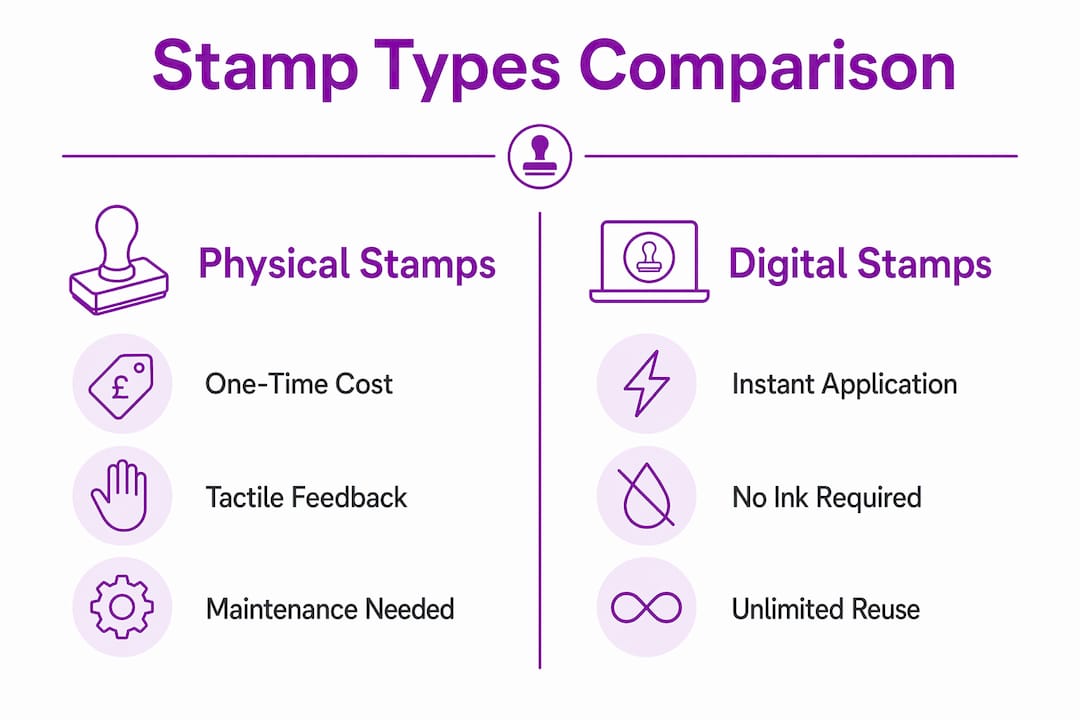
The choice between a physical rubber stamp and a digital text stamp is not about preference. It is about workflow context. Digital stamps suit electronically processed documents, while physical stamps add trust and legitimacy to tangible mail and paper-based records.

Physical stamps offer something digital tools cannot replicate directly: a tactile impression that signals human involvement. Physical stamps on mailed documents generate psychological trust and a sense of personal connection that digital processes struggle to match. For businesses sending invoices, contracts, or thank-you correspondence by post, a stamped mark functions as proof of authenticity. This matters in sectors where trust is a commercial asset, such as legal services, independent retail, and professional consultancy.
Digital stamps, by contrast, offer instant application in PDFs with unlimited reusability and no maintenance costs. A physical stamp requires periodic re-inking, careful storage, and eventual die replacement. A digital stamp file costs nothing to apply a second time. For remote teams processing documents electronically, digital stamps support remote work by applying consistent marks without the friction of printing and scanning.
| Feature | Physical text stamp | Digital text stamp |
|---|---|---|
| Cost model | One-time purchase, occasional maintenance | One-time design cost, unlimited reuse |
| Application speed | Manual, per document | Instant, applied in PDF or image editors |
| Trust signal | High on physical mail | Moderate on digital documents |
| Remote use | Not practical | Fully supported |
| Legibility over time | Degrades with wear | Consistent indefinitely |
Pro Tip: If your business handles both paper and digital documents, consider maintaining one physical self-inking stamp for outgoing post and one digital stamp file for PDF workflows. The two formats complement each other rather than compete.
For a detailed comparison of these two approaches, Stampdesign4u has published a practical guide on digital vs traditional stamping that covers the key decision factors for small businesses.
What are the most practical uses of text-only stamps?
Text stamp uses span a wider range of applications than most people initially consider. The obvious ones are administrative. The less obvious ones are where real commercial value appears.
-
Document processing marks. Stamps reading “Received,” “Approved,” “Paid,” or “Confidential” are the backbone of physical document management in offices, warehouses, and legal practices. They create an instant, legible record without requiring a signature or written note.
-
Address and correspondence stamping. A personalised address stamp on outgoing envelopes saves significant time for businesses sending regular post. A five-line address stamp applied in one press replaces writing or printing individual labels for every item.
-
Branding on packaging and materials. Small businesses use text stamps on kraft paper bags, tissue paper, cardboard boxes, and business cards to apply a brand name, website, or short message. This approach is cost-effective and gives handmade or independent brands a professional finish. Stampdesign4u’s guide on custom stamp branding covers this application in detail.
-
Loyalty and promotional stamping. Retail businesses use text stamps on loyalty cards, promotional flyers, and packaging inserts. A stamp reading “Thank You for Your Order” or “10% Off Your Next Visit” costs almost nothing to apply but creates a personal touch that printed labels do not.
-
Marketing correspondence. Physical stamps function as a tactile trust lever in marketing by signalling craft and human connection against digital automation. A stamped thank-you note pauses the recipient in a way that a printed card or email simply does not. For retail businesses, this distinction can directly influence repeat purchase behaviour. Retailers looking to strengthen their in-store and correspondence experience can find relevant guidance on retail counter display practices that complement physical branding tools.
How to select and integrate text-only stamps into your workflow
Selecting the right stamp starts with an honest assessment of your document handling. The two questions that matter most are: how many documents do you process per week, and what proportion of those are physical versus digital?
For physical document workflows, a self-inking stamp is the correct choice in almost every case. The advantages of self-inking stamps in retail and office settings are well documented. They require no separate ink pad, deliver a consistent impression depth, and are faster to use than traditional rubber stamps. For businesses processing more than twenty documents per day, the time saving is measurable within the first week.
For digital workflows, AI-powered stamp makers simplify design creation by using structural prompts rather than manual design work. These tools produce mathematically accurate kerning for curved text and apply realistic stamp textures that give digital marks an authentic appearance. The practical implication is that you no longer need a graphic designer to create a professional digital stamp.
When integrating stamps into a team workflow, the most common failure point is mixed review processes. Separating policy review from layout feedback reduces approval delays and improves first-pass approval rates. Assign explicit ownership for each stamp type so that every team member knows which stamp applies to which document stage.
- Assess weekly document volume before choosing between physical and digital formats
- Use sans-serif fonts and keep text to five lines or fewer for maximum legibility
- Assign one person ownership of stamp maintenance and re-inking schedules
- Store physical stamps horizontally to prevent ink pooling and uneven impressions
- Test digital stamp files on both light and dark document backgrounds before deploying
Pro Tip: When ordering a custom text stamp, request a digital proof before production. A single character error on a stamp used for hundreds of documents per month creates a disproportionate administrative problem.
Key takeaways
Text-only stamps are the most cost-effective tool for removing handwriting errors and standardising repetitive document workflows in both physical and digital environments.
| Point | Details |
|---|---|
| Process standardisation | Text stamps remove handwriting variation and deliver consistent, auditable marks across all document types. |
| Physical vs digital choice | Select physical stamps for mailed correspondence and digital stamps for PDF-based or remote workflows. |
| Trust and branding value | Physical stamps on outgoing mail generate psychological trust that digital marks cannot replicate directly. |
| Workflow integration | Assign explicit ownership and separate review stages to prevent approval delays in team environments. |
| Design accuracy | Use AI stamp tools or request a digital proof to avoid costly errors before production. |
The operational case that most businesses overlook
Most conversations about text stamps focus on the obvious: they save time and look professional. That is true, but it misses the deeper operational argument. The real value of a text-only stamp is that it removes a decision from the process.
Every time a staff member handwrites “Received” on an incoming document, they make a micro-decision about placement, legibility, and format. Multiply that by fifty documents a day across a team of four, and you have two hundred small decisions that add friction and introduce inconsistency. A stamp eliminates all of them in one press.
What I have observed repeatedly is that businesses underestimate this until they experience a compliance or audit situation. When a regulator or client asks to verify that a document was received on a specific date, a stamped impression with a date die is unambiguous. A handwritten note is not. The stamp is not just faster. It is more defensible.
The other point worth making is that physical and digital stamps are not in competition. The businesses that use both formats well treat them as different tools for different contexts, not as alternatives to each other. A Trodat self-inking stamp on your outgoing post and a clean digital stamp file in your PDF workflow are not redundant. They serve different trust and process functions, and both earn their place.
— Steven
Explore text-only stamps from Stampdesign4u
Stampdesign4u offers a range of custom text stamps built for operational use, from compact address stamps to multi-line logo and text combinations.
The Trodat 4927 nine-line stamp is one of the most versatile options available, accommodating up to nine lines of text across a 60 x 40mm impression area. It suits businesses that need to combine a brand name, address, and contact details in a single mark. For correspondence and address stamping, the Imprint 13 address stamp delivers a clean five-line impression at 58 x 22mm, ideal for regular outgoing post. Both products are self-inking, require no separate ink pad, and are available with custom text to your specification. Browse the full range at Stampdesign4u to find the right format for your workflow.
FAQ
What is a text-only stamp used for?
A text-only stamp is used to apply consistent, legible marks to documents, packaging, and correspondence without handwriting. Common applications include “Received,” “Approved,” “Paid,” address marking, and branding on outgoing mail.
Are self-inking stamps better than traditional rubber stamps?
Self-inking stamps are more practical for regular business use because they contain a built-in ink pad, deliver a consistent impression, and require no separate inking step. Traditional rubber stamps suit occasional use where a separate ink pad is already available.
Can text stamps be used for digital documents?
Digital text stamps apply directly to PDF files and image-based documents, making them suitable for remote and paperless workflows. AI stamp design tools can produce digital stamp files with accurate kerning and realistic textures for professional results.
How do text stamps support small business branding?
Text stamps allow small businesses to apply a brand name, website, or short message to packaging, cards, and correspondence at very low cost per impression. The physical nature of a stamped mark creates a personal connection that printed labels and digital communications do not replicate. Stampdesign4u’s guide on branding with stamps covers practical steps for integrating stamps into a small business brand identity.
How many lines of text can a business stamp hold?
Most standard self-inking business stamps accommodate between three and nine lines of text depending on the die size. The Trodat Printy 4927, for example, holds up to nine lines across a 60 x 40mm impression area, which is sufficient for a full business address, contact number, and website URL.