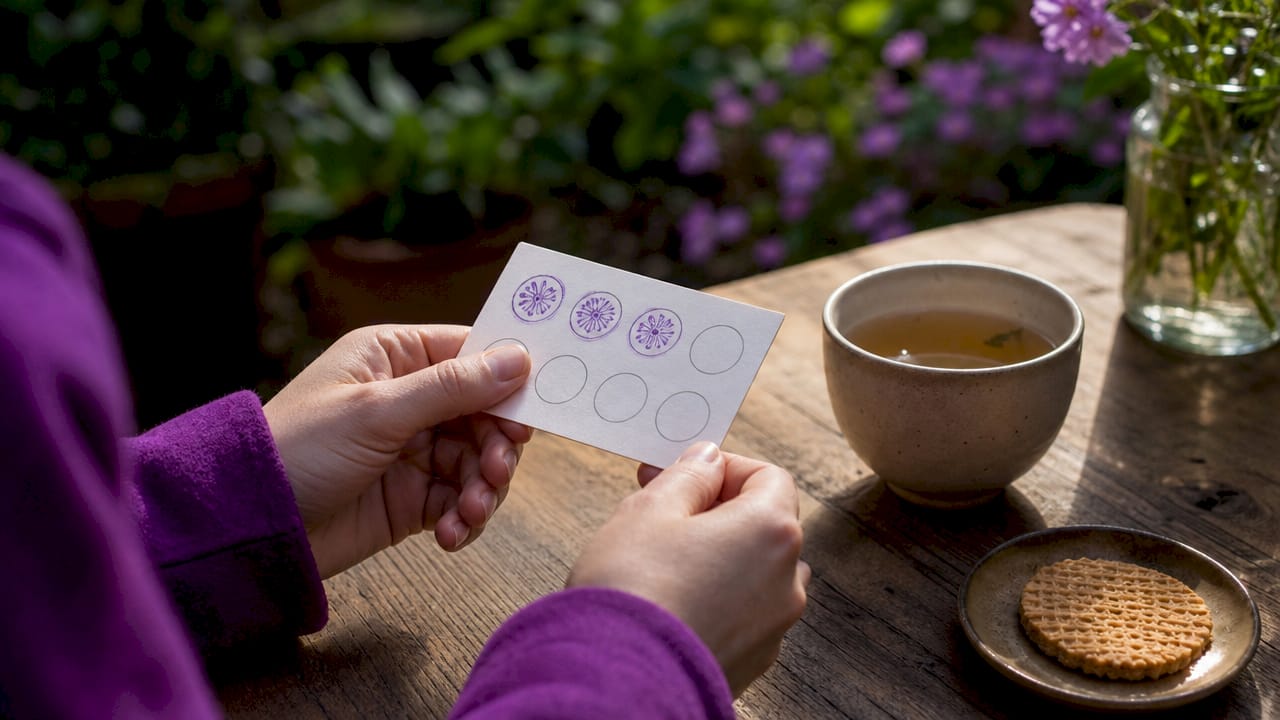
Woman stamping loyalty card at café counter

Why stamps for customer loyalty: a small business guide


TL;DR:

  • Stamp loyalty programmes increase customer visits and spending by leveraging psychological effects like the endowed progress and goal gradient effects. They are more effective than points systems because they are simple, quick to process, and resistant to inflation, making them ideal for small businesses. Proper design, consistent staff training, and clear policies are essential for maximizing programme success and customer retention.

A stamp loyalty programme is a structured reward system where customers collect individual stamps on a card and redeem a completed card for a free product or discount. Research shows that customers enrolled in a well-designed scheme visit 20–30% more frequently and spend more per visit than those not enrolled. That single statistic makes the case for why stamps for customer loyalty deserve serious attention from any small business owner. The concept is formally known as a stamp card loyalty programme, though loyalty card stamps and punch cards are the terms most customers use. Stampdesign4u works with businesses across the UK to produce custom loyalty stamps that put this psychology to work from day one.

Infographic comparing stamp cards and point systems for loyalty

Why do stamp loyalty programmes encourage repeat business?

Stamp cards work because of two well-documented behavioural principles: the endowed progress effect and the goal gradient effect. Understanding both gives you a real advantage when designing your scheme.

Close-up of stamped loyalty card on café table

The endowed progress effect

The endowed progress effect describes why customers who start with a small number of stamps already on their card are more likely to complete it. Even an artificial head start, such as two pre-stamped boxes on a ten-stamp card, creates a sense of investment. Customers feel they have already begun, so abandoning the card feels like a loss. This is the same psychological force behind sunk cost thinking, applied constructively.

“A small artificial head start in stamp progress significantly boosts customer motivation to complete the loyalty cycle. Customers who feel they have already invested in a programme are far more likely to see it through to the reward.”

Loyalty Reward Co, Stamp Card Loyalty Programmes Overview

The practical implication is clear. Print your card with ten boxes, pre-stamp two of them, and you effectively sell a “collect eight, get one free” scheme while customers perceive it as a ten-stamp card. Completion rates rise without any change to your actual cost per reward.

The goal gradient effect

The goal gradient effect shows that motivation increases as customers get closer to a goal. A customer with seven stamps on a ten-stamp card visits more urgently than one with two. Businesses can apply this directly by intensifying reward messaging in the final stages. A small sign at the till saying “One more stamp and your next coffee is free” costs nothing and accelerates the final visits.

Pro Tip: Run a double-stamp day in the week before your quietest trading period. Customers near completion will return specifically to finish their card, filling gaps in your schedule without discounting your core product.

What makes stamp cards more effective than points systems?

Stamps beat points on one critical measure: simplicity. A customer at a busy till understands “collect ten stamps, get one free” in under three seconds. A points system requires them to know the earn rate, the redemption threshold, and the current value of their balance. Stamp cards need zero explanation at the point of sale, processing in 3–5 seconds compared with the longer dialogue that points systems often require.

That speed matters more than most business owners realise. Queue length directly affects customer satisfaction. A loyalty mechanic that slows service creates friction at exactly the wrong moment.

Stamps are inflation-resistant

Points systems carry a hidden vulnerability. When your prices rise, the real value of a point changes. A point earned when a coffee cost £2.50 is worth less when the same coffee costs £3.20. You either devalue the programme or absorb the cost. Stamp card rewards are fixed items, such as a free coffee or a complimentary pastry, so customers perceive their value as stable regardless of price changes. That stability builds trust.

Stamps vs points: a direct comparison

Feature Stamp cards Points systems
Customer understanding Immediate, no explanation needed Requires education and ongoing communication
Speed at the till 3–5 seconds Longer, often requires app or card lookup
Inflation resistance High, reward is a fixed item Low, point value shifts with price changes
Setup cost Low, physical or simple digital Higher, often requires software integration
Data capture Limited with paper, good with digital Strong, built into most platforms
Best suited for Independent retailers, cafés, salons Larger chains with complex product ranges

The key advantages of stamp cards for small businesses include:

  • No software licence or monthly fee for paper-based schemes
  • Customers carry the card, removing the need for a database at launch
  • Staff training takes minutes, not days
  • The reward is tangible and emotionally satisfying

Switching from a points system to a simple stamp card can increase transactions by 16% by removing confusion at the point of sale. That figure reflects the direct commercial value of reducing customer cognitive load.

How to design an effective stamp loyalty card

Card design determines whether customers complete the scheme or abandon it. Get the mechanics wrong and even a generous reward fails to motivate.

Choosing the right stamp count

Optimal stamp counts sit between 6 and 10. Fewer than six and the reward feels too easy, reducing perceived value. More than ten and customers lose motivation because the goal feels distant. A café offering a free drink after eight stamps hits the sweet spot: achievable within two to three weeks of regular visits, but not so quick that the reward feels cheap.

Selecting the reward

A free product outperforms a discount in almost every test. “Your next coffee is free” is more emotionally compelling than “10% off your next visit.” Free feels like a gift. A discount feels like a transaction. If your margin does not support a fully free item, offer a free upgrade or a complimentary add-on instead.

Physical card materials and ink

Uncoated, absorbent paper at 300–400 gsm prevents ink smudging and keeps cards looking professional throughout their life. Coated or glossy card stock causes stamp ink to bead and smear, which looks unprofessional and can make stamps unreadable. Poor materials are a direct cause of customer dropout before card completion. You can explore stamp design trends to find formats that hold ink well and align with current branding conventions.

Pro Tip: Use a custom logo stamp rather than a generic tick or star. Practitioners who use custom logo stamps report stronger brand recognition at every customer interaction, because the stamp impression itself becomes a brand touchpoint.

Digital versus physical cards

Digital stamp cards address the lost card problem and add data capture that paper cannot provide. A customer who loses a physical card often abandons the programme entirely. A digital card lives on their phone and survives any physical mishap. The trade-off is setup cost and the need for customers to download an app or use a web link. For businesses with a strong repeat customer base and a tech-comfortable clientele, digital is worth the investment. For businesses with older customers or very high transaction volumes, paper remains faster and more reliable. A detailed comparison of both approaches is available in this digital vs traditional stamping guide.

What are the key practical steps for implementing a stamp loyalty scheme?

A loyalty scheme that launches without a clear process fails within weeks. Follow these steps to build one that runs consistently.

  1. Define the reward and threshold. Decide on your stamp count (6–10) and your reward before designing anything. The reward must be genuinely desirable and financially viable. Calculate your cost per completed card and confirm it sits within your margin.

  2. Design and print branded cards. Your card should carry your logo, the reward clearly stated, and numbered boxes for each stamp. Use 300–400 gsm uncoated stock. A card that looks professional signals that the programme is worth participating in.

  3. Order a custom loyalty stamp. A personalised loyalty card stamp with your logo or a distinctive mark makes each impression feel intentional. Generic tick stamps work, but a branded stamp reinforces your identity with every visit.

  4. Train every member of staff. Consistency is the single biggest factor in scheme success. Every customer who makes a qualifying purchase must be offered a stamp, every time. Staff who forget or skip the step break the habit loop for customers. Read more on consistent stamp use and why it matters operationally.

  5. Promote the scheme at the point of sale. A small sign at the till, a card on each table, or a note on your receipt all remind customers to ask for their stamp. Passive promotion is not enough. Staff should mention the scheme during the transaction.

  6. Handle lost cards with a clear policy. Decide in advance whether you will honour partially completed cards reported as lost. A generous policy builds goodwill. A rigid one frustrates loyal customers. Many businesses offer a replacement card with two or three stamps as a goodwill gesture.

  7. Track completion rates. Count redeemed cards each month. A low redemption rate signals that customers are not completing the scheme, which points to a stamp count that is too high, a reward that is not compelling, or inconsistent promotion by staff.

Key takeaways

Stamp loyalty programmes are the most cost-effective retention tool available to small businesses because they combine behavioural psychology, low setup cost, and immediate customer comprehension.

Point Details
Frequency and spend increase Enrolled customers visit 20–30% more often and spend more per visit than non-enrolled customers.
Psychology drives completion The endowed progress effect and goal gradient effect both increase the likelihood that customers finish their card.
Stamps beat points on simplicity Stamp cards process in 3–5 seconds and need no explanation, reducing friction at the till.
Card design is critical Use 6–10 stamps, a free product reward, and 300–400 gsm uncoated card stock to maximise completion.
Consistency determines success Every qualifying purchase must receive a stamp, every time, or the habit loop breaks for customers.

Why I think small businesses overcomplicate loyalty

After years of watching independent retailers chase complex digital points platforms, I keep arriving at the same conclusion: the businesses with the highest customer retention are almost always running the simplest programmes. A well-printed card, a decent stamp, and a genuinely desirable free reward outperform elaborate app-based schemes in most independent retail settings.

The reason is straightforward. Your customers are not thinking about your loyalty programme when they are not in your shop. They are thinking about it when they pull out their wallet and see your card sitting there. That physical reminder, that visible progress, does the work that no push notification can replicate. Research on customer retention strategies consistently shows that tangible, low-friction programmes outperform complex ones in independent retail contexts.

The businesses I have seen struggle with stamp schemes are almost always the ones that set the stamp count too high, chose a reward nobody wanted, or let staff consistency slip after the first month. None of those are design problems. They are management problems, and they are all fixable.

My honest recommendation: start with paper, keep it simple, and use a custom stamp that looks like it belongs to a real brand. Once you have a completion rate you are proud of, then consider whether digital adds enough value to justify the switch.

— Steven

Custom loyalty stamps from Stampdesign4u

Stampdesign4u produces custom rubber stamps built specifically for loyalty card programmes, with options for logo stamps, text stamps, and branded designs that make every impression count.

https://stampdesign4u.co.uk

The Trodat Printy 4927 logo stamp is a popular choice for loyalty cards, offering a clean 60 x 40mm impression area that holds fine logo detail without smudging. For businesses that want a broader range of formats, the full personalised logo stamp collection covers circular, rectangular, and custom shape options. Every stamp is produced to order, so your brand mark appears exactly as designed on every card you issue.

FAQ

What is a loyalty card stamp?

A loyalty card stamp is a physical or digital mark applied to a customer’s card each time they make a qualifying purchase. Customers redeem a completed card for a pre-agreed reward, typically a free product.

How many stamps should a loyalty card have?

Research recommends 6–10 stamps as the optimal range. Fewer than six reduces perceived reward value; more than ten lowers motivation because the goal feels too distant.

Are stamp cards better than points systems for small businesses?

Stamp cards are generally better suited to small businesses because they require no software, process in 3–5 seconds at the till, and need no explanation. Switching from points to stamps can increase transactions by 16% by reducing customer confusion.

How do I stop customers losing their loyalty cards?

A clear lost card policy, such as issuing a replacement with two or three goodwill stamps, retains most customers. Digital stamp cards eliminate the problem entirely by storing progress on a customer’s phone.

What ink and card stock should I use for physical loyalty cards?

Use uncoated, absorbent card stock at 300–400 gsm. This prevents ink smudging and keeps cards looking professional throughout their use, which directly reduces customer dropout before completion.

Leave a comment

Please note, comments need to be approved before they are published.