

TL;DR:
- Consistent stamp use in business enhances brand recognition, trust, and operational efficiency through uniform impressions.
- It reduces errors, speeds up workflows, and ensures compliance by providing clear, reliable document marks.
- Maintaining and standardizing stamps across departments is essential for a cohesive brand image and effective business processes.
Consistent stamp use in business is the practice of applying uniform, repeated physical impressions across documents, correspondence, and customer materials to reinforce brand identity and operational accuracy. Businesses that prioritise brand consistency see revenue growth of 10 to 23%, and 66% of consumers require brand trust before making a purchase. Stamps, specifically self-inking stamps and dater stamps, deliver that consistency at a fraction of the cost of digital branding tools. This article explains the commercial, operational, and strategic case for why consistent stamp use in business deserves a place in every manager’s workflow.
How does consistent stamp use improve brand recognition and trust?
Brand consistency is defined as the uniform presentation of a company’s visual identity, messaging, and tone across every customer touchpoint. 71% of consumers report feeling confused by inconsistent branding, and that confusion directly erodes purchasing confidence. A stamp bearing your company logo, applied to every invoice, parcel, and receipt, removes that confusion at the point of contact.
The marketing principle known as the Rule of 7 states that a customer needs to encounter a brand at least seven times before they act. Repeated stamp impressions on outgoing documents serve as low-cost, high-frequency brand exposures that contribute directly to that count. A small business sending 50 invoices per week generates 2,600 branded touchpoints per year from a single stamp. That is a volume most paid advertising campaigns cannot match at the same cost.
There is also a cognitive dimension worth understanding. Consistent branding creates mental shortcuts that allow customers and colleagues to recognise approvals, statuses, and company identity without conscious effort. When a stamped impression looks identical every time, the brain processes it faster and assigns it greater authority. Handwritten notes or inconsistent labels force the reader to slow down and interpret, which introduces doubt.
Consider what this means in practice:
- A stamped “Approved” mark on a purchase order carries more authority than a handwritten tick because it is uniform and unambiguous.
- A logo stamp on packaging tells the recipient immediately who sent the parcel, before they read a single word.
- A dater stamp on a contract removes any question about when a document was received or processed.
- Consistent impressions across departments signal internal discipline, which matters during audits and client reviews.
“The most powerful branding tool is not the most expensive one. It is the one used most consistently.” This principle applies directly to physical stamps, which deliver brand exposure every time a document changes hands.
For practical guidance on building trust through stamps, the approach is straightforward: standardise the design, standardise the placement, and apply it without exception.
What operational efficiencies does consistent stamping deliver?
Self-inking stamps are process tools designed for speed and uniformity. Dater stamps reduce manual entry time by several minutes per document, with each impression taking under one second to apply. In a busy accounts department processing 100 documents daily, that time saving compounds into hours recovered each week.
The operational case for consistent stamp use rests on three pillars:
- Error reduction. Stamped marks eliminate handwriting variation and the misinterpretation errors that follow. In legal and accounting contexts, a misread date or an unclear approval signature can trigger disputes, delays, or compliance failures. A self-inking stamp produces the same clear impression every time, removing that risk entirely.
- Process standardisation. In multi-step workflows such as invoice approval, goods receipt, or document filing, a consistent stamp signals completion of a step without ambiguity. Staff do not need to check with a colleague or interpret a scrawled note. The stamp is the instruction.
- Accountability and compliance. Dater stamps improve compliance by providing uniform date records that hold up during audits. A clearly stamped date on a received invoice or signed contract creates an unambiguous paper trail that protects the business in disputes.
In retail, a loyalty stamp card programme relies entirely on consistent application. If staff apply stamps inconsistently or use different stamp designs across locations, the programme loses credibility and customer trust collapses. In legal firms, a “Received” dater stamp on every incoming document is not optional. It is a compliance requirement. In accounting, an “Approved” stamp on a payment authorisation form is the difference between a controlled process and a chaotic one.
Pro Tip: Choose a self-inking stamp with a built-in ink pad rather than a traditional rubber stamp requiring a separate pad. Self-inking models such as the Trodat Printy range produce cleaner, faster impressions and require less maintenance, which directly supports consistent application across high-volume workflows.

For businesses looking to optimise purchasing workflows with stamp use, the starting point is mapping which document types pass through the most hands and standardising the stamp applied at each stage.
How does consistent stamp use complement broader branding strategies?
Stamp use does not operate in isolation. It sits within a wider brand identity system that includes typography, colour, logo usage, and tone of voice. Brand guidelines define how a company presents itself, and stamps are a physical extension of those guidelines. A logo stamp that uses the correct typeface and proportions reinforces the brand. One that uses an approximation of the logo undermines it.
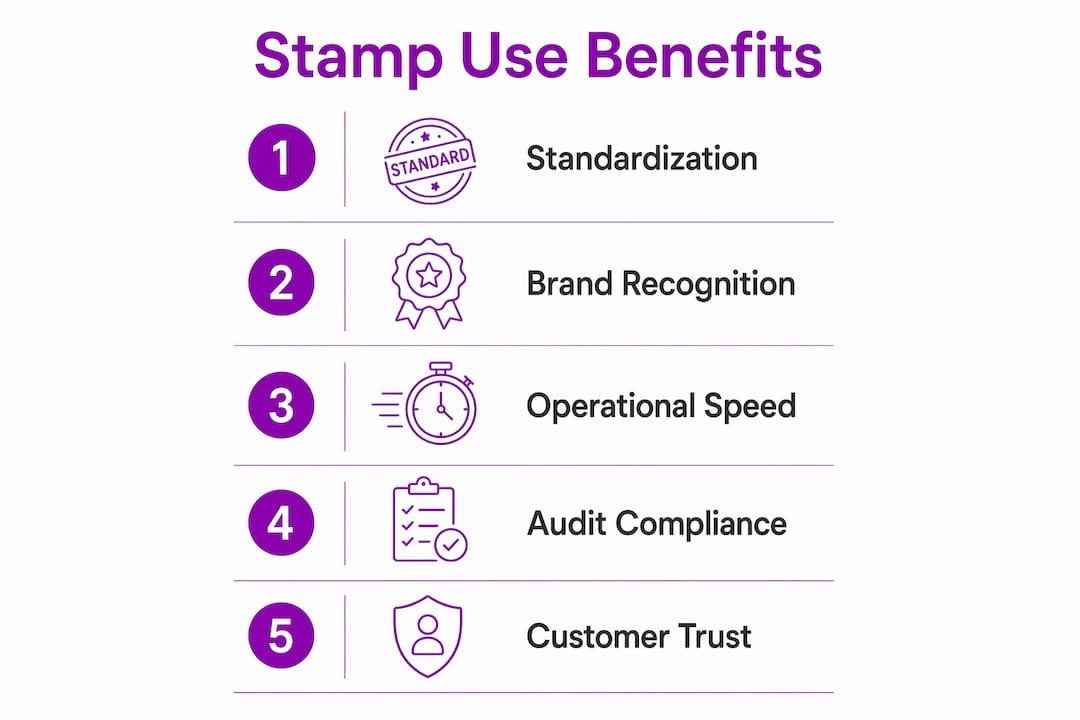
The table below compares stamp use against digital-only branding tools across the dimensions that matter most to business owners:
| Dimension | Consistent stamp use | Digital-only branding tools |
|---|---|---|
| Cost per impression | Very low after initial purchase | Variable, often recurring subscription cost |
| Physical presence | Yes, tangible on documents and packaging | No physical presence |
| Speed of application | Under one second per impression | Requires digital workflow and device access |
| Brand exposure frequency | Every physical document | Limited to digital channels |
| Offline reliability | Fully functional without internet | Dependent on connectivity and software |
| Customisation | High, via custom stamp design | High, via design software |
The comparison makes clear that stamps fill a gap digital tools cannot. Physical documents, parcels, receipts, and correspondence still exist in volume across most industries. A business that relies solely on digital branding misses every touchpoint that occurs on paper.
Avoiding inconsistent branding internally is as important as managing it externally. When different departments use different stamp designs, or when stamps are applied sporadically, the result is a fragmented impression that signals disorganisation. Brand guidelines should specify which stamp design is authorised, where it is applied, and who is responsible for maintaining the equipment. For small businesses, practical branding steps with stamps are straightforward to implement and maintain.
As a brand evolves, stamps should evolve with it. A rebranded logo requires updated stamp artwork. Treating stamp design as a permanent fixture while the rest of the brand changes creates exactly the inconsistency that erodes trust.
What are best practices for maintaining consistent stamp use?
Adopting consistent stamp use requires more than purchasing the right equipment. It requires a process that staff follow reliably and that managers can monitor.
- Select the correct stamp type for each task. A self-inking dater stamp suits high-volume document receipt. A logo stamp suits outgoing correspondence and packaging. A pre-inked stamp suits low-volume, high-quality impression needs. Matching the tool to the task prevents the wrong stamp being used in the wrong context.
- Train staff on correct application. A stamp applied at an angle, with insufficient pressure, or in the wrong location on a document produces an unclear impression. Brief, specific training on placement and pressure takes minutes and prevents months of inconsistent output.
- Maintain ink and equipment regularly. A faded impression is worse than no impression. It signals neglect and creates ambiguity. Self-inking stamps require periodic re-inking, and the schedule should be documented rather than left to individual judgement.
- Audit stamp usage across departments. In larger organisations, different teams may use different stamp designs or apply them inconsistently. A quarterly review of stamp output across departments identifies drift before it becomes a problem.
- Retire outdated stamps promptly. An old logo or an incorrect address on a stamp in circulation undermines every impression it makes. Establish a clear process for retiring and replacing stamps when brand or operational details change.
Pro Tip: Keep a small stock of replacement ink pads and a spare stamp for each critical workflow. If the primary stamp fails or runs dry during a busy period, the workflow continues without interruption. Downtime caused by a missing stamp is avoidable and costly.
For businesses considering self-inking stamp benefits in more detail, the key decision point is volume. High-volume operations benefit most from self-inking models, while lower-volume needs may be served adequately by pre-inked options.
Key takeaways
Consistent stamp use in business delivers measurable gains in brand recognition, document accuracy, and operational speed, making it one of the most cost-effective tools available to business owners and managers.
| Point | Details |
|---|---|
| Brand trust and revenue | Consistent branding, including stamp use, is linked to 10 to 23% revenue growth and higher consumer trust. |
| Cognitive recognition | Uniform stamp impressions create mental shortcuts that speed up document processing and reduce errors. |
| Operational time savings | Dater stamps reduce manual entry time by several minutes per document, with impressions taking under one second. |
| Compliance and accountability | Consistently stamped dates and approvals create clear audit trails that protect businesses in disputes. |
| Digital gap coverage | Stamps deliver brand exposure on physical documents where digital tools have no reach. |
Why stamps are more relevant in 2026 than most managers realise
I have spent years watching businesses invest heavily in digital branding, CRM systems, and social media presence while their physical documents go out with inconsistent, faded, or absent stamps. The assumption is that stamps are a legacy tool. That assumption is wrong, and it costs businesses more than they realise.
The psychology of physical consistency is underestimated. When a client receives an invoice with a clean, correctly placed logo stamp, it registers as professionalism without them consciously noting it. When that same client receives a document with a smudged impression or no stamp at all, they do not think “the stamp was missing.” They think “this company is disorganised.” That judgement happens in under a second and it shapes the entire relationship.
What I find most telling is that the businesses with the tightest operational discipline, the ones that pass audits cleanly and retain clients longest, are almost always the ones with standardised physical document processes. Stamps are part of that. They are not glamorous, but they are reliable in a way that digital tools are not when the internet is down, the software has updated, or the device is unavailable.
The role of stamps in branding for UK SMEs is particularly significant because physical correspondence remains common in sectors including legal, property, and financial services. Dismissing stamps as outdated in these contexts is not progressive. It is a gap in operational thinking.
My practical advice: audit every physical document your business produces in a week. Count how many carry a consistent, clear stamp impression. If the answer is fewer than 80%, you have an efficiency and branding problem that a well-chosen stamp and a brief staff briefing can fix within a day.
— Steven
Upgrade your business stamping with Stampdesign4u
Stampdesign4u supplies custom self-inking stamps built for consistent, high-volume business use. The Trodat 4927 logo and text stamp delivers up to nine lines of text and logo artwork in a 60 x 40mm impression area, making it well suited for invoices, approvals, and outgoing correspondence. Orders are processed quickly, with custom artwork support available for businesses updating their stamp designs. If your current stamps are producing faded or inconsistent impressions, replacing them is a straightforward decision with a direct impact on how your business is perceived. Browse the full range at Stampdesign4u and find the right tool for your workflow.
FAQ
What is consistent stamp use in business?
Consistent stamp use in business is the regular, uniform application of the same stamp design across all relevant documents and materials. It supports brand recognition, operational accuracy, and compliance by ensuring every impression is identical and clearly legible.
How do stamps improve brand consistency?
Stamps deliver repeated brand impressions on physical documents, contributing to the Rule of 7 by creating multiple brand exposures at minimal cost. Businesses that maintain consistent branding see revenue growth of 10 to 23%, according to research from Franchise Local.
Are self-inking stamps better than traditional rubber stamps for business use?
Self-inking stamps are the preferred choice for business use because they produce faster, cleaner impressions without a separate ink pad. Each impression takes under one second, and the built-in ink pad reduces maintenance and ensures consistent output across high-volume workflows.
How does stamp use support document compliance?
Dater stamps provide uniform date records on received and processed documents, creating clear audit trails that hold up during compliance reviews and disputes. Consistent stamped dates remove ambiguity about when a document was handled and by whom.
How often should business stamps be replaced or updated?
Stamps should be updated whenever a business changes its logo, address, or other key details. Outdated stamps in circulation produce impressions that contradict current brand guidelines, which undermines the consistency that makes stamp use valuable in the first place.