

TL;DR:
- Custom stamp usage policies are essential written guidelines that govern who can use stamps, on which documents, and under what conditions to ensure legal compliance and organizational control. Without clear policies, organizations risk misuse, fraud, and invalidated stamped documents, especially as government regulations increasingly scrutinize stamp validity. Effective policies require proper authorization, secure storage, detailed audit logs, and routine audits, with specific controls tailored to physical or digital tools.
Custom stamp usage policies are formalised guidelines that define who may use a stamp, on which documents, and under what conditions, to maintain organisational control and legal compliance. Without these policies, businesses expose themselves to misuse, fraud, and the risk that stamped documents carry no legal weight whatsoever. The term “stamp governance” is increasingly used by compliance professionals to describe this discipline, and it applies equally to physical rubber stamps and digital stamp tools. This guide covers the full scope of custom stamp guidelines: from prerequisites and implementation steps to common pitfalls and the critical differences between physical and digital stamp controls.
What are custom stamp usage policies and why do they matter?
Custom stamp usage policies define the rules governing stamp access, application, and accountability within an organisation. They specify authorised users, permissible document types, transaction limits, and the consequences of misuse. Without a written policy, a stamped document may carry no legal force at all. Legal validity of a stamp depends entirely on documented organisational authorisation and clear intent tied to specific documents. That is not a technicality. It is the difference between an approved purchase order and a worthless piece of paper.

Stamp policies also separate three distinct purposes: informational stamps (such as “Received” or “Copy”), administrative approval stamps, and legal authentication stamps. Rubber stamps are generally unsuitable for legal authentication and should be explicitly excluded from that category in any written policy. This three-tier classification prevents staff from applying a routine approval stamp to a document that legally requires a wet signature or a certified digital signature. The role of stamps in business extends well beyond convenience. They are governance instruments when managed correctly.
A real-world illustration of the legal risk: a USCIS rule effective May 2026 states that stamped signatures are invalid for immigration filings when used without proper authorisation, requiring handwritten signatures instead. This ruling underlines that government bodies are actively scrutinising stamp use, and organisations without clear policies are the most vulnerable.
What do you need before implementing stamp usage policies?
Establishing stamp governance requires specific resources and structures before a single policy document is drafted. Skipping prerequisites is the most common reason rollouts fail within the first quarter.
Physical and digital stamp tools
Physical stamp options include self-inking rubber stamps from manufacturers such as Trodat, pre-inked stamps, and traditional wooden-handled stamps. Digital stamping tools include Adobe Acrobat’s stamp features, which support resizing, opacity control, placement, and dynamic date and time fields. Each tool type requires a different governance approach, and your policy must specify which tools are authorised for which document categories.
Authorisation and access controls
Before writing policy, organisations must establish a clear authorisation matrix: who approves stamp use, who can physically access a stamp or digital template, and who reviews the audit log. This structure is the backbone of any effective stamp approval process.
The following prerequisites are required before policy implementation:
- A written board resolution or management directive authorising stamp use
- A named custodian for each physical stamp and each digital stamp template
- A secure storage location for physical stamps (lockable cabinet or safe)
- A controlled digital repository for stamp template files
- A logging system to record date, document reference, user identity, and purpose for every stamp application
- A staff training programme covering permitted uses, restrictions, and reporting obligations
| Prerequisite | Physical stamps | Digital stamps |
|---|---|---|
| Storage | Locked cabinet, restricted key access | Password-protected folder or document management system |
| Access control | Named authorised users only | Role-based permissions in software |
| Audit trail | Manual log book | Automated activity log in Adobe Acrobat or equivalent |
| Template management | N/A | Canonical template with version control |
| Training requirement | Handling, storage, and policy rules | Software use, template selection, and policy rules |
Pro Tip: Before finalising your prerequisites list, run a one-week pilot with a single department. This surfaces gaps in your logging system and access controls before organisation-wide rollout.
How do you create, approve, and enforce a stamp policy?
A stamp policy that sits in a shared drive and is never enforced is worse than no policy at all. It creates a false sense of compliance. The following steps build a policy that is both operational and defensible under audit.
-
Draft the policy document. Define the scope: which stamp types are covered, which document categories are included, and which are explicitly excluded. State transaction limits where relevant (for example, purchase approvals up to £5,000 may use an administrative stamp; above that threshold, a wet signature is required).
-
Assign roles and responsibilities. Name a policy owner, a stamp custodian for each physical or digital stamp, and an audit reviewer. Vague ownership is the primary cause of policy drift.
-
Establish physical controls. Lock physical stamps in a secure location. Maintain a sign-out register. Restrict access to named individuals only. LegalClarity recommends documented controls and use logs as the minimum standard to support audits and prevent misuse.
-
Configure digital controls. In Adobe Acrobat, create stamp templates from approved artwork only. Set dynamic stamps to auto-populate date and time fields. Dynamic stamps in Acrobat can automatically update fields such as current date and time, which aids document tracking and reduces manual errors. Restrict template access using role-based permissions.
-
Implement a use log. Every stamp application must be recorded with the date, document reference, user identity, and stated purpose. This log is your primary evidence in any dispute or audit.
-
Schedule periodic audits. Reconcile the use log against stamped documents quarterly. Investigate any discrepancy immediately. Enterprise best practices include a “stamp change-control board” with strict process controls, tracking metrics, and mandatory change notes for any template revision.
-
Define enforcement measures. State clearly what constitutes a breach, the reporting process, and the disciplinary consequences. A policy without enforcement provisions is not a policy. It is a suggestion.
Pro Tip: When rolling out the policy, run onboarding drills rather than distributing a PDF. Ask staff to complete a simulated stamp application under supervision. This reveals misunderstandings before they become compliance failures.
What are the most common mistakes in stamp policy management?
Most stamp governance failures are predictable and preventable. The following mistakes appear repeatedly across organisations of all sizes.
-
Uncontrolled access. Leaving physical stamps in unlocked drawers or sharing digital template files without access controls is the single most common source of misuse. The remedy is a named custodian and a sign-out register for every stamp.
-
Missing intent documentation. A stamp applied without documented authorisation and intent has no legal effect. Stamps used without authority and clear intent tied to specific documents are generally invalid. Every policy must require users to confirm their authority before applying a stamp.
-
Template drift. Digital stamp templates that are modified informally, saved under different filenames, or used in outdated versions create inconsistency. Large enterprises treat stamp templates like software, maintaining canonical sources and retirement logs with mandatory change notes to prevent uncontrolled drift.
-
Inadequate audit logs. A log that records only the date and user name is insufficient. Logs must include the document reference and stated purpose to be useful in a dispute.
-
Digital readability failures. A stamp that looks clear on screen may be illegible when printed on a low-ink printer or photocopied. Readability validation across real printers, photocopies, and low-ink conditions is a critical technical check before any digital stamp is deployed.
“Effective stamp governance is not about restricting use. It is about making every stamp application traceable, intentional, and defensible.”
How do digital and physical stamp policies differ?
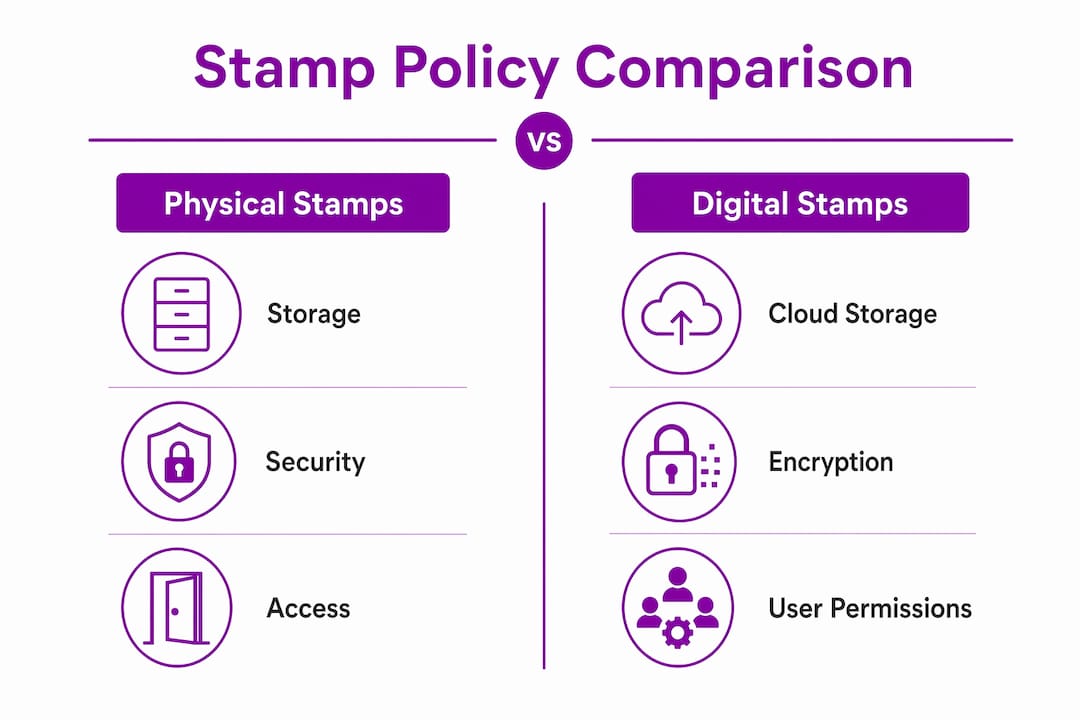
The governance principles are the same for both formats, but the practical controls differ significantly. Understanding these differences allows organisations to tailor their stamp usage regulations to the tools they actually use.
| Governance element | Physical stamps | Digital stamps |
|---|---|---|
| Storage and security | Locked cabinet, restricted physical access | Encrypted folder, role-based software permissions |
| Version control | Single physical object (no versioning risk) | Template files require canonical source and version log |
| Audit trail | Manual sign-out register | Automated log within Adobe Acrobat or document management system |
| Readability assurance | Visual inspection of ink quality | Testing across printers, photocopiers, and screen resolutions |
| Compliance documentation | Board resolution, custodian record | Board resolution, access rights record, template change log |
| Best suited for | Low-volume, in-person document processing | High-volume, remote, or multi-site workflows |
Physical stamps carry a lower technology risk but a higher physical security risk. Digital stamps, managed through tools such as Adobe Acrobat, offer automated logging and dynamic date fields, but require governance not just on creation but on consistent rendering across devices and media. Organisations running hybrid workflows need a policy that addresses both formats explicitly, with separate custodians and separate audit trails for each.
Practical stamp applications for businesses illustrate how the same stamp type can serve very different purposes depending on context, which is precisely why policies must be document-specific rather than generic.
Key takeaways
Effective custom stamp usage policies require a written authorisation structure, separate controls for physical and digital stamps, and a traceable audit log for every application.
| Point | Details |
|---|---|
| Define stamp categories | Separate informational, administrative, and authentication uses explicitly in the policy. |
| Assign named custodians | Every stamp, physical or digital, must have a named responsible individual. |
| Maintain a use log | Record date, document reference, user identity, and purpose for every stamp application. |
| Validate digital readability | Test digital stamps across printers and photocopiers before deployment. |
| Audit quarterly | Reconcile use logs against stamped documents to detect discrepancies early. |
Why most stamp policies fail before they are tested
In my experience reviewing document control frameworks across small businesses and mid-sized organisations, the most common failure is not a lack of policy. It is a policy that was written once, filed, and never operationalised. Staff receive a PDF, skim it, and continue using stamps exactly as they did before.
The organisations that get this right treat stamp governance the way they treat financial authorisation controls. They run drills. They test their audit logs. They ask: if a stamped document were challenged in court tomorrow, could we prove who applied it, when, and under what authority? If the answer is uncertain, the policy is not working.
I also think the industry underestimates the risk of template drift in digital environments. A stamp template that has been informally modified and saved under a new filename is a governance failure waiting to surface. The best practices guide for custom stamps covers this in practical terms, and it is worth reading before you finalise any digital stamp policy.
One more point worth making: the legal landscape is shifting. The USCIS ruling in 2026 is one signal among many that regulators are tightening their scrutiny of stamped documents. Organisations that have clear, enforced policies are not just better protected. They are better positioned to adapt quickly when the rules change.
— Steven
Get the right stamp for your policy from Stampdesign4u
Once your stamp usage policy is in place, the physical stamp itself must meet the same standard of clarity and consistency the policy demands. The Trodat 4927 9 Line Logo and Text Rubber Stamp from Stampdesign4u is a practical choice for businesses that need a reliable, multi-line stamp for approvals, correspondence, and document processing. With a 60 x 40mm print area, it accommodates logos alongside text, making it suitable for branded approval stamps that align with your policy requirements. Stampdesign4u offers customisation across a wide range of stamp formats, so whether your policy covers a single department or a multi-site operation, the right tool is available to match it.
FAQ
What are custom stamp usage policies?
Custom stamp usage policies are written guidelines that define who may use a stamp, on which documents, and under what conditions. They establish authorisation controls, audit requirements, and enforcement measures to maintain compliance and legal validity.
Are stamped signatures legally valid?
A stamped signature is legally valid only when it is applied with documented organisational authorisation and clear intent tied to the specific document. Without these conditions, stamped signatures carry no legal effect and may be challenged or rejected.
What is the stamp approval process for businesses?
The stamp approval process involves drafting a policy that names authorised users, specifies permitted document types, sets transaction limits, and requires a use log entry for every application. Periodic audits reconcile the log against stamped documents to confirm compliance.
Can rubber stamps be used for legal authentication?
Rubber stamps are generally not suitable for legal authentication. Vendors including Stampivity caution that stamp designs carry no guarantee of meeting legal requirements, and policies should explicitly prohibit rubber stamps from being used for binding authentication purposes.
How do digital stamp policies differ from physical stamp policies?
Digital stamp policies require additional controls including template version management, role-based access permissions, and readability testing across printers and photocopiers. Physical stamp policies focus on secure storage, named custodians, and manual sign-out registers.
Recommended
- Explaining signature stamps: uses, law, and design – Stamp Design 4U
- Enhance your branding with custom stamps: a practical guide – Stamp Design 4U
- Types of document stamps: Choosing the best fit for your business – Stamp Design 4U
- Role of Stamps in Business – Branding, Compliance, Trust – Stamp Design 4U