

TL;DR:
- A signature stamp’s legal validity depends on clear intent, proper authorization, and the document type being signed, not just appearance. Certain documents, like wills and affidavits, generally require original handwritten signatures, and stamp use in these cases risks invalidation. Proper governance, secure storage, and detailed usage logs are essential to reduce fraud and ensure compliance when using signature stamps organizationally.
Most people assume a signature stamp works just like a handwritten signature. It looks the same, it carries the signer’s name, and it lands on paper. Job done. But explaining signature stamps properly means going further than appearance. The legal validity of a stamp depends on intent, authorisation, and the type of document being signed. Use one in the wrong context and you risk having the document rejected, a filing denied, or a legal dispute with no easy resolution. This guide covers what signature stamps are, when they hold legal weight, how to design one that suits your needs, and when to leave the stamp in the drawer.
Table of Contents
- Key takeaways
- Explaining signature stamps: what they are and how they work
- Legal validity and enforceability
- Design options and selecting the right stamp
- Best practices for compliance and organisational control
- When to avoid signature stamps entirely
- My honest take on signature stamps in practice
- Get the right signature stamp from Stampdesign4u
- FAQ
Key takeaways
| Point | Details |
|---|---|
| Legal validity is conditional | A signature stamp is only enforceable when used with clear intent and by an authorised person on the correct document type. |
| Some documents reject stamps outright | Wills, deeds, affidavits, and court filings often require original wet-ink or verified digital signatures. |
| Design choices affect reliability | Stamp type, ink quality, and impression accuracy all influence how consistently your stamp performs in practice. |
| Governance reduces fraud risk | Written policies, usage logs, and secure storage are the controls that make stamp use defensible under scrutiny. |
| Regulatory pressure is increasing | USCIS rules from 2026 now allow filings to be denied for invalid stamp signatures, with fees retained on rejection. |
Explaining signature stamps: what they are and how they work
A signature stamp is a physical or digital device that reproduces a person’s handwritten signature on demand. Rather than signing each document individually, the holder presses a stamp onto paper and leaves an inked impression that visually replicates their signature. The result looks identical to a handwritten mark, though legally the two are treated very differently depending on context.
There are three main physical types in common use:
- Self-inking stamps contain a built-in ink pad that re-inks automatically with each impression. They are the most practical choice for frequent use and produce consistent results over thousands of impressions.
- Pre-inked stamps hold ink within the die itself rather than a separate pad, delivering sharper impressions. They suit applications where signature detail and clarity matter most.
- Traditional rubber stamps require a separate ink pad and manual re-inking. They are less convenient but straightforward to produce and replace.
Signature stamps are commonly used in business for volume signing tasks such as endorsing cheques, approving purchase orders, and processing high volumes of correspondence. They also serve as an accessibility tool for individuals who cannot physically sign each document due to disability or medical condition.
Digital stamps are a separate category and should not be confused with legally recognised digital signatures. A digital stamp is typically a visual marker placed on a document in software. It carries no cryptographic verification and holds no legal equivalence to a qualified electronic signature. Digital stamps are mainly useful for internal approvals and informal workflows.
Understanding the differences between stamp types helps you match the right tool to the right task before questions of legality even arise.
Legal validity and enforceability
The legal principle at the centre of signature stamp validity is straightforward: courts evaluate intent and authority. A stamp applied with the deliberate intent to authenticate a specific document, by a person with authority to do so, can carry legal weight. A stamp applied accidentally, by an unauthorised party, or without demonstrable intent has no legal effect at all.
This matters because it shifts the burden of proof. If a stamped signature is challenged, you need evidence that the right person applied it to the right document on purpose. That is a much harder standard to meet than simply producing a document with a handwritten signature.
Certain document types routinely reject stamped signatures regardless of intent:
- Wills and testamentary documents require personal execution under witness in most jurisdictions.
- Deeds and property transfers typically require original signatures and may need notarisation.
- Affidavits and statutory declarations are sworn statements that require personal execution.
- Court filings often have specific electronic or original signature requirements.
Jurisdictional rules vary significantly. Some jurisdictions permit notarisation of stamped signatures only with additional safeguards such as two impartial witnesses and detailed notary recording. Others, like Florida, prohibit notarising stamped signatures entirely. Assuming your jurisdiction follows the more permissive standard is a risk not worth taking.
“Legal validity hinges not on the stamp device but on intent to authenticate a particular document and authorised use.” — LegalClarity
Pro Tip: Before using a signature stamp on any formal document, check the specific filing rules for that document type and jurisdiction. A five-minute review can prevent a rejected filing or an unenforceable agreement.
For immigration applications specifically, USCIS online filing guidance states that applicants must use original wet-ink or accepted digital signatures. Stamps are listed among the invalid signature types that trigger system prompts or outright invalidation. The practical consequence is a delayed or rejected application.
Design options and selecting the right stamp
Choosing a signature stamp is not purely a question of which device produces the best impression, though that matters. You are also making decisions about control, longevity, and consistency.
The key design factors are:
| Factor | What to consider |
|---|---|
| Replica accuracy | The stamp image should closely match your actual handwritten signature, including proportions and characteristic marks |
| Size | Match the stamp size to the signature field on your most common documents; oversized impressions look unprofessional |
| Ink type | Water-based inks suit standard paper; oil-based inks perform better on coated or glossy surfaces |
| Mechanism | Self-inking suits volume use; pre-inked suits precision; traditional rubber suits occasional or light use |
| Customisation | Some providers allow you to upload a scanned signature for precise reproduction |
For durability and impression quality, stamp materials make a significant difference. Photopolymer dies hold finer detail than standard rubber and resist wear over a larger number of impressions. For a signature stamp you intend to use daily across months or years, the quality of the die is worth prioritising.

You can find a step-by-step guide to making personalised signature stamps that walks through the process of uploading your signature, selecting specifications, and reviewing the proof before ordering.
Pro Tip: Order a test impression on plain white paper before committing to bulk use. Small details in your signature, particularly loops and fine strokes, can be lost in the reproduction process if the die resolution is too low.
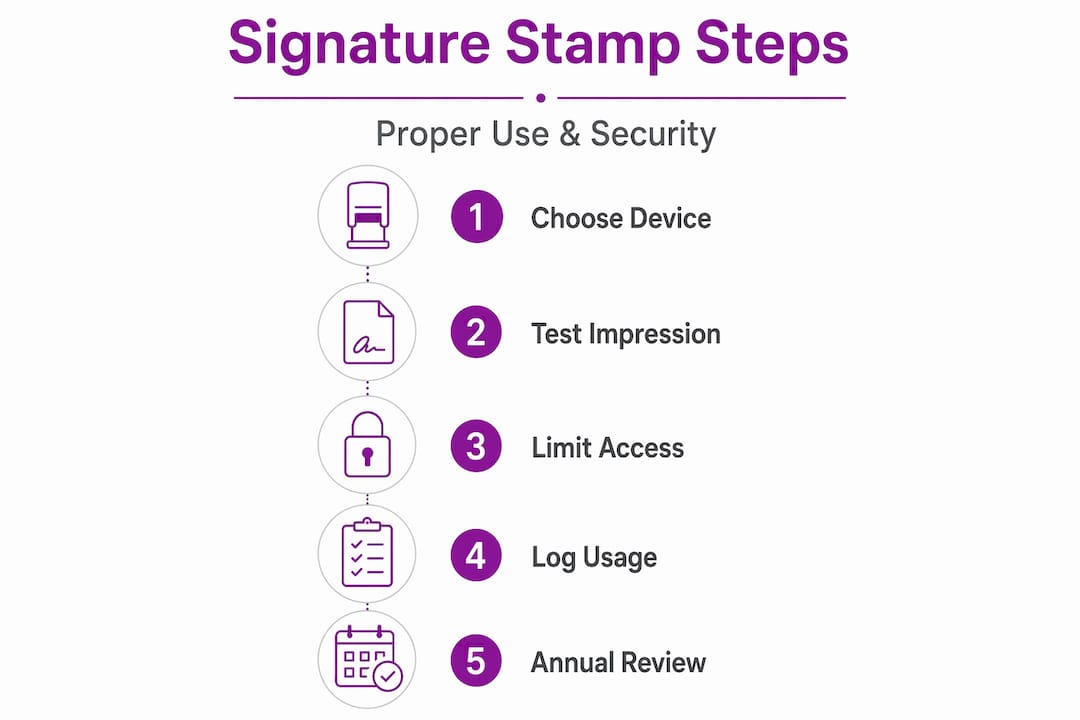
On the security side, treat your signature stamp as carefully as you would a cheque book or access card. Physical storage in a lockbox and restricting access to named individuals prevents unauthorised use that could create fraudulent documents bearing your signature.
Best practices for compliance and organisational control
Using a signature stamp within an organisation requires more than handing it to the relevant manager. Without proper governance, the stamp becomes a liability rather than a convenience.
- Establish a written policy. Define who is authorised to use the stamp, for which document types, and under what circumstances. A board resolution or internal policy document provides the formal authority that makes stamped signatures defensible if challenged.
- Maintain a usage log. Record every document stamped, including the date, document type, and the name of the person who applied the stamp. Maintaining a stamp log and securing physical access are the two most effective ways to reduce dispute risk.
- Store the stamp securely. A lockbox or secured drawer with controlled key access limits who can use the stamp outside of authorised workflows.
- Report loss or theft immediately. Lost or stolen stamps must be reported to financial institutions and relevant parties without delay. Prompt notification is the key step in disclaiming liability for any fraudulent signatures applied without authorisation.
- Retain original signed documents. For electronic filings that use a stamp or facsimile signature, court rules often require retention of original signed pages, available upon request within a specified timeframe. Stamp-only workflows that discard originals can fail this test entirely.
Businesses that adopt written policies, usage logs, and physical security turn signature stamp use from an informal convenience into a documented, controlled process. That documentation is precisely what protects them when a stamped signature is later questioned.
Pro Tip: Review your stamp policy annually. Personnel change, document types evolve, and regulatory requirements update. A policy written three years ago may no longer reflect current filing rules or organisational risk.
When to avoid signature stamps entirely
Even with strong governance, there are situations where a signature stamp creates more risk than it removes.
The following red flags indicate that a stamp is the wrong choice:
- The document requires personal execution under law (wills, deeds, statutory declarations).
- The recipient or counterparty has explicitly requested an original handwritten signature.
- The filing is with USCIS or another federal body with documented restrictions on stamp signatures.
- The document will be notarised in a jurisdiction that does not accept stamped signatures.
- The document carries significant financial or legal consequences where authenticity will be scrutinised.
- You cannot produce contemporaneous evidence that the stamp was applied by an authorised person.
“Regulators are tightening controls on signature provenance, notably USCIS’s 2026 rule clarifying enforcement and fee retention on invalid signatures.” — Federal Register
The consequences of misuse are concrete. Under the USCIS 2026 interim final rule, filings bearing invalid stamp signatures can be denied and fees retained. That means paying again to refile, with no guarantee of approval the second time. For immigration filings, that cost is significant in both money and time.
For high-stakes documents, retain original signed pages, use wet-ink signatures, or consult a solicitor before deciding. Convenience is not worth a voided agreement or a denied application.
My honest take on signature stamps in practice
I’ve seen the same pattern repeatedly. An organisation starts using a signature stamp to manage volume. It works well for routine correspondence and internal approvals. Then someone uses it on a contract or a regulatory filing without checking the rules. The document is challenged, and suddenly the business is explaining its stamp governance to a solicitor.
What I’ve found is that most people underestimate how narrow the safe zone for stamp use actually is. The theory says stamps are legally valid with intent and authorisation. The practice is that proving intent and authorisation after the fact is genuinely difficult, especially in organisations with staff turnover and informal habits around the stamp.
My view is that the stamp log is the most underused tool in this space. Organisations invest in quality stamps and secure storage, then keep no record of when the stamp was used or by whom. That log is the only contemporaneous evidence you have if a stamped document is disputed months or years later.
The design and mechanism matter too, but not as much as the process around use. A well-governed cheap stamp is safer than an expensive one sitting in a shared drawer with no usage records.
— Steven
Get the right signature stamp from Stampdesign4u
If you have worked through the legal and practical considerations above and decided that a signature stamp fits your needs, quality and accuracy in the product itself are the next priority. Stampdesign4u supplies custom signature stamps designed for both individual and business use, with precise reproduction of handwritten signatures and a choice of mechanisms to suit your usage volume.
The Trodat 4927 custom stamp is a reliable choice for business use, offering a 60 x 40mm impression area, self-inking mechanism, and the option to incorporate logo or text alongside a signature design. It suits volume signing tasks where consistency and impression quality matter.
Stampdesign4u offers design support, fast delivery, and a straightforward ordering process that takes you from uploading your signature to receiving a finished stamp. Visit stampdesign4u.co.uk to configure your stamp with the specifications that match your document needs.
FAQ
Are signature stamps legally valid in the UK?
Signature stamps can be legally valid in the UK when applied with clear intent to authenticate a specific document and by a person with authority to use the stamp. They are not universally accepted and are rejected by certain document types including wills and statutory declarations.
What documents should never use a signature stamp?
Documents that typically require original wet-ink signatures include wills, deeds, affidavits, notarised documents, and filings with government bodies that specify wet-ink or verified digital signatures. Using a stamp on these documents risks invalidity.
How do I protect against unauthorised use of my signature stamp?
Store your stamp in a locked location, limit access to named and authorised individuals, maintain a usage log recording every impression, and report any loss or theft to relevant financial institutions immediately to limit liability.
What is the difference between a digital stamp and a digital signature?
A digital stamp is a visual image placed on a document in software, carrying no cryptographic verification. A digital signature uses encryption to verify the signer’s identity and document integrity, and carries recognised legal weight in most jurisdictions.
Can a signature stamp be used for court filings?
Court filing rules vary by jurisdiction. In California, for example, electronic filings that use a stamp or facsimile signature require the original signed page to be retained and produced on request. Stamp-only workflows without retained originals may fail to meet these requirements.