

TL;DR:
- Promotional stamps are custom-printed tools used to create consistent branding on packaging and marketing materials. The three main types are self-inking, pre-inked, and traditional rubber stamps, each suited to different usage volumes and design complexity. Proper selection, testing, and technique ensure effective branding and promotional impact.
Promotional stamps are defined as custom-printed tools that apply a consistent, branded impression to packaging, correspondence, and marketing materials. The three primary types of promotional stamps are self-inking, pre-inked, and traditional rubber stamps, each suited to different usage volumes and branding requirements. Businesses that choose the right stamp type see measurable gains in brand consistency across every customer touchpoint. Stampdesign4u supplies all three categories, along with specialist options such as embossing stamps and loyalty stamps, making it a practical starting point for any marketing professional or small business owner.
What are the main types of promotional stamps used in marketing?
The three core stamp types used in business branding are self-inking, pre-inked, and traditional rubber stamps. Each serves a distinct purpose depending on how often you stamp, what surface you stamp on, and how much detail your design requires.
Self-inking stamps
Self-inking stamps are the best choice for high-volume, repetitive branding tasks. The ink pad is built into the stamp body and re-inks automatically after each impression. Self-inking stamps balance quality and moderate price efficiently, making them the go-to option for daily office use such as stamping invoices, envelopes, or branded packaging.
- Best for: daily, high-volume stamping
- Typical uses: address stamps, logo stamps on outgoing mail, date stamps
- Ink refill: replaceable ink pad, widely available
- Limitation: less suited to very fine or intricate artwork
Pre-inked stamps
Pre-inked stamps hold ink directly within the stamp die rather than a separate pad. This produces sharper, finer impressions and is the preferred format for intricate logo designs or detailed artwork. They cost more upfront than self-inking models, but the print quality justifies the investment for premium branding applications.
- Best for: detailed logos, fine-line artwork, high-quality impressions
- Typical uses: branded stationery, product packaging, client-facing documents
- Ink refill: specialist ink required; not universally interchangeable
- Limitation: higher unit cost
Traditional rubber stamps
Traditional rubber stamps require a separate ink pad and are the lowest-cost entry point for custom promotional stamping. They offer the widest range of customisation because the rubber die can be cut to almost any shape or size. They suit occasional use rather than daily stamping.
- Best for: occasional, low-frequency branding tasks
- Typical uses: craft packaging, event branding, seasonal promotions
- Ink refill: any compatible stamp pad
- Limitation: slower to use; requires a separate pad
Specialist stamp types
Embossing stamps create a raised impression without ink, adding a premium feel to certificates, letterheads, and gift packaging. Date stamps are a functional variant used to record receipt or despatch dates on correspondence. Both serve specific operational and marketing purposes that standard logo stamps do not cover.
How do different promotional stamp types compare?
Choosing between stamp formats comes down to three factors: how often you stamp, how much you want to spend, and how much design detail your brand requires.
| Stamp type | Usage frequency | Approximate cost range | Customisation level |
|---|---|---|---|
| Self-inking | Daily to weekly | Mid-range | Moderate |
| Pre-inked | Weekly to monthly | Higher | High |
| Traditional rubber | Occasional | Low | Very high |
| Embossing | Occasional | Mid to high | Moderate |
| Loyalty stamp | Daily | Low to mid | Low to moderate |
Self-inking stamps suit businesses that stamp dozens of items per day. Pre-inked stamps are the right call when brand precision matters more than speed. Traditional rubber stamps work well for small businesses that need flexibility on a tight budget.
Pro Tip: If you run a small e-commerce business and stamp 50 or more parcels a day, a self-inking logo stamp pays for itself within weeks through time saved alone.
For a direct comparison of the two most popular formats, Stampdesign4u’s guide on self-inking vs pre-inked stamps sets out the practical differences clearly.
What are the best practices for using promotional stamps?
Knowing how to use promotional stamps correctly is as important as choosing the right type. Poor technique produces patchy, off-brand impressions that undermine the consistency you are trying to build.
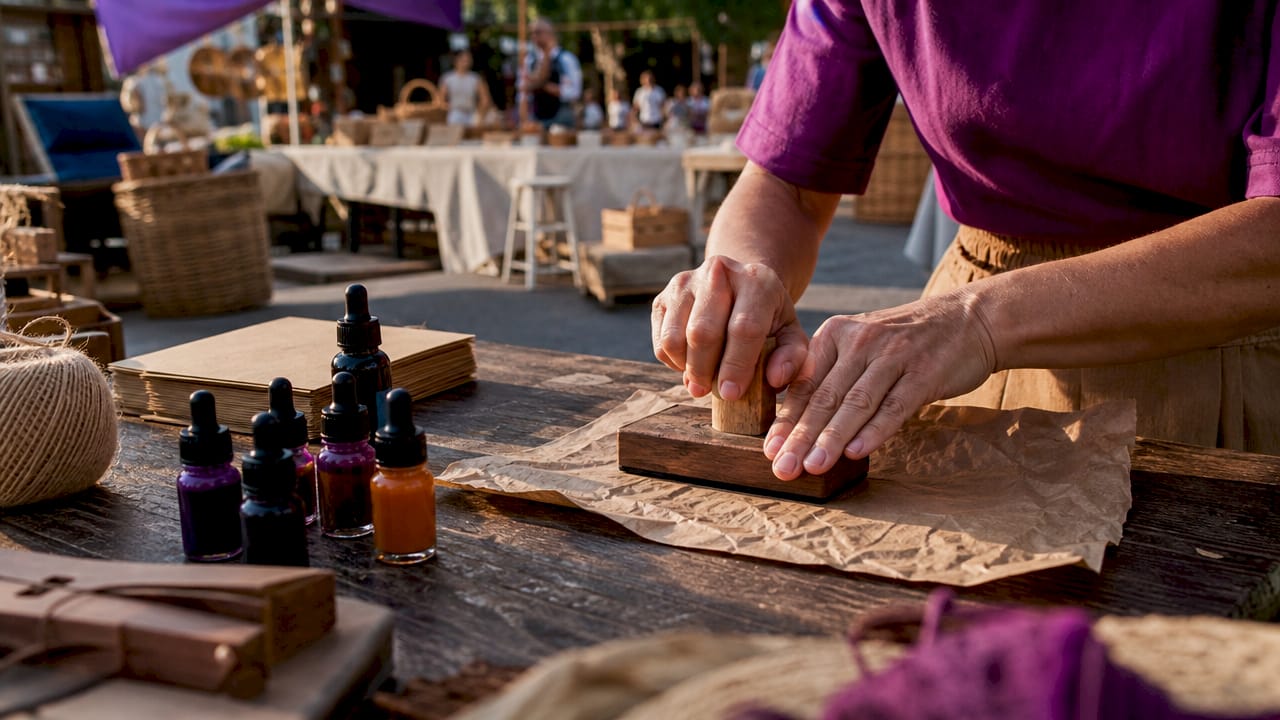
Match your ink to your surface
Water-based dye inks are ideal for clean impressions on porous materials such as kraft paper and card. Oil-based inks blur on kraft paper and should be avoided. For fabric stamping, use a pigment-based ink and heat-set with a dry iron at medium heat for 15 seconds to make the impression wash-resistant.
Support hollow or uneven surfaces
Stamping on shopping bags, tissue paper, or irregular packaging produces patchy results unless you stabilise the surface first. Insert a piece of cardboard inside the bag or box before stamping. The firm backing prevents the surface from collapsing under pressure and delivers a crisp, even impression every time.
Keep your design simple and clear
Designer Eero Lampinen, known for his work on commemorative postage stamps, states that simplicity and clarity are non-negotiable for promotional stamp designs. A stamp is a small format. Overcrowded artwork loses legibility at scale. Limit your design to a logo, a short tagline, or a single graphic element. The brand message must be readable at a glance.
Pro Tip: Test your stamp design at actual size before ordering. Print it on paper, cut it out, and hold it at arm’s length. If you cannot read it clearly in two seconds, simplify it.
For more guidance on building a stamp design that communicates clearly, Stampdesign4u’s article on custom stamp branding covers the full process from concept to finished impression.
Apply consistent pressure
Uneven pressure is the most common cause of poor impressions. Press down firmly and evenly across the full stamp surface. Rocking the stamp or lifting one edge mid-impression creates a partial print. For large stamps, use both hands to apply balanced downward pressure.
How can promotional stamps integrate with postal promotions?
Promotional stamps are not limited to physical branding. They connect directly with postal marketing strategies, and in 2026, that connection has financial value.
Businesses using integrated technologies such as QR codes on postal mailings qualify for a 5% postage discount under current promotional schemes. Additional technology integrations can push total savings up to 12%. For businesses running direct mail campaigns, that saving is material.
To qualify, your mail artwork must meet strict standards. Technical pre-approval of mail artwork is required before despatch. Non-compliant artwork is rejected and loses the discount. Key compliance requirements include:
- Correct placement of QR codes or augmented reality triggers within defined zones
- Approved ink types and textures that do not interfere with postal scanning
- Artwork submitted for pre-approval before the campaign launch date
- Consistent reproduction across the full print run
Promotional stamps can support this process by applying QR codes, promotional messages, or campaign-specific artwork directly to envelopes and packaging. A custom stamp with a QR code design bridges physical mail and digital tracking in one impression. This approach suits small businesses that cannot afford full print runs but still want to participate in postal discount programmes.
Custom logo stamps reinforce brand visibility at every customer interaction, and when combined with a tracked QR code, they generate data on campaign reach that a plain envelope never could.
For practical stamp promotion ideas that connect physical and digital marketing, Stampdesign4u’s guide on marketing with custom stamps offers ten tested approaches.
Key takeaways
The most effective promotional stamp strategy matches stamp type to usage frequency, design complexity, and surface material.
| Point | Details |
|---|---|
| Match stamp type to volume | Self-inking suits daily use; pre-inked suits precision; traditional suits occasional tasks. |
| Surface preparation matters | Insert cardboard inside hollow packaging to prevent patchy impressions. |
| Simplicity drives impact | Limit designs to one logo or tagline; complex artwork loses legibility at stamp scale. |
| Ink choice affects quality | Use water-based dye ink on kraft paper; heat-set pigment ink on fabric for wash resistance. |
| Postal integration adds value | QR code stamps on mail can qualify for up to 5% postage discounts under 2026 schemes. |
Why most businesses get their stamp choice wrong
Most small businesses buy a stamp based on price alone. That is the wrong starting point. I have seen marketing teams invest in a beautiful pre-inked logo stamp and then use it to stamp 200 envelopes a day. Within three months the die is worn and the impression is blurred. The stamp was the right quality but the wrong format for the volume.
The reverse mistake is just as common. A business buys a cheap traditional rubber stamp for a premium product line and wonders why the packaging looks amateurish. The stamp itself is fine. The ink pad is wrong for the surface, and nobody tested the design at actual size before ordering.
The thing most guides miss is that promotional stamp designs need to be tested physically, not just approved on screen. A design that looks sharp at 300 pixels per inch on a monitor can look muddy at 14 millimetres wide on a kraft bag. Eero Lampinen’s principle of simplicity is not just aesthetic advice. It is a practical constraint imposed by the physics of ink on paper.
My honest recommendation for any small business owner: order a sample before committing to a full run. Test it on the actual surface you plan to stamp. Check the impression in natural light. If it does not look right at that stage, no amount of technique will fix it later.
The emerging trend worth watching is the combination of physical stamps with digital triggers. A self-inking stamp that applies a QR code to packaging costs very little to produce. The data it generates from customer scans is worth considerably more than the stamp itself.
— Steven
Custom promotional stamps from Stampdesign4u
Stampdesign4u offers a full range of custom promotional stamps built for marketing and branding use, from high-volume self-inking logo stamps to specialist packaging options.
The Trodat Printy 4912 logo stamp is a popular choice for businesses that need a sharp, repeatable impression on envelopes and stationery. For businesses focused on packaging, the personalised packaging stamps collection covers boxes, bags, and wrapping materials. Both ranges are fully customisable with your logo or brand artwork. Stampdesign4u ships internationally, so whether you are based in the UK or elsewhere, your order reaches you ready to use.
FAQ
What are the three main types of promotional stamps?
The three main types are self-inking, pre-inked, and traditional rubber stamps. Each differs in usage volume, cost, and the level of design detail it can reproduce.
Which stamp type is best for daily business use?
Self-inking stamps are best for daily use. They re-ink automatically after each impression and handle high-volume stamping without requiring a separate ink pad.
How do I get a crisp impression on kraft paper packaging?
Use a water-based dye ink and avoid oil-based formulas, which blur on porous surfaces. Insert a firm cardboard backing inside hollow packaging before stamping to prevent uneven impressions.
Can promotional stamps qualify for postal discounts?
Yes. Stamps that apply QR codes or other qualifying technologies to mail pieces can help businesses qualify for a 5% postage discount under 2026 postal promotional schemes, with additional savings possible through further integrations.
How simple should a promotional stamp design be?
A promotional stamp design should contain one clear element: a logo, a short tagline, or a single graphic. Complex artwork loses legibility at the small scale of a stamp impression.
Recommended
- Examples of promotional stamps for small businesses – Stamp Design 4U
- Business branding with stamps: Practical steps for small businesses – Stamp Design 4U
- Enhance your branding with custom stamps: a practical guide – Stamp Design 4U
- Marketing with custom stamps: 10 ideas that work – Stamp Design 4U