

TL;DR:
- Dry stamping impresses a design onto surfaces using pressure alone without ink or moisture. It has roots in 19th-century ore processing and is now used for embossing paper, branding, and industrial work, offering a permanent, tactile mark. The technique varies from embossing and foil stamping to concrete applications, providing a versatile, ink-free method valued for authenticity and durability.
Dry stamping is defined as the process of impressing a design, mark, or pattern onto a surface using pressure alone, without ink or moisture. The technique spans an extraordinary range of applications, from 19th-century silver ore mining in Nevada to wedding invitation embossing and modern industrial concrete fabrication. Whether you are a small business owner seeking a tactile branding method, a crafter adding texture to paper, or an engineer working with green-state concrete, understanding what dry stamping is and how it works will help you choose the right approach for your project.
What is the dry stamping process? Origins and industrial roots
Dry stamping is one of the oldest mechanical processing techniques in industrial history, with its roots firmly in 19th-century mining. The method was developed to crush ore without water, producing fine powder rather than slurry. This made it particularly suited to high-sulphide silver ores found in regions such as Nevada’s Reese River district.
The Reese River process used mechanical dry crushing with 20-stamp batteries and Howell-White dryers to reduce ore to a fine, workable powder. Each stamp battery consisted of heavy iron heads raised and dropped repeatedly onto ore placed in a mortar box. The result was a dry, powdery material ready for chemical processing.
Dust management was a major operational challenge in these mills. Specialised exhaust fans and V-shaped troughs were employed to capture fine particles before they became a health and fire hazard. Without these systems, the volume of airborne dust produced by a single stamp battery would have made continuous operation impossible.
The contrast with wet stamping is straightforward. Wet stamping used water to suppress dust and carry crushed material away as a slurry. Dry stamping produced no slurry but required far more complex dust collection infrastructure. Each method suited different ore types and processing goals.
Key features of the historical dry stamping process:
- Stamp batteries: rows of heavy iron stamps dropped repeatedly onto ore
- Howell-White dryers: removed moisture from ore before crushing
- Exhaust fans and V-troughs: captured airborne dust particles
- No water input: the defining characteristic separating dry from wet stamping
Pro Tip: If you are researching historical stamp mill equipment, the stamp mill restoration community maintains detailed records of dry crushing machinery, including original Howell-White dryer specifications.
How does dry stamping work in modern art, craft, and branding?
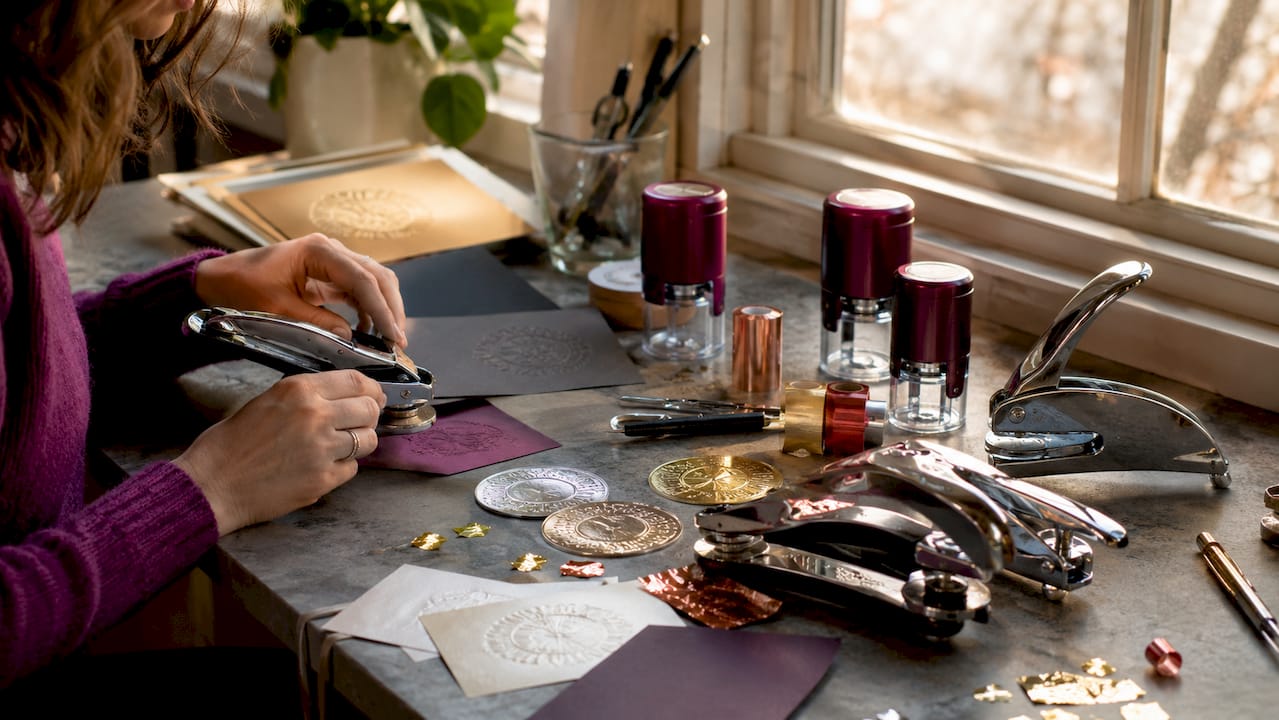
Dry stamping in creative and commercial contexts is defined by one principle: physical pressure creates a permanent impression without any ink transfer. The technique most people encounter today is dry embossing, where a metal die or embossing tool presses into paper or card to raise or indent a design.
Dry stamps emboss paper to create depth and texture, and they are used by libraries, galleries, notaries, and wedding planners. The resulting impression is subtle, tactile, and carries an air of authority that printed marks simply cannot replicate. A notary’s embossed seal on a legal document, for example, is immediately recognisable as authentic.
Businesses use dry stamping for several distinct purposes:
- Authentication: embossed seals on certificates, legal documents, and official correspondence confirm origin and authority.
- Branding: embossed logos on stationery, packaging, and invitations add a premium, tactile quality to brand communications.
- Personalisation: artists and crafters use hand-held embossing pliers or desk-mounted embossers to add monograms, motifs, or signatures to artworks and cards.
- Decoration: wedding invitations, greeting cards, and scrapbook pages frequently feature dry-embossed borders, florals, and lettering.
The tools used in this context include hand stamps, embossing pliers, foil stamping tools, and self-inking rubber stamps such as those produced by Trodat. Each tool suits a different scale of work. Embossing pliers work well for small-batch personalisation, while desk embossers handle higher volumes with consistent pressure. For businesses needing custom logo stamps for branding and sealing applications, a purpose-built rubber stamp is the most practical choice.
Pro Tip: For paper embossing, use card stock of at least 200gsm. Thinner paper tears under the pressure required for a clean, raised impression.
Henry VIII’s royal dry stamp was a facsimile signature device used to authorise documents without wet ink, functioning as a form of sanctioned administrative automation. It is one of the earliest recorded uses of a dry stamp for authentication, and it demonstrates that the principle of ink-free authorisation has been valued for centuries.
What are the key dry stamping techniques and how do they differ?
Several distinct techniques fall under the broad category of dry stamping. Understanding their differences helps you select the right method for your materials and intended outcome.
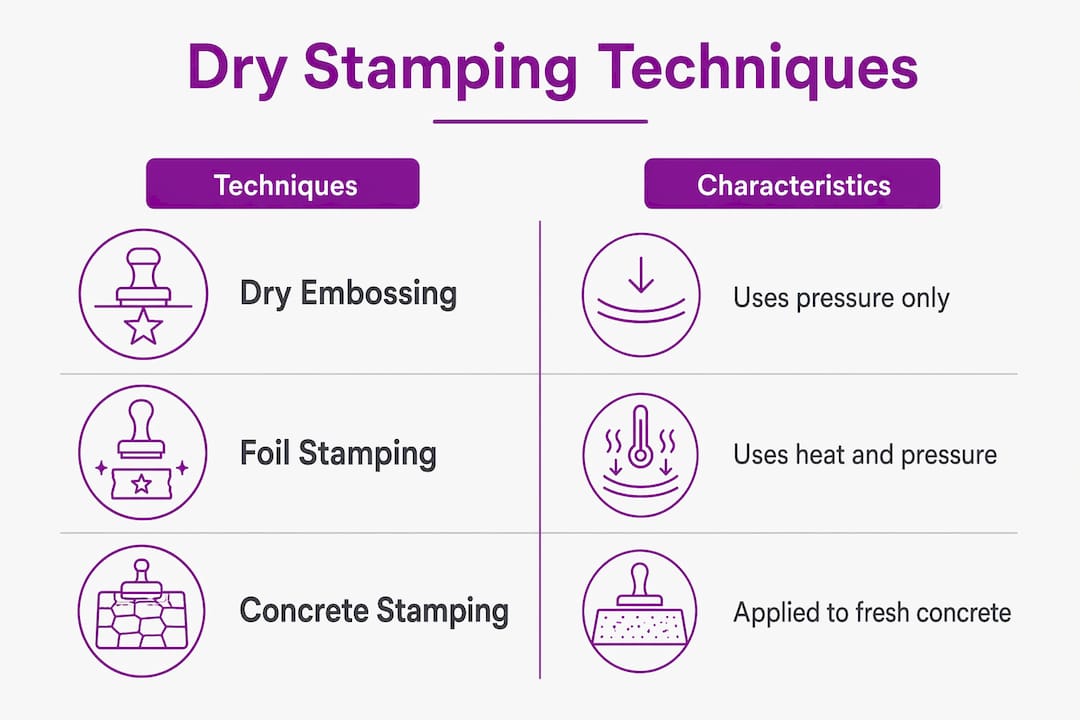
| Technique | Tools required | Materials | Typical uses |
|---|---|---|---|
| Dry embossing | Embossing pliers, metal dies | Paper, card, thin leather | Certificates, invitations, stationery |
| Foil (hot) stamping | Heated die, metallic foil | Paper, card, fabric, leather | Packaging, book covers, luxury branding |
| Cold foil printing | Printing press, UV adhesive | Paper, card | High-volume commercial print |
| Concrete dry stamping | Stamping tools, timing control | Green-state concrete | Architectural joints, precast elements |
| Traditional rubber stamping (dry) | Rubber stamp, no ink pad | Paper, card | Authentication seals, embossed marks |
Foil stamping is a dry printing process that uses heat and pressure to bond metallic foil onto a substrate. Heated dies at 100°C–150°C press a multi-layer metallic foil onto paper, producing a shiny, tactile finish. The foil itself consists of a polyester carrier film, a release layer, a colour pigment or metal layer, and a heat-activated adhesive. When the die lifts away, only the bonded design remains on the substrate.
Users often confuse foil stamping with embossing. Foil stamping transfers a metallic layer using heat. Embossing uses pressure alone to deform the substrate surface. The two techniques can be combined, a process called foil embossing, but they are mechanically distinct.
Green-state concrete stamping is a specialist industrial application. Stamping must occur within 90–120 minutes of mixing to achieve precise dry connections during fabrication. Beyond this window, the concrete hardens sufficiently to increase tool wear and introduce dimensional errors in the finished joint. End-face milling of green-state concrete causes higher tool abrasion compared to side passes, which explains why geometry-specific timing exceptions exist for certain shapes.
Pro Tip: When specifying foil stamping for packaging, request a test strike on your actual substrate before committing to a full production run. Paper weight and coating affect foil adhesion significantly.
What are the benefits and limitations of dry stamping?
Dry stamping offers a set of advantages that inked methods cannot match, but it also carries real constraints worth understanding before you commit to it for a project.
Benefits:
- No ink required: the impression is permanent and will not fade, smear, or bleed over time. This makes dry stamping ideal for archival documents and long-life branding materials.
- Tactile quality: a raised or indented impression engages the sense of touch in a way that printed marks do not. This quality is valued for authenticity and permanence in both personal and business contexts.
- Branding authenticity: embossed logos and seals signal quality and authority. Legal firms, universities, and luxury brands use dry embossing precisely because it is difficult to replicate cheaply.
- Versatility across materials: dry stamping works on paper, card, leather, fabric, metal foil, and concrete, depending on the technique used.
- Low ongoing cost: once you have the die or stamp, each impression costs almost nothing to produce.
Limitations:
- Surface restrictions: dry embossing requires a material that can deform under pressure without cracking. Rigid or very thin substrates are unsuitable.
- Design complexity: highly detailed designs lose definition in dry embossing. Fine lines and small text require precision dies and consistent pressure to reproduce clearly.
- Specialised tools: foil stamping and concrete stamping require equipment that represents a meaningful upfront investment.
- Batch size constraints: hand embossing tools are impractical for large volumes. High-volume dry stamping requires mechanical or automated equipment.
For small businesses and crafters, the most practical starting point is a desk embosser or a custom rubber stamp. Both deliver clean, repeatable impressions without significant equipment investment. Exploring personalised stamp uses for businesses and hobbyists gives a clear picture of where dry stamping adds the most value in everyday commercial and creative work.
How to get started with dry stamping for personal or business use
Starting with dry stamping is straightforward once you match your tool choice to your project requirements. Follow these steps to avoid the most common early mistakes.
- Define your application. Are you embossing paper for stationery, applying a foil finish to packaging, or marking documents with an authentication seal? Each application requires a different tool and die type.
- Choose your stamp type. For paper embossing, a desk embosser or embossing pliers with a custom die is the standard choice. For branding on documents and envelopes, a custom rubber stamp from a supplier such as Stampdesign4u gives consistent results at low cost per impression.
- Select your materials. Paper weight, surface texture, and coating all affect impression quality. Test on your actual material before ordering a final die.
- Design your artwork. Keep designs bold and relatively simple for dry embossing. Fine detail is lost under pressure. Use a custom stamp design workflow to move from concept to finished artwork efficiently.
- Order from a reputable supplier. Die quality determines impression quality. A poorly machined die produces uneven impressions regardless of how much pressure you apply.
- Maintain your stamps. Store rubber stamps flat, away from direct sunlight and heat. Clean embossing dies with a soft brush after each use to prevent material build-up in fine detail areas.
For businesses considering dry stamping as part of a broader branding strategy, enhancing your branding with custom stamps covers the practical decisions around stamp selection, design consistency, and integration with other brand materials.
Key takeaways
Dry stamping is the most versatile ink-free marking technique available, spanning historical ore processing, modern paper embossing, foil stamping, and industrial concrete fabrication.
| Point | Details |
|---|---|
| Core definition | Dry stamping uses pressure alone to create impressions, with no ink or moisture involved. |
| Historical roots | 19th-century mining used dry stamp mills with 20-stamp batteries to crush silver ore into fine powder. |
| Modern applications | Art, craft, branding, legal authentication, and industrial concrete fabrication all use dry stamping techniques. |
| Key technique differences | Foil stamping uses heat at 100°C–150°C; dry embossing uses pressure only; concrete stamping requires a strict 90–120 minute timing window. |
| Practical starting point | Match your tool to your substrate and design complexity before investing in dies or equipment. |
Why dry stamping deserves more credit than it gets
I have spent years working with stamp products across creative and commercial contexts, and the honest observation is this: dry stamping is consistently underestimated by businesses that default to printed alternatives. The tactile quality of an embossed seal on a certificate or a foil-stamped logo on a box communicates something that digital printing simply cannot. It signals that someone made a deliberate physical choice.
What surprises most people is the historical depth behind the technique. The same fundamental principle, pressure applied to a surface to leave a permanent mark, connects Henry VIII’s facsimile signature device to a Nevada stamp mill and to a modern embossing plier used at a craft table. That continuity is not trivial. It tells you that dry stamping solves a genuine, enduring need for permanent, ink-free marking.
The trend I find most interesting right now is the convergence of digital design tools with traditional dry stamping production. Designers now create artwork digitally, send files directly to die manufacturers, and receive precision-machined dies within days. The production quality available to a small business today would have required industrial equipment a generation ago. That shift makes dry stamping more accessible than it has ever been, and the history of rubber stamps shows just how far the technology has travelled from its origins.
— Steven
Custom dry stamping products from Stampdesign4u
Stampdesign4u offers a range of custom rubber and embossing stamps suited to dry stamping applications across business and personal use.
The Trodat 4927 9 Line Logo and Text Rubber Stamp at 60 x 40mm is a practical choice for businesses needing a reliable, high-impression stamp for branding, correspondence, and document marking. Stampdesign4u also stocks compact loyalty stamps for promotional use on packaging and materials. All products are available with custom design options, and the site supports orders from an international customer base. Browse the full catalogue at Stampdesign4u to find the stamp type that fits your project.
FAQ
What is dry stamping in simple terms?
Dry stamping is the process of pressing a design onto a surface using pressure alone, without ink or liquid. The result is a permanent raised, indented, or transferred mark depending on the technique used.
How does dry stamping differ from wet stamping?
Wet stamping uses water or ink as part of the process, as in traditional ink pad stamping or water-based ore crushing in mining. Dry stamping uses only mechanical pressure, producing no liquid byproduct.
What materials are used in dry stamping?
Common materials include paper, card, leather, fabric, and metallic foil for creative applications. Industrial dry stamping works with ore and green-state concrete, depending on the specific process.
Is dry stamping effective for business branding?
Dry stamping is effective for business branding because it produces tactile, permanent impressions that signal quality and authenticity. Embossed seals and foil-stamped logos are widely used by legal firms, publishers, and luxury brands.
What temperature is used in foil stamping?
Foil stamping uses heated dies at 100°C–150°C to bond metallic foil onto a substrate. The heat activates an adhesive layer within the foil, transferring only the design area onto the surface.