

TL;DR:
- Repetitive stamping refers to both creating identical craft impressions and producing high-volume metal parts with presses. Using self-inking stamps and positioner tools ensures consistent, precise results in small-scale branding and craft applications. In manufacturing, it involves precision dies and presses to produce uniform metal components rapidly and efficiently.
Repetitive stamping is one of those terms that means something quite different depending on who you ask. Ask a crafter and they will describe producing identical impressions across a sheet of cardstock. Ask an engineer and they will describe a high-volume press forming thousands of metal components per hour. Understanding what is repetitive stamping in both contexts matters because the tools, techniques, and goals differ significantly. Whether you are a small business owner wanting consistent logo prints or a buyer evaluating manufacturing processes, this guide gives you the precise, working knowledge you need.
Table of Contents
- Key takeaways
- What is repetitive stamping in crafting and branding
- Repetitive stamping in metal manufacturing
- Crafting vs industrial stamping: key differences
- Practical tips for effective repetitive stamping
- My honest experience with repetitive stamping
- Stamping tools for every repeat application
- FAQ
Key takeaways
| Point | Details |
|---|---|
| Two distinct meanings | Repetitive stamping refers to both repeated craft impressions and high-volume industrial metal forming. |
| Self-inking mechanisms | Self-inking stamps re-ink automatically after each impression, making craft repetition fast and reliable. |
| Alignment tools matter | Positioner tools with peg guides remove guesswork and deliver professional, evenly spaced results. |
| Industrial scale differs sharply | Metal stamping presses use progressive die sets to produce complex parts at hundreds of strokes per minute. |
| Practical branding applications | Businesses use repetitive stamping for logos, loyalty marks, packaging, and promotional items. |
What is repetitive stamping in crafting and branding
The definition of repetitive stamping in a crafting or branding context is straightforward: it is the process of applying the same stamp impression multiple times across a surface, producing consistent, evenly spaced results with minimal effort. The key word is consistent. A single misaligned impression can ruin a pattern on a greetings card or undermine the professional look of a branded envelope.
Achieving that consistency used to require considerable skill and patience. Today, two tools make it accessible to almost anyone.
Self-inking stamps are the most common tool for repetitive stamping in business and craft settings. According to NIST’s OSAC Lexicon, self-inking stamps contain a rotating die plate that presses against an internal miniature ink pad and re-inks after every impression. You press down, the die rotates back, picks up fresh ink, and is ready for the next use. There is no separate ink pad to manage between impressions, which means your workflow stays uninterrupted. For businesses stamping hundreds of envelopes or loyalty cards daily, this mechanism is the difference between a practical tool and an exhausting one.
Stamp positioners solve the alignment problem. A positioner tool uses pegs to hold stamp plates at fixed intervals, allowing you to produce evenly spaced repeated images across cardstock without measuring each placement by hand. A typical setup spaces impressions roughly an inch apart. For pattern stamping across wrapping paper or a row of logos across a product label, this removes the guesswork entirely.
The repetitive stamping process in crafting is particularly well suited to:
- Pattern making across cards, fabric, and paper goods
- Lettering and borders where consistent spacing matters
- Logo application on envelopes, packaging, and promotional materials
- Loyalty card stamping where the same mark must appear cleanly every time
- Layered designs where a base pattern is stamped first and detail added on top
Pro Tip: Before starting a long repetitive stamping run, do three test impressions on scrap paper. This confirms ink saturation is correct and your alignment is set. A dry or uneven first impression on your actual project is difficult to correct.
For businesses, the practical value of the repetitive stamping process extends well beyond craft projects. A consistent logo stamp on outgoing mail, order packing slips, or event materials creates a recognisable brand presence at very low cost. Explore personalised stamp uses for a broader picture of how self-inking tools serve real branding needs.
Repetitive stamping in metal manufacturing
The industrial meaning of repetitive stamping is technically distinct from the crafting version, though the underlying principle is the same: apply the same forming action repeatedly to produce identical results.
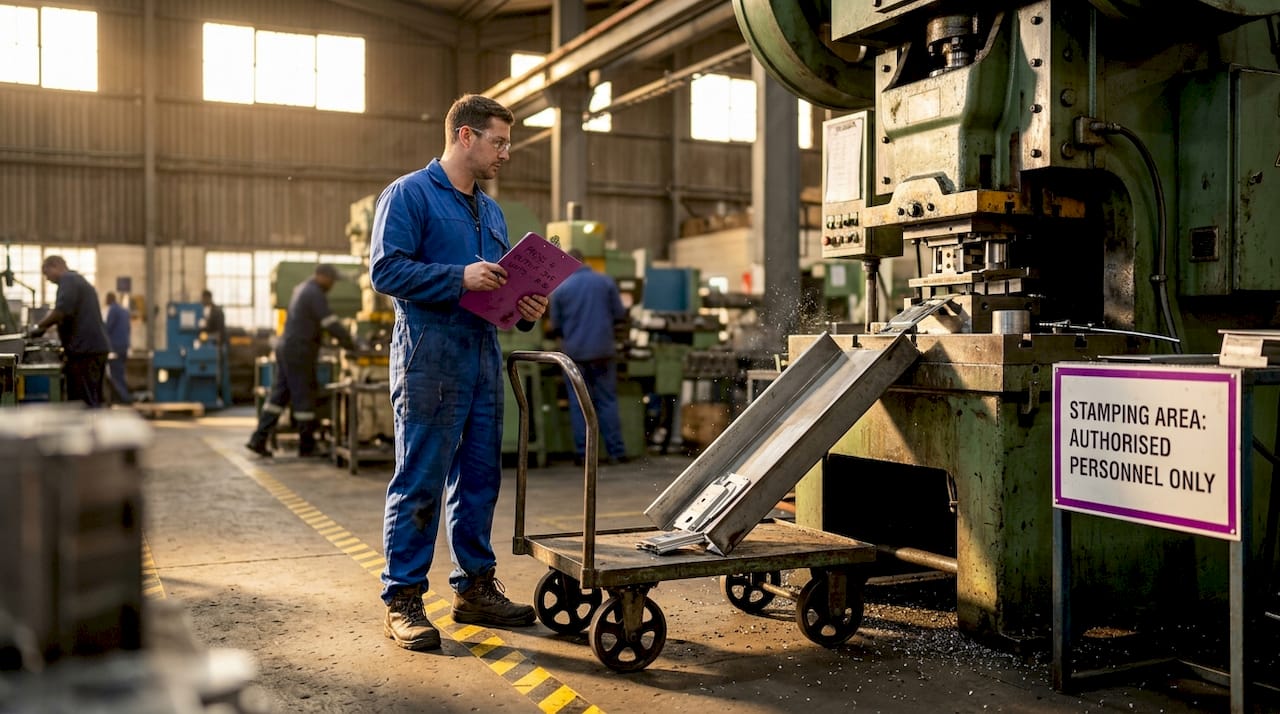
Metal stamping is a cold-forming process that uses precision dies and hydraulic or mechanical presses to cut, bend, and shape sheet metal into parts. The process is built for high-volume production because its repeatability is embedded in the physics of tooling and press operation. Once a die set is installed and the press is calibrated, every stroke produces a dimensionally identical part.
The most sophisticated form is progressive stamping. Here is how it works:
- A continuous strip of sheet metal feeds into the press on a carrier strip.
- The strip passes through a series of sequential die stations, each performing one specific operation, such as piercing, forming, or trimming.
- With each press stroke, the strip advances to the next station.
- A finished part is produced with every single stroke of the press.
This sequential, continuous process is where repetitive stamping in manufacturing reaches its highest efficiency. Progressive stamping tooling uses heat-treated steel die components requiring exact timing and tolerances, enabling presses to run at hundreds of strokes per minute with uniform output. The upfront tooling investment is significant, but the per-part cost drops sharply at volume.
Beyond forming metal parts, repetitive stamping also refers to industrial marking. Automated stamping machines apply logos, serial numbers, and part codes onto products repetitively. These devices are often integrated with CNC systems or robotic arms on production lines, marking thousands of components per shift without manual input.
| Aspect | Progressive stamping | Industrial marking stamping |
|---|---|---|
| Primary purpose | Part forming from sheet metal | Applying text or codes to surfaces |
| Tooling type | Multi-station die set | Mechanical or pneumatic stamp head |
| Automation level | Fully automated | Semi or fully automated |
| Output speed | Hundreds of parts per minute | Hundreds of marks per minute |
| Upfront cost | High tooling investment | Moderate to high |
Crafting vs industrial stamping: key differences
The two versions of repetitive stamping share a name and a concept, but the scale, tooling complexity, and materials involved place them in entirely separate categories. Understanding where they differ helps you choose the right approach for your purpose.
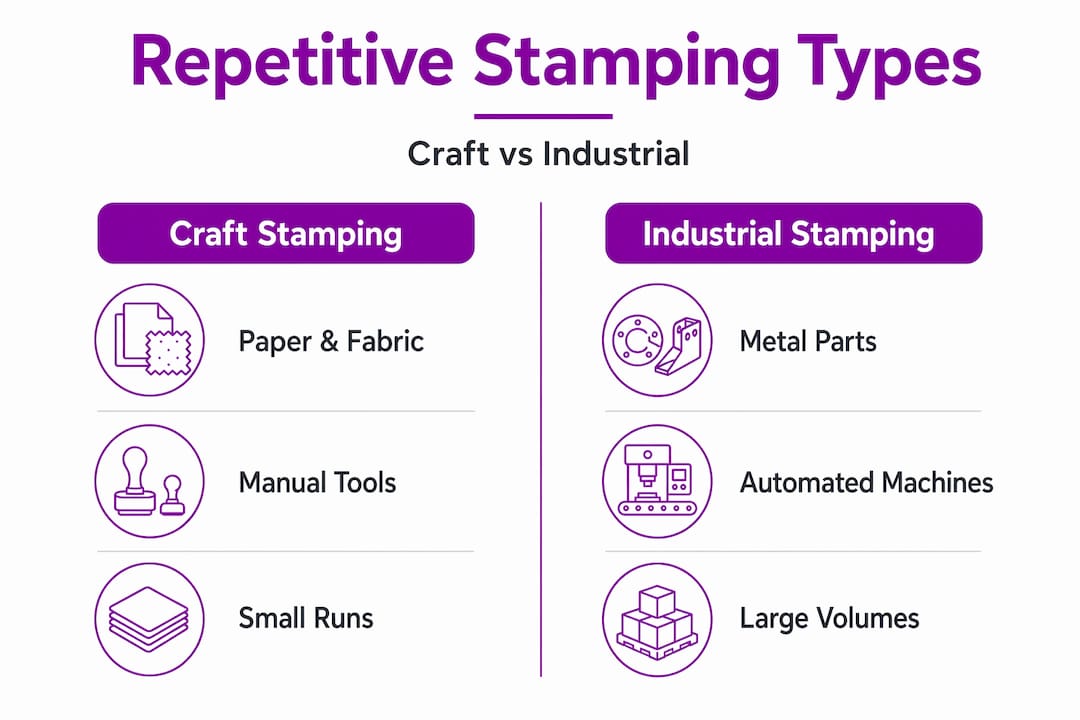
| Factor | Craft and branding stamping | Industrial metal stamping |
|---|---|---|
| Scale | Small runs to a few hundred | Thousands to millions of parts |
| Tooling | Self-inking stamp, positioner tool | Progressive die sets, stamping presses |
| Materials | Paper, card, fabric, light packaging | Sheet metal, aluminium, steel |
| Repeatability mechanism | Internal re-inking mechanism | Precision die and press calibration |
| Cost to start | Low (£20 to £200 for stamps) | High (tooling costs can reach thousands) |
| Skill required | Minimal with right tools | Significant technical expertise |
The most common source of confusion is that both processes are described using the same language. “Repeatability” in crafting means the stamp re-inks cleanly and lands consistently. In manufacturing, repeatability means every pressed part meets dimensional tolerances within fractions of a millimetre.
For individuals and small businesses, the crafting and branding version of repetitive stamping is the relevant one. It is accessible, affordable, and produces professional results with the right tools. The types of rubber stamps available for repeat use cover everything from simple logo marks to multi-line text blocks.
Practical tips for effective repetitive stamping
Whether you are stamping loyalty cards, branded packaging, or decorative patterns, the repetitive stamping techniques that produce reliable results are the same. Here is a practical process you can follow.
Getting set up correctly:
- Choose a self-inking stamp with a die plate sized to your design. Larger die plates need more even pressure to produce a clean impression.
- If you need precise spacing, use a stamp positioner tool. Peg-guided positioning eliminates the need for measuring and marking before each impression.
- Work on a firm, flat surface. Soft or uneven surfaces cause blurred edges on repeated impressions.
- Test your ink saturation before committing to your final material. Three test presses on scrap paper will tell you if the ink pad needs refreshing.
Maintaining quality through the run:
- Re-ink your stamp pad after every 200 to 300 impressions, or when you notice the impression becoming lighter or patchy.
- Apply even downward pressure. Rocking the stamp side to side during application is a leading cause of blurred edges.
- If you are stamping fabric, use a fabric-specific ink formulation. Standard dye inks do not bond to fabric fibres and will fade quickly.
Pro Tip: For repetitive branding on packaging, consider a multi-line self-inking stamp that combines your logo and address in a single impression. This cuts stamping time in half compared to using two separate stamps and keeps alignment consistent across every package.
Troubleshooting common problems:
Smudging usually means too much ink, too soft a surface, or the material moving between impression and lift. Misalignment in a series most often comes from not using a positioner guide or from a worn peg on the positioner tool. If impressions are uneven in density, the ink pad is running low or the die plate is partially blocked with dried ink. A soft, damp cloth applied gently to the die face resolves most residue build-up.
For promotional and creative applications, stamp imprint ideas offer practical inspiration for getting more value from your repetitive stamping setup.
You can also explore what a stamping machine does if you are considering moving from hand stamping to a semi-automated setup for higher-volume work.
My honest experience with repetitive stamping
I have worked with stamping tools across both craft and business contexts, and the biggest mistake I see consistently is treating repetitive stamping as self-explanatory. People assume that because the tool is simple, no preparation is needed.
In my experience, the preparation stage accounts for about 80% of the quality difference between a professional-looking result and an inconsistent one. Ink saturation, surface firmness, and alignment setup are the three variables that determine whether your hundredth impression looks as clean as your first.
What genuinely surprised me is how much consistency you lose when you skip the test impressions. I once watched a business owner stamp 150 mailer envelopes without testing first. The first 30 looked fine. By impression 50, the ink was running thin. By impression 90, the impressions were barely legible. Everything had to be redone. Three test presses would have caught it.
The industrial side of repetitive stamping taught me something different: the investment in tooling precision pays for itself many times over in reduced waste and rework. The principle translates directly to craft stamping. A well-maintained, properly set up self-inking stamp with a positioner tool is not an indulgence. It is the mechanism that makes the process worth doing.
The creative and the precise are not opposites in repetitive stamping. Balancing them is what produces work that holds up across a long run.
— Steven
Stamping tools for every repeat application
If you are ready to put repetitive stamping techniques to practical use, Stampdesign4u offers a range of purpose-built tools for business branding and creative projects.
The Trodat 4927 9-line logo stamp is built for exactly this kind of repeat use, combining logo and text in a self-inking format across a 60 x 40mm die plate. For loyalty programmes and promotional runs, the Traxx 9021 loyalty stamp delivers clean, consistent marks at speed. Both products are available with custom designs tailored to your brand. The Stampdesign4u team is available to help you select the right stamp for your specific volume and application needs.
FAQ
What is repetitive stamping?
Repetitive stamping is the process of applying the same stamp impression multiple times to produce consistent, identical results. It applies to both craft and business stamping with hand tools and to high-volume industrial metal forming using dies and presses.
How does a self-inking stamp enable repetition?
A self-inking stamp contains a rotating die plate that automatically re-inks against an internal pad after each impression, removing the need for a separate ink pad and keeping the workflow continuous.
What industries use repetitive stamping?
Repetitive stamping is used in metal manufacturing, automotive parts production, electronics, packaging, and promotional branding. Small businesses and crafters also rely on it for logos, loyalty cards, and pattern work.
What is the difference between craft and industrial repetitive stamping?
Craft stamping uses self-inking stamps and positioner tools on paper or fabric for small runs. Industrial stamping uses precision die sets and mechanical presses to form or mark metal parts at high volume, often with fully automated systems.
How do I stop smudging in repetitive stamping?
Apply even downward pressure without rocking the stamp, work on a firm flat surface, and check ink saturation regularly. Blurred edges most commonly come from movement between impression and lift.
Recommended
- Enhance your branding with custom stamps: a practical guide – Stamp Design 4U
- Stamp branding consistency: build trust and boost revenue – Stamp Design 4U
- Step-by-step guide to making personalised signature stamps – Stamp Design 4U
- Stamp layout guide for better branding and customisation – Stamp Design 4U