

A company seal, also called a common seal, is a physical rubber or embossed stamp businesses use to imprint their name, logo or registration details onto paperwork, mail and certificates. It works as an official mark of authenticity and consistent branding rather than a legal signature. Suppliers like Stamp Design 4U produce these in rubber, self-inking and embossed formats to suit different office volumes and document types.
TL;DR:
- Choosing the correct stamp type depends on volume: self-inking for daily office use, pre-inked for high-detail logos, and traditional rubber for occasional low-volume stamping.
- Proper preparation involves using vector artwork with high contrast and appropriate size, and reviewing proofs thoroughly before ordering.
- Rectangular stamps suit longer lines of text, while round seals are better for certificates and ceremonial documents, with size depending on content length.
- Most small businesses use seals mainly for branding and authenticity, not for legal purposes, unless specified in their articles of association or for official deeds.
- Proper application requires documented authority and a formal process for official use, while routine stamping involves simple pressing without legal formalities.
Table of Contents
- What is common seal in company law: stamp types and when to use each
- What information goes on a company or common seal
- Size, shape and design: rectangular vs round stamps
- How to choose and order a company seal step by step
- Ink, maintenance and longevity of a company stamp
- Legal significance and purpose of the common seal in company law
- Statutory requirements and regulations governing common seal use
- When a common seal is required and when it isn’t
- Common seal versus electronic and digital signatures
- Disputes and cases involving common seal use
- How to properly affix a common seal during official actions
- Why most stamp orders go wrong (and how to fix them)
- Ordering your seal: proofs, formats and support from Stamp Design 4U
- Sources
What is common seal in company law: stamp types and when to use each
Choosing the right physical format matters more than most buyers expect, because impression quality and daily workload pull in different directions. A traditional rubber stamp uses a separate ink pad and gives sharp, dark impressions, but you re-ink it by hand each time, which slows things down on high-volume desks.
Self-inking stamps hold the pad inside the mechanism, so one press delivers a clean mark every time without touching a pad. They’re built for offices stamping dozens of envelopes, invoices or delivery notes daily, and professional buying guides consistently recommend them for that reason.
Pre-inked stamps store ink inside the die itself, producing the finest detail of the three, which makes them the pick for logos, certificates and anything where impression quality outranks stamping speed. They cost more upfront and the die eventually needs replacing rather than simple re-inking.
An embosser presses a raised, inkless impression into paper. It carries genuine ceremonial weight on certificates and formal documents but can’t be used on carbon mail or anything needing a visible ink mark.
- Traditional rubber: cheapest option, needs a separate pad, best for occasional low-volume use
- Self-inking: fastest for daily office work, moderate cost, pad wears out and needs swapping
- Pre-inked: sharpest detail, ideal for logos and certificates, higher initial cost
- Embosser: formal and permanent, no ink required, limited to paper-only documents
What information goes on a company or common seal
Getting the wording right the first time saves a reorder. Follow this sequence when preparing your details:
- Start with the exact registered company name, spelt and punctuated precisely as it appears on official incorporation documents. Guides on choosing a company stamp flag this as the single most common source of ordering errors.
- Add the company registration number if the stamp will appear on invoices, contracts or formal correspondence. It links the impression back to your official records and reassures anyone checking your credentials.
- Include the registered office address or a contact line only where space allows. It’s optional but useful on stamps meant for outgoing mail or supplier paperwork.
- Decide on your logo treatment. Keep it simple. Fine gradients and thin outlines compress and blur once pressed into paper, so a bold, single-colour version of your logo will always outperform a detailed original at stamp scale.
- Prepare artwork as a vector file (EPS, AI or high-resolution PDF) rather than a raster image. Vector art scales cleanly to any stamp size without pixelation, which matters because your design team will resize your logo to fit the die.
- Check contrast before submitting. Dark, solid shapes photocopy and scan far better than light or intricate patterns.
Businesses ordering personalised logo stamps should read our layout guide for effective branding before submitting final artwork.
Size, shape and design: rectangular vs round stamps
Shape says something before a single word is read. Rectangular stamps suit multi-line content: a company name, registration number and address block sit naturally in horizontal rows, and standard dimensions such as 60 x 40mm handle nine or more lines of text comfortably. That’s the format behind stamps like the Trodat 4927, built specifically for logo-and-text combinations of that size.

Round stamps carry more formality. A circular seal reads as traditional and official, which is why they turn up on certificates, membership cards and documents meant to look ceremonial rather than administrative. The trade off is line capacity. Curved text around a circle’s edge limits how much you can fit before it becomes unreadable.
Line length should dictate your dimensions, not the reverse. A single company name might sit comfortably on a 38mm round die, while a full address block with a registration number typically needs the extra width a rectangular 60 x 40mm or larger die provides.
A few practical rules keep any layout legible:
- Never drop below roughly 6 point equivalent text height on a physical die; anything smaller blurs on impression
- Leave white space around the border rather than running text to the edge
- Choose a clean sans-serif font over decorative scripts, which lose definition when pressed
- Keep borders thin and simple so they don’t compete with the text inside
Pro Tip: *If your design looks cramped on screen at
zoom, it will look worse once pressed into paper. Add breathing room before you submit the file, not after the proof comes back.*
How to choose and order a company seal step by step
Ordering doesn’t need to be complicated, but skipping a step is exactly how the wrong stamp ends up on your desk.
- Decide your primary use and daily volume. A stamp for occasional certificate signing has very different needs to one stamping fifty envelopes a day.
- Pick your stamp type and size using the guidance above. Match format to volume, and match dimensions to your line count.
- Prepare your text and artwork as a vector file, checking spelling, registration numbers and logo contrast before you submit anything.
- Review your digital proof carefully. Reputable suppliers send a proof before production. Check every line for typos and confirm the layout fits the die comfortably.
- Choose your ink colour and refill type, factoring in turnaround time and whether you need bulk or bespoke pricing for multiple branches.
- Store your approved proof and stamp details once delivery arrives, so future reorders or replacements match exactly.
| Step | What to confirm | Common mistake to avoid |
|---|---|---|
| Use and volume | Daily stamping frequency | Choosing traditional rubber for high-volume desks |
| Type and size | Format matches document type | Picking round stamps for long address blocks |
| Artwork | Vector file, high contrast | Submitting a detailed, multi-colour logo |
| Proof review | Every line checked against records | Approving without checking registration number |
| Ink and turnaround | Colour and refill compatibility | Assuming all refill inks are interchangeable |
| Record keeping | Proof and specs filed safely | Losing die details before a reorder |
Ink, maintenance and longevity of a company stamp
Corporate documents call for black or dark blue quick-drying inks because they resist smudging and hold their definition through a photocopier or scanner, a point buying guides raise consistently. Brighter colours look informal and can distort on low-quality copies.
Refill compatibility trips up more buyers than you’d think. Manufacturers warn against mixing ink types between self-inking and pre-inked mechanisms, because the wrong formula can degrade the pad or die over time.
- Use only the ink type specified by your stamp’s manufacturer, never a generic substitute
- Wipe the die gently with a damp cloth after heavy use to prevent buildup
- Store stamps upright, away from direct heat, to stop the pad drying out
- Expect to refill or replace the pad every few months under daily office use, and the die itself far less often
Choosing pre-inked stamps can extend the interval between visible ink refills, since the reservoir sits inside the die rather than a separate pad.
Legal significance and purpose of the common seal in company law
A physical seal’s legal weight has shrunk substantially in most jurisdictions over recent decades, but that doesn’t make it pointless. Historically, affixing a company seal to a document was treated as evidence that the company itself, not just an individual signatory, had authorised the action. Many company constitutions and older articles of association still reference a seal as a formal method of execution for deeds, share certificates and certain contracts.
In practice today, a seal functions less as a legal requirement and more as a mark of authenticity and professionalism. It tells a recipient, at a glance, that a document originated from a genuine, registered business rather than an informal source. That’s precisely why small businesses, charities and clubs still order custom stamps carrying their registered name and number even where no statute demands it.
The purpose has shifted from strict legal necessity toward branding, administrative clarity and internal control. A stamped invoice or delivery note looks more credible to a supplier or customer, and a consistent seal design across paperwork reinforces brand recognition every time it’s used. For membership organisations, a seal on certificates still carries genuine ceremonial value, even where no external authority insists on it.
Statutory requirements and regulations governing common seal use
Requirements around seals vary considerably by jurisdiction and by organisation type, and this is where sweeping generalisations cause the most confusion. Some jurisdictions have historically mandated that companies hold a seal and use it for specific transactions, such as executing deeds. Many of those requirements have since been relaxed or removed entirely, with alternative execution methods, such as signatures from two directors, now accepted in their place.
Where a seal remains referenced in a company’s own articles of association or constitution, that internal document governs how and when it must be used, regardless of what wider statute says. This means two companies operating in the same jurisdiction can have entirely different obligations depending on what their own founding documents specify.
Membership bodies, professional associations and charities often retain more formal seal requirements than standard private companies, particularly where certificates or membership documents need a recognisable mark of authenticity. Anyone unsure whether their organisation is bound by a statutory or constitutional seal requirement should check their own articles or governing documents directly, or seek advice from a qualified professional, rather than assume a generic rule applies. For most small businesses ordering a seal today, the driver is administrative and branding value rather than a specific legal obligation.
When a common seal is required and when it isn’t
Few areas cause more uncertainty than knowing whether a seal is genuinely necessary for a given transaction. Some formal legal instruments, particularly certain deeds and property transactions in specific jurisdictions, have historically required sealing as part of valid execution. Whether that still applies depends entirely on local law and the type of document involved.
For the overwhelming majority of everyday business activity, a seal isn’t required at all. Everyday invoices, delivery notes, general correspondence and most contracts execute perfectly validly with an authorised signature alone. A stamp on these documents adds branding consistency and a professional finish rather than legal force.
Situations where organisations most commonly still choose to use a seal include:
- Certificates issued by membership bodies, clubs or professional associations
- Formal share certificates in companies that retain a traditional constitution
- Documents where an organisation’s own articles specifically mandate sealing
- Ceremonial or ratifying acts where visible authentication reinforces trust
Outside of those cases, the decision to use a stamped seal on general paperwork is a business choice, not a legal one. That distinction is worth sitting with, because it explains why so many small businesses order a seal purely for consistency and presentation, while larger corporations with formal governance structures may retain sealing procedures written into their constitution.
Common seal versus electronic and digital signatures
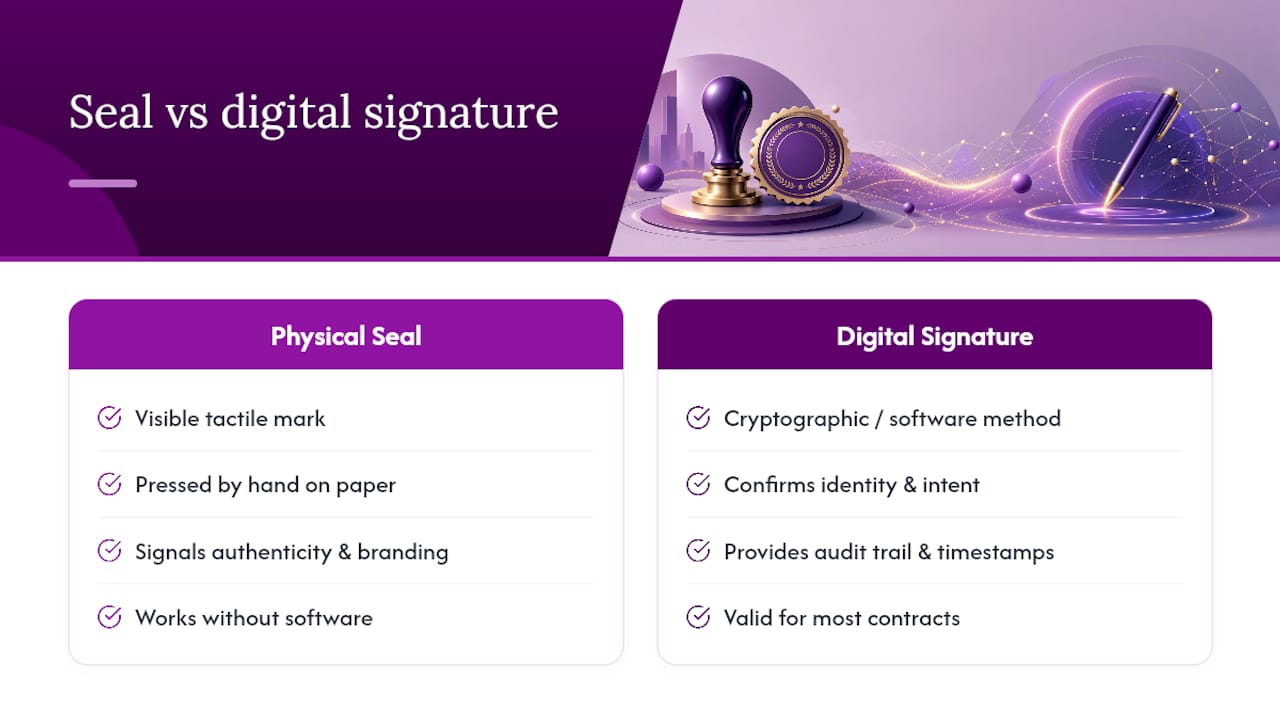
Physical seals and electronic signatures solve overlapping but distinct problems, and conflating them causes real confusion for buyers. A physical seal is a visible, tangible mark, pressed by hand onto paper, that signals authenticity and brand consistency at the point of viewing. An electronic or digital signature, by contrast, is a cryptographic or software-based method of confirming a signatory’s identity and intent on a digital document, typically carrying an audit trail behind the scenes.
Legally, most jurisdictions now treat electronic signatures as valid for the vast majority of contracts, and many businesses have shifted entirely digital workflows away from any physical mark whatsoever. Digital signature platforms offer verification, timestamps and tamper detection that a rubber stamp simply cannot replicate.
Where physical seals retain an advantage is in immediate, visual recognisability on paper documents, mail and printed certificates. A stamped envelope, a sealed certificate, or a branded delivery note communicates identity instantly to a human reader without any software or verification step. For businesses that still handle meaningful volumes of physical paperwork, mail or printed materials, a stamp remains genuinely useful precisely because it works without a screen.
The two aren’t really competitors. A growing number of businesses use both: digital signatures for contracts and formal agreements, and a physical stamp for everyday branding, mail and administrative paperwork where a screen-based signature would be overkill.
Disputes and cases involving common seal use
Historical disputes over company seals have generally centred on one core question: did the person affixing the seal have actual authority to bind the company at that moment? Courts in various jurisdictions have had to determine whether a sealed document was validly executed when the individual applying the seal lacked proper authorisation from the board or the company’s own constitution.
These cases matter less for the everyday branding stamps most small businesses order today, and far more for companies still using a seal in a formal, constitutional sense to execute deeds or binding agreements. The consistent thread across such disputes is that a seal alone, without evidence of proper internal authorisation, has rarely been treated as sufficient to make a document binding. Courts have tended to look behind the mark itself at the process that led to it being applied.
The practical lesson for a modern small business or membership organisation isn’t really about litigation risk. It’s about internal consistency. Anyone using a seal for genuinely formal purposes, share certificates or governance documents, for instance, should have a documented internal procedure covering who holds the seal, who authorises its use, and how that use gets recorded. For a business simply stamping invoices and mail with a branded logo, none of this historical case law carries meaningful weight, because no binding legal act depends on the impression itself.
How to properly affix a common seal during official actions
Where an organisation genuinely uses a seal for formal purposes, such as executing a deed or authenticating a certificate, a consistent affixing procedure protects everyone involved. Start by confirming that the person applying the seal has documented authority to do so, whether that comes from board minutes, the articles of association, or a specific resolution for the transaction at hand.
Most formal procedures require at least one authorised signatory, often a director or company secretary, to witness or countersign alongside the seal impression. This creates a paper trail showing the seal was applied with proper oversight rather than unilaterally.
Position the seal clearly on the document, typically near the signature block, and ensure the impression is fully legible; a smudged or partial mark can raise questions later about whether the seal was validly applied. Log the transaction, keeping a simple register noting the date, document type and authorising signatory whenever the seal is used for anything beyond routine branding.
For day-to-day stamping, invoices, packaging or general mail, none of this formality applies. A branded logo stamp from a collection like personalised packaging stamps simply gets pressed onto the document as needed, with no register or authorisation chain required, because no legal act depends on the mark.
Why most stamp orders go wrong (and how to fix them)
The single most common mistake we see is text sized for a screen rather than a die. A logo that looks crisp at 100% zoom often turns into a smudged blob once compressed onto rubber, particularly with fine gradients or thin serif fonts.
One client submitted a nine-line address stamp crammed onto a 30mm round die. The fix was simple: switch to a 60 x 40mm rectangular layout, drop the font size slightly, and add margin around the border. The reprint was instantly more legible, and it cost nothing beyond the initial reorder that better planning would have avoided.
The fastest way to speed up approval is submitting a bold, mono version of your logo from the outset, rather than the full-colour original. Design teams strip detail anyway; sending it simplified saves a proofing round.
— Steven
Ordering your seal: proofs, formats and support from Stamp Design 4U
Stamp Design 4U gets your stamp right on the first proof, not the third, by combining ready-made formats with genuine design input rather than leaving you to guess at sizing alone.
For businesses needing a straightforward text-and-logo combination, the Trodat 4927 9 Line Logo and Text Rubber Stamp 60 x 40mm handles a full company name, registration number and address block without crowding. If your priority is branding rather than administrative text, the personalised logo stamps collection covers everything from simple wordmarks to fuller logo treatments, with bulk and wholesale pricing available for organisations ordering across multiple departments or branches.
Every order goes through a digital proof before production, so you catch a misspelt registration number or an oversized logo before it’s pressed into rubber, not after. International delivery is available for businesses ordering outside the UK. Browse the personalised stamps collection or contact the Stamp Design 4U team directly to request a proof for your own layout today.