

TL;DR:
- A horizontal stamp features a landscape layout with design, text, and imagery wider than tall, primarily used in business and postal applications. Its fixed orientation during manufacture affects impression quality and cannot be rotated or reconfigured after production. Proper measurement of the stamping area before ordering ensures the correct orientation and prevents costly errors.
A horizontal stamp is defined as a stamp whose design, text, and imagery are arranged in a landscape orientation, with the content extending wider than it is tall. This layout is the standard format for many business and postal stamps, and it directly influences how the stamp performs in use. The orientation is not merely aesthetic. It affects the internal mechanics of self-inking stamps, the quality of the impression, and how well the design fits the available space on a document or envelope. Understanding the horizontal stamping definition helps businesses and individuals order the right tool from the outset and avoid costly re-orders.
What is a horizontal stamp and how does it work?
A horizontal stamp produces an imprint where the width of the design is greater than its height, placing text and graphics in a landscape format. This is the most common orientation for office rubber stamps, address stamps, and business logo stamps. The landscape layout gives designers more room to arrange multiple lines of text alongside a logo without crowding the composition.
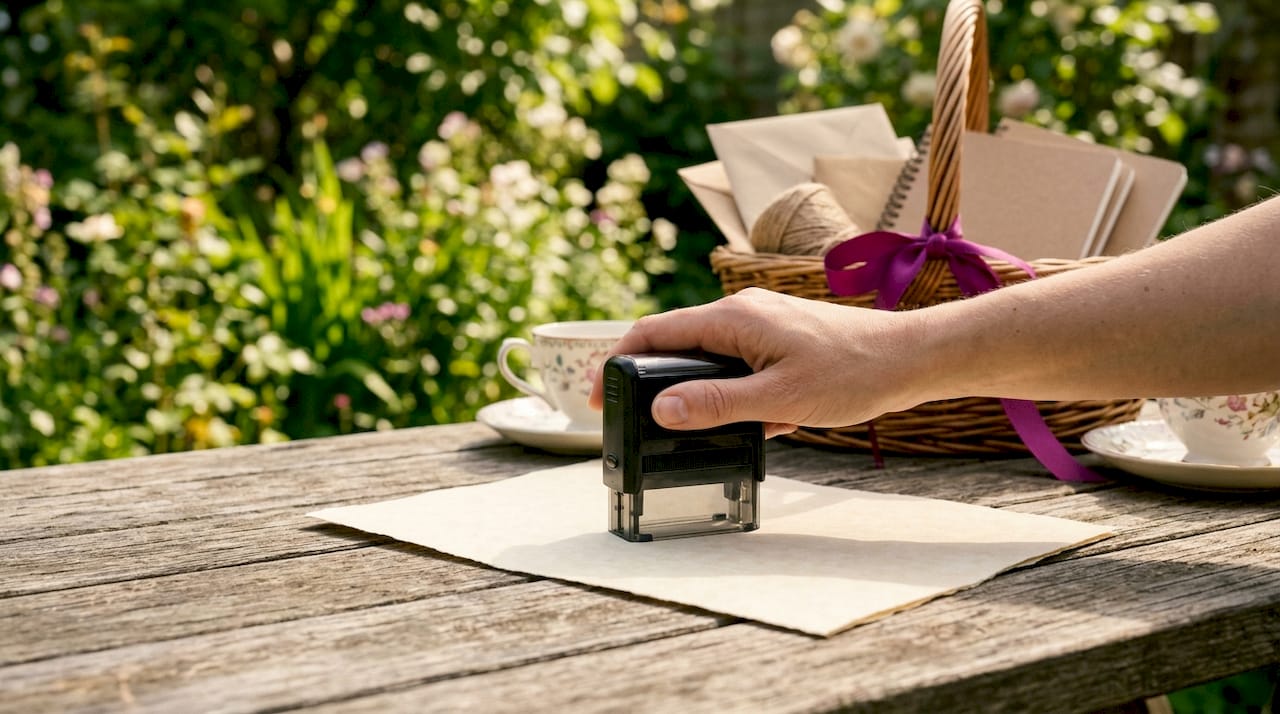
The mechanics of a self-inking stamp are built around its orientation from the point of manufacture. The internal spring, ink pad, and rubber die are all calibrated to work in one fixed direction. Rotating a horizontal stamp 90° does not convert it into a vertical stamp. It causes uneven pressure distribution across the die, which produces a blurred or incomplete impression. The orientation is set during production and cannot be changed after manufacture.
Postal design standards have long favoured horizontal layouts because they offer more surface area for detailed imagery and text. Modern UK postage stamps, for example, use horizontal orientation to accommodate barcodes that postal scanning systems read efficiently. That same logic applies to office stamps: a wider format fits more information cleanly.
How does a horizontal stamp differ from a vertical stamp?
The core difference between horizontal and vertical stamps is orientation, but that single difference has practical consequences for design, mechanics, and usability.
A horizontal stamp suits wide, landscape-format spaces on documents, envelopes, and packaging. A vertical stamp suits narrow, portrait-format spaces, such as the margin of a form or a tall label. Choosing the wrong orientation for the available space produces a mark that either overhangs the designated area or leaves awkward gaps.
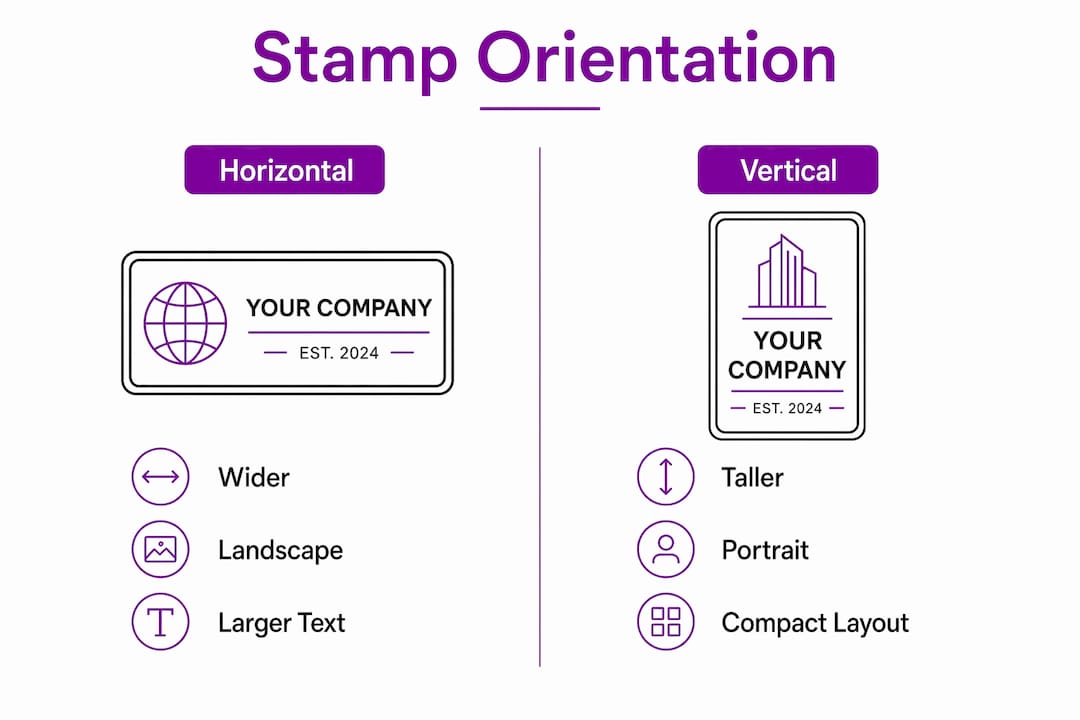
The table below summarises the key differences:
| Feature | Horizontal stamp | Vertical stamp |
|---|---|---|
| Layout | Wider than tall (landscape) | Taller than wide (portrait) |
| Best use | Envelopes, wide document fields | Narrow margins, tall labels |
| Ink distribution | Even across wide die | Even across tall die |
| Logo placement | Ideal for side-by-side text and logo | Better for stacked text and logo |
| Rotation risk | Cannot rotate to vertical without quality loss | Cannot rotate to horizontal without quality loss |
Self-inking stamp mechanics require orientation selection before production to deliver even pressure and a quality impression. This means the decision between horizontal and vertical must be made at the design stage, not after the stamp arrives.
Pro Tip: Measure the stamping area on your document before ordering. If the space is wider than it is tall, choose a horizontal stamp. If it is taller than it is wide, choose a vertical stamp.
What are the common applications and benefits of horizontal stamping?
Horizontal stamps are the preferred format for most business stamping tasks. Their wider format accommodates more design elements without sacrificing legibility.
The most common applications include:
- Business address stamps. A company name, street address, city, and postcode fit naturally across a horizontal layout without requiring a very small font size.
- Logo stamps. Logos that are wider than they are tall, which describes the majority of business logos, reproduce clearly in a horizontal format.
- Official approval marks. Stamps reading “Received,” “Approved,” or “Paid” are typically set in a horizontal rectangle that fits neatly into form fields.
- Packaging stamps. Boxes and mailer bags have flat, wide surfaces that suit a horizontal imprint for branding or return address details.
- High-volume document processing. Professionals stamping more than 50 documents daily benefit from horizontal self-inking stamps because the consistent mechanics deliver reliable quality at speed.
The benefits of horizontal stamping go beyond aesthetics. A wider imprint area means text can be set at a larger point size, which improves legibility on photocopies and scanned documents. Horizontal stamp layouts also offer more space for detailed designs, making them practical for stamps that combine a logo with multiple lines of contact information.
Pro Tip: If your stamp design includes a logo and three or more lines of text, a horizontal format will almost always produce a cleaner, more readable result than a vertical one.
Consistent stamp use also supports professional branding. A well-placed horizontal stamp on every outgoing envelope or invoice reinforces brand identity without additional effort. Stampdesign4u offers a range of custom logo stamps built for exactly this purpose.
How to choose and use a horizontal stamp effectively
Selecting the right horizontal stamp requires a clear assessment of three things: the available stamping area, the design content, and the volume of use.
-
Measure the stamping area first. Place a ruler over the space on your document or envelope where the stamp will land. If the width exceeds the height, a horizontal stamp is the correct choice. Design experts advise assessing the “throat” space, which is the clear area available for the stamp mark, before placing any order.
-
Confirm your design orientation matches the stamp orientation. A logo or text block that is wider than it is tall belongs in a horizontal stamp. Submit your artwork in the correct orientation to the manufacturer. Sending a portrait-format design for a horizontal stamp forces the manufacturer to rescale or reposition elements, which often reduces quality.
-
Apply even, consistent pressure when stamping. Press the stamp straight down without rocking it side to side. Rocking shifts the die mid-impression and produces a mark that is darker on one edge than the other. This is a particular risk with wider horizontal dies because the greater surface area amplifies any pressure imbalance.
-
Never rotate a horizontal stamp to use it vertically. The rubber die’s alignment is laser-engraved to match the horizontal layout. Rotating the stamp 90° physically impairs the cushioning and spring-loading mechanism, producing an uneven, illegible impression.
-
Re-ink before quality drops, not after. Self-inking stamps carry a finite ink supply. Check impression quality every 20–30 uses in high-volume settings. Fading at the edges of a horizontal stamp is the first sign that re-inking is needed.
Following a custom stamp design workflow from design to final order reduces the risk of orientation errors and wasted expenditure.
What confusion exists around “horizontal stamping” in different industries?
The phrase “horizontal stamping” means different things depending on the industry, and this causes genuine procurement errors.
In the document and postal context, a horizontal stamp refers to the orientation of the design on a rubber or self-inking stamp. The word “horizontal” describes the layout of the imprint.
In manufacturing, the term “horizontal” in metal stamping refers to the axis and feed direction of a press machine, not the orientation of a printed mark. Horizontal de-coilers and horizontal press configurations are industrial tools that shape metal components. They share the word “horizontal” with document stamps but have no functional relationship to them.
The confusion matters most in two situations:
- Procurement teams searching online for “horizontal stamping” may find industrial machinery results when they need office stamps, or vice versa.
- Suppliers in mixed-industry catalogues may list both product types under similar terminology, leading to incorrect orders.
The clearest way to avoid this confusion is to specify the full product description when ordering. Use terms such as “horizontal self-inking rubber stamp” or “landscape-format document stamp” rather than “horizontal stamp” alone. This removes ambiguity and ensures the supplier understands the application.
Key takeaways
A horizontal stamp is defined by its landscape orientation, and that orientation determines its mechanics, its best applications, and the quality of every impression it produces.
| Point | Details |
|---|---|
| Orientation is fixed at manufacture | You cannot rotate a horizontal stamp to use it vertically without damaging impression quality. |
| Horizontal suits wide design content | Logos, multi-line addresses, and wide approval marks all reproduce more clearly in a horizontal format. |
| Measure before ordering | Assess the available stamping area on your document to confirm the correct orientation before placing an order. |
| High-volume use favours horizontal | Self-inking horizontal stamps deliver consistent results for offices processing large numbers of documents daily. |
| Terminology varies by industry | “Horizontal stamping” means orientation in document contexts and machine axis in metal manufacturing. Specify clearly when ordering. |
Why orientation is the detail most businesses overlook
Stamp orientation is the kind of decision that feels trivial until it goes wrong. I have seen businesses order a batch of self-inking stamps, receive them, and only then realise the design sits portrait on a landscape form field. The stamp does not fit the space. The impression looks cramped. The entire order goes to waste.
The ordering errors caused by overlooked orientation are almost always avoidable. The fix is simple: look at the document before you look at stamp options. The document tells you everything. If the space is wide, you need a horizontal stamp. If it is tall, you need a vertical one. No amount of good design rescues a stamp that physically does not fit the space it is meant to fill.
What I find most telling is that historical postal design arrived at horizontal orientation through practical necessity, not convention. Wider stamps carry more information, scan more reliably, and sit more naturally on the surfaces we write and print on. That logic has not changed. Businesses that take orientation seriously from the start produce stamps that look professional every single time they are used. Those that treat it as an afterthought spend money correcting avoidable mistakes. Consult a specialist before finalising any custom stamp order. The conversation takes five minutes and saves considerably more than that in wasted stock.
— Steven
Horizontal stamp options from Stampdesign4u
Stampdesign4u stocks a range of horizontal self-inking stamps built for business and personal use, including models that combine logos with up to nine lines of text.
The Trodat Printy 4927 is a 60 x 40mm horizontal self-inking stamp that handles logos alongside multiple lines of contact or approval text. It is a practical choice for offices that stamp documents daily and need consistent, clean results. For broader requirements, the full range of personalised rubber stamps at Stampdesign4u covers address stamps, logo stamps, and packaging stamps in horizontal formats, with design support available to help you get the orientation and layout right before production.
FAQ
What is the horizontal stamping definition?
A horizontal stamp is a stamp whose design is arranged in landscape orientation, with the width greater than the height. The term describes the layout of the imprint rather than any specific stamping technique.
Can I use a horizontal stamp in a vertical position?
Rotating a horizontal self-inking stamp 90° causes uneven pressure and a poor-quality impression. The internal mechanics and rubber die are fixed to the horizontal orientation during manufacture and cannot be safely reoriented.
What types of horizontal stamps are available?
Common types include self-inking horizontal stamps, pre-inked horizontal stamps, and traditional rubber horizontal stamps mounted on a wooden or acrylic handle. Self-inking models are the most popular for high-volume office use.
How do I know if my design suits a horizontal stamp?
If your design, logo, or text block is wider than it is tall, a horizontal stamp is the correct format. Measure the available space on your document and match the stamp orientation to that space before ordering.
Is “horizontal stamping” the same in all industries?
No. In document and postal contexts, horizontal stamping refers to landscape-format rubber or self-inking stamps. In metal manufacturing, the term describes machine axis and feed direction in press operations. Always specify the full product description when ordering to avoid confusion.