

TL;DR:
- Custom stamping is shifting towards sustainable materials, digital customization, and expanded marketing uses in 2025. These trends boost branding, reduce errors, and meet regulatory demands for verifiable eco-friendly practices. Small businesses benefit from cost-effective, versatile stamps applied across packaging, loyalty, and seasonal campaigns.
Custom stamping is defined as the production of personalised impression tools used to apply logos, text, or decorative marks to physical surfaces for branding, authentication, or creative purposes. The trends in custom stamping 2025 centre on three forces: sustainability compliance, digital customisation, and expanded marketing applications. The global custom self-inking stamp market was valued at USD 0.2 billion in 2024 and is projected to reach USD 0.33 billion by 2033, growing at approximately 5.0% CAGR. That growth reflects a broader shift: businesses and creative professionals are treating custom stamps not as administrative tools but as front-line branding assets. Stampdesign4u sits at the centre of this shift, offering personalised stamp solutions that align with each of these emerging directions.
What are the key trends in custom stamping 2025?
Sustainability, digital integration, and creative marketing use are the three defining forces reshaping the custom stamping industry this year. Each trend builds on the others. Eco-friendly materials require digital supply chain documentation. Digital tools make personalised design faster and more accurate. And new marketing applications give both small businesses and large brands a reason to invest more in physical stamping.

The industry is also responding to regulatory pressure. UK and EU procurement teams now require verifiable environmental credentials from suppliers, which means stamp manufacturers must adapt their materials and documentation practices. Businesses that understand these shifts gain a real advantage when selecting stamping partners and products.
How is sustainability shaping custom stamping in 2025?
Sustainability is now a procurement requirement, not a preference. UK corporate buyers increasingly demand that FSC-certified wood and recycled plastics form the basis of any stamp product entering their supply chain. FSC certification confirms that timber comes from responsibly managed forests. Recycled plastics reduce the carbon footprint of the stamp body itself.
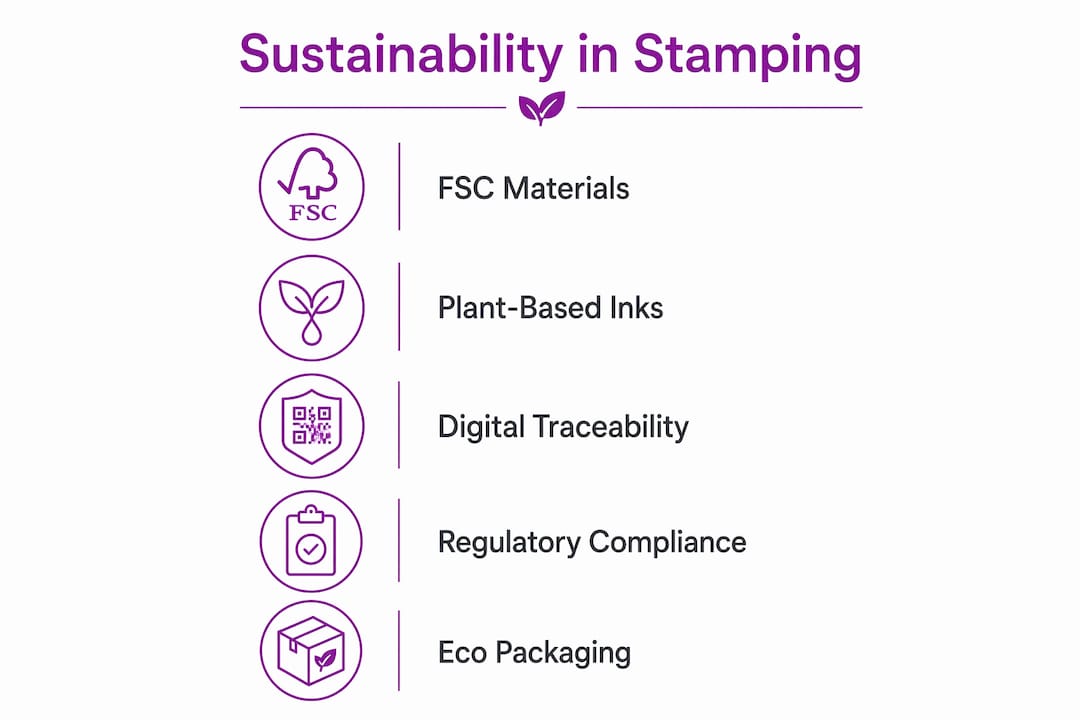
Ink formulation is equally important. Plant-based and water-based inks are replacing solvent-based alternatives across the industry. Water-based inks produce sharper impressions on porous surfaces like kraft paper and cardboard, which makes them ideal for packaging stamps. They also carry lower VOC (volatile organic compound) emissions, which matters for businesses operating under ESG reporting frameworks.
Corporate ESG mandates are driving product design decisions at the manufacturing level. Stamp producers now face pressure to provide carbon footprint data and recycled content documentation alongside their products. Sustainability claims require specific, verifiable data to comply with UK and EU regulations. A vague “eco-friendly” label no longer satisfies procurement teams or passes regulatory scrutiny.
Practical applications of sustainable stamping are growing across packaging and retail branding:
- Kraft paper mailer bags stamped with a logo in water-based ink replace printed poly bags.
- Recycled cardboard inserts stamped with brand messaging reduce the need for printed leaflets.
- Reusable stamp pads with refillable ink cartridges cut ongoing consumable waste.
- FSC-certified wooden stamp handles appeal to artisan and independent retail brands seeking authentic, tactile packaging.
Pro Tip: When selecting a stamp supplier, ask for the specific FSC certificate number and the ink’s technical data sheet showing VOC content. These two documents satisfy most UK corporate procurement checklists and demonstrate genuine compliance rather than marketing language.
Digital product passports and traceability frameworks are also entering the promotional products space. Traceability frameworks will likely influence custom stamps, adding environmental accountability to supply chains. Businesses that adopt reusable stamp solutions now will be better positioned when these requirements become mandatory.
How are digital tools transforming the custom stamping process?
Digital customisation has removed the guesswork from stamp design. Online platforms with design tools and AR features now let businesses create and preview custom stamps interactively before placing an order. That capability reduces costly design errors and speeds up the approval process significantly.
The workflow improvements follow a clear sequence:
- Upload your artwork. Most online stamp platforms accept vector files (SVG, EPS, PDF) and convert them automatically for stamp production.
- Preview in real time. Design tools show how the stamp impression will look on paper, including ink spread and edge definition.
- Use AR visualisation. Augmented reality features let you place a virtual stamp impression on a product image, so you can check scale and positioning before committing.
- Approve and order. Digital approval workflows replace back-and-forth email chains, cutting lead times from days to hours in many cases.
- Track production. Order tracking tools give businesses visibility over production status, which matters when stamps are needed for a product launch or seasonal campaign.
IoT integration represents the next stage of this digital evolution. IoT-enabled self-inking stamps can record real-time usage data, support authentication workflows, and trigger automated processes in connected environments. In pharmaceutical packaging, for example, a smart stamp can log each application to a compliance record automatically. That capability is currently most relevant to regulated industries, but the underlying technology will filter into commercial and creative applications over the next few years.
Branding consistency is a direct beneficiary of digital tools. When a business designs a logo stamp through a platform with live preview, the final product matches the brand’s visual standards far more reliably than a stamp produced from a low-resolution image sent by email.
Pro Tip: Always supply your logo as a vector file when ordering a custom stamp online. Vector artwork scales without quality loss, which means the stamp manufacturer can produce a clean impression at any size. A rasterised PNG or JPEG often results in jagged edges on the finished stamp.
What are the most effective branding applications of custom stamps?
Rubber stamps have evolved into branding tools that small businesses use for cost-effective marketing, improving brand recognition and customer trust. The range of applications has expanded well beyond office administration.
Businesses now use stamps as marketing assets for loyalty cards, social media engagement, and seasonal unboxing experiences. A stamped loyalty card costs a fraction of a printed alternative and carries a handcrafted quality that resonates with customers in independent retail and food service. Seasonal stamps applied to packaging during Christmas or Valentine’s Day create shareable unboxing moments that customers photograph and post online.
Key applications worth considering for your branding strategy:
- Logo stamps on packaging. A personalised packaging stamp applied to a plain box or tissue paper creates a branded experience at minimal cost per unit.
- Signature stamps for correspondence. Professional correspondence stamped with a business signature or address mark reinforces brand identity on every document.
- Loyalty card stamps. Physical stamp cards drive repeat visits and create a tangible reward mechanism that digital apps cannot fully replicate.
- Seasonal promotional stamps. Limited-edition stamp designs for key retail periods generate novelty and encourage customers to share their purchases.
Minimalist stamp designs with clean lines and simple typography are the standout aesthetic trend this year. Clean designs reproduce reliably across diverse materials, from kraft paper to fabric, and appeal to design-conscious customers. A single-colour logo stamp with tight typography outperforms a complex multi-element design in both reproducibility and visual impact.
| Application | Primary benefit | Best material pairing |
|---|---|---|
| Packaging stamps | Brand visibility at low cost per unit | Kraft paper, cardboard |
| Loyalty card stamps | Repeat customer engagement | Card stock |
| Correspondence stamps | Professional brand consistency | White or cream paper |
| Seasonal promotional stamps | Customer shareability and novelty | Tissue paper, gift wrap |
For small businesses, custom stamps offer measurable cost savings compared to printed alternatives, particularly for short-run packaging and event materials.
What market forces are driving custom stamping industry trends?
The North American custom self-inking stamps market was valued at USD 1.2 billion in 2024, growing due to automation, regulatory requirements, and digital workflow integration. The UK market follows a similar trajectory, with growth driven by SME branding needs and sustainability procurement rules.
Regulatory influence is significant. UK and EU green claims legislation now requires that any environmental statement made about a product be backed by verifiable evidence. Stamp manufacturers that cannot document their materials and processes face reputational and legal risk. This is pushing the entire supply chain towards greater transparency.
Customer preferences are also shifting. Businesses want stamps that serve multiple functions: branding, authentication, and customer engagement. That demand is driving product diversification, with manufacturers offering modular stamp systems, refillable ink options, and custom die shapes beyond the standard rectangle. Digital commerce has accelerated this trend by making small-batch custom orders economically viable for manufacturers and affordable for buyers.
The use of stamps in customer loyalty programmes is one area where physical tools are holding their ground against digital alternatives. Customers respond to the tactile nature of a stamped card in a way that a mobile app notification cannot replicate.
Key takeaways
Custom stamping in 2025 is defined by three non-negotiable priorities: verified sustainable materials, digital design accuracy, and expanded marketing application across packaging, loyalty, and seasonal branding.
| Point | Details |
|---|---|
| Sustainability is mandatory | FSC-certified materials and water-based inks are now required by UK and EU corporate procurement. |
| Digital tools reduce errors | Online design platforms with live preview and AR cut costly mistakes before production begins. |
| IoT adds smart capability | Connected stamps can log usage data and support authentication in regulated industries. |
| Marketing use is expanding | Stamps now serve loyalty cards, packaging, and seasonal campaigns as cost-effective branding tools. |
| Minimalist design performs best | Clean lines and simple typography reproduce reliably across diverse materials and surfaces. |
Why I think most businesses are still underusing custom stamps
Working in this space, the pattern I see most often is businesses investing heavily in digital marketing while overlooking the physical touchpoints that customers actually remember. A well-designed logo stamp on a parcel creates a moment of brand recognition that a social media post rarely achieves. The customer holds it, photographs it, and sometimes keeps the packaging.
The sustainability angle is where I see the biggest missed opportunity. Businesses spend time crafting ESG reports but overlook the fact that switching to an FSC-certified, water-based ink stamp for their packaging is a verifiable, documentable action. It is a small change with a paper trail, which is exactly what procurement teams and sustainability auditors want to see.
My honest view is that the businesses gaining the most from custom stamping right now are the ones treating it as part of a broader branding system rather than a standalone product. A logo stamp, a loyalty card stamp, and a seasonal packaging stamp used together create a coherent physical brand identity. That consistency builds customer trust faster than any single marketing channel can. The importance of custom stamps for UK businesses is still underestimated, and that gap represents a real opportunity for businesses willing to act on it.
— Steven
Stampdesign4u: custom stamping solutions for 2025
Stampdesign4u offers a full range of custom stamp products built for the trends shaping branding and marketing this year.
From personalised logo stamps designed for consistent brand application across correspondence and packaging, to dedicated packaging stamp collections that work with kraft paper and cardboard, the range covers every practical application discussed in this article. Products use quality materials and are available with fast turnaround times, making them suitable for seasonal campaigns and product launches. The ordering process is straightforward: upload your artwork, preview your design, and place your order. Stampdesign4u serves businesses across the UK and internationally, with options to suit both small independent brands and larger organisations with volume requirements.
FAQ
What materials should a sustainable custom stamp use?
Sustainable custom stamps use FSC-certified wood or recycled plastic for the body and water-based or plant-based inks for the impression. These materials satisfy UK and EU corporate procurement requirements and support ESG reporting.
How do online design tools improve custom stamp accuracy?
Online platforms with live preview and AR features let businesses see exactly how a stamp impression will look before production begins. This reduces design errors and shortens approval times significantly.
Are custom stamps effective for small business marketing?
Custom stamps are one of the most cost-effective physical branding tools available to small businesses. They work across packaging, loyalty cards, and seasonal promotions, delivering brand recognition at a low cost per use.
What is IoT integration in custom stamping?
IoT-enabled stamps record usage data in real time and can trigger automated workflows in connected systems. This capability is currently most common in pharmaceutical and security-sensitive sectors.
What stamp design style works best in 2025?
Minimalist designs with clean lines and simple typography are the leading aesthetic trend. They reproduce reliably on diverse materials and appeal to design-conscious customers across retail and professional sectors.