

TL;DR:
- Invisible ink stamps use UV-fluorescent or heat-activated inks that remain invisible under normal light but reveal themselves with UV light or heat. They are widely utilized for security marking, authentication, promotions, and educational activities, offering a discreet and versatile tool. Proper matching of ink type and reveal method is essential for effective use, with high-quality inks producing clear, residue-free marks.
Invisible ink stamps are far more than a trick from a spy film or a toy for children’s birthday parties. An invisible ink stamp, known more formally as a UV or fluorescent security stamp, applies ink that remains completely undetectable under normal lighting conditions yet reveals itself instantly under the right trigger. Businesses, event organisers, schools, and hobbyists all rely on these tools for purposes ranging from covert authentication to playful craft projects. This guide covers exactly what these stamps are, how the chemistry behind them works, where they are most useful, and how to choose the right one for your needs.
Key takeaways
| Point | Details |
|---|---|
| Two main ink types | Invisible inks are either heat-revealed (sympathetic) or UV-fluorescent, each requiring a different activation method. |
| Chemistry drives visibility | Heat-reveal inks oxidise organic substances to produce visible marks; UV inks fluoresce under ultraviolet light. |
| Broad practical applications | Organisations use invisible ink stamps for security marking, anti-forgery, event access control, and promotional loyalty schemes. |
| Quality determines invisibility | High-quality invisible ink dries with no residue, shine, or texture, ensuring marks stay hidden until intentionally revealed. |
| Matching ink to purpose | The reveal method must match the ink type selected, so choosing correctly is critical before purchasing. |
What is an invisible ink stamp?
An invisible ink stamp is a stamping tool loaded with ink that cannot be seen by the naked eye under ordinary visible light. The industry more commonly refers to this as a UV security stamp or fluorescent stamp, though the colloquial term “invisible ink stamp” is widely understood by consumers and trade buyers alike. Both names describe the same core concept: a mark is applied to a surface and only becomes visible when the correct detection method is used.
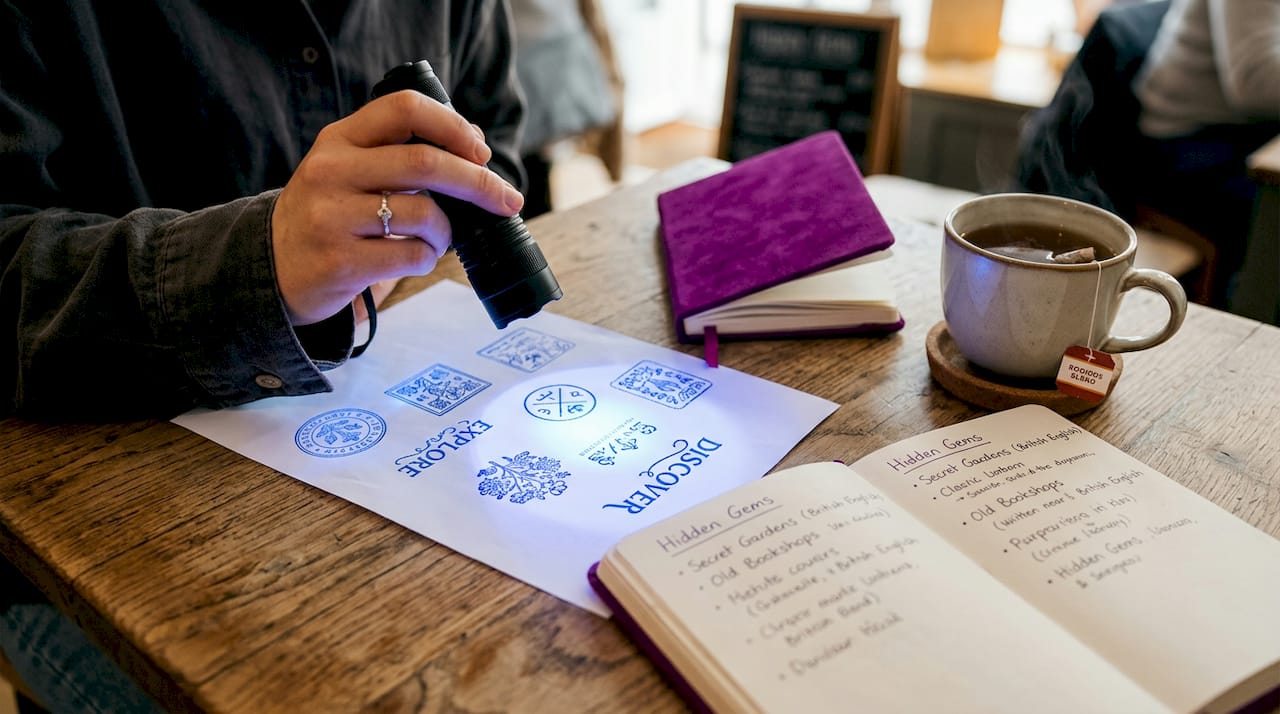
Invisible inks fall into two categories: sympathetic inks and fluorescent or UV-reactive inks. Understanding the difference matters because it directly affects how you reveal the mark.
Sympathetic inks include organic substances such as lemon juice, diluted milk, and certain acidic compounds. These are associated more with homemade or educational uses rather than professional stamping products.
UV-fluorescent inks are the standard in commercial and security stamping. These are synthetic formulations that absorb ultraviolet light and re-emit it as visible light, typically appearing as a bright blue or yellow-green glow under a UV torch. A well-known professional example is Noris #110UV ink, which is completely invisible under standard lighting but glows visibly under approximately 370 nm ultraviolet light. This is the type you will find in self-inking stamps used at nightclub entrances, sports venues, and warehouses.
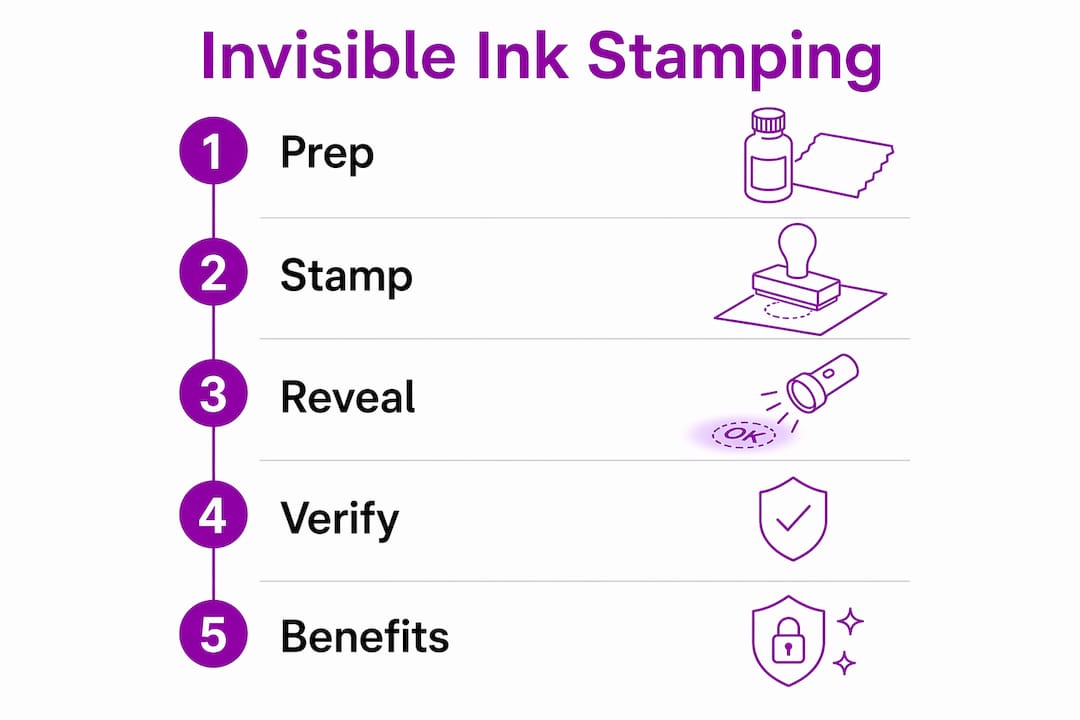
The chemistry behind why these inks stay invisible is straightforward. UV-fluorescent compounds do not absorb or reflect wavelengths within the visible spectrum under normal light, so the human eye registers nothing. Once a UV source is introduced, the compounds activate and emit light the eye can detect. The ink has not changed chemically. Only the lighting condition has changed.
For heat-activated sympathetic inks, the chemistry is different. Lemon juice and similar acidic fluids oxidise visibly under heat, turning brown as the organic compounds break down. This is the same process that causes paper to yellow over time, simply accelerated by applying a warm iron or other heat source directly to the page.
How invisible ink stamping works
Understanding the mechanism behind invisible ink stamping helps you use these tools correctly and avoid common errors that result in marks either failing to appear or appearing when they should not.
The reveal process depends entirely on which type of ink you are using. Here is how each method works in practice:
- Apply the stamp. Load the stamp pad with UV-fluorescent or sympathetic ink and press it firmly onto the target surface. With self-inking stamps, the mechanism does this automatically.
- Allow the ink to dry. This is the step most people skip. High-quality invisible ink dries completely clear with no shine or texture. Rushing this risks leaving a faint residue that can be seen under normal light, which defeats the purpose entirely.
- Verify with the correct tool. For UV inks, use a UV torch or blacklight at close range. For heat-reveal inks, apply gentle, even heat from an iron or a hair dryer.
- Interpret the result. UV marks glow immediately and clearly. Heat marks darken gradually over a few seconds and may take longer on thicker paper.
Several environmental factors affect how well heat-activated marks appear. Paper type, dryness, heating duration, and completeness all affect mark darkness and visibility. A heavily coated or glossy paper, for instance, tends to conduct heat poorly and may produce a faint or uneven result. Plain uncoated paper gives the clearest outcome.
UV-fluorescent inks are far less sensitive to environmental conditions, which is why they dominate professional applications. They work on most paper, cardboard, skin, and many plastics, though heavily dark or textured surfaces can make the glow harder to read.
Pro Tip: Always test an invisible ink stamp on a scrap of the same material you intend to mark before committing to a full run. Different paper stocks and surface finishes interact with UV inks differently, and a quick test prevents wasted stock.
For those comparing digital and traditional stamping, it is worth noting that UV stamps offer a tactile, instantaneous verification that does not require a smartphone, scanner, or network connection.
Applications and benefits of invisible ink stamps
The range of practical invisible ink uses is considerably broader than most people initially assume. Invisible ink stamp benefits span security, commerce, and creativity.
Security and authentication
Invisible ink marks remain hidden without verification equipment and are used for security and anti-forgery. This makes them popular for:
- Marking valuable assets such as laptops, tools, and equipment for property identification
- Stamping event wristbands or hands for re-entry verification at concerts and festivals
- Adding covert authentication marks to official documents, certificates, and banknotes
- Anti-counterfeiting applications in retail packaging and pharmaceutical labelling
The critical point here is control. Security applications depend on controlling who applies the ink and who can verify it with UV or heat tools. If UV torches are freely available to everyone, the security value diminishes. Proper security use keeps verification equipment restricted to authorised personnel.
Branding and promotional marketing
Businesses use invisible ink for loyalty card schemes, promotional reveals, and creative customer engagement. A retailer might stamp a receipt or loyalty card with a UV mark that, when revealed by the customer using a provided UV torch, discloses a discount code. UV-reactive ink stickers and stamps can be printed on many materials, making them adaptable for packaging inserts, mailers, and branded merchandise.
For examples of how stamps support loyalty programmes, the Traxx 9021 loyalty stamp offers a compact format suitable for both visible and UV-ink applications in retail settings.
Creative and recreational uses
Invisible ink for kids is one of the most widely recognised applications. Craft sets, educational kits, and party activities frequently incorporate UV-reveal or heat-reveal stamping to create hidden messages and secret codes. The format works well for escape room experiences, treasure hunt activities, and personalised gifts where a surprise reveal adds to the enjoyment.
Invisible ink stamps vs other marking methods
No marking method is perfect for every situation. Understanding the trade-offs helps you choose wisely.
| Method | Visibility | Cost | Security level | Environmental impact |
|---|---|---|---|---|
| Visible ink stamp | Immediate | Low | Low | Low waste |
| Invisible ink stamp | Hidden until revealed | Low to medium | Medium to high | Low waste |
| Digital marking (QR/barcode) | Requires device | Medium | High | Moderate (device dependency) |
| Paper shredding | N/A | Medium | Medium | High (destroys paper) |
Privacy stamps obscure text whilst preserving paper integrity, which is an advantage over shredders from a recycling standpoint. Invisible ink stamps take this further by leaving no visible evidence of any mark at all, preserving the appearance of the document or item completely.
Digital verification methods offer higher security for sophisticated forgery attempts but require infrastructure. An invisible ink stamp requires only a pad, a stamp, and a UV torch. That simplicity is genuinely valuable in field conditions, at outdoor events, or anywhere connectivity is unreliable.
The main limitation of invisible ink stamps is that their security depends entirely on keeping the reveal method away from those who should not have access to it. For very high-security requirements, they work best as one layer within a broader authentication system rather than a standalone solution. Reading about practical personalised stamp uses for businesses gives a clearer picture of where stamps sit within a wider operational context.
Pro Tip: For event security, always combine invisible ink stamps with one additional verification step, such as a wristband or ticket check. A single-layer system is easier to bypass than a two-step process.
Where to buy invisible ink stamps and supplies
Sourcing the right product is straightforward once you know what to look for. The key decisions to make before purchasing are:
- Ink type. UV-fluorescent for professional or security use; heat-reveal for educational or novelty purposes.
- Stamp mechanism. Self-inking stamps are the most practical for repeated use and produce consistent impressions. Traditional rubber stamps with a separate UV ink pad give more flexibility over ink choice.
- Stamp size and design. Smaller stamps suit hand or wristband marking at events. Larger formats work for document or packaging authentication.
- Ink quality. Cheap invisible ink may leave a faint, visible residue when dry. High-quality ink dries completely clear with no texture or shine.
- Safety and maintenance. UV inks are generally non-toxic but should not be used on skin unless the product is specifically rated safe for skin contact. Stamp pads should be stored sealed and away from direct sunlight to prevent premature drying.
Specialist online stamp suppliers and general office supply retailers both carry UV stamp inks and compatible stamp mechanisms. If you need a custom design, such as a logo or specific text, look for suppliers that offer personalised stamp making alongside UV ink options. Understanding why self-inking stamps suit small businesses is a good starting point before placing an order.
My honest take on invisible ink stamps
I have seen businesses dismiss invisible ink stamps as a novelty and then scramble to introduce them later after a stock theft incident or a document fraud issue. The assumption that these are toys is one of the most persistently unhelpful misconceptions in the stamping trade.
What I have found is that the greatest practical value comes from using UV stamps consistently, not sporadically. A warehouse that marks every piece of outgoing equipment with a UV stamp from day one has a complete record. One that starts after a problem arises has gaps. The technology costs almost nothing compared to the security it provides over time.
The chemistry is also more reliable than people expect, provided you buy quality ink and match it correctly to your reveal method. Choosing the ink must match the reveal method, since no amount of UV light will reveal a heat-activated mark, and vice versa. Most failures I have seen come from this mismatch, not from the technology itself.
For hobbyists and families, my advice is to treat UV-reveal crafts as a genuine educational tool. The chemistry of fluorescence is a surprisingly engaging topic for younger learners, and the practical stamping activity gives it a memorable context. Investing in a decent UV torch alongside any invisible ink kit makes the experience far more satisfying than the disposable pens many starter kits include.
— Steven
Explore invisible ink stamps at Stampdesign4u
Stampdesign4u offers a practical range of stamp products suitable for both UV-ink applications and standard visible marking, with custom design options for businesses, event organisers, and creative projects.
Whether you need a compact loyalty stamp for a retail promotion or a larger format self-inking stamp for document authentication, the product range covers both. The Trodat 4927 stamp is a strong option for businesses needing a larger impression area for text and logo marking, and it is compatible with specialist inks. For compact loyalty and access applications, the Traxx 9021 loyalty stamp provides a consistent, repeatable impression. Custom stamp design is available across the range, so your marking solution can include your branding or any specific code or symbol you require.
Common questions
What does an invisible ink stamp do?
An invisible ink stamp applies UV-fluorescent or heat-sensitive ink that cannot be seen under normal lighting conditions. The mark only becomes visible when the correct trigger is applied, such as UV light or gentle heat.
How does invisible ink work?
UV-fluorescent compounds absorb ultraviolet light and re-emit it as visible light, making the mark glow. Heat-reveal inks rely on oxidation of organic substances, turning the mark brown when exposed to a heat source.
Are invisible ink stamps safe for use on skin?
Most UV stamp inks used for event entry marking are formulated for brief skin contact, but you should always confirm that the specific product is rated safe for skin use before applying it to hands or wrists.
Where can you buy invisible ink stamps in the UK?
Invisible ink stamps and UV ink pads are available from specialist online stamp retailers, office supply shops, and custom stamp providers such as Stampdesign4u, which offers personalised designs alongside standard products.
Can invisible ink stamps be used for children?
Yes. Invisible ink for kids is a popular educational and craft application. UV-reveal sets are widely available and provide a safe, engaging way to explore hidden messages and basic chemistry concepts.