

TL;DR:
- Security inks in stamps are specially formulated to react under UV, IR, or viewing angles, making counterfeiting difficult. Multiple layered security features, verified with appropriate tools, enhance protection beyond single overt indicators like optically variable inks. Combining spectral layers and proper training forms the most effective strategy for authenticating secure stamps in professional applications.
Ink security in stamps is not simply about using coloured ink. It refers to specialised ink formulations engineered to behave in ways that ordinary inks cannot replicate, making unauthorised reproduction far more difficult. Whether you are handling tax stamps, identity documents, or official seals, understanding what is ink security in stamps helps you distinguish a genuine stamp from a forgery. This guide covers the core technology, the main ink types, their real-world benefits and limits, and how to apply verification correctly in professional practice.
Table of Contents
- Key takeaways
- Fundamentals of security ink technology
- Types of security inks and how they work
- Benefits and limitations of ink security
- Applications and verification best practices
- My perspective on ink security today
- Secure stamps from Stampdesign4u
- FAQ
Key takeaways
| Point | Details |
|---|---|
| Security ink is specialised | Security inks are engineered to react under UV, IR, or angle-dependent conditions that standard inks cannot replicate. |
| Multiple ink types exist | UV-reactive, IR-reactive, optically variable, and covert watermark inks each serve distinct verification purposes. |
| Multi-layer security is necessary | Relying on a single ink feature is insufficient; layered approaches combining multiple ink types are strongly recommended. |
| Verification requires correct tools | UV lamps, IR detectors, and controlled light sources are needed to authenticate security ink features accurately. |
| Ink security differs from redaction | Invisible security inks and blackout redaction inks solve different problems and should not be used interchangeably. |
Fundamentals of security ink technology
Security inks are specialised formulations engineered to react under verification conditions such as UV or infrared light rather than behaving like ordinary visible ink. Standard printer inks absorb and reflect light in a predictable visible spectrum. Security inks go further. They contain chemical compounds that respond to specific stimuli, producing effects that cannot be seen or replicated without knowledge of the original formulation.
This distinction matters because security inks provide predictable interactions with verification methods, and that predictability is their core security advantage. A counterfeiter working with conventional inks cannot reproduce a fluorescence response under UV light simply by copying the visible appearance of a stamp. The reaction is built into the chemistry, not the colour.
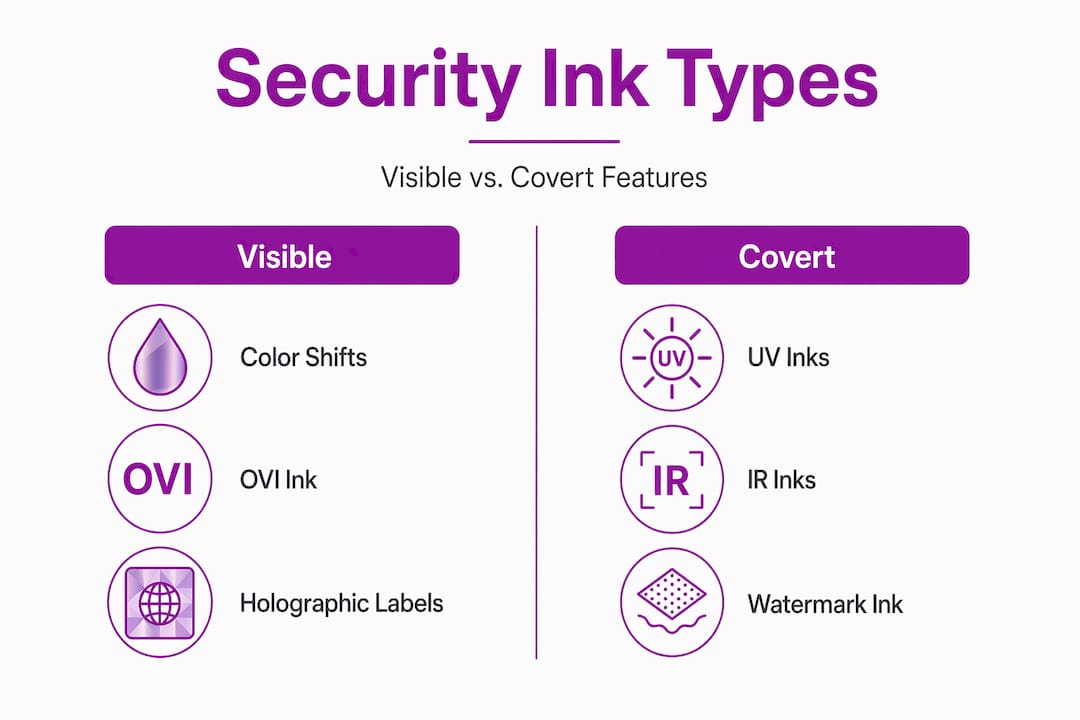
Modern security ink formulations often work in layers. Multi-layer inks involve printing elements that respond differently under various wavelengths, producing multiple security checkpoints within the same stamp. One layer may fluoresce under ultraviolet light while another absorbs infrared radiation, and a third shifts colour depending on the viewing angle. Each layer requires a different tool to detect, multiplying the complexity for anyone attempting to reproduce the stamp.
Optically variable ink, commonly known as OVI, is a well-known example of this kind of technology. OVI changes colour depending on viewing angle), which makes it a visible and immediately testable security feature. You can see it shift without any equipment at all. That makes it useful for quick first-line checks, though it works best when combined with covert layers that require instruments to verify.
- Security inks are distinct from standard inks due to their specific chemical responses to stimuli
- Verification stimuli include UV light at approximately 365 nm, infrared illumination, and polarised angles
- Multi-layer approaches embed several checkpoints in one stamp, each detectable by different tools
- OVI provides a visible angle-dependent colour shift as an overt first-line security feature
- The formulation itself remains the proprietary element that prevents replication
Pro Tip: When evaluating security ink technology for professional use, ask suppliers specifically whether their formulation includes both overt and covert layers. A single-layer ink, however sophisticated, offers a weaker defence than a layered system.
Types of security inks and how they work
Understanding the main categories of security ink helps you choose the right verification approach and spot the difference between a genuine stamp and a reproduction.
UV-reactive inks
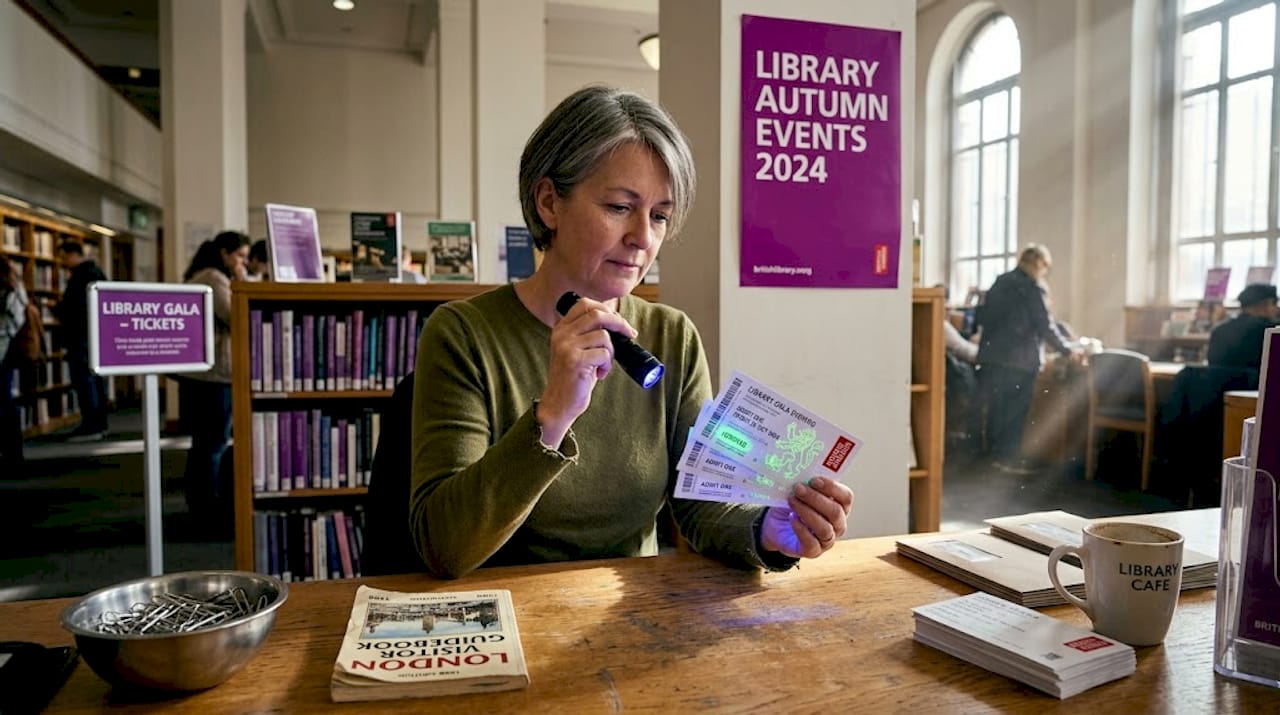
UV security ink is invisible under normal light and fluoresces under UV illumination at around 365 nm. This means the ink produces no visible mark in ordinary conditions, so it adds authentication capability without altering the visible appearance of a document. When a UV lamp is passed over the stamp, the ink glows clearly, confirming authenticity.
UV inks are widely used in tax stamps, event tickets, and identity documents precisely because they are discreet. The fluorescing pattern can include logos, serial numbers, or geometric designs that only appear under UV light, making them extremely difficult to copy without access to the original formulation.
IR-reactive inks
IR-based security inks respond to infrared illumination and require IR detectors or scanners for verification. Unlike UV inks that produce a visible glow, IR inks work in a spectral range outside human vision entirely. They are heavily used in banknotes and passports because automated scanning systems can verify them quickly and reliably at scale.
IR inks are particularly valuable in high-throughput environments where human visual checks are impractical. A barcode reader or document scanner equipped with IR capability can authenticate hundreds of stamps per minute without any operator judgement involved.
Covert watermark inks
Covert watermark inks react only at specific wavelengths, typically UV 365 nm or IR 940 nm, and produce unique machine-readable optical fingerprints. These inks go beyond simple fluorescence. They generate patterns or codes that can be read by calibrated scanners, producing a forensic-level authentication layer that is extraordinarily difficult to duplicate.
Comparison of key ink types
| Ink type | Visibility to naked eye | Verification tool needed | Security level |
|---|---|---|---|
| UV-reactive | Invisible (normal light) | UV lamp (~365 nm) | Medium to high |
| IR-reactive | Invisible | IR detector or scanner | High |
| Optically variable (OVI) | Visible (colour shift) | None for basic check | Medium (overt only) |
| Covert watermark | Invisible | Calibrated UV/IR scanner | Very high |
- UV inks suit document protection where human verification with a portable lamp is practical
- IR inks suit automated high-volume authentication workflows
- OVI provides an accessible first-line check but should not be the sole security feature
- Covert watermark inks provide the highest resistance to replication due to their unique molecular signatures
Benefits and limitations of ink security
The benefits of ink security in stamps are real and well-documented. Multi-spectral features make counterfeiting significantly more difficult and expensive. A forger must not only replicate the visible appearance of a stamp but also source the correct chemical formulations to pass UV, IR, and optical tests. That combination of requirements raises the barrier to entry considerably.
Verification is also fast and reliable when the right tools are used. Security ink verification uses controlled stimuli and machines to avoid subjective human judgement, which improves consistency across different operators and locations. A UV lamp produces the same result whether it is used in London or Lagos.
Security inks are also compatible with industrial printing processes. Offset, flexographic, and digital printing systems can all accommodate security ink formulations, meaning there is no fundamental barrier to deploying them at scale for commercial stamp production.
That said, there are genuine limitations to acknowledge. Modern counterfeiting can replicate single overt security features, which is why relying on one ink type alone is not advisable. A single UV fluorescent layer, for example, can potentially be copied with commercially available UV-reactive materials if the visual pattern is known.
Another common misconception is that invisible security inks and blackout redaction inks serve the same purpose. They do not. The correct choice between invisible security inks and blackout inks depends on the threat being addressed. Invisible security ink fights counterfeiting. Blackout ink prevents data exposure. Using a confidential-marking stamp for document redaction is a different function entirely from embedding a covert UV marker for authentication.
Pro Tip: If you are sourcing stamps for document security purposes, be specific about whether you need authentication (proving something is genuine) or redaction (obscuring sensitive information). The ink technology required is fundamentally different in each case.
The other practical limitation is equipment dependency. UV lamps and IR scanners add cost and procedural steps. Organisations that cannot maintain and train staff on verification tools will not realise the full benefit of their ink security investment.
Applications and verification best practices
Ink security features appear across a wide range of professional stamp applications. Understanding where they are most commonly used helps clarify how verification should be carried out in practice.
-
Tax and excise stamps. Governments use UV and IR inks in tax stamps on tobacco, alcohol, and pharmaceuticals to confirm that duty has been paid and the product is legitimate. Retailers and customs officials verify these using handheld UV lamps or automated scanners at point of entry.
-
Identity protection stamps. Covert watermark inks are used in stamps applied to identity cards, passports, and official certificates to create a forensic layer that can only be verified by authorised scanning equipment.
-
Secure document processing. Organisations handling contracts, legal papers, or financial records use stamps with identity stamp types that include UV-reactive elements to confirm that a document has passed through an authorised process.
-
Verification step using UV lamps. Hold the UV lamp within 5 to 10 centimetres of the stamped area and observe under a controlled low-light environment for the clearest fluorescence. Ambient light can wash out UV responses and produce false negatives.
-
Verification step using IR scanners. Use a calibrated IR detector set to the appropriate wavelength for your ink specification. Confirm the scan result against a reference sample held by your organisation.
-
Avoiding common verification errors. The most frequent mistake is assuming that absence of UV fluorescence means a stamp is fake. The lamp itself may be faulty or the wrong wavelength. Always cross-check with a reference standard before drawing conclusions.
Multi-spectral checks are becoming necessary given the capabilities available to professional counterfeiters, which is why verification protocols that combine at least two different ink detection methods are now the professional standard for high-risk documents.
My perspective on ink security today
I’ve spent considerable time reviewing how organisations actually apply security ink technology, and the pattern I see most often is this: the ink is right, but the process is not.
In my experience, the biggest gap is not in the ink formulation itself. It is in training. Staff responsible for verification often use UV lamps at the wrong distance, in rooms with too much ambient light, or against the wrong reference. The result is a security system that works on paper but fails in practice.
What I’ve also found is that professionals tend to overestimate OVI because it is the most visible and intuitive ink security feature. You see the colour shift and it feels reassuring. But OVI is most effective when combined) with UV, IR, or forensic ink layers. Alone, it is a first-line check, not a complete solution.
My view is that anyone selecting stamps for a security-sensitive application should prioritise suppliers who can specify the full spectral profile of their ink. Knowing which wavelengths activate which features gives you the ability to build a verification protocol rather than relying on a single test. That specificity separates a professionally secured stamp from one that just looks secure.
The best ink security systems I’ve seen combine at least two spectral layers with a physical verification procedure and staff who understand why each step matters. That is the standard worth aiming for.
— Steven
Secure stamps from Stampdesign4u
If you are looking for stamps that offer genuine document protection features, Stampdesign4u provides a range of products suited to both individual and professional needs.
From word stamps for document control to fully customised logo and text stamps designed for high-volume professional use, Stampdesign4u makes it straightforward to find the right product for your security requirements. The Trodat 4927 model, for example, accommodates up to nine lines of text and logo artwork, giving organisations the flexibility to incorporate the specific marking information their security process requires. Explore the full range at Stampdesign4u to find a stamp that fits your document protection workflow.
FAQ
What is ink security in stamps?
Ink security in stamps refers to the use of specialised ink formulations that react to UV light, infrared light, or viewing angle changes in ways that standard inks cannot reproduce, making stamps far harder to counterfeit.
How does UV security ink work in stamps?
UV security ink is invisible under normal light and fluoresces visibly when exposed to UV illumination at approximately 365 nm, allowing rapid covert authentication using a handheld UV lamp.
Can a single ink security feature fully protect a stamp?
No. Modern counterfeiting can replicate single overt features, so security professionals recommend combining at least two spectral layers, such as UV and IR, within the same stamp.
What is the difference between security ink and blackout ink?
Security ink prevents counterfeiting by embedding covert authentication markers, while blackout ink redacts visible data to prevent unauthorised reading. They address different threats and are not interchangeable.
What tools are needed to verify security ink in stamps?
Verification requires tools matched to the ink type: a UV lamp at approximately 365 nm for UV-reactive inks, an infrared detector or scanner for IR inks, and a calibrated scanner for covert watermark inks.
Recommended
- Your Guide To Legal Stamps for True Copy and True Likeness Paperwork. – Stamp Design 4U
- What Is a Self-Inking Stamp? Complete Guide UK – Stamp Design 4U
- Blue ink stamps: uses, benefits, and how to choose – Stamp Design 4U
- SD4U Imprint 11 CONFIDENTIAL Word Stamp in 5 Ink Colours | 38 x 14mm – Stamp Design 4U