

TL;DR:
- A stamp mount is a transparent plastic holder that safeguards collectible stamps without adhesive contact, preserving their condition. There are pre-cut sealed mounts for standard sizes and universal strip mounts for irregular formats, both offering protective benefits and aesthetic options. Using mounts ensures reversible, non-damaging storage, whereas hinges risk permanent damage to a stamp’s gum and perforations.
A stamp mount is a clear plastic pocket that holds a collectible stamp between two plastic layers, allowing display without any adhesive contact with the stamp itself. In philately, the recognised industry term is “mount” or “philatelic mount,” and brands such as Hawid and Davo have made these products standard equipment for serious collectors. The term is occasionally confused with rubber stamp hardware, but all authoritative philatelic sources define stamp mounts as protective plastic holders for postage stamps. This guide covers the main types, protection benefits, practical selection advice, and clarifies where the term does and does not apply.
What is a stamp mount and why does it matter?
A stamp mount is defined as a transparent plastic sleeve that encases a stamp for safe display and storage without touching the stamp’s gum or perforations. The mount holds the stamp between two layers of plastic, one of which is typically clear to show the stamp’s face, while the other forms the backing. Wikipedia confirms that mounts allow a stamp to be removed undamaged when properly used, which is the defining advantage over older methods.
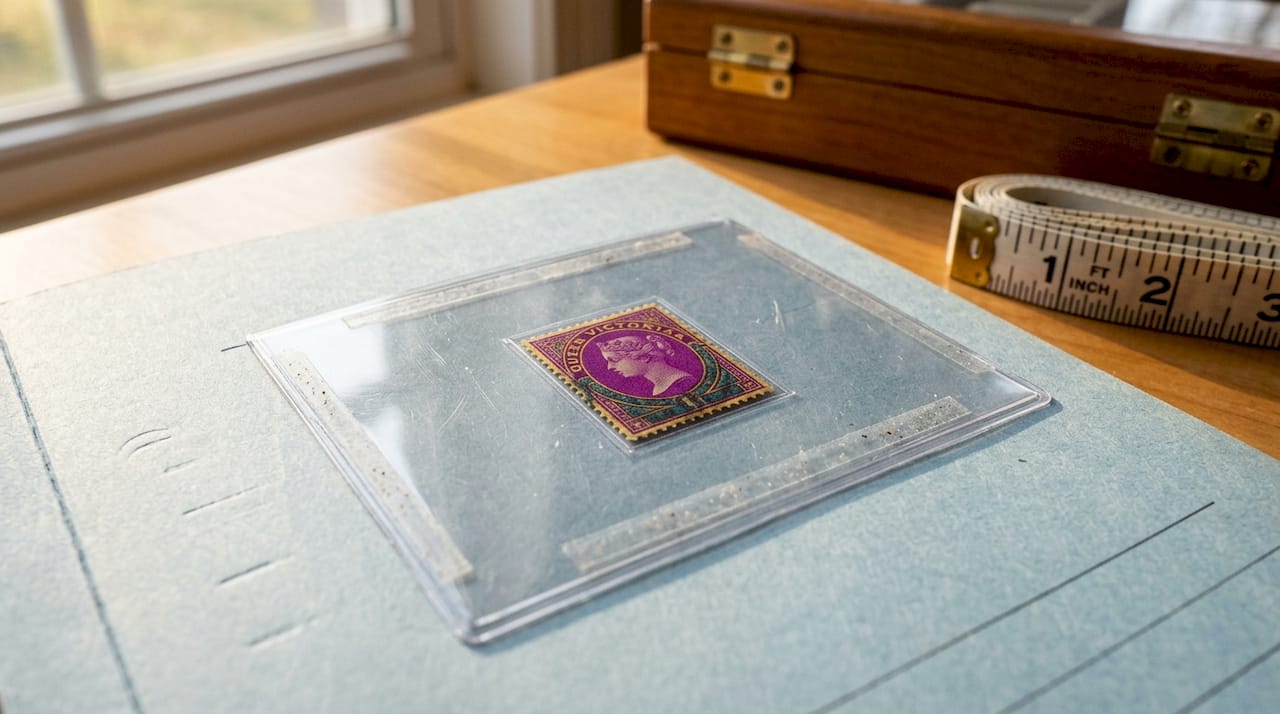
Before mounts became standard, collectors used tape, glue, or paper hinges. Each of these methods caused lasting damage to gum and perforations, reducing a stamp’s condition grade and market value. Mounts solved this problem by creating a reversible, non-adhesive housing. Hawid, a German manufacturer, is widely credited with popularising the modern clear-plastic mount format, and Davo followed with its own range of pre-cut sizes tailored to specific stamp series.
The distinction matters financially. A mint stamp with undamaged original gum is worth significantly more than the same stamp with hinge remnants. Collectors who switched to mounts early protected the long-term value of their collections in a way that hinge users could not reverse.
What are the main types of stamp mounts?
Two main types of stamp mounts exist: pre-cut sealed mounts and universal strip mounts. Understanding the difference is the first practical step for any collector choosing how to house their stamps.
Pre-cut sealed mounts come in fixed dimensions matched to standard stamp sizes. They are convenient because no cutting is required. You simply slide the stamp in and the mount is ready to place on an album page. Hawid and Davo both produce extensive catalogues of pre-cut sizes covering the most common British, European, and Commonwealth stamp formats.
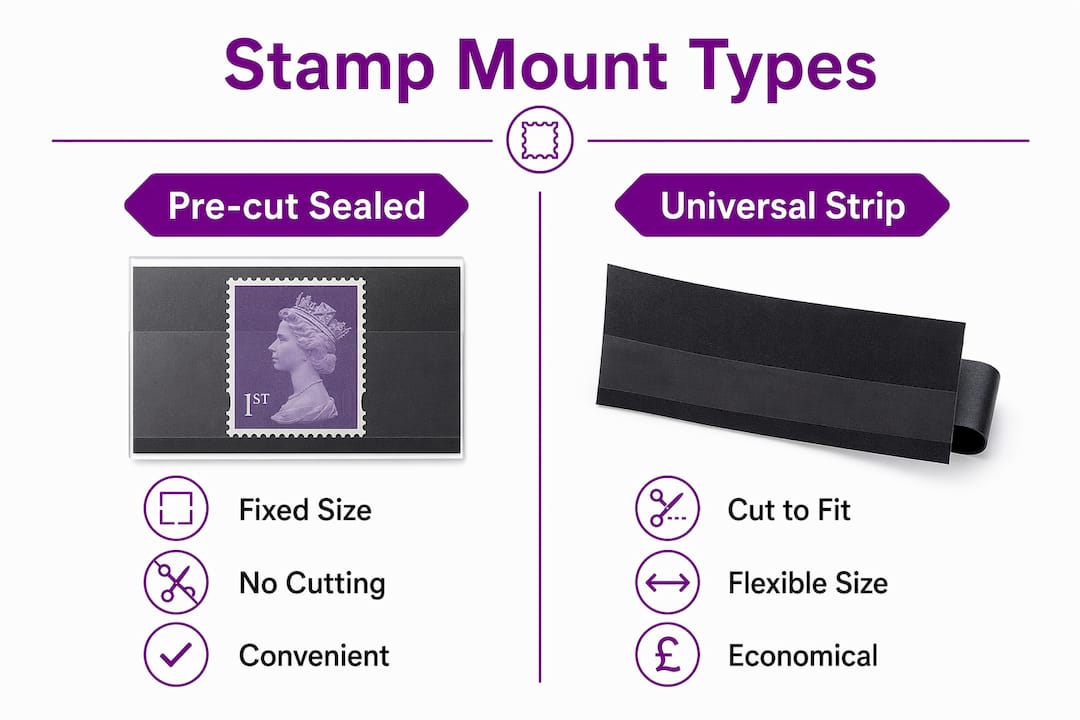
Universal strip mounts are sold in long strips that you cut to the required length using a philatelic guillotine or mount cutter. This format suits non-standard sizes, miniature sheets, and stamps with unusual proportions. The trade-off is that cutting requires care and a steady hand to avoid misalignment.
Backing colour and adhesive type
Mounts come in black or transparent backings, and the choice affects how a stamp appears on the page. Black backings create strong contrast, making stamp colours appear more vivid. Transparent backings blend with white album pages and suit collectors who prefer a minimal look.
Adhesive type is the other key variable. Some mounts are self-adhesive on the reverse, sticking directly to the album page without additional glue. Others require moistening or a glue stick to fix in place. Self-adhesive mounts are faster to use but can be harder to reposition once placed.
| Feature | Pre-cut sealed mounts | Universal strip mounts |
|---|---|---|
| Sizing | Fixed to standard stamp dimensions | Cut to any length with a guillotine |
| Convenience | High, no cutting required | Lower, requires cutting tools |
| Best for | Standard-sized stamps | Miniature sheets, unusual formats |
| Brands | Hawid, Davo | Hawid strips, Lighthouse strips |
| Backing options | Black or transparent | Black or transparent |
How do stamp mounts protect stamps better than hinges?
Mounts protect stamps by holding them without any adhesive contact on either the front or the back of the stamp. Protection from dust, moisture, UV light, and oils from handling is built into the design. This matters because even brief contact with fingers transfers oils that degrade paper fibres over years.
Hinges are small folded pieces of gummed paper that attach a stamp to an album page. They are inexpensive and widely used for common used stamps, but they carry a significant risk. When a hinge is removed, it often takes a layer of the stamp’s original gum with it, or leaves a visible remnant. Either outcome reduces the stamp’s condition grade permanently.
The key differences between mounts and hinges are:
- Mounts hold stamps reversibly with no adhesive contact on the stamp itself
- Hinges attach directly to the stamp’s gum, risking damage on removal
- Mounts protect against moisture, UV, and handling oils
- Hinges offer no environmental protection
- Mounts are preferred for mint stamps; hinges are reserved for used material to reduce cost and risk
Mounts allow reversible removal without harm, which means a stamp can be transferred to a new album, re-examined under a loupe, or sold without any evidence of previous mounting. This is not possible with hinges once the gum bond has formed.
Pro Tip: If you are unsure whether a stamp is mint or used, treat it as mint and use a mount. The cost of a mount is always less than the value lost by hinge damage to an original-gum stamp.
Practical tips on how to choose and use stamp mounts
Selecting the right mount size is the single most common source of error among newer collectors. A mount that is too large allows the stamp to shift inside, causing edges to rub against the mount opening. Poorly sized or misaligned mounts risk stamp edges lifting or rubbing during album handling, which defeats the purpose of using a mount at all.
Follow these steps to select and use stamp mounts correctly:
- Measure the stamp accurately. Use a millimetre ruler to measure height and width, including perforations. Round up to the nearest available mount size rather than down.
- Choose the backing colour before buying. Black backing suits colourful stamps on white pages. Transparent backing suits stamps on coloured or patterned album leaves.
- Verify the material is PVC-free. Archival-quality mounts must be PVC-free to avoid chemical off-gassing that degrades stamp paper and ink over decades. Check the packaging before purchasing.
- Cut universal strips with a proper mount cutter. A philatelic guillotine produces a clean, square cut. Scissors introduce angled cuts that leave gaps at the mount corners.
- Insert the stamp slightly below the upper lip of the mount. This prevents the stamp from lifting when album pages are turned, reducing handling damage over time.
- Centre the stamp before pressing the mount closed. Once sealed, repositioning the stamp inside the mount is difficult without risking perforation damage.
- Plan for page bulk. Mounts add thickness to album pages, so avoid placing mounts back-to-back on facing pages. Stagger their positions to keep the album flat and prevent pressure damage.
Pro Tip: When building a new album page, lay all mounts out dry before fixing any of them. This lets you adjust spacing and balance the page visually without committing to positions that are hard to change.
Choosing between stamp options for personal and business use also involves thinking about how stamps will be stored and displayed long-term, which makes mount selection part of the broader planning process.
Does ‘stamp mount’ apply to rubber stamps too?
The term “stamp mount” is primarily a philatelic term and is rarely used in rubber stamp printing or equipment contexts. All authoritative sources define stamp mounts as plastic holders for collectible postage stamps. Searching for “stamp mount” in a rubber stamping context will almost always return philatelic results, which causes confusion for businesses and crafters who encounter the term.
In rubber stamping, the equivalent concept is the stamp block or stamp handle. These are the wooden, acrylic, or foam bases to which rubber or photopolymer dies are attached. The terminology differs entirely from philatelic mounts:
- Philatelic mount: a plastic sleeve protecting a collectible stamp
- Rubber stamp block: a wooden or acrylic base holding a rubber die for inking
- Cling mount: a repositionable foam backing used with clear photopolymer stamps
- Wood mount: a traditional wooden block with rubber die permanently bonded
Businesses using rubber stamps for branding or office use do not typically need philatelic mounts. Their focus is on the stamp die, the ink pad, and the handle or block. Exploring top rubber stamp brands such as Colop, Trodat, and Shiny gives a clearer picture of what rubber stamp hardware actually involves and how it differs from philatelic equipment.
The practical takeaway is straightforward. If you are a collector, “stamp mount” means a protective plastic holder. If you are a business user looking for rubber stamp equipment, the term you need is “stamp handle,” “stamp block,” or the specific product name from the manufacturer.
Key takeaways
Stamp mounts are the standard protective housing for mint collectible stamps, chosen specifically because they preserve original gum and perforations without any adhesive contact.
| Point | Details |
|---|---|
| Core definition | A stamp mount is a clear plastic sleeve holding stamps without adhesive contact. |
| Two main types | Pre-cut sealed mounts suit standard sizes; universal strips suit non-standard formats. |
| Mounts versus hinges | Mounts are reversible and non-damaging; hinges risk permanent gum damage on removal. |
| Material safety | Always choose PVC-free, archival-quality mounts to prevent long-term chemical damage. |
| Rubber stamp distinction | In rubber stamping, the equivalent term is stamp block or handle, not stamp mount. |
Why mounts are worth the extra effort
I have seen collectors spend years building impressive collections only to discover that early hinge use has permanently reduced the value of their best stamps. The regret is real and it is irreversible. Mounts require slightly more time and a small additional cost per stamp, but the protection they provide is not comparable to any alternative.
What I find underappreciated is the role of backing colour. Most beginners default to black backing without considering how it interacts with the specific stamps they collect. Pale, pastel-coloured stamps from mid-20th century British Commonwealth issues, for example, look far better against transparent backing on a white page. Black backing can overpower delicate colour palettes and make a page feel heavy. Spending five minutes testing both options before committing to a full album page saves considerable frustration later.
The other mistake I see repeatedly is buying mounts in bulk before measuring stamps properly. Mount sizes are not universal across manufacturers. A Hawid size 26 is not identical to a Davo size 26. Always measure your stamps first and buy a small sample pack before committing to a large quantity. This is especially true for unusual formats like coil stamps, booklet panes, or modern self-adhesive issues where standard sizing assumptions break down.
Mounts transformed philately from a hobby that gradually destroyed its own subject matter into one that can genuinely preserve stamps across generations. That is not a small thing.
— Steven
Explore rubber stamps and custom stamp options at Stampdesign4u
Stampdesign4u offers a range of rubber stamps suited to both personal and business use, with options covering everything from simple text designs to full logo stamps. The Trodat Printy 4927 is one of the most popular models available, offering a 60 x 40mm print area across nine lines of text or logo content. It is a practical choice for businesses that need a reliable, self-inking stamp for daily use. Whether you are setting up a new office stamp or looking for a personalised design, Stampdesign4u provides clear product options and international delivery to help you find the right fit.
FAQ
What is a stamp mount used for?
A stamp mount is used to protect and display collectible postage stamps without adhesive contact. It holds the stamp between two plastic layers, preserving the original gum and perforations.
What are the main types of stamp mounts?
The two main types are pre-cut sealed mounts, sized for standard stamps, and universal strip mounts that collectors cut to fit using a philatelic guillotine. Brands such as Hawid and Davo produce both formats.
How do I choose the right size stamp mount?
Measure the stamp in millimetres, including perforations, and select the nearest mount size that is equal to or slightly larger. Avoid mounts that are too large, as the stamp will shift and risk edge damage.
Are stamp mounts the same as rubber stamp mounts?
No. Stamp mounts in philately are plastic protective sleeves for collectible stamps. In rubber stamping, the equivalent component is a stamp block or handle, which is a separate product category entirely.
Do stamp mounts need to be PVC-free?
Yes. Archival-quality mounts must be PVC-free to prevent chemical off-gassing that degrades stamp paper and ink over time. Always check packaging for material safety information before purchasing.