

TL;DR:
- A handstamp is a manual device used for applying inked impressions onto various surfaces. Its effectiveness depends on matching the stamp type and ink to the material being stamped for clear, consistent marks.
A handstamp is a handheld device used to apply an inked impression manually onto documents, packaging, or postal items. The term covers both the physical tool and the mark it leaves, making it one of the few objects in everyday use that shares its name with its own output. Postal authorities worldwide have relied on handstamps for centuries to cancel postage and record mailing locations. Businesses use them for branding, dispatch paperwork, and quality control. Stampdesign4u supplies custom handstamps to individuals and organisations across the globe, from simple address stamps to logo designs built for high-volume use.
What is a handstamp and how does it work?
A handstamp is defined as a manual stamping device that transfers ink from a die or pad onto a surface through direct hand pressure. The die carries the design, whether text, a logo, or a date, and the ink transfers cleanly when the stamp meets the surface. No electricity or machinery is involved. The operator controls everything: placement, pressure, and timing.
The term has two meanings in common use. In philately, a handstamp refers specifically to the impression left on a mail item by a postal worker’s tool. In general commerce, it refers to any manually operated stamp device. Both meanings share the same core mechanic: a person presses a marked surface onto another surface to leave a repeatable impression.
Climax rubber handstamps, introduced in 1885, were among the first affordable alternatives to steel postal tools. Post offices used them to date-stamp parcels and postal orders. That history explains why the word “handstamp” still carries a postal connotation, even though the tool now appears in offices, warehouses, and craft studios worldwide.
What types of handstamps are available?
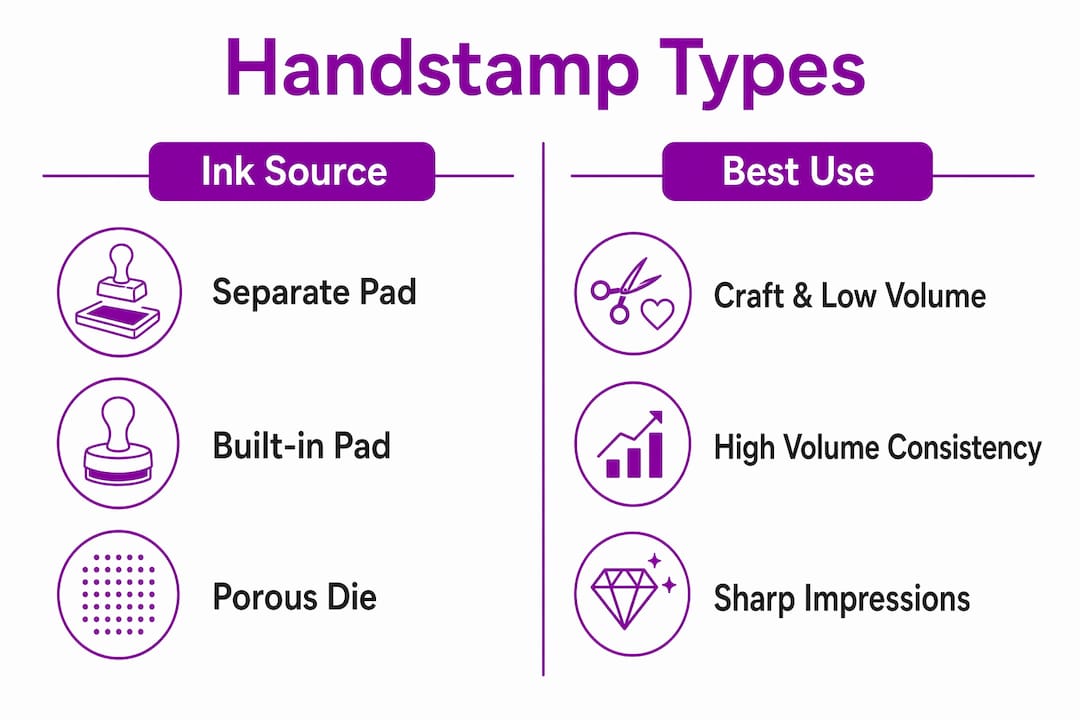
Three main types of rubber handstamp exist: traditional stamps with separate ink pads, self-inking stamps with built-in pads, and pre-inked stamps with ink contained inside the die itself. Each suits different volumes, surfaces, and budgets.
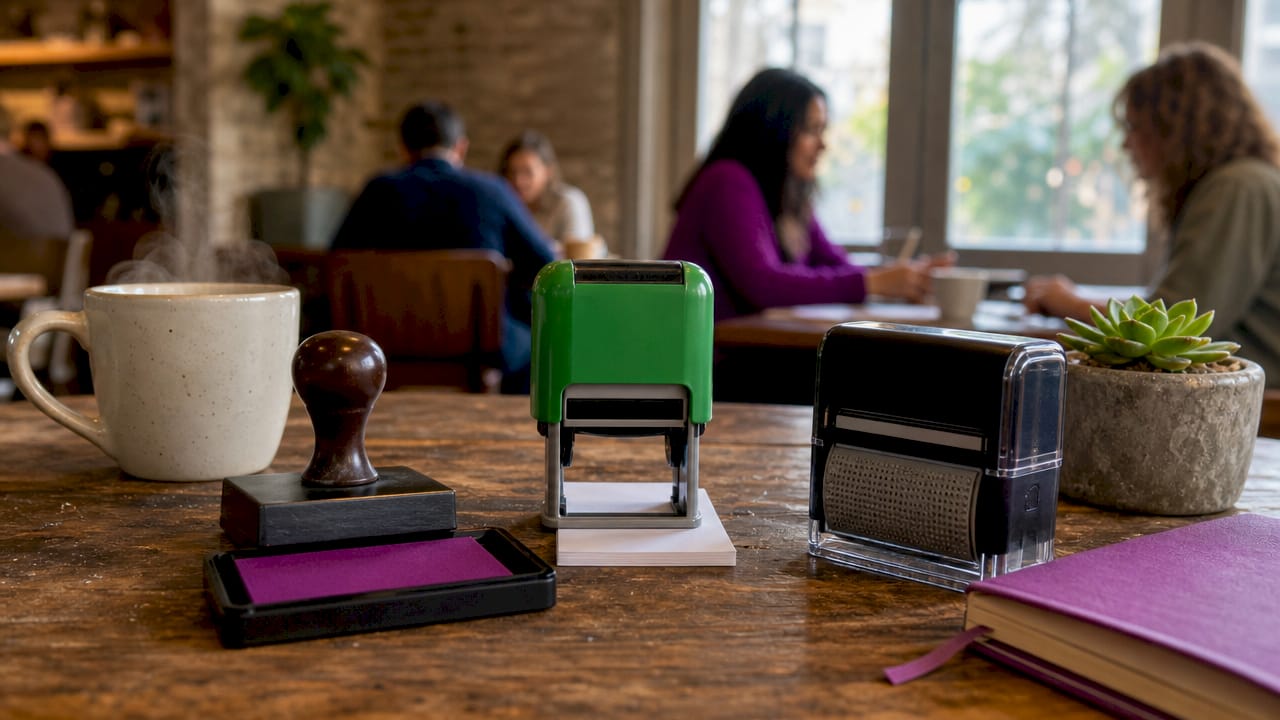
Traditional rubber stamps
Traditional stamps use a separate ink pad that the operator presses the die against before each impression. They offer the widest ink compatibility because you can swap pads freely. The trade-off is speed: each impression requires a separate inking step. These suit low-volume tasks and craft projects where ink colour variety matters.
Self-inking stamps
Self-inking stamps contain an integrated pad that re-inks the die automatically after each impression. They produce consistent results at speed, making them the standard choice for office use. The pad is replaceable, though ink colour options are narrower than with separate pads. For a detailed comparison of these two formats, the self-inking vs pre-inked guide from Stampdesign4u covers the key differences clearly.
Pre-inked stamps
Pre-inked stamps hold ink inside a porous die. They deliver the sharpest impressions of the three types, making them ideal for fine logos or small text. The die releases ink gradually, so no separate pad is needed. When the ink runs out, the die can be re-inked, though this process requires the correct ink formulation.
| Type | Ink source | Best for | Key limitation |
|---|---|---|---|
| Traditional | Separate pad | Craft, low volume | Slower, two-step process |
| Self-inking | Built-in pad | Office, high volume | Fewer ink colour options |
| Pre-inked | Inside the die | Fine detail, logos | Specific re-inking ink required |
Pro Tip: If you stamp more than 30 times per day, a self-inking model will save significant time and produce more consistent results than a traditional stamp.
How to use a handstamp effectively
Clean, sharp impressions depend on technique as much as equipment. The most common errors are rocking the stamp sideways or pressing unevenly, both of which blur the design.
Follow these steps for a reliable result every time:
- Prepare the surface. Remove dust, moisture, or grease from the area you plan to stamp. Contaminants prevent ink from bonding cleanly.
- Ink the die. For traditional stamps, press the die firmly onto the ink pad two or three times. For self-inking and pre-inked models, no separate inking step is needed.
- Position the stamp. Place it flat on the surface without tilting. Align it visually before applying pressure.
- Press firmly and hold. Apply even pressure with both hands for approximately two seconds. Uneven pressure produces a partial impression.
- Lift straight up. Pull the stamp directly upward without sliding or rocking. Any lateral movement smears the wet ink.
- Inspect the impression. Check for gaps or smudging before moving on. If the impression is incomplete, re-ink and repeat.
Choosing the right ink for your surface
Surface type determines ink choice. Standard office ink works on porous materials such as paper, card, and uncoated envelopes. For non-porous surfaces like glossy packaging, coated card, or plastic, standard ink will not dry properly and will smear indefinitely. Solvent-based or quick-dry inks are the correct choice for these materials.
Selecting the right combination of stamp material and ink is covered in detail in the Stampdesign4u guide on stamp materials and durability.
Pro Tip: Always test your ink and surface combination on a scrap piece before committing to a full run. A five-second test prevents wasted stock and rework.
Handstamp vs rubber stamp: what is the difference?
The terms overlap, but they are not identical. All handstamps are operated by hand, but not every rubber stamp qualifies as a handstamp in the traditional sense.
The distinction matters most in postal and philatelic contexts. A handstamp, in that setting, refers specifically to a manually operated postal tool used to apply cancellations or cachets. A rubber stamp is a broader category that includes self-inking and pre-inked models, which may use rubber, photopolymer, or other die materials.
Key distinctions between the two terms:
- Handstamp refers to manual operation and often implies a traditional or postal-style device.
- Rubber stamp is a category name covering multiple mechanism types, including self-inking and pre-inked formats.
- Self-inking and pre-inked stamps are technically rubber stamps but are rarely called handstamps in postal usage.
- In general business contexts, the two terms are used interchangeably without meaningful consequence.
The practical takeaway: if you are purchasing a stamp for office or branding use, the category label matters less than the mechanism type, ink compatibility, and impression quality.
What are the main applications of handstamps?
Handstamps serve postal services as the primary tool for cancelling postage and recording mailing location and date, preventing stamp reuse. That function has not changed since the 19th century. What has changed is the range of non-postal applications.
Businesses use custom handstamps across a wide range of workflows:
- Branding and packaging. Stamping a logo or address onto kraft paper bags, cardboard boxes, or tissue paper creates a professional finish without the cost of printed packaging.
- Event entry and security. Handstamps applied to the back of a hand mark paid entry at events. The ink fades within hours, making it a practical and low-cost access control method.
- Dispatch and quality control. Warehouse teams use date stamps and “inspected” or “approved” stamps to mark batches as they move through a production or fulfilment process.
- Administrative marking. Offices use handstamps for “received,” “confidential,” or “paid” impressions on incoming documents, reducing manual writing and speeding up processing.
- Loyalty programmes. Retailers use small handstamps to mark loyalty cards, offering a tactile and branded alternative to digital tracking.
The cost advantage of handstamps over printed labels or digital alternatives is significant for small businesses. A single custom stamp produces thousands of impressions before requiring re-inking or replacement, making the per-impression cost negligible. Proper maintenance of rubber stamps extends that lifespan further. Removing fibres from the die and replacing ink pads on schedule keeps impression quality consistent across the full working life of the tool.
Key takeaways
A handstamp is the most direct, cost-effective tool for applying repeatable marks to documents, packaging, or postal items, provided you match the stamp type and ink to your surface.
| Point | Details |
|---|---|
| Handstamp definition | A manual device that transfers an inked impression onto a surface through hand pressure. |
| Three stamp types | Traditional, self-inking, and pre-inked stamps each suit different volumes and surfaces. |
| Technique matters | Press flat, hold for two seconds, and lift straight up to avoid smudging. |
| Ink and surface matching | Use solvent-based or quick-dry ink on non-porous surfaces; standard ink fails on glossy materials. |
| Wide business applications | Handstamps cover branding, dispatch, event entry, loyalty programmes, and administrative marking. |
Why substrate comes before stamp type every time
Most buyers focus on the stamp mechanism first and the ink second. That is the wrong order. The surface you are stamping onto determines everything else: which ink you need, which die material holds up, and how long each impression takes to dry.
I have seen businesses invest in high-quality pre-inked stamps for branded packaging, only to find the impressions smear because the packaging uses a coated finish. The stamp was not the problem. The ink was. Switching to a quick-dry formulation solved it immediately.
The same logic applies to maintenance. Cleaning and re-inking on a regular schedule is not optional if you want consistent quality. Fibres from paper accumulate in the die over time and degrade impression sharpness. A quick clean after every 200 or so impressions takes under a minute and extends the stamp’s working life considerably.
My honest recommendation: before ordering any stamp, stamp your actual surface with a test ink. Not a similar surface. Not a substitute. The exact material you will use in production. That single step eliminates the most common complaints about poor impression quality.
— Steven
Custom handstamps from Stampdesign4u
Stampdesign4u offers traditional, self-inking, and pre-inked handstamps, all available with custom text, logos, and address layouts. The range covers individual use through to high-volume business applications.
The Trodat 4927 logo and text stamp is a popular choice for businesses needing a 60 x 40mm impression area with up to nine lines of text or a logo. For retail and hospitality, the loyalty stamp collection provides compact, durable options for card-marking programmes. Businesses focused on presentation can browse the personalised packaging stamps range for custom branding on boxes, bags, and wrapping materials.
FAQ
What is a handstamp used for?
A handstamp is used to apply repeatable inked impressions onto documents, packaging, postal items, and event entry materials. Businesses use them for branding, dispatch marking, quality control, and loyalty card programmes.
What is the difference between a handstamp and a rubber stamp?
A handstamp is any manually operated stamping device, while a rubber stamp is a broader category that includes self-inking and pre-inked mechanisms. In postal contexts, “handstamp” refers specifically to a tool used by postal workers for cancellations.
How do I avoid smudging when using a handstamp?
Press the stamp flat with even pressure, hold for two seconds, and lift straight up without sliding or rocking. On non-porous surfaces, use solvent-based or quick-dry ink rather than standard office ink.
Which type of handstamp is best for high-volume use?
Self-inking stamps are the best choice for high-volume use because the pad re-inks the die automatically after each impression, maintaining consistent quality without a separate inking step.
How do I maintain a handstamp?
Regular maintenance involves removing paper fibres from the die and replacing or re-inking the pad on a set schedule. Clean dies produce sharper impressions and extend the working life of the stamp significantly.