

TL;DR:
- Embossing stamps create textured or raised impressions on various materials, with different types suited for specific effects.
- While commercial methods like registered and multi-level embossing achieve precise, sculptural results, crafters primarily use heat embossing and embossing folders for their simplicity and affordability.
Embossing stamps are tools that create raised or textured impressions on paper, card, and packaging, and the main types of embossing stamps include blind embossing, registered embossing, combination embossing, multi-level embossing, heat embossing, and embossing folders. Each method produces a distinct tactile or visual finish, from the understated elegance of a pressure-only impression to the bold metallic shine of foil embossing. Whether you are making greeting cards, designing business stationery, or adding polish to product packaging, understanding what an embossing stamp does and which technique suits your goal is the fastest route to professional results. Tools like VersaMark ink, embossing powder, and embossing folders each play a role depending on the method you choose.
1. Types of embossing stamps: an overview
The four core embossing types used in branding and print are blind embossing, registered embossing, combination embossing, and multi-level embossing. These correspond to a spectrum of visibility and texture, from subtle light-and-shadow play to complex three-dimensional sculpting. For crafters, heat embossing and embossing folders extend that range into accessible, hands-on territory. Knowing where each method sits on that spectrum helps you match technique to budget, skill level, and the impression you want to leave.
2. Blind embossing: subtle texture without ink or foil
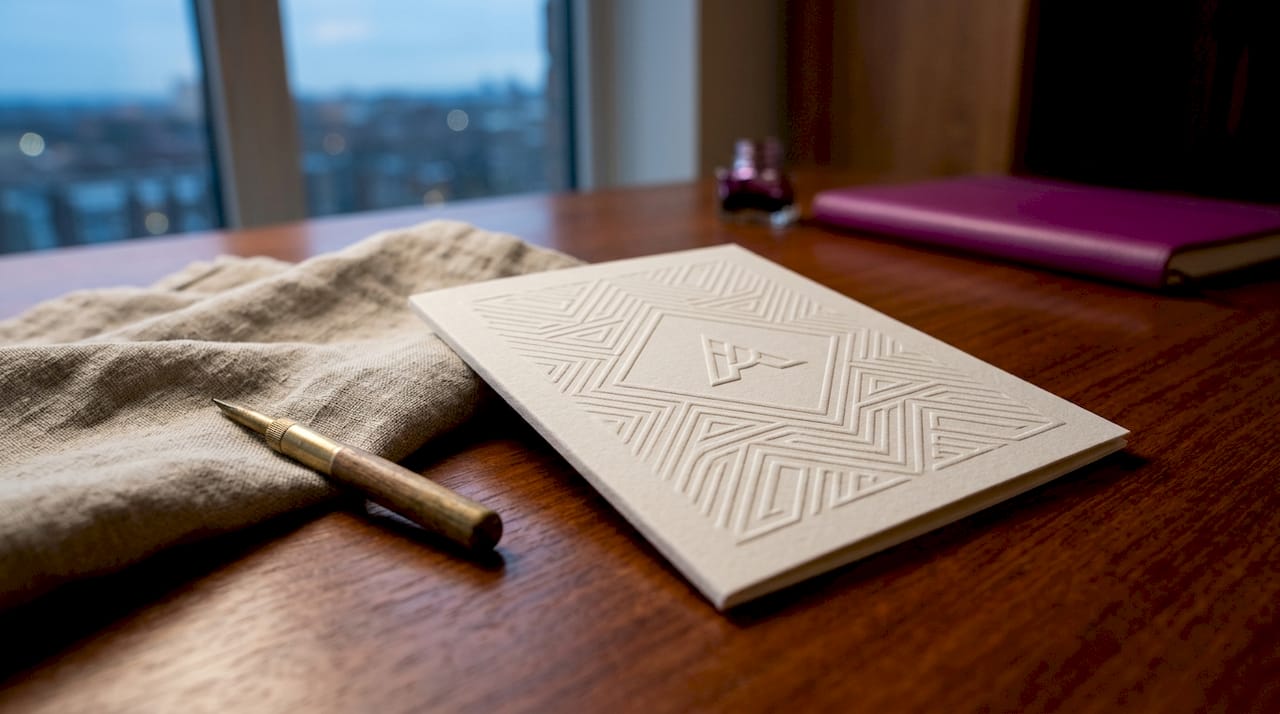
Blind embossing creates raised impressions without any ink or foil, relying entirely on pressure to reshape paper fibres into a relief design. The result is a minimalist, tactile effect that catches light rather than colour, making it a favourite for premium stationery, business cards, and packaging where restraint signals quality. It is the technique behind the quiet luxury aesthetic you see on high-end notepaper and boutique brand packaging.
The technique works by pressing a male die against a female die with the paper sandwiched between them. The paper fibres compress and stretch to hold the shape permanently. Heavier, uncoated paper stocks such as cotton or laid paper hold fine detail far better than thin coated sheets, which can crack or lose definition under pressure.
Common applications for blind embossing:
- Premium business cards and letterheads
- Book covers and journal bindings
- Product packaging for cosmetics and spirits
- Wedding stationery and formal invitations
Pro Tip: Choose a paper weight of at least 300gsm for blind embossing. Lighter stocks struggle to hold crisp detail and may tear at fine edges.
Blind embossing favours minimalist branding that lets paper texture and natural highlights do the work, without competing with ink or foil elements. For small businesses wanting to signal quality on a modest print run, it is one of the most cost-effective premium finishes available.
3. Registered embossing: precision alignment with printed artwork
Registered embossing aligns a raised impression exactly with pre-printed artwork, so the embossed area sits perfectly within or around a printed logo, border, or illustration. The visual result is a cohesive, layered design where print and texture reinforce each other rather than sitting independently on the page. This is the technique used on branded business cards where a logo appears both printed and raised simultaneously.
Registered embossing demands tight engineering control for die and print alignment within sub-millimetre tolerances, which puts it firmly in commercial production territory rather than DIY crafting. Even a fraction of a millimetre of misalignment makes the embossed area visibly off-centre from the printed design, undermining the entire effect.
What registered embossing requires for best results:
- A custom die machined to match the exact dimensions of the printed artwork
- Consistent paper registration on the press to prevent sheet-to-sheet variation
- Controlled humidity in the print environment, as paper expands and contracts with moisture
- A skilled operator who can make micro-adjustments during the run
Registered embossing is the right choice when your brand identity depends on precise, repeatable presentation across large print runs. For small businesses, commissioning registered embossing through a specialist commercial printer is the practical route, rather than attempting it with desktop equipment.
4. Combination embossing: adding foil for maximum impact
Combination embossing, also called foil embossing, applies heated metallic or coloured foil at the same time as the embossing impression, producing a shiny raised design in a single press operation. The foil bonds to the raised area under heat and pressure, creating a finish that is both tactile and visually striking. You see this technique on luxury wedding invitations, premium gift boxes, and high-end book covers.
The process combines two finishing operations into one, which reduces production time compared to applying foil and embossing separately. However, the tooling cost is higher because the die must be engineered to handle both functions simultaneously.
Foil finish options available in combination embossing:
- Metallic foil: Gold, silver, copper, and bronze for classic luxury effects
- Holographic foil: Rainbow-shifting patterns for high-visibility packaging
- Matte foil: Flat, non-reflective colour for contemporary or understated designs
- Pigment foil: Solid opaque colours for brand-matched finishes
| Finish type | Visual effect | Best suited for |
|---|---|---|
| Metallic | High shine, light-reflective | Invitations, certificates, premium packaging |
| Holographic | Colour-shifting, eye-catching | Retail packaging, promotional materials |
| Matte | Flat, tactile, modern | Contemporary branding, book covers |
| Pigment | Solid colour, opaque | Brand-colour matching on stationery |
Combination embossing carries a higher unit cost than blind embossing, but the visual impact justifies the investment for products where shelf presence or perceived value drives purchasing decisions.
5. Multi-level embossing: sculptural, three-dimensional effects
Multi-level embossing uses complex dies with varying depths to create different relief heights within a single design, producing sculptural, lifelike textures that standard embossing cannot achieve. A floral motif, for example, might have petals at one depth, leaves at a shallower level, and a stem at a third, giving the impression of a real three-dimensional object pressed into the surface. The effect is immediately noticeable to the touch and visually arresting under directional light.
Specialty pattern embossing includes full-surface, spot texture, micro-pattern, and multi-level variants, each requiring different die types. Roller dies suit continuous full-surface patterns, while plate dies handle spot and multi-level work with greater precision. The choice of die type affects both the clarity of the finished texture and the cost of tooling.
| Embossing type | Depth variation | Production complexity | Typical cost level |
|---|---|---|---|
| Standard blind | Single level | Low | Low to medium |
| Multi-level | Multiple depths | High | High |
| Combination foil | Single level with foil | Medium | Medium to high |
Multi-level embossing is used mainly for luxury packaging and artistic presentations where tactile impact is the primary goal. For small businesses, it is worth commissioning for flagship products or limited-edition packaging where the premium finish directly supports a higher retail price.
Pro Tip: Ask your printer for a physical sample die proof before approving a multi-level embossing run. The depth relationships between levels are difficult to judge from digital artwork alone.
6. Heat embossing: the crafter’s go-to technique
Heat embossing is the most accessible of all the different embossing techniques for crafters, requiring only a stamp, embossing ink, embossing powder, and a heat tool to produce glossy, raised designs on paper and card. The process is fast, repeatable, and produces results that rival commercial finishes when executed correctly. It is the foundation of card making with embossing stamps at every skill level, from beginner to professional.
Heat embossing uses tacky ink like VersaMark, powder, and a heat tool to produce raised designs, with surface preparation preventing stray powder. The sequence matters: stamp, apply powder immediately while the ink is still tacky, tap off the excess, then heat from below or the side until the powder melts and fuses into a smooth raised surface.
Step-by-step heat embossing process:
- Stamp your design using VersaMark or a dedicated embossing ink pad
- Pour embossing powder over the wet ink immediately and tap off the excess
- Use an anti-static tool or embossing buddy on the paper before stamping to prevent stray powder clinging to the surface
- Apply heat from a heat gun, moving it steadily until the powder melts and becomes glossy
- Allow the embossed area to cool for 10 to 15 seconds before handling
Rapid stamping followed immediately by powder application prevents ink tack loss and patchy embossing. If you wait too long between stamping and powdering, the ink begins to dry and the powder will not adhere evenly, leaving gaps in the raised design.
Pro Tip: Use a dedicated heat gun rather than a hairdryer. Hairdryers disperse powder before it melts and produce uneven results. A heat gun concentrates heat precisely where you need it.
7. Embossing folders: texture at the press of a machine
Embossing folders create raised and recessed textures by sandwiching card between two patterned plates and running them through a die-cutting machine such as a Sizzix Big Shot or Spellbinders Platinum. The folder’s top plate creates the raised side and the bottom plate creates the recessed side. Flipping the folder reverses the effect, giving you two distinct looks from a single tool.
Folders are particularly well suited to card making with embossing stamps because they apply consistent texture across an entire panel or a precise spot area in seconds. Combining a folder-embossed background with a heat-embossed focal image is one of the most popular techniques in contemporary papercrafting. Highlighting the raised areas with ink applied by a blending tool adds further dimension and contrast.
The range of embossing stamp designs available in folder format is extensive, covering geometric patterns, florals, script textures, seasonal motifs, and abstract surfaces. Brands like Spellbinders, Tim Holtz, and Sizzix release new folder collections regularly, meaning the design options for crafters expand continuously.
Key takeaways
Choosing the right embossing method requires matching the technique’s visual output, tooling cost, and production complexity to your specific project or branding goal.
| Point | Details |
|---|---|
| Blind embossing suits minimalist branding | Use on premium paper stocks of 300gsm or above for crisp, ink-free raised impressions. |
| Registered embossing is a commercial process | Requires sub-millimetre die-to-print alignment; commission through a specialist printer for best results. |
| Combination embossing maximises visual impact | Foil and embossing in one press operation; metallic, holographic, and matte finishes are all available. |
| Heat embossing is the most accessible method | VersaMark ink, embossing powder, and a heat gun produce professional raised designs at home or in small batches. |
| Embossing folders offer repeatable texture | A die-cutting machine and folder deliver consistent full-panel or spot embossing for card making and crafting. |
Which embossing type actually suits your project?
I have worked with every method on this list, and the most common mistake I see is choosing a technique based on the finished look rather than the production reality. Multi-level embossing photographs beautifully in supplier catalogues, but if you are producing 200 branded mailers for a small business launch, the tooling cost alone will consume a significant portion of your print budget before a single sheet is run.
My honest recommendation for small business owners is to start with blind embossing or combination embossing on a short commercial run. Both techniques are well understood by most trade printers, the tooling is relatively affordable, and the results are immediately legible as premium quality to a customer holding your card or package. You can read more about custom stamps for branding to see how these finishes translate into real business identity work.
For crafters, heat embossing is where I would tell anyone to begin. The learning curve is short, the materials are inexpensive, and the technique teaches you the fundamentals of ink tackiness, powder behaviour, and heat control that underpin every other embossing method. Once you understand why rapid powder application matters, the logic of commercial embossing dies makes far more sense. Embossing folders are the natural next step, adding texture at scale without the timing pressure of heat embossing.
The overlooked combination is heat embossing over a folder-embossed background. The folder creates a subtle all-over texture, and the heat-embossed focal image sits above it with its own distinct raised finish. The result looks far more complex than the two steps involved, and it costs almost nothing beyond the tools you already own.
— Steven
Explore custom embossing stamps from Stampdesign4u
Stampdesign4u offers a range of custom rubber stamps suited to both crafting projects and business branding, with personalisation options that let you upload your own logo or design text layouts to match your identity. The Trodat 4927 logo and text stamp is a practical choice for businesses wanting a repeatable, professional impression on correspondence, packaging, and stationery. For loyalty and promotional use, the Traxx 9021 loyalty stamp offers a compact, purpose-built option. Browse the full catalogue at Stampdesign4u to find the stamp format that fits your project, whether you are a crafter working in small batches or a business owner building a consistent brand presence.
FAQ
What are the main types of embossing stamps?
The main types are blind embossing, registered embossing, combination embossing, multi-level embossing, heat embossing, and embossing folders. Each produces a different tactile or visual finish suited to specific crafting or branding applications.
How do you use embossing stamps for card making?
Apply VersaMark or embossing ink to your stamp, press it onto card, immediately cover the wet ink with embossing powder, tap off the excess, then heat with a heat gun until the powder melts into a raised glossy design.
What is the difference between blind embossing and combination embossing?
Blind embossing uses pressure alone to create a raised impression with no ink or foil, while combination embossing adds heated metallic or coloured foil to the raised area simultaneously, producing a shiny, high-contrast finish.
Can crafters do registered embossing at home?
Registered embossing requires sub-millimetre alignment between a die and pre-printed artwork, making it impractical for home or small-batch production. It is best commissioned through a commercial printer with the correct press setup.
What paper works best for embossing?
Uncoated paper stocks of 300gsm or above hold embossed detail most reliably. Thin or heavily coated papers can crack or lose definition under the pressure required to form a clean raised impression.