

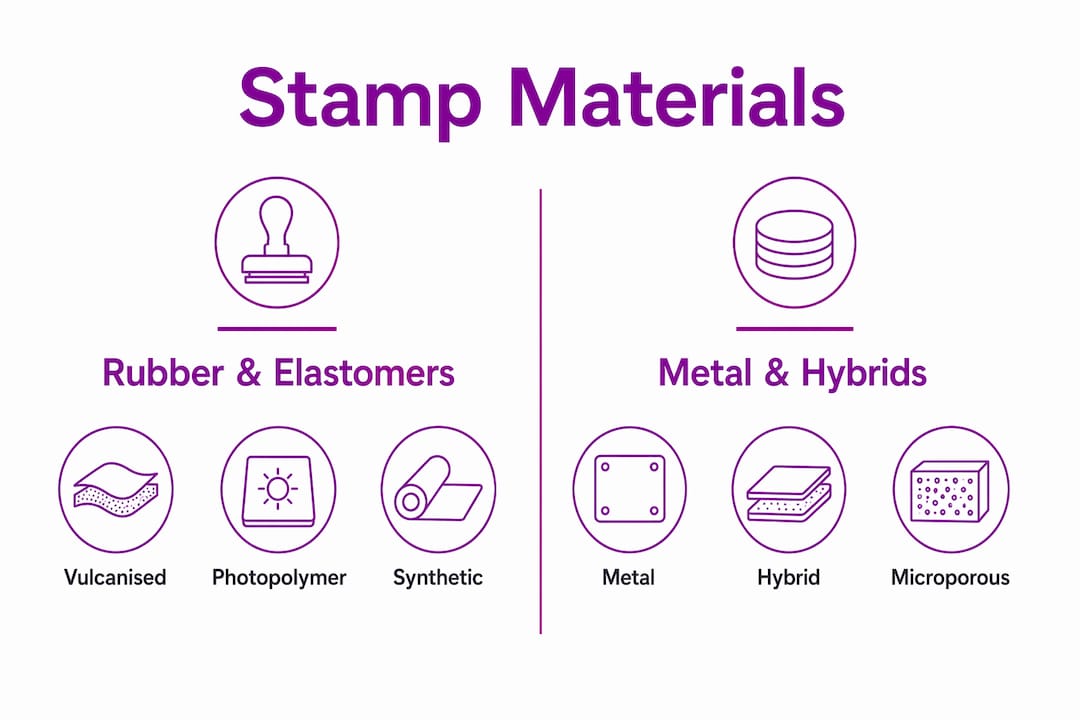
Modern stamp materials fall into four main categories: vulcanised rubber, photopolymer resin, synthetic elastomers, and metal. Each carries distinct properties that directly affect impression quality, durability, ink compatibility, and cost. Choosing the wrong material for your application leads to blurred impressions, premature wear, and wasted expenditure. The guide below covers every major material type, their trade-offs, and the practical criteria that matter most for individuals and small business buyers.
Key material categories at a glance:
- Vulcanised rubber: the standard for high-volume, high-clarity applications; handles oil, water, and solvent-based inks
- Photopolymer resin: UV-cured for maximum detail resolution; best suited to controlled indoor environments
- Synthetic elastomers (nitrile, silicone, EPDM): engineered for chemical resistance or food-grade requirements
- Metal (stainless steel, brass): rigid, extremely durable, used in industrial and embossing applications
- Handle and mount materials: wood (typically hard rock maple), acrylic, and plastic, each affecting ergonomics and longevity
Modern stamp materials explained: properties, uses, and handles
Understanding each material in depth is the foundation of any informed purchasing decision. The sections below cover the core characteristics, practical strengths, and known limitations of every major stamp material in use today.
Vulcanised rubber
Vulcanised rubber remains the preferred choice for high-volume commercial stamp applications, owing to its exceptional rebound and durability. The vulcanisation process treats raw rubber under heat and pressure, typically around 900 lb (408.6 kg) per square inch for approximately three minutes, which transforms the molecular structure and dramatically improves strength and chemical stability. The result is a material that can reproduce fine lines with high clarity and withstand many impressions without significant degradation.
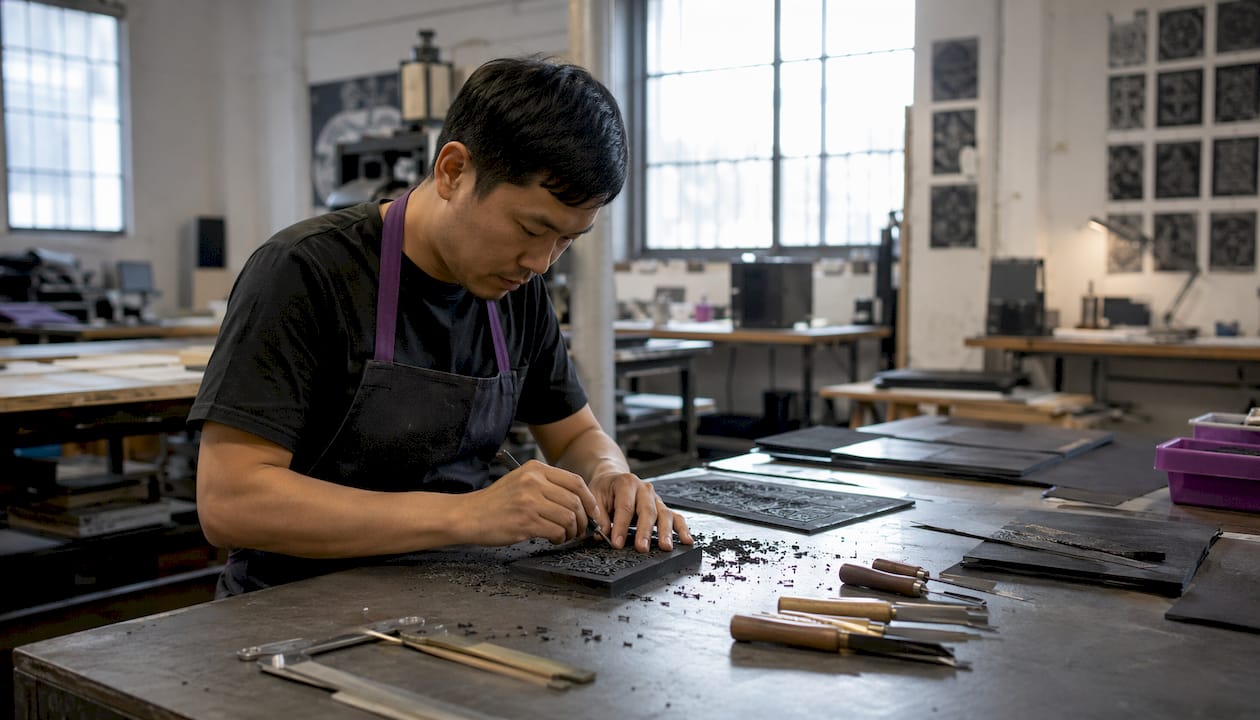
Its flexibility allows it to conform to slightly uneven surfaces, and it accepts a wide range of inks without special preparation. The main drawback is sensitivity to ozone, UV light, and petroleum-based solvents, which rules it out for outdoor signage or industrial solvent-ink environments. For custom logo stamps and notary seals, vulcanised rubber is consistently the most reliable choice.
Photopolymer resin
Photopolymer is a UV-cured material that starts as liquid resin and hardens when exposed to ultraviolet light through a design negative. It delivers high resolution detail, making it well suited to intricate artwork and micro-text. Turnaround is fast: expose, wash, and mount, often within an hour.
The trade-off is brittleness. Photopolymer stamps degrade under prolonged UV exposure and can crack under impact, so they perform best in controlled office environments rather than field use. Strongly solvent-based inks can also swell the polymer over time, reducing impression accuracy. Cycle life is fewer impressions compared to vulcanised rubber, reflecting its more delicate composition.
Synthetic elastomers: nitrile, silicone, and EPDM
Nitrile rubber (NBR) trades some fine-line capability for chemical toughness. It resists oils, greases, and alcohol-based inks, which makes it the practical choice for warehouse floor marking, automotive part tagging, and food-processing facility labels. Its minimum line width is somewhat coarser than natural rubber, but it maintains dimensional stability across a wide temperature range and shows minimal swelling when used repeatedly with fast-drying alcohol inks.
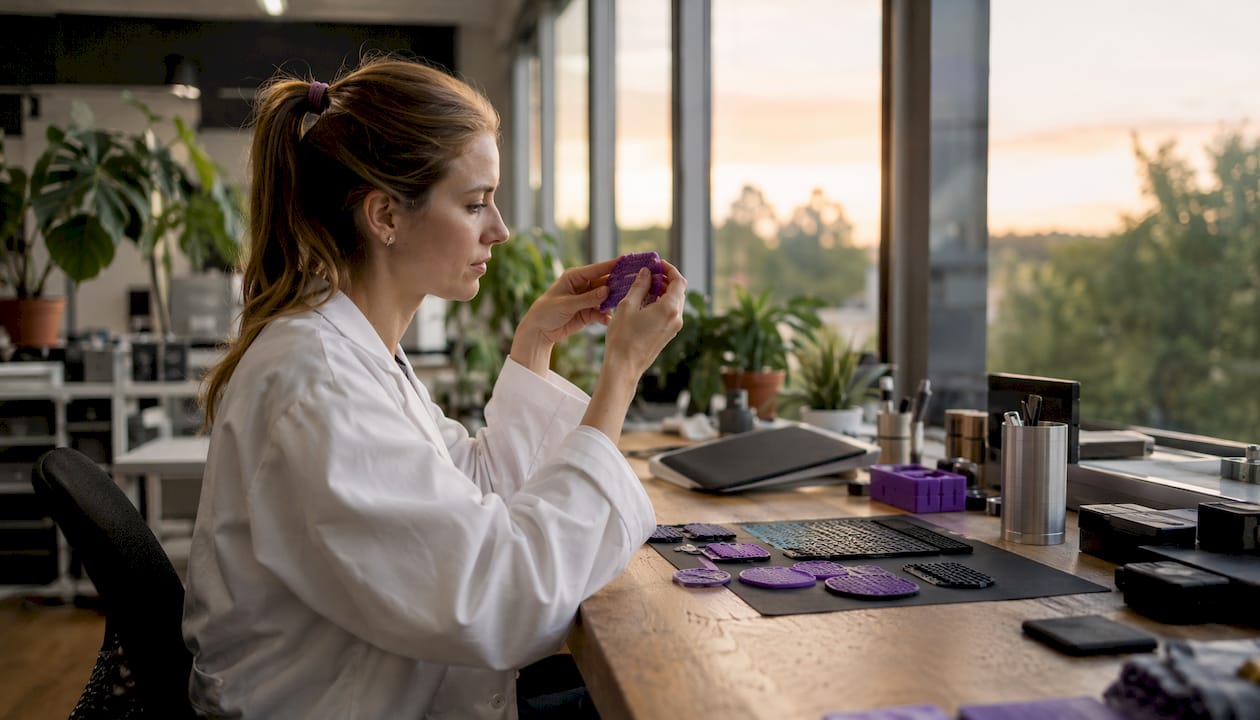
Silicone occupies a different niche entirely. It is chemically inert, naturally non-porous, and heat-resistant, making it the standard for food-grade stamp applications such as bakery logos. The downside is low surface energy, which means many standard inks bead rather than transfer cleanly. A silicone-specific ink or primer is usually required. EPDM and polyurethane elastomers sit between nitrile and silicone in terms of chemical resistance, and both can be laser-etched or CNC-machined without a dedicated UV exposure unit.
Metal stamps
Metal stamps offer high durability and precise detail, but they are limited to flat surfaces and require specialised CNC or EDM fabrication. Stainless steel and brass are the most common metals used, with cycle lives exceeding 100,000 impressions under normal stamping forces. The perfectly flat surface yields uniformly deep impressions, and metal can be combined with elastomeric pads for self-inking systems.
Cost is the primary barrier. CNC and EDM equipment is expensive, and setup costs make metal stamps economical only for long production runs or applications where absolute durability is non-negotiable, such as manufacturing part marking or embossing official documents.
Handle and mount materials
The handle material affects ergonomics, longevity, and how the stamp behaves under repeated use. Hard rock maple is the traditional choice for wooden handles, often superior in density to furniture-grade maple, and is hand-rubbed with linseed oil to resist warping from humidity changes. Acrylic handles are used with clear photopolymer stamps because their transparency allows precise placement on symmetrical designs. Plastic mounts are standard on self-inking commercial stamps, housing both the rubber plate and the internal ink pad within a single unit.
Material and handle feature highlights:
- Vulcanised rubber on maple: proven durability, broad ink compatibility, traditional feel
- Photopolymer on acrylic: transparent block enables precise alignment, best for detailed artwork
- Nitrile rubber on plastic mount: chemical resistance, suited to self-inking industrial stamps
- Silicone on oven-cured mould: food-grade safe, heat-resistant, requires specialist ink
- Metal on plastic or wood handle: maximum cycle life, flat-surface applications only
How do the main stamp materials compare?
The table below sets out the key performance criteria side by side. Cost figures are indicative and reflect typical material costs rather than finished stamp retail prices.
| Material | Durability (impressions) | Detail resolution | Ink compatibility | Typical use cases | Relative cost |
|---|---|---|---|---|---|
| Vulcanised rubber | 10,000–30,000 | 0.15 mm line width | Oil, water, solvent-based | Commercial stamps, notary seals, branding | Low to moderate |
| Photopolymer resin | — | 0.08 mm line width | Water-based, pigment (avoid strong solvents) | Artistic stamps, fine lettering, craft | Moderate |
| Nitrile rubber (NBR) | — | 0.25 mm line width | Solvent, alcohol, oil-based | Industrial, warehouse, food processing | Moderate |
| Silicone | — | — | Silicone-specific inks, food dyes | Food-grade, heat-resistant applications | High |
| Metal (stainless steel) | 100,000+ | — | Standard inks via pad | Manufacturing, embossing, long-run industrial | Very high |
A few trade-offs are worth highlighting. Photopolymer wins on resolution but loses on durability and solvent tolerance. Vulcanised rubber offers the best all-round balance for most small business buyers: broad ink compatibility, solid cycle life, and lower material cost. Nitrile rubber is the correct choice when solvent or alcohol inks are involved, even though its detail ceiling is lower. Metal is the only material that genuinely scales to industrial volumes, but the fabrication cost makes it impractical for anything below very high-run production.
Hybrid stamps, which combine a photopolymer face bonded to a rubber backing, are an increasingly practical middle ground. They preserve fine-line detail while the rubber backing absorbs compression stress, extending the stamp’s working life beyond what photopolymer alone would achieve.
How do ink type and design complexity affect your material choice?
Ink chemistry and design detail are the two factors most buyers underestimate when selecting stamp materials. Getting either wrong produces blotching, incomplete transfer, or accelerated material wear.
Ink categories and their interactions with stamp materials:
Water-based inks work with virtually all stamp materials and dry slowly, which suits office environments but can smear on non-absorbent substrates. Solvent-based inks dry quickly and produce vivid colour, but acetone-rich formulations will rapidly degrade natural rubber, and methyl ethyl ketone (MEK) attacks many photopolymers. UV-curable inks require a UV lamp after application and work best with metal, polyurethane, and certain elastomers. Always cross-check the rubber’s chemical resistance data against the ink’s Safety Data Sheet before committing to a material.
Proper ink formulation and matching rubber hardness prevent stamp wear and ink blotching, directly improving impression longevity. Softer rubbers in the 30–45 Shore A range conform well to rough or uneven surfaces such as burlap or recycled paper, but they wear faster and blur fine details. Harder rubbers in the 55–70 Shore A range maintain sharp edges longer and resist deformation during high-speed stamping, yet they may skip over heavily textured surfaces.
Design complexity adds another layer. Photopolymer handles fine lines down to 0.08 mm and is the right material for micro-text or intricate artwork. Vulcanised rubber holds fine edges reliably at 0.15 mm under repeated pressure, making it the better choice for small text that must remain legible across thousands of impressions. Nitrile rubber’s 0.25 mm minimum line width rules it out for highly detailed designs, but it is entirely adequate for bold text, barcodes, and simple logos.
Compatibility tips for buyers:
- Match rubber hardness (Shore A) to your substrate: softer for rough or textured surfaces, harder for smooth flat materials
- For solvent or alcohol inks, specify nitrile rubber rather than natural rubber or photopolymer
- For food contact applications, request written compliance documentation rather than relying on a “non-toxic” label
- Test any new ink-and-rubber combination with a 30-second soak test before committing to a full production run
- Mirror your design file before laser engraving to produce a correct impression
Why material quality directly affects your stamp’s reliability and brand perception
Poor material quality produces predictable, avoidable problems: fading impressions, blurred edges, ink blotching, and stamps that fail well before their expected cycle life. For a small business, a stamp that delivers inconsistent impressions on invoices, packaging, or correspondence undermines the professional image that the stamp was purchased to reinforce.
Material fatigue is a specific risk with lower-grade rubbers. Worn rubber loses its ability to fully release ink, causing residual transfer or “ghosting” around the impression edge. Ink swelling, where the rubber absorbs solvent components from incompatible inks and expands, distorts the relief surface and widens fine lines. Environmental degradation from UV exposure or ozone attack causes surface cracking, particularly in natural rubber stored near windows or in unheated spaces.
Certification provides a practical quality benchmark. Rubber compliant with FDA 21 CFR §177.2600 or EU Regulation (EC) No 1935/2004 meets verified standards for food contact safety. For general commercial use, requesting an ASTM D2000 classification code from your supplier, such as “AA710” for nitrile rubber meeting specific tensile and elongation standards, confirms that the material has been manufactured to a defined specification rather than a vague “premium grade” claim.
Investing in quality materials reduces rework, lowers the frequency of stamp replacement, and produces the consistent impressions that build credibility with customers and colleagues. The right stamp material for your application is not always the most expensive option, but it is always the one matched to your ink type, volume, and substrate.
Signs of substandard stamp material:
- Impressions fade or blur after fewer than 1,000 uses
- Rubber surface feels tacky or shows surface cracking after short storage
- Fine lines fill in or bleed after repeated inking
- Stamp swells visibly after contact with solvent-based inks
- No material certification or ASTM classification available from the supplier
Pro Tip: Avoid PVC-based rubber entirely. When laser engraved, PVC releases chlorine gas, which is hazardous to operators and corrodes laser optics. The Health and Safety Executive identifies PVC rubber as contraindicated for laser engraving. Always confirm your rubber is laser-safe before cutting.
Expert insights: advanced materials, laser engraving, and sustainability
The stamp materials market has moved well beyond the choice between vulcanised rubber and basic photopolymer. Several developments are worth knowing about if you are specifying stamps for commercial production or evaluating longer-term material investments.
Laser engraving and material selection
Laser engraving has become the dominant production method for custom rubber stamps because it is fast, repeatable, and requires no physical mould. CO₂ lasers outperform diode lasers for production work, delivering better depth control and cleaner edges on rubber. Laser engraving rubber responds best to medium-high laser power at slow speed to avoid melting and produce crisp lines. Recommended settings typically involve 80–100% power and head velocity of 2–20% depending on machine wattage, with a DPI range of 300–600.
Not all rubbers are suitable. Laser-specific contract-grade rubbers vaporise cleanly, preventing fume damage and producing sharp edges. Natural rubber vulcanisates containing chlorine pose risks if laser-engraved. Silicone melts rather than vaporises and produces uneven results. EPDM delivers poor engraving quality and is not recommended for stamp production. After engraving, the rubber must be washed immediately with detergent and water to remove burnt residue. Delayed cleaning makes residue significantly harder to remove and compromises impression clarity.
Flash stamps and microporous rubber
Flash stamps use microporous rubber that holds ink internally, enabling multi-colour impressions without a separate ink pad. This makes them a practical option for branding and craft applications at low to medium volumes. They are less suited to industrial, high-volume use compared to vulcanised rubber, but their ink efficiency and compact format make them a genuine premium alternative for small business buyers who need clean, pad-free stamping.
Hybrid UV and heat-curing technologies
A newer class of dual-cure photopolymers can be partially UV-cured for rapid prototyping and then heat-cured to lock in final hardness. This extends stamp lifespan beyond what standard UV-only photopolymer achieves and reduces the brittleness that limits photopolymer in field conditions. Hybrid stamps combining a photopolymer face with a rubber backing take a similar approach, balancing cost with detail and durability for commercial custom stamp production.
Environmental and sustainability considerations
Bio-based elastomers derived from Hevea latex blends are under active development. These materials cure at lower temperatures and are biodegradable, addressing the environmental concerns associated with conventional vulcanisation chemistry. Solvent-free photopolymers and food-grade silicone carry lower hazard profiles than traditional vulcanised rubber mixtures. For buyers with sustainability requirements, specifying solvent-free materials and requesting Safety Data Sheets from suppliers is the most reliable way to verify environmental credentials rather than relying on marketing claims.
Key advances in stamp materials:
- Laser-specific rubber sheets vaporise cleanly and are the only safe choice for CO₂ laser production
- Flash stamps with microporous rubber deliver multi-colour impressions without a pad, suited to branding at low to medium volumes
- Dual-cure photopolymers extend lifespan by combining UV and heat curing in sequence
- Hybrid photopolymer-face-plus-rubber-backing stamps reduce material cost while preserving fine-line detail
- Bio-based elastomers offer a lower-temperature, biodegradable alternative to conventional vulcanised rubber
- Solvent-free polymers and food-grade silicone carry lower environmental and operator hazard profiles
For buyers ordering custom stamps for branding, specifying the material type, laser compatibility, and ink system upfront avoids the most common production problems and ensures the finished stamp performs as expected across its full working life.
Get the right stamp material for your application
Stampdesign4u supplies custom stamps built from materials matched to your specific application, whether that is a high-volume self-inking office stamp, a food-safe silicone stamp for packaging, or a laser-engraved rubber stamp for branding. The Trodat Printy 4912 is a practical example of a quality rubber stamp suitable for logo and address use, available to order with a custom design. For packaging and despatch applications, Stampdesign4u’s personalised packaging stamps cover a range of sizes and formats. Every order is supported by material and design guidance to help you select the right specification from the outset.
Key takeaways
Vulcanised rubber remains the most versatile stamp material for small business buyers, offering broad ink compatibility, reliable fine-line reproduction, and a cycle life of 10,000–30,000 impressions.
| Point | Details |
|---|---|
| Vulcanised rubber leads on durability | It handles oil, water, and solvent-based inks and delivers 10,000–30,000 impressions before significant wear. |
| Photopolymer excels on resolution | It renders lines down to 0.08 mm but is brittle under impact and sensitive to UV, limiting it to indoor use. |
| Nitrile rubber suits solvent ink environments | Its chemical resistance to alcohol and oil-based inks makes it the correct choice for industrial and food-processing applications. |
| Material certification matters | Requesting ASTM D2000 classification or FDA 21 CFR §177.2600 compliance confirms the rubber meets a defined manufacturing standard. |
| Laser-safe rubber is non-negotiable for engraving | PVC rubber releases chlorine gas when laser-engraved; only laser-specific contract-grade rubber should be used in CO₂ laser production. |