

TL;DR:
- Custom stamps are an affordable way to create consistent brand marks on packaging and materials.
- They can be tailored to different volumes and surfaces, with types like rubber, self-inking, and pre-inked stamps.
Custom stamp branding, the industry term for using purpose-made stamps to apply consistent brand marks across physical materials, is one of the most cost-effective tools in a marketing professional’s kit. Organisational branding with stamps turns every package, receipt, and card into a deliberate brand touchpoint. A quality stamp produces thousands of clean impressions before it needs replacing, making it a one-time investment with long-term returns. Stampdesign4u supplies custom rubber and self-inking stamps to businesses across the UK and internationally, covering everything from logo stamps to multi-line text formats.
What are the different types of custom stamps for organisational branding?
Choosing the right stamp type is the first decision that shapes your entire branding programme. The four main categories are rubber, self-inking, pre-inked, and digital stamps. Each suits a different volume, surface, and branding context.
Rubber stamps are the most traditional option. They require a separate ink pad, which gives you full control over ink colour and type. That flexibility makes them well suited to creative branding applications where you want to switch colours between runs.
Self-inking stamps come pre-inked and ready to use, eliminating the need for a separate ink pad. They deliver clean, consistent impressions quickly, which makes them ideal for high-volume stamping on packaging lines or in busy despatch rooms.
Pre-inked stamps hold ink inside the die itself, producing sharper detail than self-inking models. They work particularly well for fine logo artwork where line clarity matters.
Digital stamps are image files used in digital workflows. They do not create a physical impression, so they sit outside the tactile branding category entirely. They are useful for email footers and digital documents, but they cannot replicate the physical impact of a hand-stamped package.
| Stamp type | Ink source | Best for | Impression volume |
|---|---|---|---|
| Rubber | Separate ink pad | Colour flexibility, craft branding | Very high |
| Self-inking | Internal reservoir | High-volume, consistent output | High |
| Pre-inked | Die-embedded ink | Fine logo detail | Medium |
| Digital | None (image file) | Digital documents | Unlimited |
- Rubber stamps suit brands that change ink colours seasonally.
- Self-inking stamps suit despatch teams stamping dozens of boxes per day.
- Pre-inked stamps suit brands with intricate logos or small text.
- Date and received stamps complement logo stamps in administrative branding, reinforcing brand presence in office communications.
Pro Tip: Order a test impression on your most common surface before committing to a full stamp run. Ink behaves differently on kraft paper, tissue paper, and coated card.
How to design an effective custom stamp for organisational branding
A stamp design that works at full size often fails at 40mm wide. Simplicity is not a compromise. It is the design principle that makes stamps readable across every surface you use.
The core rules for effective stamp design are:
- Keep the logo clean. Remove fine gradients, thin strokes under 1pt, and reversed-out text smaller than 8pt. These details disappear in ink.
- Match your brand fonts. Use the same typeface you use on your website and print materials. Consistent fonts across stamps, labels, business cards, and social media build recognition over time, and customers associate that consistency with trust.
- Limit the design to one or two elements. A logo mark plus a web address works. A logo, tagline, address, phone number, and social handle does not.
- Account for ink spread. Ink expands slightly on absorbent surfaces. Design with slightly heavier strokes than you would use for print.
- Test on varied surfaces. Kraft packaging, tissue paper, and recycled card all absorb ink differently. A design that reads clearly on smooth white paper may bleed on uncoated stock.
Adapting your design for different stamp sizes matters too. A 60 x 40mm stamp like the Trodat 4927 can carry a logo and up to nine lines of text. A 25mm round stamp should carry only a logo mark or a single short line of text.
Pro Tip: Convert your logo to a single-colour version before sending it to your stamp supplier. This forces you to see exactly what will transfer to the die, with no colour masking weak line work.

What are the best strategies for using stamps across marketing materials?
Custom stamps can be applied to a wider range of surfaces than most brand managers initially consider. Envelopes, packaging boxes, tissue paper, paper bags, thank-you cards, receipts, and product tags all become branding opportunities with a single stamp. That breadth of application is what makes stamps genuinely useful as a promotional tool for business.
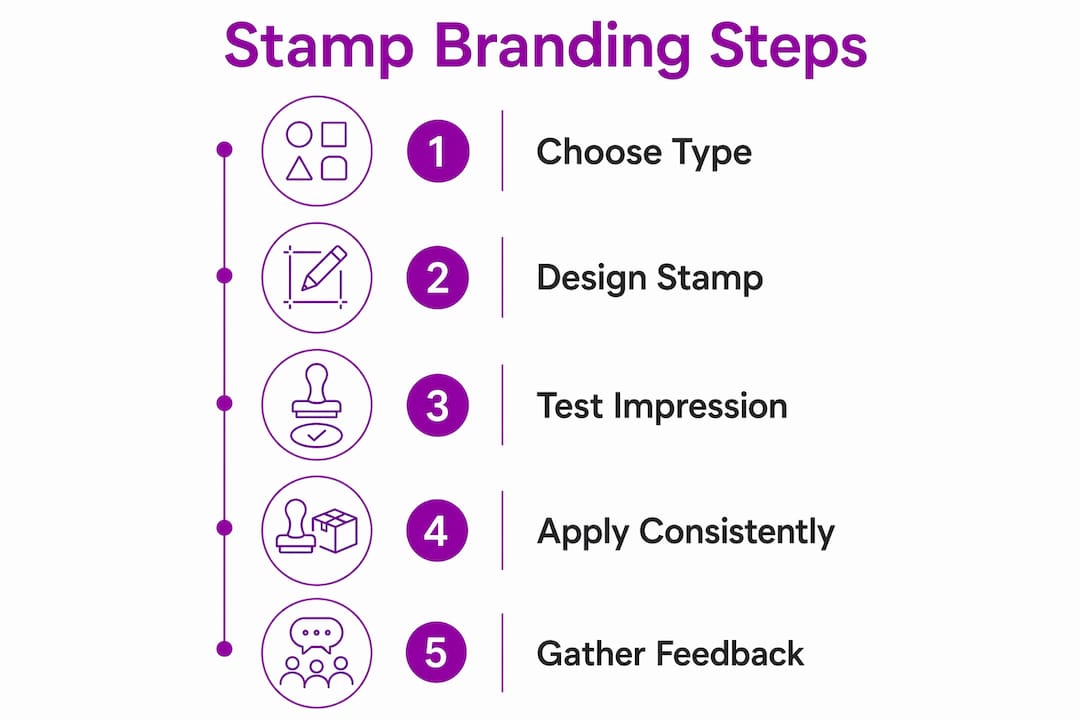
Physical interaction through hand-stamped materials strengthens customer perception of brand authenticity. A stamped thank-you card feels considered in a way that a printed sticker does not. That tactile quality is difficult to replicate digitally, and it is one reason why stamps provide a more personal touchpoint than most digital alternatives.
Sustainability is another practical advantage. Rubber and polymer stamps use minimal materials and produce no waste beyond the ink. Many brand managers now prefer them over printed stickers or adhesive labels precisely because they are an eco-friendly branding option that aligns with corporate sustainability commitments.
The following placement and timing tips maximise the impact of stamped materials:
- Stamp packaging at the point of packing, not in advance. Pre-stamped boxes can smudge in storage.
- Use a consistent stamp position on each surface type. Centre-top on boxes, bottom-right on cards.
- Stamp tissue paper before wrapping, not after. Post-wrap stamping distorts the impression.
- Apply stamps to receipts at the point of issue to keep the impression fresh and legible.
- Use a loyalty stamp on a dedicated card to encourage repeat visits. The Traxx 9021 loyalty stamp is one practical format for this.
- Rotate ink colours seasonally to signal campaign changes without redesigning the stamp itself.
How to integrate stamps into your overall branding strategy
Stamps work best when they are part of a coordinated brand system, not a standalone tactic. Aligning your stamp design with your website, social media, and print assets means customers encounter the same visual language at every point of contact. That repetition builds recognition.
The table below shows how stamp branding fits across different campaign types:
| Campaign type | Stamp application | Brand goal |
|---|---|---|
| Product launch | Stamp on outer packaging and tissue | First impression, unboxing experience |
| Loyalty programme | Stamp on loyalty cards | Repeat purchase incentive |
| Seasonal promotion | Colour-rotated logo stamp on bags | Campaign differentiation |
| Corporate correspondence | Logo stamp on envelopes and letters | Professional identity reinforcement |
| Event or pop-up | Stamp on receipts and thank-you cards | Personalised customer interaction |
Tracking the impact of stamp branding does not require complex analytics. Ask customers how they heard about you, note whether stamped packaging generates social media shares, and monitor repeat purchase rates among loyalty card holders. These are practical signals that stamp branding is working.
For brands running special promotions, stamps offer a low-cost way to personalise interactions at scale. A stamped card with a handwritten note costs a fraction of a printed mailer and often generates a stronger response. The guide to branding with custom stamps from Stampdesign4u covers additional use cases for promotional contexts.
Common mistakes and troubleshooting tips when using stamps for branding
Smudging, uneven impressions, and ink fading are the three most common problems brand managers encounter. All three are usually caused by incorrect stamp type or poor maintenance, not by a flawed design.
- Smudging happens when you move the stamp before the ink has set. Press down firmly, hold for two seconds, then lift cleanly. Do not rock the stamp.
- Uneven impressions result from an uneven stamping surface. Place a firm pad or book under thin materials before stamping.
- Ink fading on absorbent surfaces means the ink pad needs re-inking or the stamp type is wrong for that surface. Pre-inked stamps fade faster on rough stock.
- Wrong stamp size is a common early mistake. A stamp that is too large for a product tag overwhelms the design. A stamp that is too small for a shipping box disappears visually.
- Inconsistent placement undermines brand recognition. Set a placement guide, a simple card template with a marked position, and use it every time.
Storage matters too. Keep stamps face-down on their ink pads when not in use. Store them away from direct sunlight, which dries the ink and warps rubber dies.
Pro Tip: Run a test batch of 20 impressions on your actual packaging material before committing to a full production run. Adjust ink pad saturation and stamping pressure based on those results.
Key takeaways
Custom stamp branding delivers consistent, tactile brand impressions across physical materials at a fraction of the cost of printed alternatives, making it one of the most practical tools for organisational identity.
| Point | Details |
|---|---|
| Choose the right stamp type | Match stamp format to your volume and surface: self-inking for high output, pre-inked for fine detail. |
| Design for simplicity | Remove thin strokes and small text; a clean single-colour logo transfers most reliably to any surface. |
| Apply stamps consistently | Use a placement guide to stamp the same position on every surface type, reinforcing brand recognition. |
| Integrate with wider brand assets | Align stamp design with fonts, colours, and messaging used across print, packaging, and digital channels. |
| Test before full rollout | Always run a sample batch on your actual materials to catch smudging or fading before production scale. |
Why tactile branding deserves more credit than it gets
Tactile branding via stamps is gaining renewed appreciation as customers seek authentic, personalised interactions. I have watched this shift happen gradually, and the pattern is consistent: brands that invest in physical touchpoints generate stronger emotional recall than those that rely entirely on digital channels.
What surprises most brand managers I speak with is how little it costs to get this right. A well-designed rubber stamp, used consistently on packaging and correspondence, does the work of a much more expensive print campaign. The investment is in the design thinking, not the production cost.
The mistake I see most often is treating stamps as a stopgap rather than a deliberate brand asset. Brands order a basic text stamp, use it inconsistently, and then conclude that stamping does not work. The tool is not the problem. The absence of a clear placement and design standard is.
My honest view is that stamps will become more valued, not less, as digital saturation increases. A hand-stamped package stands out precisely because it is rare. Brands that build stamping into their standard operating process now will have a recognisable physical identity that is genuinely difficult for competitors to replicate quickly.
— Steven
Stampdesign4u: custom stamps for organisational branding
Stampdesign4u offers a full range of custom stamps suited to marketing professionals who need consistent, quality results across packaging, correspondence, and promotional materials.
The Trodat 4927 9 Line rubber stamp at 60 x 40mm is a practical choice for brands that need both a logo and contact details in a single impression. For packaging-focused branding, the personalised packaging stamps collection covers a wide range of sizes and formats. Stampdesign4u ships internationally and provides design support to help you get the impression right before you order. Browse the full custom logo stamp range to find the format that fits your brand.
FAQ
What is organisational branding with stamps?
Organisational branding with stamps is the practice of using custom-made stamps to apply consistent brand marks, logos, or messages across physical materials such as packaging, correspondence, and promotional items.
Which stamp type is best for high-volume branding?
Self-inking stamps are best for high-volume applications. They deliver clean, consistent impressions without a separate ink pad, making them efficient for busy despatch or packaging environments.
How do I avoid smudging when stamping packaging?
Press the stamp down firmly, hold for two seconds, then lift cleanly without rocking. Ensure the surface beneath the material is firm and flat before stamping.
Can stamps be used as part of a sustainability strategy?
Rubber and polymer stamps use minimal materials and produce no waste beyond the ink, making them a more eco-friendly alternative to printed stickers or adhesive labels.
How many impressions does a quality rubber stamp produce?
A quality rubber stamp produces thousands of clean impressions before it needs replacing, making it a cost-effective long-term investment for consistent brand application.