

TL;DR:
- Rubber stamps are now legally recognized tools when applied with proper authority and intent.
- Proper controls, written authorizations, and security measures are essential to ensure their lawful use.
- They offer a cost-effective, efficient alternative for high-volume signing and official documentation.
Rubber stamps carry an undeserved reputation as relics of bureaucratic paperwork, better suited to post rooms than professional practice. That view is increasingly at odds with reality. Across legal offices, small businesses, and financial departments, rubber stamps are now performing functions that carry genuine legal weight. They appear on contracts, invoices, branding materials, and compliance documents. Far from being outdated, a properly controlled stamp can be as legally effective as a handwritten signature. This guide sets out exactly how that works, what conditions must be satisfied, and where rubber stamps deliver the greatest practical value for professionals in 2026.
Table of Contents
- How rubber stamps gained legal recognition
- Requirements for lawful use of rubber stamps
- Practical legal applications for professionals and businesses
- Mistakes to avoid when using rubber stamps legally
- Why the future of legal rubber stamp use belongs to those who embrace secure innovation
- Find the right rubber stamp solution for your legal needs
- Frequently asked questions
Key Takeaways
| Point | Details |
|---|---|
| Legal status clarity | Rubber stamps are legally valid for many business documents when used with authority and intent. |
| Compliance essentials | Proper authorisation, witness procedures, and usage controls are vital for legal stamp validity. |
| Professional applications | Rubber stamps streamline contract signing, document processing, and branding for modern practice. |
| Common mistakes | Failing to document intent or secure stamps can lead to invalidation or legal challenges. |
How rubber stamps gained legal recognition
For many years, legal professionals viewed rubber stamps with understandable caution. A stamp felt informal, easy to misuse, and difficult to attribute to a specific individual. Courts and regulators reinforced this scepticism, insisting on wet ink signatures for most formal instruments. That position has changed substantially, driven by a combination of commercial necessity and legislative reform.
Two statutes have been particularly influential. In the United States, the Uniform Commercial Code and the Electronic Signatures in Global and National Commerce Act both expanded the definition of a valid signature to include marks and symbols applied with the intent to authenticate a document. The principle that matters is not the physical form of the signature but the authorisation and intent behind it. As signature stamp legality confirms, stamps are legally valid on many business documents under UCC and ESIGN when applied with authorisation and clear intent to sign.
UK commercial practice has followed a broadly similar trajectory. English contract law recognises that a signature may take many forms provided it demonstrates the party’s intention to be bound. A rubber stamp, applied by or at the direction of the relevant individual, satisfies that test in a wide range of contexts.
“Signature stamps are legally valid on many business documents under UCC and ESIGN if applied with authorisation and intent to sign.” — Legal Clarity
The types of rubber stamps now available range from self-inking models suited to high-volume signing, through to pre-inked stamps that produce sharp, consistent impressions on formal correspondence. Each type can serve a legal purpose when deployed correctly. For a broader view of how organisations structure their stamp usage, the organisational stamp guide offers a practical overview.
Documents that rubber stamps commonly support include:
- Routine commercial contracts and purchase agreements
- Internal authorisation forms and approval records
- Invoices, receipts, and delivery confirmations
- Correspondence requiring an authorised signatory
- Compliance records and quality assurance documentation
The shift in legal thinking has been gradual but it is now well established. Understanding the basis for that shift is the first step towards using stamps confidently and correctly.
Requirements for lawful use of rubber stamps
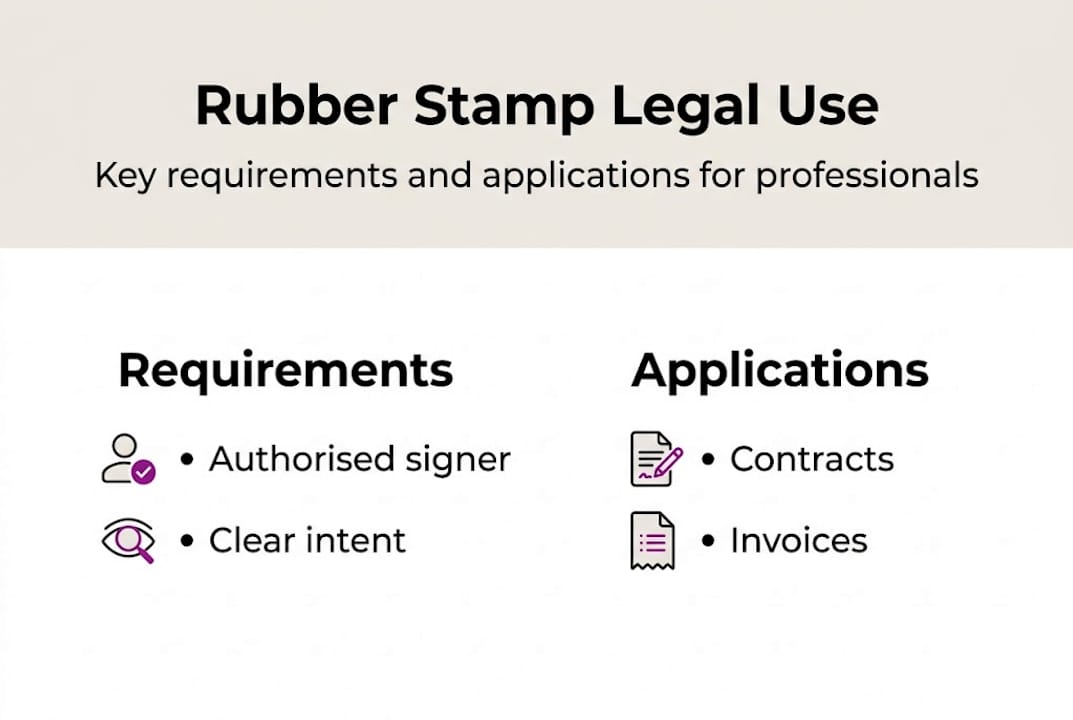
A rubber stamp does not become legally valid simply by being applied to a document. Several clear conditions must be satisfied, and professionals who overlook them expose their businesses to costly disputes.
The most fundamental requirement concerns who applies the stamp. As outlined in a Florida Attorney General Opinion, a stamp must be affixed by the signer or by an authorised person acting in their direct presence. A stamp applied by an assistant in a separate room, without the signatory’s knowledge or supervision, does not meet this standard and can be challenged.
Beyond the physical act of stamping, intent must be documented. The signer must intend the stamp to represent their authorisation of the document. Vague delegation or casual handing over of a stamp to a colleague creates legal risk. Formal written authority, specifying which documents the stamp may be used on and by whom, significantly strengthens the enforceability of stamped documents.
The following steps provide a reliable framework for lawful stamp use:
- Obtain written authorisation from the relevant signatory specifying the scope of permitted stamp use.
- Apply the stamp only in the presence of the authorised person or under their direct supervision.
- Record each instance of stamp use, noting the document, date, and person who applied it.
- Restrict physical access to the stamp using a lockable storage solution.
- Review and renew authorisation records regularly, particularly when staff change roles.
Pro Tip: Self-inking stamps reduce the risk of inconsistent impressions that can raise questions about authenticity. Explore self-inking stamp solutions if your business handles high volumes of signed documentation.
Risk management should also account for the possibility of stamp misuse. A stamp that falls into unauthorised hands can be used fraudulently, with the business bearing reputational and legal consequences. Physical security combined with a clear usage log is not optional. It is the baseline standard for any professional operation relying on stamp-based signatures. For a wider view of how stamps serve business operations, practical stamp uses covers a range of relevant scenarios.

Practical legal applications for professionals and businesses
Once you understand the requirements, you will find that rubber stamps offer genuinely efficient solutions across several common business and legal scenarios. The key is matching the stamp type and controls to the specific application.
For everyday contract signing, a signature stamp allows an authorised director or partner to process high volumes of standard agreements without attending to each document individually. Provided authorisation is documented and the stamp is applied correctly, the resulting signatures carry the same weight as handwritten ones. High-volume use demands particularly robust intent and authorisation controls to avoid invalidation, so documentation discipline is essential.
Invoicing and accounts payable departments benefit significantly from stamps. Approved stamps applied to invoices and purchase orders confirm both the identity of the authorising party and the organisation’s consent to the transaction. This is both a legal record and an internal control.
For branding and legal identification, customised logo branding stamps allow businesses to imprint their registered name, address, and contact details consistently across all outgoing correspondence. This creates a formal record that satisfies both branding and compliance requirements.
Common legal and professional stamp applications:
- Signing standard commercial contracts and service agreements
- Authorising invoices, purchase orders, and payment records
- Marking correspondence with company registration and contact details
- Approving internal documentation such as HR records and expense forms
- Certifying copies of documents for regulatory submission
The table below compares stamp types against their legal and operational suitability:
| Stamp type | Best legal use | Volume capacity | Security considerations |
|---|---|---|---|
| Self-inking | High-volume contract signing | High | Lock away when not in use |
| Pre-inked | Formal correspondence | Medium | Limit access to authorised staff |
| Traditional rubber | Occasional use, certifying copies | Low | Supervise each application |
| Logo or branding stamp | Company identification on documents | High | Control design and reproduction |
For staff who handle a wide range of document types, office stamp essentials provides a useful reference for building a complete and compliant stamp system.
Mistakes to avoid when using rubber stamps legally
Innovative legal uses offer real advantages, but common errors can put your business at risk. Awareness of these mistakes is as important as knowing the correct practices.
The most frequent error is applying a stamp without documented authorisation. Even if the signatory verbally consents, verbal permission leaves no audit trail. When a dispute arises, the business must prove that the stamp was used with authority. Without written records, that is nearly impossible.
A second serious mistake is allowing unrestricted access to signature stamps. Stamps left in unlocked drawers or shared office spaces can be used by anyone. Courts treat fraudulent stamp use as a significant matter, and the burden of proving misuse falls partly on the organisation that failed to secure the stamp properly. Weak controls have caused real financial and legal harm to businesses that assumed stamps were low-risk items.
Third, professionals sometimes confuse intent with mere application. Stamps are only valid where the signer’s intent and authorisation are clear. Stamping a document out of routine, without any conscious decision by the relevant party, undermines the legal standing of the impression.
Fourth, using an outdated stamp design creates avoidable confusion. If a company’s name, address, or authorised signatory has changed, continuing to use an old stamp on new documents generates inconsistencies that can be exploited in disputes.
The following steps reduce the most common risks:
- Create a written stamp use policy and circulate it to all relevant staff.
- Assign a named custodian for each stamp and document transfers of responsibility.
- Audit stamped documents periodically to confirm that controls are being followed.
- Replace or update stamps promptly when business details or authorised personnel change.
Pro Tip: When selecting a new stamp, consider the specific documents it will support. Choosing the right stamp for a legal function requires attention to impression quality, durability, and design clarity, not just convenience.
Why the future of legal rubber stamp use belongs to those who embrace secure innovation
Conventional wisdom has long treated rubber stamps as a shortcut, a practical convenience without serious legal standing. That view misses something important. When supported by robust authorisation frameworks and clear intent documentation, rubber stamps are not a workaround. They are a legitimate and efficient tool for modern professional practice.
The businesses that will benefit most are those willing to treat stamp management with the same rigour they apply to digital signature platforms. The underlying legal principles are comparable. Both depend on authority, intent, and a clear audit trail. Firms that combine streamlined branding with stamps alongside proper controls will find they have a cost-effective, legally sound alternative to more expensive document management systems. The advantage goes to those who act on that insight now, before competitors recognise the same opportunity.
Find the right rubber stamp solution for your legal needs
Those aspiring to modern, legally secure workflows will benefit most from proven stamp solutions. Selecting the right product for your specific legal and operational requirements makes a significant difference to both compliance and efficiency.
For professional documentation and high-volume authorisation, the Trodat 4927 logo stamp offers a reliable, sharp impression suited to formal correspondence and contract signing. For customer-facing applications, the Traxx 9021 loyalty stamp provides a compact, reusable option. Browse the full Stamp Design 4U catalogue to find customised solutions that match your branding and legal requirements precisely.
Frequently asked questions
Are signature rubber stamps legal for contracts and formal documents?
Yes, provided the stamp is applied with clear authority and intent, as recognised under statutes like the UCC and ESIGN. Stamps are legally valid on many business documents when these conditions are met.
Who must apply the rubber stamp for documents to be valid?
The stamp must be applied by the authorised signer or in their direct presence. As confirmed by the Florida AG opinion, stamps affixed outside this arrangement may be challenged.
How can I protect my business from rubber stamp misuse?
Maintain strict physical controls, document each use in a log, and restrict stamp access to named authorised staff only. High-volume stamp use requires particularly careful intent and authorisation records to remain enforceable.
Are custom logo stamps allowed on legal paperwork?
Yes, custom logo stamps are widely used for lawful company identification on legal paperwork, provided the stamp accurately reflects current business details and any applicable documentation requirements are satisfied.