

A self-inking stamp re-inks itself with every press, and a pre-inked stamp holds its ink inside the rubber die. Choose self-inking when you need speed and repeat office use; choose pre-inked when the sharpest possible impression matters more than how fast you can stamp a stack of forms. Stampdesign4u sells both, including the Trodat 4927, a self-inking model built for exactly this kind of everyday, high-frequency use.
- Mechanism: self-inking flips an internal pad onto the die between strikes; pre-inked pushes stored ink through the rubber surface itself.
- Lifespan before re-inking: self-inking pads need topping up sooner; pre-inked dies can run for many impressions before needing re-inking.
- Best use case: self-inking suits invoices, addresses and endorsements; pre-inked suits logos, signatures and anything needing fine detail.
Key Takeaways
The right stamp choice comes down to one trade-off: self-inking gives speed and low running cost, while pre-inked gives sharper detail and a longer stretch between refills.
| Point | Details |
|---|---|
| Mechanism drives everything | Self-inking flips a pad onto the die; pre-inked releases ink stored within the die itself. |
| Ink chemistry shapes the look | Dye ink suits speed and cost; pigment ink suits sharp, long-lasting detail. |
| Lifespan varies by type | Pre-inked dies can reach tens of thousands of impressions before self-inking pads need refilling. |
| Design limits matter | Fine text and halftones reproduce more cleanly on pre-inked stamps than on self-inking ones. |
| Stampdesign4u covers both | Its self-inking and pre-inked ranges, including the Trodat 4927, let you match the mechanism to the job. |
Table of Contents
- What is the difference between self inking pre inked stamps mechanically?
- What is the difference between self inking pre inked stamps in ink delivery?
- How each mechanism actually makes an impression
- Ink types and the visual differences you can expect
- Lifespan and typical impression counts
- Refillability and maintenance: what you will need to do
- Design limits: maximum sizes, fine detail and artwork considerations
- Price, total cost of ownership and decision checklist by use case
- At-a-glance comparison table
- Quick real-world notes from product specs and short tests
- How Stampdesign4u can help with your next stamp order
What is the difference between self inking pre inked stamps mechanically?
A self-inking stamp is built around a small internal ink pad and a spring-loaded flip mechanism. Press the handle down, and the die swings against the pad to load fresh ink, then flips forward to strike the paper. The whole cycle happens in one motion, which is why these stamps feel almost instant in use.
- Uses water-based or dye ink in most cases
- Re-inks automatically with every stroke, no manual dipping
- Fast enough for repetitive, high-frequency stamping
- Common on address stamps, date stamps and “PAID” or “RECEIVED” endorsements
Stampdesign4u’s self-inking range covers this exact use case, from small text-only designs to multi-line business stamps like the Trodat 4927.
What is the difference between self inking pre inked stamps in ink delivery?
A pre-inked stamp works differently: the ink lives inside the die itself, in a porous rubber or foam matrix, and seeps out through the surface each time you press it against paper. There is no external pad and no flipping mechanism, which also makes the stamp noticeably quieter to use.
- Typically uses oil-based or pigment-style ink
- Produces sharper, more consistent edges on fine detail
- Operates almost silently compared with the click of a flip mechanism
- Harder to re-ink than a pad, but rarely needs it early on
This construction is why pre-inked formats dominate logo stamps, signature stamps, and any design where crisp lines matter more than raw speed.
How each mechanism actually makes an impression
The self-inking cycle runs in four beats: the pad sits against the die at rest, the flip action swings the die across the pad on the downstroke, ink transfers evenly across the raised design, and the die presses onto paper before springing back. Every impression gets a fresh, even coat.
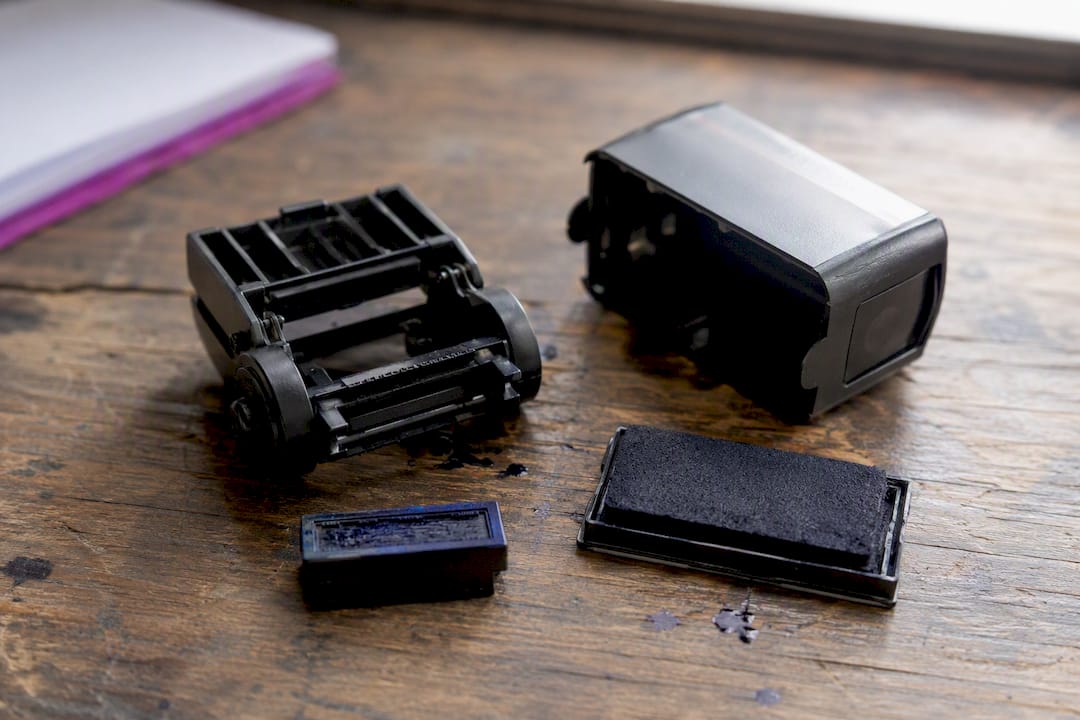
Pre-inked stamps skip the moving parts entirely. Pressure on the die forces ink already saturated through the rubber to seep out at the point of contact, so impression quality depends more on even hand pressure than on any mechanism doing the work for you.
Pro Tip: For pre-inked stamps, a firm, even, single press gives sharper results than rocking or double-pressing, which can blur fine text and spread ink beyond the design edges.
- Self-inking: pad → flip → transfer → return, all in one stroke
- Pre-inked: pressure forces stored ink through the die surface directly
Ink types and the visual differences you can expect
Self-inking stamps generally run on water-based or dye ink, which sits on the paper surface rather than soaking deep into the fibres. Pre-inked stamps more often use oil-based or pigment ink, which tends to hold a crisper edge and resist fading better over time, as Stampdesign4u’s guidance on pigment versus dye explains.
- Dye ink: brighter colour range, faster drying, more prone to smudging on glossy stock
- Pigment ink: better edge definition, stronger colourfastness, slightly slower to dry on non-porous surfaces
- Absorbent paper favours dye inks; smooth or coated stock favours pigment
Switching colours is simple on a self-inking stamp because you just swap the pad. Pre-inked dies are locked to whatever colour they were saturated with at manufacture, so colour changes usually mean ordering a new stamp.
Lifespan and typical impression counts
Manufacturer guidance often points to pre-inked dies delivering up to around 50,000 impressions before the ink runs dry, well beyond what most self-inking pads manage before needing a top-up. Self-inking stamps still last for years in practice, but the pad itself needs refreshing far sooner than a pre-inked die needs anything at all.
Design density matters too: a stamp covered in fine text or a detailed logo uses more ink per impression than a simple date stamp, so it depletes faster under identical use. Firm, consistent pressure and dry storage away from direct sunlight both extend working life on either type.
- Self-inking pads: refill needed well before the stamp body wears out
- Pre-inked dies: can run tens of thousands of strikes before topping up
- Storage and pressure consistency affect both equally
Refillability and maintenance: what you will need to do
- Lift or slide out the ink pad from the self-inking stamp housing.
- Apply a few drops of compatible refill ink evenly across the pad surface.
- Let it sit for a few minutes to absorb before reassembling.
- Test on scrap paper before using it on real documents.
Pre-inked stamps can often be re-inked directly onto the die, but the process takes longer and changing to a different ink colour is far more fiddly than swapping a self-inking pad.
Pro Tip: Keep spare ink and replacement pads on hand rather than waiting for a stamp to run dry mid-task; Stampdesign4u’s replacement pads and stamp ink ranges cover most common sizes.
Design limits: maximum sizes, fine detail and artwork considerations
Self-inking stamps generally cap out around a moderate imprint size, since the flip mechanism and pad need to fit inside a compact housing. Pre-inked formats are often available in larger imprint sizes, which suits bigger logos or multi-line letterheads.
- Fine text under about 6pt can blur on self-inking dies; pre-inked handles small type more cleanly
- Halftones and shaded logos reproduce better on pre-inked stamps
- Send Stampdesign4u vector artwork where possible, with line weights kept above the minimum your chosen size can hold
Price, total cost of ownership and decision checklist by use case
Self-inking stamps usually cost less upfront and cheaper still to refill, since a pad refill is a small bottle of ink rather than a full re-inking service. Pre-inked stamps often carry a higher initial price but need attention far less frequently, which can even out the running cost over a few years of steady use, as Choice Checks points out when comparing the two for business buyers.
Ask yourself:
- How many impressions do I make per day or week?
- Does fine detail (a logo, signature or small text) matter to the result?
- Does noise matter in my workplace?
- What’s my upfront budget versus my tolerance for occasional maintenance?
- What surface am I stamping onto most often?
- Do I need to switch ink colours regularly?
- Postal and admin stamping: self-inking, for speed and low running cost
- Branding and logo work: pre-inked, for sharper reproduction
- Craft and hobby use: self-inking for volume, pre-inked for polished results on finished pieces
At-a-glance comparison table
| Dimension | Self-inking | Pre-inked |
|---|---|---|
| Mechanism | Internal pad with flip action | Ink stored inside the die itself |
| Ink type | Water-based / dye | Oil-based / pigment |
| Impression quality | Good, slight softness on fine detail | Sharper, cleaner edges |
| Typical impressions | Pad needs refilling relatively soon | Up to around 50,000 before re-inking |
| Refillability | Simple pad swap | Possible but more involved |
| Max imprint size | Moderate, limited by housing | Often larger |
| Best use cases | Postal, admin, repetitive stamping | Logos, signatures, branding |
If speed and running cost matter most, self-inking wins; if the final look on the page matters most, pre-inked usually earns its higher price tag.
Quick real-world notes from product specs and short tests
Stampdesign4u’s own product comparison page lists imprint sizes and mechanism details for both ranges, useful reading if you’re matching a stamp to an exact design brief.
- Heavier hand pressure on pre-inked dies tends to spread fine lines slightly, confirming that a lighter, even press gives the cleanest result
- Self-inking pads dry out faster on absorbent card stock than on standard office paper, so factor substrate into refill frequency
- Full spec breakdowns for what a self-inking stamp actually is are worth a read before ordering a custom size
Author perspective
I default to self-inking for anything used daily and pre-inked for anything that represents a brand on paper. The exception is oversized or security-sensitive designs, where the size and ink chemistry limits of each type deserve a closer look before you order.
How Stampdesign4u can help with your next stamp order
Stampdesign4u is the practical route to both stamp types without guessing which one suits your workload. Whether you need a fast, repeat-use stamp or a sharp logo impression, the self-inking versus pre-inked collection lays out sizes and specs side by side, and the Trodat 4927 is a solid example of a self-inking model built for nine lines of text or logo detail at 60 x 40mm.
If your priority is brand presentation rather than speed, browse the personalised logo stamps range instead, or head to the full personalised stamps collection to compare sizes and get design advice, including bulk pricing for larger orders.