

TL;DR:
- Digital stamps offer quick, remote application and cost savings, but lack the legal weight of traditional ink stamps. Traditional stamps provide physical authority and authenticity in certain legal and in-person situations, whereas digital stamps suit internal and low-risk processes. Combining digital and traditional stamps ensures efficiency and compliance across different document types and legal requirements.
Digital and traditional stamps are defined, respectively, as electronic image or cryptographic seals and physical inked impressions used to authenticate, brand, or approve documents. The choice between them shapes your workflow, legal exposure, and branding consistency in ways that are easy to underestimate. This guide covers the key differences, legal realities, and practical decision points for individuals and businesses weighing digital vs. traditional stamps in 2026.
What are the main benefits of digital stamps?
Digital stamps offer speed that physical stamps cannot match. A digital stamp can be inserted into a document in seconds, with no ink, no pad, and no physical handling required. That speed matters most when your team works remotely or processes high volumes of documents daily.
The practical advantages of digital stamps include:
- Instant application with no drying time or smudging risk
- Remote workflow support, allowing stamps to be applied from any location
- No recurring costs for ink refills or replacement pads
- Easy design updates without ordering new physical stock
- Paperless processing, reducing paper consumption across your operation
- Audit trail integration, where professional platforms embed timestamps and identity metadata alongside the stamp image
Cost efficiency builds over time. A physical stamp requires replacement pads, occasional re-cutting, and storage. A digital stamp, once created, costs nothing to apply repeatedly. For businesses processing dozens of documents per week, that saving is real and measurable.
Digital stamps support remote workers and digital document management in ways that physical stamps structurally cannot. A team member in Edinburgh can stamp a contract prepared in London without posting anything or waiting for an office visit.

Pro Tip: Protect your digital stamp files with two-factor authentication on the platform or account where they are stored. An unsecured image file can be copied and misused, so treat your digital stamp with the same care as a company signature.
When do traditional stamps still make sense?
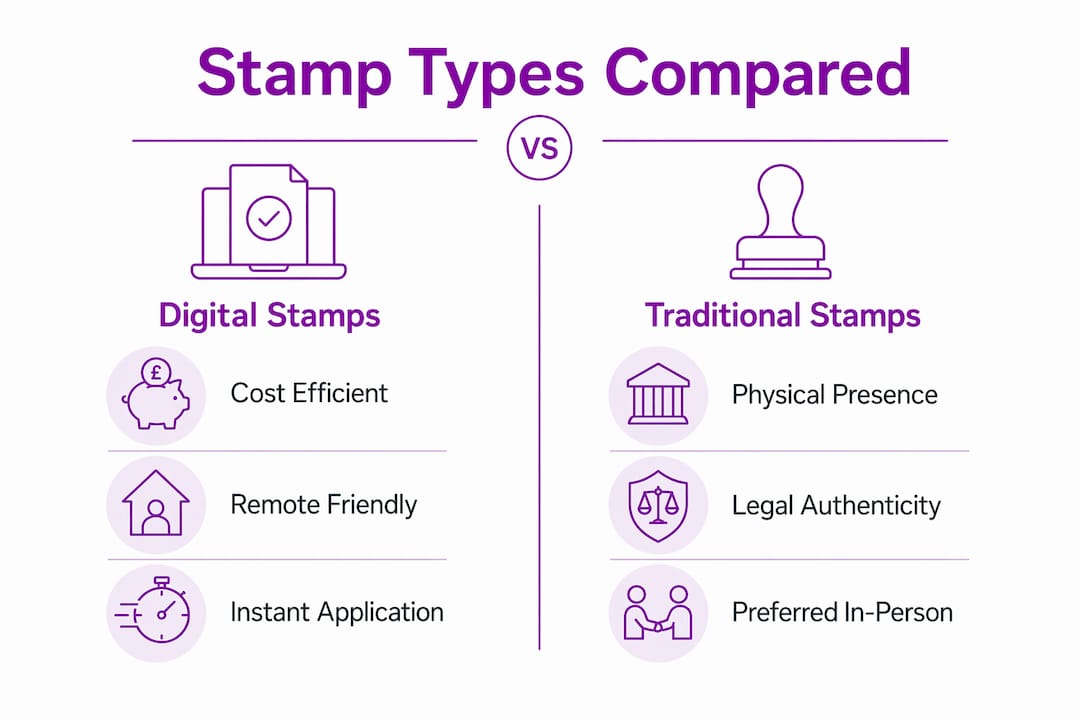
Physical stamps retain genuine value in specific, well-defined situations. Many counterparties still associate an inked physical stamp with professionalism and finality, even where the legal requirement for one has diminished. That psychological trust is not trivial. It signals authority in a way that a digital image on screen does not always replicate.
Physical stamps also carry a form of authenticity that is difficult to dispute. Physical artefacts carry legal weight through their physical presence, particularly in sensitive transactions such as probate, property title documents, or in-person approvals. A wet ink impression on paper is inherently harder to fabricate than a copied image file.
The limitations of traditional stamps are real, though. Rubber and polymer dies wear over time. Ink pads dry out. Stamps cannot support remote workflows. The cost of replacement, storage, and consistent quality control adds up across a large organisation.
| Feature | Digital stamp | Traditional stamp |
|---|---|---|
| Application speed | Instant | Requires physical presence |
| Remote use | Yes | No |
| Recurring cost | Minimal | Ink, pads, replacement |
| Tamper resistance | Depends on platform | Inherent physical authenticity |
| Legal weight for deeds | Not sufficient | Accepted with wet ink |
| Branding consistency | Easily updated | Fixed until re-cut |
| Workflow integration | High | Low |
Traditional stamps remain the preferred choice for in-person document processing, regulated industries requiring physical records, and any context where the recipient expects a tangible mark. The role of stamp making in business continues to evolve, but physical stamps have not been made redundant.
Pro Tip: Consider a hybrid approach for businesses in transition. Use a traditional stamp for client-facing documents and physical approvals, while adopting digital stamps for internal workflows and remote document management. This covers both audiences without committing fully to one method.
How do digital stamps and electronic signatures differ legally?
This is where most businesses make costly mistakes. Digital stamps used as image files are legally acceptable for internal operational use, branding, and non-binding administrative purposes. They are not sufficient for legally binding contracts or deeds in the UK.
UK law recognises three tiers of electronic signature under the Electronic Communications Act 2000 and the retained eIDAS regulation:
- Simple electronic signatures — a typed name or basic image; lowest evidential weight
- Advanced electronic signatures — uniquely linked to the signatory with identity verification; stronger legal standing
- Qualified electronic signatures (QES) — the highest tier, equivalent in law to a handwritten signature; required for certain deeds and land registration
Qualified electronic signatures carry the highest legal equivalence to handwritten signatures. A digital stamp image, regardless of how professional it looks, sits below even a simple electronic signature in terms of legal enforceability.
Electronic signatures often provide stronger legal protection than handwritten signatures when audit trails capture timestamps and identity metadata. UK courts accept electronic signatures where intention and attribution are proven. A digital stamp image alone proves neither.
The standard BS 10008 sets out requirements for the evidential weight of electronic information in the UK. Compliance with BS 10008 requires documented processes, access controls, and audit trails. A simple stamp image does not meet that standard.
Key legal rules when using stamps digitally:
- Do use digital stamps for internal approvals, branding, and administrative records
- Do use qualified electronic signatures for contracts, deeds, and land transactions
- Do choose platforms that embed cryptographic verification and timestamps
- Do not rely on a digital stamp image as the sole mark of authority on a legally binding document
- Do not use digital stamps for wills, land dispositions, or high-value contracts without qualified e-signature support
Digital stamps without cryptographic backing are vulnerable to tampering. Professional platforms link digital stamps to issuing accounts and timestamp them. An image-only stamp lacks this verification entirely. The difference between a professional digital stamp and a copied image file is invisible to the naked eye but legally significant.
What factors should you weigh when choosing between stamp types?
The right choice depends on your specific document types, workflow, and legal obligations. No single answer fits every business or individual.
Assess your document mix
Start by categorising the documents you stamp most often. Internal memos, invoices, packing slips, and approval records suit digital stamps well. Deeds, regulated contracts, and documents requiring physical witness signatures require wet ink or qualified electronic signatures. If your document mix is split, a hybrid approach is the most practical answer.
Evaluate your workflow and team structure
Remote teams benefit directly from digital stamps. A distributed workforce cannot pass a physical stamp around efficiently. On-site teams with a single point of approval may find a traditional stamp faster and simpler for day-to-day use. Frequency matters too. A business stamping hundreds of documents per week will see greater efficiency gains from going digital than one stamping a handful per month.
Consider branding and professional appearance
Consistent stamp use reinforces branding and signals professionalism to clients and partners. Digital stamps allow instant updates when your logo or address changes. Traditional stamps require a new die, which takes time and money. For businesses with stable branding and a preference for tactile, premium presentation, a well-made physical stamp remains a strong choice.
| Decision factor | Digital stamp excels | Traditional stamp excels |
|---|---|---|
| Remote team | Yes | No |
| Legal documents (deeds) | No | Yes (wet ink) |
| High-volume processing | Yes | No |
| Brand update flexibility | Yes | No |
| Physical document handling | No | Yes |
| Low upfront cost | Yes | No |
| Psychological trust signal | Moderate | High |
Pro Tip: Whatever stamp type you choose, apply it consistently across all outgoing documents. Inconsistent stamping, whether digital or physical, undermines the professional signal you are trying to send and creates compliance gaps in your records.
Key takeaways
The most defensible stamping strategy combines digital stamps for speed and remote workflows with traditional stamps or qualified electronic signatures where legal weight is required.
| Point | Details |
|---|---|
| Digital stamps suit operational use | Use digital stamps for internal approvals, branding, and administrative records, not legal contracts. |
| Traditional stamps carry physical authority | Physical inked stamps retain legal and psychological weight for deeds, probate, and in-person transactions. |
| Legal tiers matter | UK law distinguishes simple, advanced, and qualified electronic signatures; digital stamp images sit below all three. |
| Hybrid approaches work | Combining digital and traditional stamps covers remote efficiency and physical compliance simultaneously. |
| BS 10008 sets the standard | Digital records require audit trails and access controls to meet UK evidential standards in court. |
Steven’s view: the stamp debate is more nuanced than most guides admit
Working with document workflows across a range of UK businesses, I have seen the same mistake repeated. A business adopts digital stamps enthusiastically, applies them to everything, and then discovers that a key contract is unenforceable because the stamp carried no cryptographic verification and no qualified signature. The assumption that “digital” automatically means “better” is the root of the problem.
Physical stamps have something that digital images genuinely cannot replicate: inherent immutability. You cannot secretly alter an inked impression on paper after the fact without leaving physical evidence. A digital image, by contrast, can be copied, edited, and reapplied without trace unless the platform embeds cryptographic proofs. That is not an argument against digital stamps. It is an argument for using them correctly.
The businesses I have seen handle this best treat digital and traditional stamps as complementary tools rather than competitors. They use custom rubber stamps for client-facing documents and physical approvals, and digital stamps for internal records and remote workflows. Neither replaces the other. The choice is about matching the tool to the task.
Regulatory direction in the UK is clearly moving towards greater acceptance of digital records, but BS 10008 compliance and qualified electronic signatures are not going away. Businesses that invest in understanding the legal tiers now will avoid expensive corrections later.
— Steven
Stampdesign4u: stamps built for your workflow
Whether you need a physical stamp for client documents or a custom logo stamp for consistent branding, Stampdesign4u offers a full range of personalised options built for businesses of every size.
Browse personalised logo stamps designed for professional branding across invoices, packaging, and correspondence. For businesses that stamp high volumes, the Trodat 4927 9-line stamp delivers consistent, sharp impressions across thousands of uses. Stampdesign4u ships to customers across the UK and internationally, with custom design support available for every order.
FAQ
Are digital stamps legally binding in the UK?
Digital stamp images are not legally binding for contracts or deeds in the UK. Legal enforceability requires a qualified electronic signature or wet ink, not a stamp image alone.
What is the difference between a digital stamp and an electronic signature?
A digital stamp is an image applied to a document for branding or administrative purposes. An electronic signature, particularly a qualified electronic signature, carries legal equivalence to a handwritten signature under UK law.
When should a business use a traditional rubber stamp?
Traditional rubber stamps are the right choice for in-person document approvals, physical records, deeds, and any situation where a tangible inked impression is expected or legally required.
Can digital stamps be tampered with?
Digital stamps without cryptographic verification can be copied and reapplied without detection. Professional platforms embed timestamps and account links to prevent this, but a basic image file offers no such protection.
What is BS 10008 and why does it matter for digital stamping?
BS 10008 is the UK standard for the evidential weight of electronic information. Compliance requires documented audit trails, access controls, and tamper-evident processes, all of which go beyond a simple digital stamp image.
Recommended
- Digital vs traditional stamping: a small business guide – Stamp Design 4U
- Types of document stamps: Choosing the best fit for your business – Stamp Design 4U
- Self-Inking vs Pre-Inked Stamps | Which Stamp Type Is Best? – Stamp Design 4U
- Custom vs Pre-Made Stamps – What’s Best for You? – Stamp Design 4U