

Nearly 60 percent of british small businesses say brand consistency across packaging directly influences customer trust. For business owners and marketing managers, standing out in the competitive British market means every detail matters right down to your packaging. Custom rubber stamps transform everyday parcels into signature branded statements, helping your products leave a memorable impression while meeting strict UK label requirements.
Table of Contents
- Custom Stamp Packaging Defined And Explained
- Types Of Custom Stamp Packaging In The UK
- How Custom Stamp Packaging Works For Branding
- Cost Factors And Practical Implications
- Common Mistakes And How To Avoid Them
Key Takeaways
| Point | Details |
|---|---|
| Custom Stamp Packaging Enhances Branding | Utilising personalised stamps transforms standard packaging into a consistent branding tool that communicates professionalism. |
| Types of Custom Stamps Suit Different Needs | Options like self-inking and digital print stamps cater to various branding, volume, and design requirements. |
| Cost Considerations Are Crucial | Factors such as design complexity and order quantity significantly affect the overall investment in custom stamp packaging. |
| Avoid Common Mistakes | Ensuring consistency in design and strategic placement of stamps is essential to prevent brand damage and maintain professional standards. |
Custom stamp packaging defined and explained
Custom stamp packaging represents a strategic branding approach where businesses utilise personalised stamps to create consistent, professional visual communication across packaging materials. These specialised stamps enable organisations to reproduce standardised images or text that effectively represent their brand identity and messaging.
The core purpose of custom stamp packaging involves transforming ordinary packaging into a powerful marketing tool. By using precision-engineered stamps, companies can imprint logos, company names, handling instructions, or compliance information directly onto packaging surfaces. This technique ensures uniform branding and provides critical product details while maintaining a professional aesthetic. Packaged goods regulations require clear labelling, making custom stamps an efficient solution for meeting legal communication standards.
Key components of effective custom stamp packaging include selecting high-quality stamp designs that accurately represent the brand, choosing appropriate ink types compatible with various packaging materials, and ensuring consistent stamp impression quality. Businesses can leverage these stamps across multiple packaging formats - from cardboard boxes and shipping envelopes to product packaging and promotional materials.
Pro tip: Invest in professional stamp design services that offer multiple impression sizes and ink compatibility to maximise your packaging branding potential.
Types of custom stamp packaging in the UK
British businesses have developed diverse custom stamp packaging solutions tailored to specific branding and operational needs. These types range from rubber stamp designs that offer versatility across different packaging materials to specialised imprinting techniques for various industry requirements.
The primary categories of custom stamp packaging in the United Kingdom include self-inking stamps, traditional rubber stamps, digital print stamps, and pre-inked stamps. Self-inking stamps represent a convenient option for businesses requiring rapid, consistent impressions, featuring an integrated ink pad that automatically re-inks after each use. Traditional rubber stamps remain popular for organisations seeking classic, customisable branding solutions that can be used with separate ink pads across multiple packaging surfaces.

Digital print stamps offer advanced customisation, allowing companies to incorporate complex graphic designs, intricate logos, and multi-colour impressions directly onto packaging materials. These stamps utilise high-resolution printing technologies to create precise, professional-looking imprints that can include detailed brand elements, contact information, and regulatory compliance details. Pre-inked stamps provide another innovative solution, with ink embedded directly into the stamp’s polymer material, ensuring clean and consistent impressions without requiring separate ink application.
Pro tip: Select custom stamp packaging types that align with your specific packaging volume, design complexity, and budgetary constraints to maximise branding efficiency.
Here is a comparison of the main types of custom stamp packaging available in the UK:
| Stamp Type | Key Advantage | Ideal Usage Scenario | Typical Drawback |
|---|---|---|---|
| Self-inking | Fast, consistent impressions | High-volume stamping tasks | Limited to simpler designs |
| Traditional Rubber | Highly customisable | Unique, varied packaging jobs | Requires separate ink pads |
| Digital Print | Complex graphic capability | Detailed, multi-colour logos | Higher initial investment |
| Pre-inked | Clean, crisp impressions | Premium branding needs | Higher cost, harder to refill |
How custom stamp packaging works for branding
Custom stamp packaging serves as a strategic visual communication tool that transforms ordinary packaging into a powerful branding mechanism. Companies leverage custom branding techniques to create memorable, consistent visual identities that communicate professionalism and brand recognition across various packaging materials.
The branding process begins with designing a unique stamp that encapsulates the company’s visual identity. This involves selecting appropriate stamp types, such as self-inking or traditional rubber stamps, that can reproduce logos, company names, contact information, or promotional messages with precision. Businesses carefully consider factors like impression quality, ink colour, and stamp durability to ensure each packaging interaction reinforces their brand narrative. The stamp design must be scalable, allowing for consistent reproduction across different packaging sizes and materials, from small product boxes to large shipping containers.
Implementation of custom stamp packaging involves strategic placement and consistent application of the branded stamp. Marketing teams typically develop guidelines that specify exact stamp positioning, colour standards, and impression clarity. This systematic approach ensures that every package becomes a branded touchpoint, transforming mundane packaging into a marketing opportunity. Digital print and pre-inked stamps offer advanced capabilities, enabling businesses to incorporate complex graphic elements, multi-colour designs, and intricate brand details that go beyond traditional single-colour impressions.
Pro tip: Develop a comprehensive stamp usage guide that establishes clear rules for stamp placement, colour consistency, and impression quality to maintain uniform branding across all packaging materials.
Cost factors and practical implications
Understanding the financial considerations of custom stamp packaging requires a comprehensive analysis of multiple interconnected factors. Packaging cost variables significantly impact the overall investment businesses must evaluate when implementing branded stamping solutions.
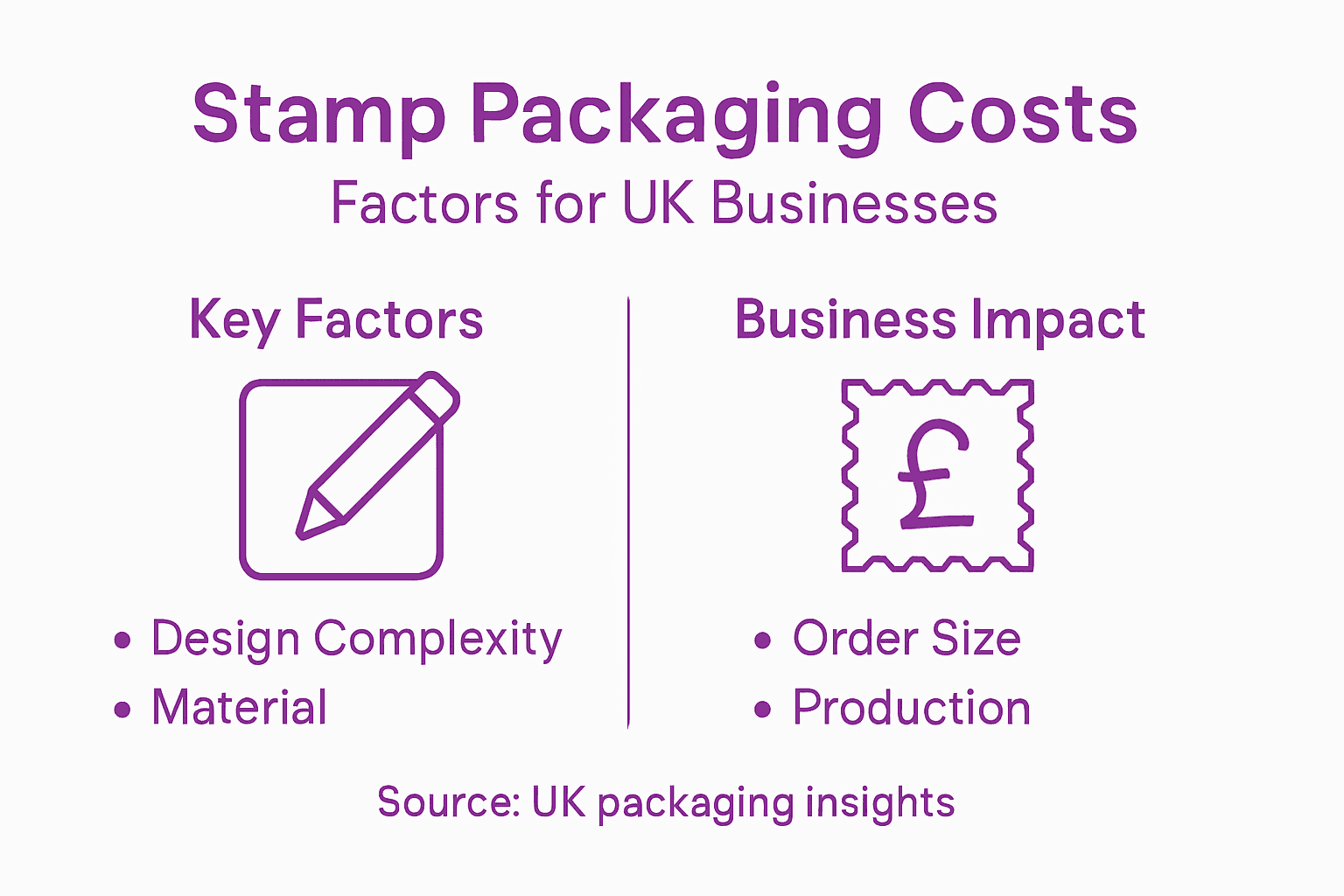
The primary cost determinants include stamp design complexity, material selection, order quantity, and production techniques. Initial design costs can range from modest investments for simple single-colour stamps to substantial expenses for intricate multi-colour or digitally complex stamp designs. Small businesses might expect initial design fees between £50-£250, while larger corporations could invest £500-£1,500 for highly specialised custom stamp packaging solutions. Order quantity plays a crucial role in reducing per-unit costs, with bulk orders providing substantial price reductions. For instance, ordering 100 stamps might cost approximately £2-£5 per stamp, whereas 1,000 stamps could reduce the per-unit price to £1-£2.
Practical implications extend beyond direct monetary investments, encompassing operational considerations such as stamp durability, maintenance requirements, and long-term branding consistency. Businesses must factor in ongoing costs like ink replacement, stamp replacement cycles, and potential staff training for proper stamp usage. High-quality stamps made from durable materials like polymer or premium rubber offer longer-term value, potentially reducing replacement frequency and maintaining consistent brand representation across packaging materials.
Pro tip: Request comprehensive quotes that include design, production, and potential maintenance costs to develop a holistic understanding of your custom stamp packaging investment.
Below is a summary of key cost factors and their business implications:
| Cost Factor | Impact on Business | Consideration for Investment |
|---|---|---|
| Design Complexity | Raises initial costs | Choose scalable designs |
| Material Quality | Affects longevity | Invest in durable options |
| Order Quantity | Influences per-unit price | Larger orders offer savings |
| Maintenance | Ongoing operational spend | Plan for ink and replacements |
Common mistakes and how to avoid them
Custom stamp packaging requires precision and strategic planning to avoid costly errors that can compromise brand perception and operational efficiency. Postal packaging mistakes can significantly impact a business’s reputation and financial performance, making careful implementation crucial.
One of the most prevalent mistakes businesses encounter involves inconsistent stamp design and application. Companies often underestimate the importance of maintaining uniform stamp impressions across different packaging materials. This inconsistency can result from using worn-out stamps, selecting inappropriate ink types, or failing to establish clear branding guidelines. Stamp alignment, impression pressure, and colour accuracy are critical factors that demand meticulous attention. Businesses should invest in high-quality stamps, conduct regular maintenance, and develop comprehensive stamp usage protocols to ensure every packaging interaction reflects professional standards.
Another significant pitfall is neglecting the strategic placement and sizing of custom stamps on packaging materials. Poorly positioned stamps can obscure important shipping information, reduce packaging structural integrity, or create visual clutter that detracts from the brand message. Organisations must carefully consider stamp dimensions, placement locations, and their interaction with other packaging elements. This requires collaboration between design teams, marketing departments, and packaging engineers to create a harmonious and functional branding approach that enhances rather than compromises packaging effectiveness.
Pro tip: Develop a comprehensive stamp usage manual that includes precise guidelines for stamp design, positioning, ink selection, and maintenance to maintain consistent and professional branding across all packaging materials.
Enhance Your Brand with Custom Stamp Packaging Solutions
Struggling to maintain consistent and professional branding across your packaging materials Do your packaging impressions lack clarity or consistency Custom stamp packaging offers a practical way to transform every parcel into a powerful marketing opportunity by embedding your logo, contact details, or compliance information with precision and style. With challenges like stamp design complexity, ink compatibility, and impression uniformity, it is essential to choose the right custom stamp that aligns with your branding needs and operational volume
Discover how you can avoid common pitfalls such as inconsistent stamp impressions and poor placement by leveraging expert stamp design and high-quality materials from StampDesign4U. Their easy-to-navigate platform allows you to create and order personalised stamps tailored to your specific packaging demands. Act now to elevate your UK branding strategy with bespoke stamps that ensure every package speaks clearly about your professionalism and identity. Start crafting your custom stamp today at https://stampdesign4u.co.uk and turn every parcel into a lasting brand impression.
Frequently Asked Questions
What is custom stamp packaging?
Custom stamp packaging is a branding method where personalised stamps are used to imprint logos, text, and other branding elements directly onto packaging materials, enhancing visual communication and brand identity.
What are the main types of custom stamps used in packaging?
The primary types of custom stamps include self-inking stamps, traditional rubber stamps, digital print stamps, and pre-inked stamps, each with distinct advantages suited for different branding needs.
How can businesses ensure consistent quality in their stamp impressions?
To ensure consistent quality, businesses should invest in high-quality stamps, select appropriate ink types, conduct regular maintenance, and develop comprehensive usage guidelines detailing stamp positioning and application techniques.
What are the cost factors to consider when implementing custom stamp packaging?
Key cost factors include the complexity of stamp design, the quality of materials used, order quantity (as bulk orders can reduce per-unit costs), and ongoing maintenance expenses for ink replacements and stamp durability.
Recommended
- Custom Logo Stamps: Why They Matter for your Brand Identity – Stamp Design 4U
- Boost Your Branding: Custom Logo Stamps For Businesses – Stamp Design 4U
- Business Stamp Layout Guide for Effective Branding UK – Stamp Design 4U
- Complete Guide to Branding With Custom Stamps – Stamp Design 4U
- How to Personalize Phone Cases: A Simple Guide – StudioShake