

TL;DR:
- Without a structured stamp approval process, businesses face inconsistent application, unapproved documents, and compliance gaps that damage credibility and increase costs. Implementing role-based workflows with clear lifecycle states, controlled assets, and audit trails ensures reliable, compliant document authorization. Regular reviews and role-focused policies help maintain consistency, accountability, and scalability across organizational changes.
Without a structured custom stamp approval process, businesses routinely face the same problems: stamps applied inconsistently across documents, unapproved versions reaching clients, and no reliable record of who authorised what. These are not minor inconveniences. They erode brand credibility, create compliance gaps, and generate rework that costs real time and money. This guide walks you through how to plan, implement, and maintain a stamp approval workflow that holds up to internal scrutiny and external audit alike, covering everything from stakeholder mapping to version control.
Table of Contents
- Key takeaways
- Setting up a custom stamp approval process
- Implementing the approval workflow step by step
- Common challenges and how to address them
- Benefits of a well-run approval process
- My experience with stamp approval workflows
- Customise your approval stamps with Stampdesign4u
- FAQ
Key takeaways
| Point | Details |
|---|---|
| Define roles before designing | Identify approvers, document owners, and policy leads before you create a single stamp. |
| Treat workflows as state machines | Map every lifecycle state explicitly so invalid approvals cannot occur by accident. |
| Standardise stamp assets centrally | Distribute controlled stamp files to prevent size, colour, and opacity drift across users. |
| Capture audit evidence at every step | Record actor, timestamp, and document version for every approval action taken. |
| Review and update regularly | Schedule periodic audits of your approval process to catch drift and update policies. |
Setting up a custom stamp approval process
The term most commonly used in document governance circles is stamp approval workflow, though many businesses refer to it simply as an approval stamp process. Whatever you call it, the underlying principle is the same: no stamp should reach a live document without passing through defined checks. Getting the foundations right before you design anything is where most organisations go wrong.
Identifying your business requirements
Start by mapping what your stamps actually do. Are they authorising invoices, marking documents as reviewed, confirming dispatch, or flagging confidential status? Each use case has a different risk profile and may require a different level of sign-off. A “received” stamp carries far less regulatory weight than an “approved for release” stamp in a quality-managed environment.
You should also identify every stakeholder who needs to be involved. This typically includes document owners, departmental managers, a compliance or legal lead, and someone responsible for brand integrity. Capturing all of these perspectives early prevents the most common failure mode: a process designed by one team that the rest of the organisation ignores.
Mapping approval levels and document contexts
Not every stamp needs the same approval route. Consider structuring your requirements using a simple framework:
- Stamp type. Define categories such as transactional (invoices, purchase orders), compliance (quality approvals, safety sign-offs), and branding (logos, return addresses).
- Approval level. Determine whether each category requires single sign-off, multi-stage review, or senior authorisation.
- Document context. Specify which document types, formats, and systems each stamp applies to.
- Tool requirements. Decide whether physical rubber stamps, digital PDF stamps, or both are needed for each context.
| Category | Approval level | Key stakeholder |
|---|---|---|
| Transactional | Single sign-off | Finance manager |
| Compliance | Multi-stage review | Quality and legal leads |
| Branding | Senior authorisation | Brand or marketing lead |
| Operational | Single sign-off | Department manager |
Clear stamp design guidelines at this stage save considerable revision work later. Documenting the rules around colour, size, wording, and placement means designers and approvers are working from the same reference point.
Pro Tip: Before writing a single policy document, interview two or three people who currently apply stamps in your organisation. Their workarounds reveal the gaps your process needs to close.
Implementing the approval workflow step by step
Once your requirements are mapped, you are ready to build. A well-structured stamp approval workflow functions like a state machine: defined states and valid transitions control movement between stages, and invalid transitions are blocked by design rather than by trust.
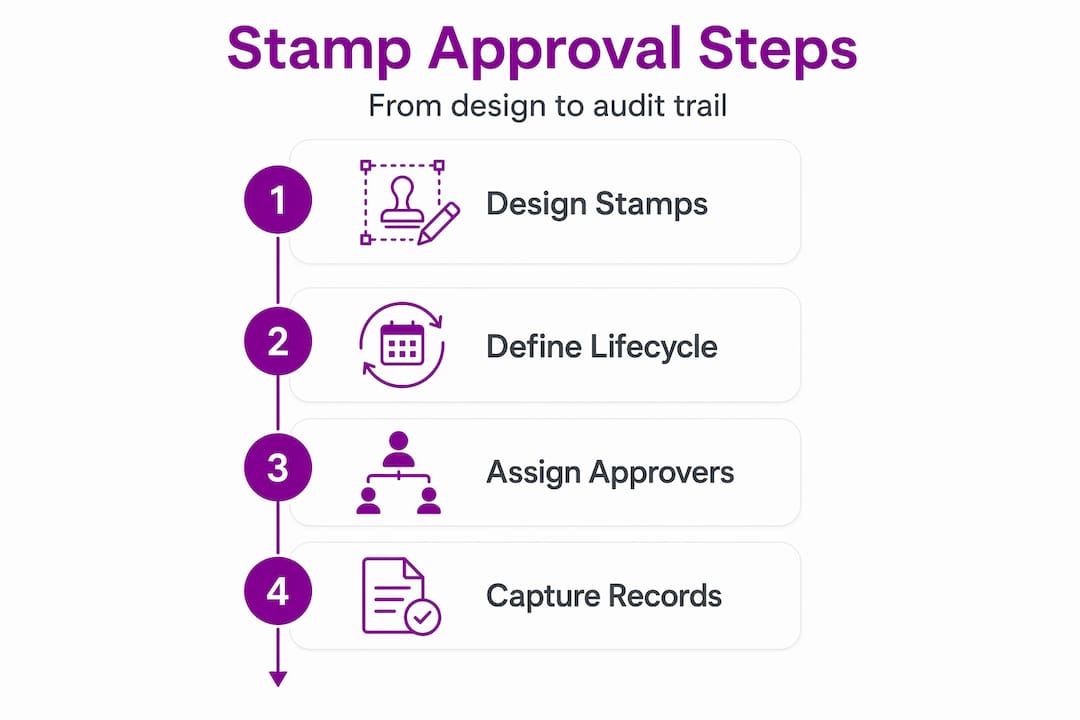
Step 1: Design your stamp assets
Work from your stamp design guidelines to produce master artwork files for each stamp category. Key design decisions at this stage include:
- Set exact dimensions, font, and colour values in your brand palette.
- Create separate files for physical and digital applications where formats differ.
- Name files using a consistent convention that includes category, version number, and date.
- Store master files in a controlled location with restricted write access.
For digital stamps, Adobe Acrobat supports creating custom stamp sets with configurable properties including opacity, size, and rotation. Organising these into clearly labelled categories within Acrobat makes the correct stamp easy to locate and reduces the chance of the wrong one being applied.
Step 2: Define lifecycle states
Every stamp in your process should have a documented lifecycle. A practical structure for regulated documents looks like this:
- Draft. Stamp design created but not yet submitted for review.
- Under review. Submitted to nominated approvers for assessment.
- Compliance check. Reviewed by legal or regulatory lead where applicable.
- Approved. Cleared for use and distributed to authorised users.
- Archived. Superseded version removed from active use and retained for records.
A robust approval process for regulated documents requires explicit lifecycle states and versioning to prevent ambiguity and track every change made between versions.
Step 3: Assign approvers by policy, not by person
This is where many organisations default to convenience and later regret it. Assigning approvals to a named individual creates a single point of failure and a compliance gap when that person is absent. Assigning approvers via policies based on roles or groups prevents unauthorised approvals and keeps the process intact regardless of personnel changes.
Map each approval step to a role, not a name. If your process requires a finance director to approve transactional stamps, write the policy so that whoever holds that role at the time is automatically in scope.
Step 4: Capture audit evidence
Every approval action should generate a record that includes the approver identity, the timestamp, the document version, and the reason for approval or rejection. Treating stamp approvals as governance controls means binding approvals to specific document versions with immutable audit trails.

For physical stamps, this means maintaining a sign-off log. For digital workflows, configure your document management system to capture metadata automatically at each transition.
Pro Tip: Store audit logs separately from the documents themselves. If a document is edited or deleted, the approval record should remain intact and independently retrievable.
You can find a detailed overview of best practices for custom stamps that covers asset management and workflow integration in practical terms.
Common challenges and how to address them
Even well-designed processes run into problems once they meet real-world use. Anticipating these issues means you can build mitigation in from the start rather than patching it in later.
Settings drift
Standardising stamp assets and controlling user permissions ensures consistent application across an organisation. When users can modify stamp properties freely, you will eventually find stamps in the wrong colour, at the wrong size, or with reduced opacity that makes them difficult to read or photograph. The fix is to distribute read-only stamp files and lock properties where your platform allows it.
- Audit applied stamps quarterly against the master specification.
- Use a checklist for approvers that includes visual verification of stamp properties.
- Revoke access to editable stamp files for general users and restrict them to a controlled asset library.
Unauthorised use and misuse
Approver assignment rules that are tied to roles rather than individuals are the single most effective control against unauthorised stamp use. When the policy defines who can approve, not just who currently approves, the process is self-maintaining.
Pair role-based assignment with a clear escalation path. If an approval step cannot be completed because the relevant role is vacant, there should be a documented route to an interim approver rather than an informal workaround that bypasses your controls.
Version control for amended documents
When a document is revised after stamping, the original approval is invalidated. Your process needs an explicit rule for this. A practical approach: any material amendment to a stamped document triggers a return to the review stage, with the revision noted in the version history.
Audit trails for traceability must include the prior and next state along with reasons for any change, maintaining an immutable record that survives internal and external review.
Pro Tip: Number your document versions and your stamp versions independently. A version 3 document stamped with version 2 of your approval stamp tells you something has changed. Without both numbers, you cannot spot the discrepancy.
Reviewing your rubber stamp compliance practices periodically is worth building into your annual governance calendar.
Benefits of a well-run approval process
The practical advantages of getting this right extend well beyond avoiding errors.
| Benefit | What it delivers |
|---|---|
| Faster approvals | Clear roles and defined routes remove the bottlenecks caused by ambiguity. |
| Brand consistency | Controlled stamp assets produce identical output across every user and document. |
| Regulatory compliance | Documented lifecycle states and audit trails satisfy internal and external requirements. |
| Accountability | Immutable records link every approval to a named role, date, and document version. |
| Scalability | A role-based process accommodates team changes without requiring process redesign. |
The scalability point deserves particular attention. Businesses often design approval processes around current team structures and then find the process breaks whenever someone leaves or a department reorganises. A role-based customised stamp procedure, where the policy references the job function rather than the individual, adapts without intervention.
My experience with stamp approval workflows
I have reviewed a fair number of approval processes across organisations of different sizes, and the pattern is consistent. The businesses that struggle are almost always the ones that treated stamp approvals as an afterthought, something administrative staff handled informally, without any documented rules or oversight.
What I have learned is that the hidden costs are rarely visible until something goes wrong. A document approved with the wrong stamp version, a compliance audit that uncovers no paper trail, a client who questions whether a contract was properly authorised. These are the moments that make organisations wish they had spent a few hours building a proper process.
The other thing I would say from experience is that resistance to formalising the process usually comes from people who have built up unofficial workarounds. The solution is not to override them but to understand why the workarounds exist. Nine times out of ten, the workaround is solving a real problem that your formal process should address instead.
The balance between flexibility and control matters too. An over-engineered process with too many approval stages will be circumvented. A process with too few controls will drift. The sweet spot is the simplest process that satisfies your compliance requirements and keeps your brand consistent.
— Steven
Customise your approval stamps with Stampdesign4u
If you are ready to put the right physical stamp in the hands of the right approvers, Stampdesign4u offers a range of custom rubber stamps suited to business approval workflows. The Trodat 4927 rubber stamp provides up to nine lines of text alongside your logo, giving you space to include role, department, and reference details directly on the stamp. Each stamp can be ordered with your exact artwork, produced to a consistent specification, and delivered ready for immediate use. With options to upload your own logo and select the dimensions that suit your documents, ordering a stamp that fits your approval process is straightforward. Contact the Stampdesign4u team for guidance on the right product for your workflow.
FAQ
What is a custom stamp approval process?
A custom stamp approval process is a formalised workflow that governs how stamps are designed, authorised, and applied to business documents. It defines lifecycle states, approver roles, and audit requirements to maintain compliance and brand consistency.
How do I prevent unauthorised stamp use in my organisation?
Assign approvers by role rather than by individual, and restrict access to editable stamp files. Role-based policies automatically transfer approval authority when personnel change, removing the risk of informal workarounds.
Why does stamp version control matter?
When a document is amended after stamping, the original approval no longer applies. Maintaining separate version numbers for documents and stamp assets lets you identify immediately when a mismatch has occurred and reopen the approval route accordingly.
What should an audit trail for stamp approvals include?
An effective audit trail records the approver identity, timestamp, document version, prior and next lifecycle state, and the reason for each approval or rejection. Immutable audit records are stored independently from the documents themselves.
How often should I review my stamp approval process?
A quarterly check of stamp asset compliance and an annual review of the full approval process are practical benchmarks for most organisations. Trigger an additional review whenever your team structure, regulatory requirements, or document types change significantly.