

TL;DR:
- Corporate mailing stamps influence branding, fraud prevention, and cost management beyond mere postage. Using various stamp types strategically and sourcing from verified suppliers can enhance operational efficiency and brand perception. Planning ahead for rate increases and treating stamps as integral communication assets can yield significant savings and brand consistency.
Most corporate professionals treat postage as an afterthought. You order stamps when the office runs out, stick them on envelopes, and move on. Yet corporate mailing stamps explained properly reveal something far more consequential. They touch branding, compliance, fraud prevention, and cost control in ways that a simple trip to the post office does not capture. With proposed rate increases landing in July 2026, the administrative teams managing these decisions will either cost their organisations money or save it. This guide covers types, usage, procurement, and the branding opportunities most offices are currently missing.
Table of Contents
- Key takeaways
- Corporate mailing stamps explained: types and terminology
- Stamps as a branding tool
- Understanding postage costs in 2026
- Operational best practices for corporate mail
- Procuring corporate stamps: channels and vendors
- My take on corporate stamp strategy
- Practical solutions for corporate stamp needs
- FAQ
Key takeaways
| Point | Details |
|---|---|
| Stamps have strategic value | Corporate mailing stamps affect branding, fraud control, and postage costs, not just mail delivery. |
| Multiple stamp types exist | Forever stamps, metered mail, perfins, and custom designs each serve distinct corporate functions. |
| Postage costs are rising | The 2026 USPS rate increase raises First-Class Forever stamps to $0.82, making commercial rates worth pursuing. |
| Security matters at scale | Perfins and verified sourcing protect against stamp theft and maintain audit compliance. |
| Custom stamps build brand | Thoughtfully chosen or designed stamps increase mail open rates and reinforce professional image. |
Corporate mailing stamps explained: types and terminology
Understanding mailing stamps at a corporate level starts with recognising that not all stamps are alike, and the differences carry operational weight.
Forever stamps are the most familiar. They cover first-class postage for a standard one-ounce letter regardless of future rate changes, which makes them a stable purchasing choice for bulk buying ahead of rate rises.
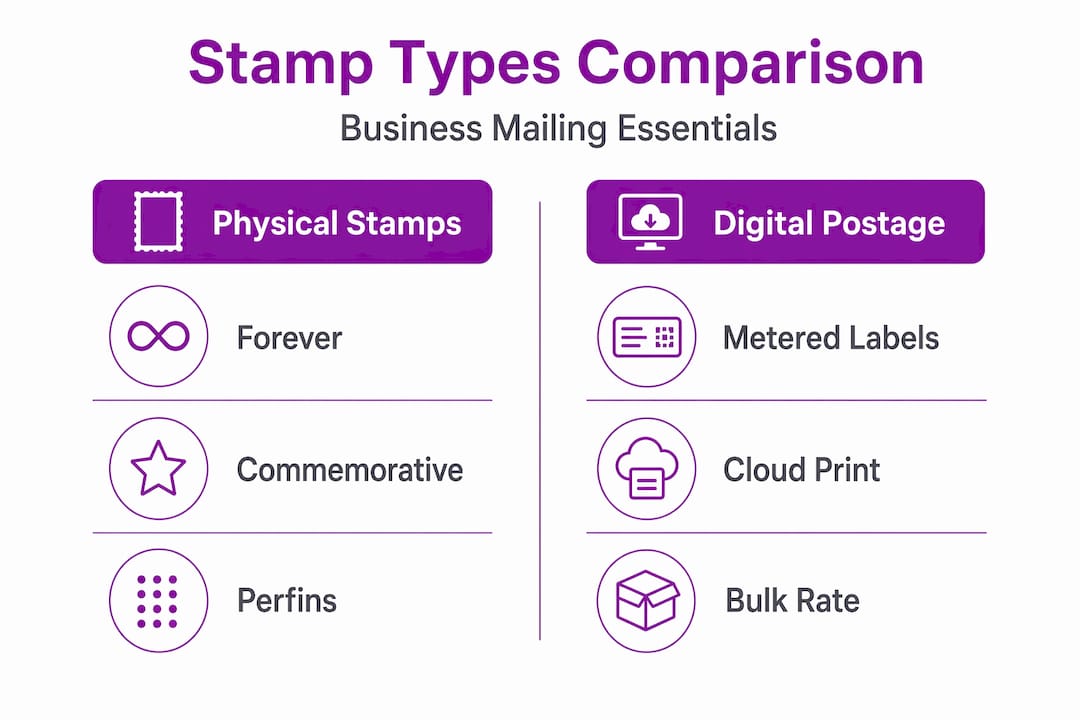
Metered mail uses a postage meter or cloud-based platform to print exact postage values directly onto envelopes or labels. This approach is common in larger offices because it scales well and reduces manual counting. The metered mail rate is typically lower than the retail stamp price, which matters when you’re processing hundreds of pieces per week.
Perfins are postage stamps that have been perforated with a company’s initials or a symbol. They are a corporate security measure used specifically to prevent employee stamp theft and to maintain audit trails. Their use is particularly common in finance, legal, and professional services environments where every expenditure requires documentation.
Commemorative and custom stamps carry design value beyond their postage function. Some organisations procure commemorative series tied to national milestones to use in client and shareholder correspondence. Others commission entirely custom designs.
- Forever stamps: reliable, rate-proof, good for general use
- Metered mail: scalable, auditable, lower per-piece cost
- Perfins: fraud prevention, audit compliance, internal controls
- Commemorative stamps: branding and prestige in correspondence
- Custom rubber stamps: office use, address marking, logo applications
Pro Tip: When buying ahead of a rate increase, stick with Forever stamps rather than denominated stamps. Any unused denominated stock becomes a liability the moment rates change.
Sourcing matters as much as type. Counterfeit stamps exist and they can result in mail being returned, postage-due fees charged to recipients, and reputational damage. Purchasing from verified business portals and Royal Mail or USPS authorised retailers eliminates this risk.
Stamps as a branding tool
Most administrative teams think of stamps as a cost line. The more useful frame is to think of them as the last touchpoint before a letter reaches a client’s hands.
Research confirms that customers respond differently to mail that carries well-chosen stamps. Commemorative designs, in particular, signal care and intentionality. When a private equity firm or law practice sends correspondence bearing a thoughtfully selected stamp series, it communicates attention to detail in a way that a printed postage label simply does not.
The USPS American Icons series, curated by Ralph Lauren for the nation’s 250th anniversary, is a clear example of how stamps function as cultural artefacts. Organisations using this series in their 2026 correspondence are associating their brand with heritage, quality, and national significance.
Beyond postage stamps, custom rubber stamps applied to envelopes, packaging, or internal documents serve branding purposes directly. A custom logo stamp applied to an outer envelope reinforces brand recognition at the moment of opening. The consistency this creates across all physical correspondence is measurable in terms of professional image.
“Stamps contribute soft power in corporate and shareholder correspondence, beyond mere postage payment.” — USPS on the strategic role of stamp selection
Key branding applications for corporate stamp usage include:
- Using commemorative postage stamps in shareholder and client letters
- Applying custom logo rubber stamps to envelopes and packaging
- Matching stamp aesthetic to wider brand identity in direct mail campaigns
- Using branded stamps for internal document processing to reinforce consistency
For practical guidance on integrating stamps into your brand identity, the branding with custom stamps resource from Stampdesign4u offers specific steps for businesses of varying sizes.
Understanding postage costs in 2026
Business postage explained simply: you pay more than you need to if you are not buying at the right tier. This is where the difference between retail and commercial pricing becomes material.

The July 2026 rate changes raise the retail First-Class Forever stamp from $0.78 to $0.82. Metered mail rises from $0.74 to $0.78 per ounce. Those differences compound quickly at volume.
| Postage option | Current rate | July 2026 rate | Potential saving vs retail |
|---|---|---|---|
| Retail Forever stamp | $0.78 | $0.82 | Baseline |
| Metered mail | $0.74 | $0.78 | ~5% saving |
| Commercial/bulk rate | Variable | Variable | Up to 30% saving |
| PC Postage (cloud) | Discounted | Auto-updated | Significant at scale |
PC Postage platforms give businesses access to pre-negotiated commercial pricing without requiring large volume commitments. They integrate with reporting tools, which converts mailing from a cost centre with no visibility into a managed budget line.
For organisations sending more than 200 pieces or 50 pounds of mail at a time, bulk mailing services apply address cleaning, ZIP code presorting, and barcoding to unlock commercial automation rates. The savings relative to retail stamps are substantial and consistent.
Cloud-based postage platforms remove the hardware overhead of physical postage meters while providing automatic rate updates. This matters particularly in 2026 as rates shift mid-year.
Pro Tip: If your organisation sends international correspondence regularly, note that international letter rates rise from $1.70 to $1.75 in July 2026. Buying international stamps ahead of the change and tracking usage against budget is a straightforward way to contain costs.
The corporate courier workflow article covers how integrating electronic postage systems with delivery workflows reduces total mailing expenditure for organisations managing high volumes of outbound correspondence.
Operational best practices for corporate mail
Getting the most from mailing stamps for businesses is not only about buying at the right price. It is about managing stamps as an asset within your operational framework.
Security is the starting point. Perfins prevent employee misuse by perforating stamps with company initials, making them useless for personal use. For organisations where petty theft of office supplies is a governance concern, perfins are an inexpensive and effective control measure.
Envelope geometry directly affects whether your mail moves through automated processing or gets handled manually at extra cost. The length-to-height ratio must fall between 1.3 and 2.5. Square envelopes are non-machinable, which means they attract surcharges and risk delivery delays. Every mailing format decision carries a cost implication.
Common pitfalls in corporate stamp management include:
- Purchasing stamps from unverified retail outlets without audit documentation
- Using non-machinable envelope formats without accounting for surcharge costs
- Failing to account for add-on ounce rates ($0.29 per additional ounce) when mailing multi-page documents
- Mixing stamp types across departments, making spend tracking impossible
- Storing stamps without a secure access protocol, leaving them vulnerable to casual misuse
Pro Tip: Assign stamp management to a single point of contact within your administrative team. Centralising procurement and usage tracking eliminates the most common source of postage waste in offices: unaccountable, ad hoc purchasing by multiple staff members.
Verified sourcing also supports compliance. Booklets of 20 stamps purchased through verified business portals create an auditable supply chain, reduce the risk of mailing rejections, and protect brand reputation in large-scale correspondence campaigns. This matters particularly in regulated industries where correspondence records are subject to review.
Procuring corporate stamps: channels and vendors
Knowing where to buy matters as much as knowing what to buy. The importance of postage in companies is reflected in the procurement decisions administrative teams make, not just the act of applying stamps to envelopes.
The main procurement channels for corporate stamp usage are:
- Post office retail counters. Accessible and straightforward for small volumes. No commercial discounts apply, and there is no automatic audit trail beyond your own record-keeping.
- Verified bulk resellers. Offer booklets, coils, and sheets at commercial rates with documentation. Suitable for organisations with consistent, high-volume mailing needs.
- Online PC Postage platforms. Cloud-based systems that print postage to order, apply automatic rate updates, and generate spend reports. The lowest overhead option for most mid-to-large offices.
- Custom rubber stamp suppliers. For branded stamps applied to envelopes and documents, specialist providers such as Stampdesign4u supply custom designs for logos, addresses, and compliance markings.
- Royal Mail Business Account (UK). For UK-based organisations, a Royal Mail business account provides access to account-based pricing, collection services, and consolidated billing.
For guidance on choosing stamps for business mail, Stampdesign4u covers the key considerations around sourcing authenticity and format decisions. The role of stamps in business resource also addresses compliance and trust dimensions of corporate stamp procurement. Understanding bulk purchasing strategies can further support administrative teams looking to build a cost-effective, auditable supply of stamps.
Avoid unverified third-party sellers operating outside official postal or authorised reseller channels. The risk of counterfeit stock is real, and the operational and reputational cost of undelivered mail or postage-due notices far outweighs any short-term saving on unit price.
My take on corporate stamp strategy
I’ve spent considerable time working with administrative teams across different industries, and the same pattern comes up repeatedly. Stamps get treated as a stationery item until something goes wrong. A batch of mail gets returned. An audit flags unaccountable postage spend. A client notices that a competitor’s correspondence looks considered while yours looks generic.
What I’ve found is that the organisations managing this well treat stamps as part of their communications infrastructure, not their office supply list. They have a procurement owner, they buy ahead of rate changes, they use perfins or access controls where appropriate, and they think deliberately about what lands in a client’s hands.
The move to digital-first communication has, somewhat counterintuitively, made physical mail more impactful. When most correspondence arrives digitally, a well-prepared physical letter stands out. The stamp is part of that presentation. It signals that someone made deliberate choices, and that signal carries weight in professional relationships.
My practical advice for 2026: review your current mailing spend against commercial and bulk rate options before July. The rate increase is predictable and the savings available through metered or PC Postage systems are not trivial. Then look at what your outbound mail actually looks like. If the answer is “generic,” there is an opportunity there that costs very little to address.
— Steven
Practical solutions for corporate stamp needs
Stampdesign4u supplies custom rubber stamps designed specifically for business and corporate use, covering everything from logo stamps for branded correspondence to address and compliance stamps for document processing. Whether you need a compact solution for high-volume office marking or a professional stamp that carries your brand identity consistently across all outbound mail, the product range covers the requirement.
The Trodat 4927 rubber stamp is a reliable choice for offices needing a 9-line logo and text stamp at 60 x 40mm, suitable for letterheads, envelopes, and document processing. For organisations with an environmental messaging component to their brand, the Traxx 9021 recycle stamp offers a compact, purpose-built option. Stampdesign4u’s ordering process is direct and straightforward, making it practical for administrative teams to specify, order, and receive custom stamps without delays.
FAQ
What are the main types of corporate mailing stamps?
The main types are Forever stamps, metered mail labels, perfins (security-perforated stamps), commemorative stamps, and custom rubber stamps. Each serves a distinct function covering postage payment, fraud prevention, and branding.
How do perfins help with corporate stamp security?
Perfins are stamps perforated with company initials to prevent employee misuse and support internal audit trails. They are standard practice in finance and legal environments where postage expenditure requires documentation.
What postage rate changes affect businesses in July 2026?
The First-Class Forever stamp rises from $0.78 to $0.82 and metered mail increases from $0.74 to $0.78. International letter rates also rise marginally, making pre-purchase and commercial rate adoption worth prioritising before the change takes effect.
How can businesses reduce postage costs at volume?
PC Postage platforms provide access to pre-negotiated commercial rates without large volume requirements, and bulk mailing services unlock further discounts through address presorting and barcoding for mailings exceeding 200 pieces.
Do stamp choices genuinely affect brand perception?
Research indicates clients respond more positively to correspondence bearing well-chosen stamps, and commemorative designs in particular associate the sender with quality and intentionality. Custom rubber stamps applied to envelopes reinforce this further.
Recommended
- Role of Stamps in Business – Branding, Compliance, Trust – Stamp Design 4U
- Personal vs Business Stamps: Choosing For UK Branding – Stamp Design 4U
- Reusable Stamps for UK Businesses: Streamlined Branding – Stamp Design 4U
- Business branding with stamps: Practical steps for small businesses – Stamp Design 4U