

TL;DR:
- UV ink stamping involves either fluorescent inks for covert security purposes or UV-curable inks for instant, durable industrial markings. Fluorescent inks glow under UV light to reveal hidden marks, while UV-curable inks harden instantly upon UV exposure for high-speed production uses. Correctly matching the UV light wavelength to the ink type is essential for effective verification and application success.
UV ink stamping is defined as the process of applying ultraviolet-reactive ink to a surface using a stamp, producing marks that are invisible or low-contrast under normal light but clearly visible under a UV lamp. The term covers two distinct systems: fluorescent UV-reactive inks, which glow when exposed to ultraviolet light, and UV-curable inks, which harden instantly when hit by UV energy. Both serve very different purposes. Fluorescent inks are the tool of choice for security authentication, document verification, and covert branding. UV-curable inks are the standard in industrial printing where speed and durability matter. Understanding which system you need is the first decision any buyer or specifier must make.
How does the UV ink stamping process work?
The UV ink stamping process differs fundamentally depending on which of the two ink systems you are using. Both involve UV light, but the chemistry and the outcome are entirely different.
Fluorescent UV ink: revealing hidden marks
Fluorescent UV inks contain pigments that absorb UV energy and re-emit visible light when exposed to a UV lamp. The mark sits on the surface in normal conditions, appearing invisible or nearly so to the naked eye. Hold a UV torch over it and the pigments fluoresce, producing a bright glow that reveals the stamp impression clearly. This is the mechanism behind security stamps on event tickets, passports, and product authentication labels.
The workflow for fluorescent UV stamping follows three steps:
- Apply the ink. The stamp is pressed onto the surface, depositing a thin layer of fluorescent ink. Self-inking UV stamps, such as those used in retail and event management, carry the ink in a built-in pad for consistent impressions.
- Normal handling. The mark dries quickly and remains invisible under ambient light. No special treatment is needed at this stage.
- UV verification. A UV lamp, typically operating at 365nm, is passed over the surface. The fluorescent pigments activate and the mark becomes visible for authentication.
Pro Tip: The wavelength of your UV lamp must match the activation spectrum of your ink. A lamp operating at the wrong frequency will fail to reveal the mark, even when the stamping was applied correctly.
Uv-curable ink: instant hardening
UV-curable inks work on an entirely different principle. These inks contain photoinitiators, chemical compounds that trigger polymerisation under UV exposure, forming a solid polymer network on the substrate in a fraction of a second. There is no evaporation, no waiting for solvents to disperse. The ink goes from liquid to hard solid the moment UV light hits it. This is why UV-curable inks are standard in high-speed packaging lines, label printing, and industrial marking where downtime is not an option.
What are the benefits of UV ink stamping vs traditional stamping?
Traditional stamping uses solvent or water-based inks that dry through evaporation. UV ink stamping replaces that process with chemistry, and the advantages are measurable.
- Covert security. Visible security features can be scanned and copied, but UV fluorescent marks remain hidden until verified with a UV lamp. This makes them significantly harder to forge or replicate without specialist materials.
- No drying time. UV-curable inks improve workflow efficiency by removing drying bottlenecks, allowing immediate handling of stamped items. In a production environment, this translates directly to higher throughput.
- Durability. The photopolymer network formed during UV curing is chemically bonded to the substrate. Marks resist smearing, moisture, and abrasion far better than air-dried inks.
- Surface flexibility. UV inks adhere to paper, card, plastic, glass, metal, and even skin. Traditional inks are far more substrate-specific, often requiring treated or absorbent surfaces to perform reliably.
- Precision. Because UV-curable inks do not spread or bleed during a drying phase, the stamped impression holds its exact shape. Fine detail in logos and text is preserved clearly.
Pro Tip: If you are using UV fluorescent stamps for event entry or loyalty schemes, test your UV lamp against the ink before the event. Lamp degradation over time reduces output intensity and can cause verification failures at the worst possible moment.
For a broader look at how invisible ink stamps work in practice, Stampdesign4u has a dedicated guide covering the core uses and advantages.
What are the common applications of UV ink stamping?
UV stamping technology appears across a wider range of industries than most people expect. The applications split broadly into security and authentication on one side, and industrial production on the other.
- Document and product authentication. Passports, banknotes, event tickets, and pharmaceutical packaging all use UV security marks. The mark is applied during production and verified at the point of use with a UV lamp.
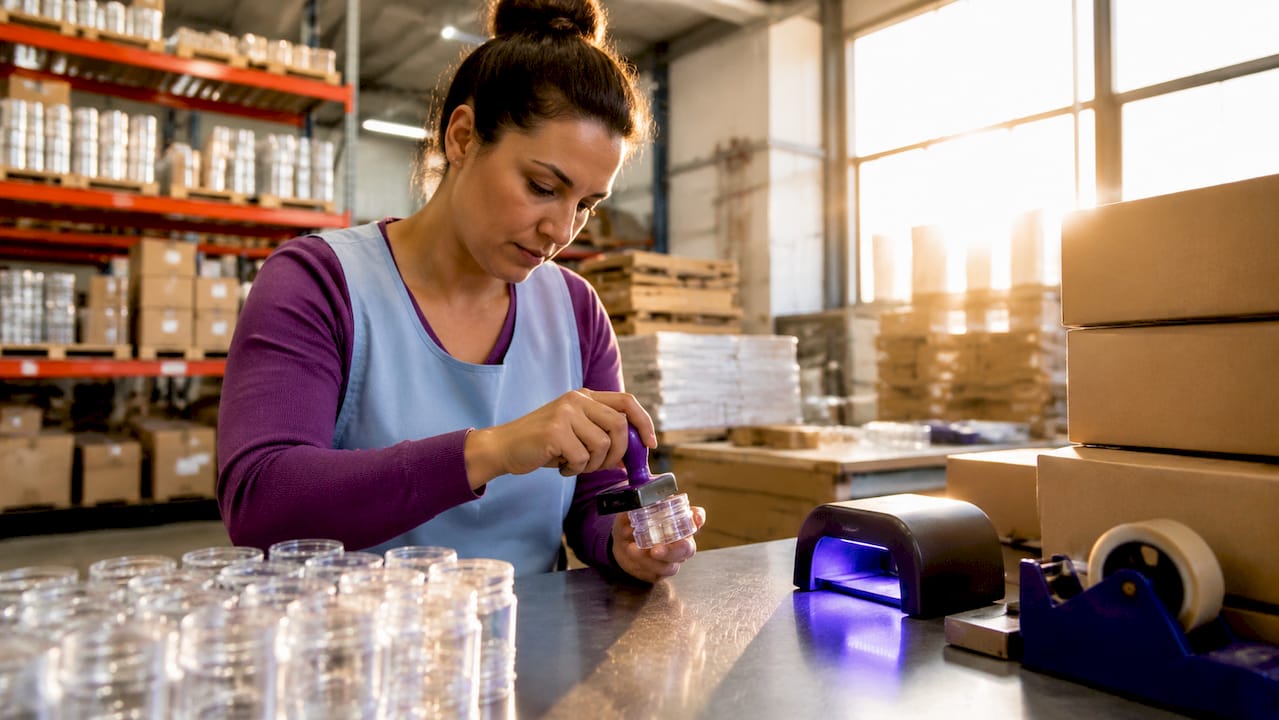
- Retail and event management. UV self-inking stamps are used for authentication and tracking at venue entry points, loyalty card schemes, and promotional campaigns. The stamp is applied to a hand or card and checked under UV light for entry or redemption.
- Industrial packaging. UV-curable inks are standard in high-speed label and packaging lines. Instant curing means printed or stamped items can be stacked, wrapped, or dispatched immediately after marking.
- Creative and brand authenticity uses. Some brands apply UV marks to products as a covert authenticity feature, invisible to the consumer but verifiable by retailers or customs officials. Artists also use fluorescent UV inks for decorative effects visible only under UV light.
The table below summarises the primary application areas and the UV ink system each one typically uses.
| Application | UV Ink System Used | Key Benefit |
|---|---|---|
| Document authentication | Fluorescent UV-reactive | Covert mark, hard to forge |
| Event entry stamps | Fluorescent UV-reactive | Invisible until verified |
| Industrial packaging lines | UV-curable | Instant cure, no bottleneck |
| Loyalty and promotional stamps | Fluorescent UV-reactive | Tamper-resistant, reusable |
| Product anti-counterfeiting | Fluorescent UV-reactive | Hidden until UV inspection |
| High-speed label printing | UV-curable | Durable, substrate-flexible |
For more detail on how ink security in stamps functions across these use cases, Stampdesign4u covers the subject in a separate guide.
Fluorescent UV ink vs uv-curable ink: key technical differences
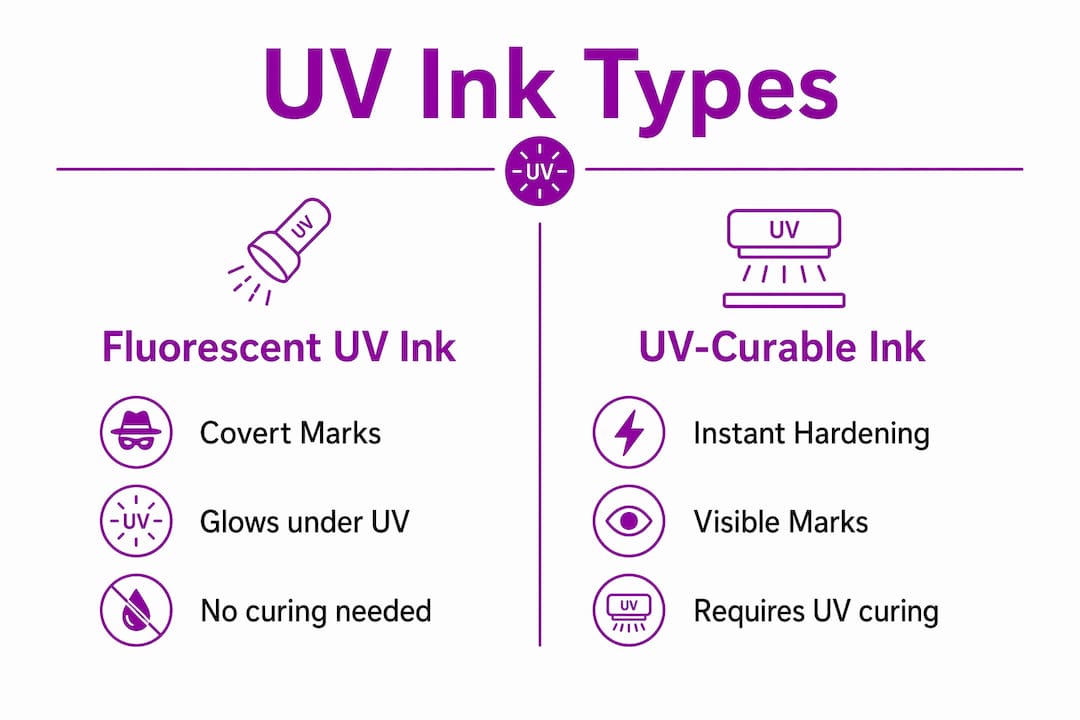
The phrase “UV ink stamping” covers two chemically distinct systems. Treating them as interchangeable is the most common mistake buyers make. The table below sets out the core differences.
| Feature | Fluorescent UV-Reactive Ink | UV-Curable Ink |
|---|---|---|
| Primary function | Covert marking and authentication | Instant curing and durability |
| Visibility under normal light | Invisible or very low contrast | Fully visible |
| Revealed by UV light | Yes, fluoresces brightly | No additional effect |
| Drying mechanism | Air drying or absorption | Photoinitiated polymerisation |
| Substrate range | Paper, card, skin, plastic | Paper, plastic, glass, metal |
| Typical use case | Security stamps, event entry | Packaging, industrial printing |
| Verification requirement | UV lamp at correct wavelength | None required |
The chemistry behind each system matters for practical use. Fluorescent UV inks are visual-reactive only, meaning they produce no structural change in the ink film. They simply glow. UV-curable inks undergo a permanent chemical transformation. Once cured, the polymer network cannot be reversed.
Matching the UV lamp wavelength to the ink’s activation spectrum is not optional for fluorescent verification. Without the correct UV light source, authentication fails even when the stamp was applied perfectly. Most fluorescent security inks activate at 365nm, though some specialist formulations use shorter wavelengths around 254nm. Always confirm the activation wavelength with your ink supplier before purchasing verification equipment.
UV-curable inks carry their own technical demands. Incomplete curing from suboptimal UV exposure leads to tacky surfaces, poor adhesion, and production failures. Process validation, confirming that photoinitiator chemistry and UV energy parameters align, is standard practice in any serious industrial application.
Key takeaways
UV ink stamping divides into two distinct systems: fluorescent inks for covert security marking and UV-curable inks for instant, durable impressions in production environments.
| Point | Details |
|---|---|
| Two separate systems | Fluorescent UV inks reveal marks under UV light; UV-curable inks harden instantly on UV exposure. |
| Security advantage | Fluorescent marks are invisible under normal light, making them significantly harder to forge than visible stamps. |
| Production speed | UV-curable inks remove drying time entirely, allowing immediate downstream handling of stamped items. |
| Wavelength matching | Fluorescent verification requires a UV lamp matched to the ink’s activation spectrum, typically 365nm. |
| Surface flexibility | UV inks work on paper, plastic, glass, metal, and skin, outperforming most traditional solvent-based inks. |
Why most people choose the wrong UV stamp system
Most buyers arrive at UV ink stamping looking for one thing: a stamp that is invisible until you want it seen. That is a reasonable starting point. The problem is that “UV ink” gets used loosely to describe both fluorescent inks and UV-curable inks, and the two are not remotely the same product.
I have seen businesses order UV-curable inks expecting invisible security marks, then find their stamps are fully visible in daylight. The confusion is understandable. Both systems involve UV light. But the role UV plays is completely different. In fluorescent inks, UV light is the revealer. In curable inks, UV light is the hardener. Conflating the two leads to wasted spend and failed verification at exactly the moment it matters most.
The other mistake I see regularly is lamp selection. A cheap UV torch from a general retailer often outputs at a wavelength that does not match the ink’s activation spectrum. The mark appears faint or absent, and the user concludes the stamp is faulty. The stamp is fine. The lamp is wrong.
My advice is straightforward. If you need covert authentication, specify fluorescent UV-reactive ink and confirm the activation wavelength before buying any verification equipment. If you need speed and durability in a production context, UV-curable is the correct system. Do not let a supplier sell you one when you need the other. The applications of UV ink stamping are genuinely broad, but only when you start with the right chemistry for the job.
— Steven
Custom UV stamps from Stampdesign4u
Stampdesign4u offers a range of customisable stamps suited to both security and branding applications, including options compatible with UV-reactive inks.
The Trodat Printy 4927 is a 9-line logo and text stamp at 60 x 40mm, giving businesses a large, clear impression area for logos, addresses, or authentication marks. For loyalty and promotional uses, the Traxx 9021 loyalty stamp at 14 x 14mm is compact and well-suited to event entry and card-stamping schemes using UV-reactive inks. Both products are available with custom design options through Stampdesign4u, with fast turnaround and quality-checked production. Browse the full range at stampdesign4u.co.uk to find the right stamp for your application.
FAQ
What is UV ink stamping used for?
UV ink stamping is used for security authentication, event entry verification, loyalty schemes, and industrial packaging. Fluorescent UV marks remain invisible under normal light and are revealed only under a UV lamp, making them effective for anti-counterfeiting and access control.
How does UV ink become visible under UV light?
Fluorescent pigments in UV security ink absorb ultraviolet energy and re-emit it as visible light, causing the mark to glow. The effect is only visible when a UV lamp of the correct wavelength is directed at the stamped surface.
What is the difference between fluorescent UV ink and uv-curable ink?
Fluorescent UV ink is used for covert marking and glows under UV light without changing its physical structure. UV-curable ink undergoes photoinitiated polymerisation under UV exposure, hardening instantly to form a durable, fully visible impression.
Does UV ink stamping work on all surfaces?
UV inks adhere to a wide range of substrates including paper, card, plastic, glass, metal, and skin. Substrate compatibility varies by ink formulation, so confirming compatibility with your supplier before use on non-standard surfaces is advisable.
Why would a UV stamp fail to show under a UV lamp?
The most common cause is a mismatch between the UV lamp’s output wavelength and the ink’s activation spectrum. Most fluorescent security inks activate at 365nm. A lamp operating outside this range will not trigger fluorescence, even when the stamp has been applied correctly.