

TL;DR:
- An official endorsement stamp verifies the authenticity and procedural compliance of a document, not its content. Choosing between an apostille or consular legalisation depends on the destination country’s membership in the Hague Convention, with each requiring different processes. Precise, legible stamps are essential, as any illegibility or errors cause document rejection and delays.
An official endorsement stamp is an authorised mark certifying authenticity and legal compliance of a document, providing tangible proof that the correct administrative procedures have been completed. Whether you are submitting contracts abroad, applying for a foreign visa, or registering a business in an overseas jurisdiction, this stamp is the physical or printed evidence that the relevant authority has verified the document. Without it, foreign governments, courts, and registries will frequently reject paperwork outright. Understanding what an official endorsement stamp is, how it functions, and which type you need can save considerable time, money, and frustration.
What is an official endorsement stamp and how does it work?
An official endorsement stamp functions as a link in a verification chain, with each stamp confirming the legitimacy of the authority that signed or sealed the document before it. The authentication chain works sequentially: a notary first certifies a signer’s identity, a government ministry then verifies the notary’s credentials, and an embassy or consulate may finally confirm the ministry’s authority. Each step depends on the one before it. If any stamp is missing, illegible, or incorrectly placed, the entire chain breaks and the document faces rejection.

The authorities most commonly applying these stamps include notaries public, government ministries such as the UK Foreign, Commonwealth and Development Office (FCDO), and diplomatic missions including embassies and consulates. Each body operates within a defined scope. A notary confirms identity; a ministry confirms the notary’s standing; an embassy confirms the ministry’s authority for the receiving country. The scope does not overlap, and substituting one for another is not acceptable.
Legibility is not a minor technical concern. Incorrect or partial stamps break the authentication chain and cause rejection by recipient authorities. A smudged date, an incomplete seal, or a signature that bleeds into the stamp area can all trigger refusal. Practitioners who process high volumes of international documents treat stamp clarity as a non-negotiable standard.
Pro Tip: Before submitting any document for official endorsement, photocopy it and check that every stamp impression is fully legible, including the date, issuing authority name, and any reference number. Blurred or partial impressions are the single most common cause of rejection.
The types of documents that require official endorsement stamps span a wide range: birth certificates, marriage certificates, academic transcripts, power of attorney documents, commercial contracts, and company registration papers. Each document type may require a different level of endorsement depending on its destination country and intended use.
Apostille stamps vs consular legalisation: which do you need?
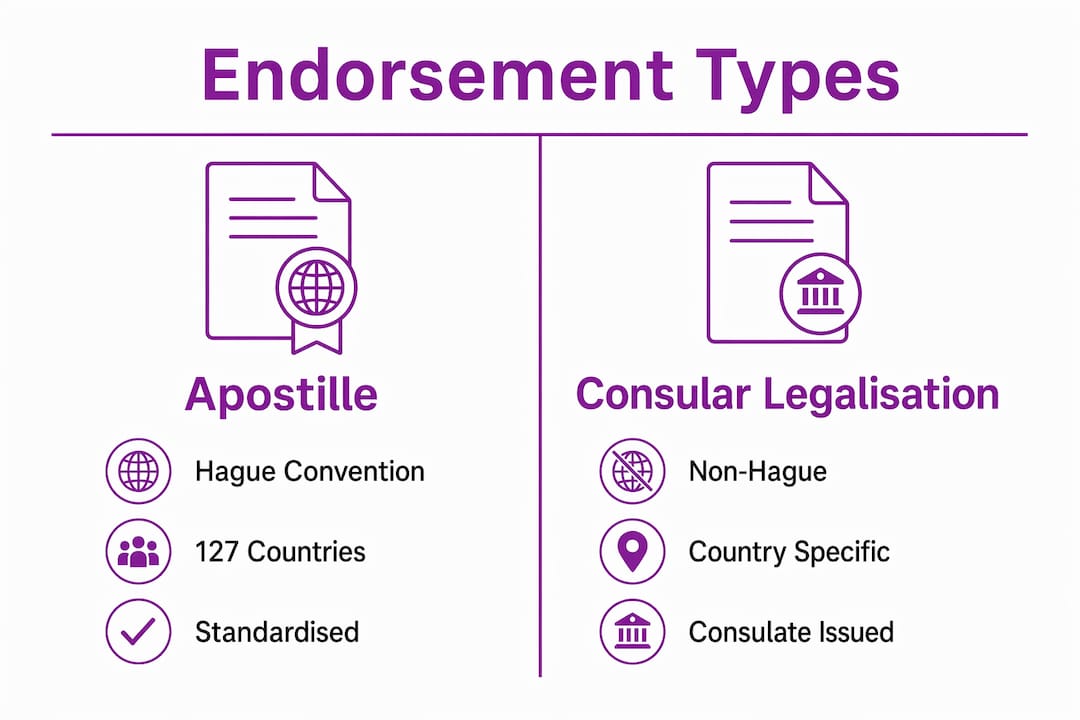
The two principal forms of official endorsement for international use are the apostille and consular legalisation. Choosing the wrong one wastes time and money, and the distinction is straightforward once you understand the underlying framework.
| Feature | Apostille stamp | Consular legalisation |
|---|---|---|
| Governing framework | Hague Convention (1961) | Bilateral or national requirements |
| Countries accepted | 127 member countries | Non-Hague member countries |
| What it verifies | Signatory official’s authority | Full chain of official authority |
| Steps involved | Single certificate from competent authority | Multi-step: notary, ministry, consulate |
| Format | Printed certificate, standardised format | Varies by country and consulate |
| Typical use | EU documents, US documents, UK documents | China, UAE, Saudi Arabia, and others |
An apostille is a standardised certificate issued under the Hague Convention of 1961, accepted across 127 countries and designed to replace the lengthy multi-step legalisation process. It certifies that the signature or seal of an official is genuine. Critically, it does not validate the content of the document itself. A fraudulent contract with a genuine apostille is still a fraudulent contract. The apostille simply confirms that the person who signed it held the authority they claimed.
Consular legalisation is the process required when the destination country is not party to the Hague Apostille Convention. It involves multiple sequential steps: notarisation, authentication by a national authority such as the FCDO in the UK, and a final stamp or seal from the destination country’s consulate or embassy. The final consular stamp is a sovereign act conferring legal standing on the foreign document within the receiving country. Missing this final step is the most common error in cross-border document processing.
Pro Tip: Always confirm the destination country’s membership of the Hague Convention before ordering an apostille. Countries including China, Vietnam, and several Gulf states are not members, meaning consular legalisation is mandatory regardless of how many apostilles the document already carries.
Common misconceptions about endorsement stamps
The most persistent misconception about official endorsement stamps is that they validate the content of a document. They do not. Endorsement stamps verify authority and procedural compliance, not the substantive legal content of what is written. A certified translation with an apostille confirms that the translator’s credentials are genuine; it says nothing about whether the translation is accurate.
A second common confusion is between notarisation and endorsement stamping. These are distinct steps in a hierarchy:
- Notarisation authenticates the identity of a signer within a domestic context. A UK notary confirms that the person signing a document is who they claim to be.
- Authentication or legalisation validates the notary’s own credentials for international recognition. The FCDO, for example, confirms that the notary is properly registered.
- Apostille or consular endorsement then certifies the authentication authority’s standing for the receiving country.
Notarisation authenticates signers domestically, while endorsement stamps validate officials’ signatures for international use. Conflating these steps leads to documents being submitted at the wrong stage, causing delays and additional costs.
A third misconception is that a company seal or corporate stamp carries the same weight as an official government endorsement. In China, for example, specific official seals are mandatory for contracts and legal filings. A document lacking the correct official stamp faces rejection and can block market entry or invalidate contracts entirely. Corporate stamps serve internal branding and administrative purposes; they do not substitute for government-issued endorsement marks.
Missing or unclear stamps in the authentication chain create a cascading problem. If a ministry’s stamp is illegible, the consulate cannot verify the ministry’s authority, and the entire document must return to the beginning of the process. This is not a theoretical risk. It is a routine occurrence for anyone processing documents for use in jurisdictions with strict formal requirements.
How to get an endorsement stamp: a step-by-step process
Obtaining the correct official endorsement stamp requires following a defined sequence. Skipping steps or reordering them produces documents that will be rejected.
- Identify the destination country’s requirements. Confirm whether the country is a Hague Convention member. If yes, an apostille suffices. If not, consular legalisation is required. Check the specific requirements with the destination country’s embassy or a qualified legal professional.
- Prepare and notarise the document. Present the document to a registered notary public. The notary will verify the signer’s identity and apply their own seal and signature. In the UK, the Notaries Society maintains a directory of registered notaries.
- Submit to the competent national authority. For UK documents, this means submitting to the FCDO for an apostille, or to the FCDO for authentication as the first step in consular legalisation. Processing times vary; the FCDO currently offers both standard and premium services.
- Obtain consular endorsement if required. If consular legalisation applies, submit the FCDO-authenticated document to the relevant embassy or consulate in the UK. Each diplomatic mission has its own submission procedures, fees, and turnaround times.
- Verify all stamps before submission. Check that every stamp in the chain is fully legible, correctly dated, and bears the issuing authority’s name and reference number. Use the best practices for custom stamps guide if you are applying your own organisational stamp as part of the process.
- Keep certified copies. Retain certified copies of every document at each stage. If a stamp is later challenged, having a complete record of the authentication chain protects your position.
Checking jurisdiction requirements before starting saves significant time. Requirements change, and what was accepted two years ago may not be accepted today. The UK government’s official guidance and the destination country’s embassy website are the most reliable sources.
Key takeaways
An official endorsement stamp verifies the authority behind a document’s signature or seal, not the document’s content, and the correct stamp type depends entirely on the destination country’s treaty membership.
| Point | Details |
|---|---|
| Core definition | An endorsement stamp certifies that the signing authority is genuine, not that the document content is accurate. |
| Authentication chain | Each stamp verifies the previous authority; a single illegible or missing stamp breaks the entire chain. |
| Apostille vs consular | Apostilles cover 127 Hague Convention countries; consular legalisation is required for all others. |
| Common error | Confusing notarisation with endorsement stamping leads to documents submitted at the wrong procedural stage. |
| Legibility matters | Partial or smudged stamps cause rejection; always verify every impression before submission. |
Why precision in document endorsement is non-negotiable
Working with official documents across multiple jurisdictions has shown me one consistent truth: the errors that cause the most damage are not complex legal mistakes. They are simple, avoidable failures of attention. A stamp applied with insufficient ink pressure. A date omitted. A seal placed over a signature rather than beside it.
What surprises most people encountering this process for the first time is how unforgiving the system is. Foreign authorities do not contact you to request corrections. They reject the document, and you restart from the beginning. I have seen professionals with years of experience submit documents to the FCDO for apostille only to have them returned because the notary’s stamp had faded. The notary had to re-execute the document, the apostille had to be reapplied, and weeks were lost.
The digital shift in official documentation is worth noting. Modern apostilles are printed certificates rather than traditional ink stamps, and some jurisdictions now accept electronic apostilles verified through the HCCH e-APP system. This does not reduce the need for precision. It shifts the precision requirement from physical impression quality to digital certificate integrity and correct file formatting.
My advice for anyone handling official endorsements for the first time: treat the types of business stamps you use internally with the same rigour you apply to government-issued marks. Consistency in your own organisational stamps builds credibility and reduces the risk of your documents being questioned at any stage of the chain.
— Steven
Get the right stamp for official and professional use
When your documents require a clear, professional impression, the quality of the stamp itself matters. Stampdesign4u supplies custom rubber stamps designed to produce consistent, fully legible marks every time. The Trodat 4927 9 Line Logo and Text Rubber Stamp (60 x 40mm) is particularly well suited for organisations that need to apply their own authority marks, reference numbers, or certification text as part of a document authentication process. With a large impression area and support for both logo and text, it delivers the clarity that official procedures demand. Stampdesign4u offers expert design support and an easy ordering process for businesses and individuals across the UK and internationally.
FAQ
What does an official endorsement stamp certify?
An official endorsement stamp certifies that the signature or seal of an authority on a document is genuine and that the correct procedural steps have been followed. It does not validate the content of the document itself.
What is the difference between an apostille and a consular stamp?
An apostille is a standardised certificate accepted in 127 Hague Convention member countries, while a consular stamp is required for countries outside that framework and involves a multi-step authentication process ending at the destination country’s embassy.
What is a certification stamp in official documentation?
A certification stamp is an official mark applied by an authorised body, such as a notary, government ministry, or consulate, confirming that a document or signature meets the required legal or administrative standard for a specific purpose or jurisdiction.
Can a company seal replace an official endorsement stamp?
A company seal cannot replace a government-issued endorsement stamp. In jurisdictions such as China, specific official seals are mandatory for legal filings, and a corporate stamp carries no equivalent authority for formal document validation.
How do I get an endorsement stamp for my documents?
Present your document to a registered notary, then submit it to the relevant national authority such as the FCDO for an apostille or authentication, and finally to the destination country’s consulate if consular legalisation is required.