

“Stamp paper” means one of two very different things, and mixing them up leads to wasted searches and, in legal contexts, real risk. It either refers to the substrate used to print postage stamps, classified by philatelists as wove paper, laid paper, double paper, chalk paper, and various security papers with burelage or watermarks. Or it refers to revenue and legal stamp paper, the judicial and non-judicial paper once required to denote payment of stamp duty on contracts, conveyances, and affidavits, now largely replaced in many jurisdictions by e-stamping.
The two share a name because both trace back to the same origin: a physical mark denoting that something had been paid for or authorised. That’s where the overlap ends.
- Postage-stamp paper: wove, laid, double paper, chalk-coated, security papers with burelage or watermarks, catalogued by references such as Scott’s Standard Postage Stamp Catalog.
- Revenue/legal stamp paper: judicial stamp paper, non-judicial stamp paper, and modern e-stamping systems that replace the physical document.
- The legal dimension in the UK is anchored in the Stamp Act 1891, still cited today in HMRC guidance on document admissibility.
If you’re trying to identify an old postage stamp’s paper stock, head to the section on postage varieties below. If you need to know whether a contract requires stamping to be valid, or how e-stamping works in your jurisdiction, skip to the legal section. Either way, the identification methods and sourcing advice later in this piece apply to both tracks.
Key Takeaways
Understanding stamp paper type means separating the philatelic substrate question from the legal duty-payment question, since the correct action differs completely between the two.
| Point | Details |
|---|---|
| Two distinct meanings | “Stamp paper” refers either to postage-stamp substrate (wove, laid, double, chalk) or to revenue/legal stamp paper for duty payment. |
| Jurisdiction changes the legal answer | The UK now processes Stamp Duty electronically since March 2020, while some countries still issue physical judicial or non-judicial stamp paper. |
| Identification needs layered tests | Combine backlighting, watermark fluid, UV inspection, and tactile checks rather than relying on a single method. |
| Unstamped instruments carry real legal risk | Section 14(4) of the Stamp Act 1891 can make an unstamped chargeable document inadmissible as evidence in UK civil courts. |
| For everyday business stamping needs | Stampdesign4u supplies self-inking and logo stamps for consistent business impressions, though these do not substitute official e-stamping or Stamp Duty payment. |
Table of Contents
- What is stamp paper, and why does the term mean two things?
- Postage stamp paper varieties and how to spot them
- Revenue and legal stamp paper across jurisdictions
- How governments moved from paper stamps to e-stamping
- How to identify stamp paper type step by step
- Why paper variations matter to collectors
- Where to buy genuine stamp paper or use e-stamping services
- Rubber stamps for consistent, professional impressions
- Frequently asked questions
- Sources
What is stamp paper, and why does the term mean two things?
The confusion isn’t accidental. Both meanings grew from the same 19th-century practice of using an official stamp, whether printed, embossed, or adhesive, to prove that a fee or tax had been paid. A postage stamp proved you’d paid to send a letter. A revenue stamp proved you’d paid duty on a legal document. For decades, both were physical objects affixed to paper, and both depended on the quality and security features of that paper to resist forgery.
Historical revenue stamps of the United Kingdom show just how blurred this distinction was: many 19th-century duty stamps were embossed directly onto documents, using coloured inks introduced from the 1850s onwards, in patterns that echoed contemporary postage stamp design. A collector researching an old embossed duty stamp and a homeowner researching modern Stamp Duty Land Tax are, technically, researching descendants of the same idea.
Geography splits the two meanings further apart. Countries such as India still issue physical non-judicial stamp paper for many legal instruments, sold through authorised stamp vendors and treasury offices, alongside a growing e-stamping infrastructure. The UK moved almost entirely the other way. Since March 2020, HMRC has processed stamp duty through electronic notification rather than physical stamping, meaning a UK reader searching “stamp paper” for legal reasons will not find a physical product to buy at all.
Work out which track you need with three quick questions:
- Are you holding, buying, or researching an actual postage stamp? You want the philatelic meaning.
- Are you dealing with a contract, share transfer, or legal instrument that needs “stamping”? You want the revenue/legal meaning.
- Are you unsure which country’s rules apply? Note your jurisdiction first, because the legal answer changes completely between, say, the UK and India.
One detail catches almost everyone out early: philatelists and printers treat paper stock as a production and collecting variable, affecting opacity, absorbency, and how sharply ink sits on the surface. Legal and tax authorities, by contrast, no longer treat paper stock as relevant at all. What matters to HMRC is proof of payment, not what the document was printed on.
Postage stamp paper varieties and how to spot them
Printers have never used a single, uniform paper for postage stamps, and the differences matter enormously to how a stamp looks, prints, and survives handling. The main substrate categories recognised by philatelic authorities are wove paper, laid paper, double paper, and chalk-coated (chalky) paper, each with distinct production characteristics and security implications.
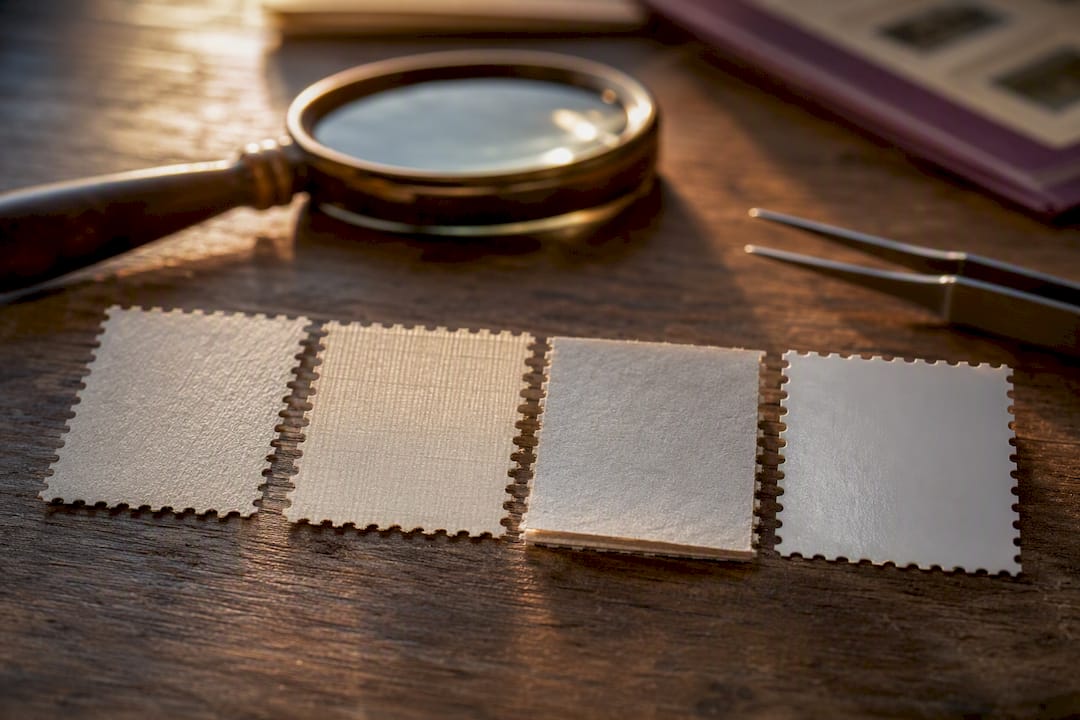
Wove paper is the most common substrate for modern stamps. It’s manufactured on a fine wire mesh that leaves no visible pattern when held to light, giving a smooth, even texture. Most stamps issued since the mid-20th century use wove stock because it prints cleanly and takes gum evenly.
Laid paper carries visible parallel lines when backlit, a legacy of the mesh pattern used in its manufacture. Older stamp issues, particularly from the 19th century, often used laid paper, and its presence or absence on a specific issue can be a key identifying feature for collectors trying to distinguish a genuine early printing from a later reprint.
Double paper consists of two layers bonded together, historically used to strengthen thin stock or to embed a security layer between the sheets. It’s less common today but appears in certain revenue and postage issues where forgery resistance mattered more than production cost.
Chalk-coated paper has a chalky surface layer designed as an anti-forgery measure: attempting to remove a cancellation or postmark damages the surface visibly, exposing tampering. It has a distinct matte, slightly powdery feel compared to standard wove stock, and testing for it (carefully, since the test can damage the stamp) is a standard part of expertising valuable issues.
Beyond the base substrate, several finishing features add further layers of classification:
- Burelage (or network paper): a fine printed pattern, often in a contrasting colour, applied beneath the stamp design as a forgery deterrent.
- Watermarks: patterns pressed into the paper during manufacture, visible mainly by backlighting or watermark fluid, and one of the most important identifiers in philately.
- Security threads and UV fluorescence: modern postal authorities often add fluorescent fibres or coatings, invisible in normal light but revealed under a UV lamp.
- Gum type and finish: gum arabic, PVA, and self-adhesive backings all behave differently with age, and gum condition affects both authentication and value.
- Weight and opacity: measured in gsm, paper weight affects how much design detail shows through and how the stamp performs during printing and perforation.
These characteristics feed directly into collecting practice. Reference works such as Scott’s Standard Postage Stamp Catalog and Stanley Gibbons catalogues frequently list paper variety as a distinguishing factor between otherwise identical-looking stamps, sometimes creating significant price differences between a common wove printing and a rarer laid-paper variant of the same design.
Pro Tip: Comparative backlighting beats a single inspection every time. Hold the unknown stamp against a known example of the same issue with a strong light source behind both, ideally using a dedicated watermark tray with fluid rather than dry examination, since fluid reveals faint watermarks that backlighting alone can miss.
Paper choice isn’t a cosmetic detail for printers either. Opacity, absorbency, and surface finish directly influence print sharpness, gum adhesion, and how cleanly perforations punch through the sheet, which is precisely why philatelists and printers track substrate so closely. A postal authority switching paper stock mid-print-run, whether deliberately or through a supplier change, can create an entire sub-category of collectable variants from a single stamp design.
Revenue and legal stamp paper across jurisdictions
Judicial and non-judicial stamp paper serve one function: proving that stamp duty, a tax on specific legal documents, has been paid. Where they’re still used, judicial stamp paper covers court-related documents such as affidavits and legal petitions, while non-judicial stamp paper covers a wider range of instruments, including contracts, agreements, and property conveyances. Neither has anything to do with postage.
Jurisdictions that retain physical revenue stamps typically require the correct denomination of stamp paper before a document is executed, with the paper purchased through authorised treasury offices or licensed stamp vendors. Using the wrong denomination, or an out-of-date stamp, can render an otherwise valid agreement unenforceable until corrected.
The UK has moved almost entirely away from physical stamping. Stamp Duty still exists as a tax, most visibly on stock transfer forms, but the mechanism changed fundamentally. Since March 2020, HMRC has processed Stamp Duty through electronic notification: the taxpayer emails a scanned copy of the instrument along with payment details, and HMRC confirms the duty has been recorded rather than physically embossing the document.
Rates and thresholds still matter even in an electronic system. Stamp Duty and Stamp Duty Reserve Tax (SDRT) are both charged at 0.5% on chargeable share transfers, with Stamp Duty on paper instruments rounded to the nearest £5 and SDRT on electronic transfers rounded to the nearest 1p. Stock transfer forms below £1,000 typically attract no duty at all. Property transactions run under a separate regime entirely: Stamp Duty Land Tax (SDLT) applies in England and Northern Ireland, with Scotland running Land and Buildings Transaction Tax (LBTT) and Wales running Land Transaction Tax (LTT).
The legal stakes of getting this wrong are not abstract. Section 14(4) of the Stamp Act 1891 is still active law, and it says something that catches many people out.
An instrument chargeable with duty shall not, except in criminal proceedings, be given in evidence, or be available for any purpose whatever, unless it is duly stamped in accordance with the law in force at the time when it was first executed.
In practice, the statute also allows a document to be produced at court, with the outstanding duty paid on the spot and later formally denoted, which softens the harshness of the rule somewhat. But the underlying principle, that an unstamped chargeable instrument can be worthless as evidence, remains a live risk for anyone relying on an old or informally executed document. This provision from the Stamp Act 1891 governs admissibility in UK civil courts to this day.
- Judicial stamp paper: used for court filings, affidavits, and petitions in jurisdictions that retain physical revenue paper.
- Non-judicial stamp paper: used for contracts, agreements, and conveyances outside direct court proceedings.
- E-stamping: an electronic alternative that generates a certificate or digital record of duty payment instead of a physical stamped sheet, now standard in the UK and increasingly common alongside physical systems elsewhere.
- SDLT, LBTT, LTT: property-specific regimes, separate from the Stamp Duty charged on share transfers and other instruments.
Legislation also permits flexibility in how duty is denoted. UK law allows the Treasury to prescribe multiple methods of denoting duty, including impressed stamps, adhesive stamps, and printed or electronic records, which is the legal foundation that made the 2020 shift to email-based stamping possible without new primary legislation.
How governments moved from paper stamps to e-stamping
The UK’s shift away from physical stamping wasn’t a one-off pandemic measure that quietly reversed. HMRC’s electronic notification process, introduced in March 2020, has remained the standard route for notifying and paying Stamp Duty, and the direction of policy points further towards digitisation rather than back to paper.
A government consultation on modernising stamp taxes on shares has proposed collapsing the separate Stamp Duty and SDRT regimes into a single, simplified tax on securities, reflecting the reality that electronic transfers now dominate share trading. Practitioners should treat current rates and processes as settled but not permanent.
The practical rate mechanics remain straightforward for now: 0.5% on chargeable transfers, rounding to the nearest £5 for paper instruments or 1p for electronic ones, and no duty below the £1,000 threshold for stock transfer forms.
- Retain a scanned copy of the original document.
- Keep HMRC’s written acknowledgement of duty payment or exemption.
- Note the date of first execution, since the rate that applied then governs the charge, not the rate at the time of a later dispute.
Pro Tip: Treat the HMRC email confirmation as the legal equivalent of an old ink stamp: it’s the piece of evidence a court or counterparty will ask for, not the scanned document itself. Stamping rules vary sharply by jurisdiction and by instrument type, so none of this should be read as a substitute for advice specific to your own country and document.
How to identify stamp paper type step by step
Whether you’re holding a Victorian postage stamp or an old legal document with an embossed duty mark, the identification process follows a similar logic: work from non-invasive checks through to more detailed ones, and stop before you risk damaging anything valuable.
- Backlight the item first. Hold it against a strong, even light source. Laid paper shows parallel lines immediately; wove paper looks uniform.
- Use a watermark tray or fluid for anything inconclusive. A shallow black tray with watermark detector fluid makes faint watermarks visible within seconds, far more reliably than backlighting alone.
- Check under a UV lamp. Modern security papers and some postal issues use fluorescent fibres or coatings invisible in normal light.
- Feel for surface texture with clean, dry hands. Chalk-coated paper has a distinct matte, slightly powdery quality; double paper often feels marginally thicker and stiffer.
- Weigh or estimate gsm if precision matters. A jeweller’s scale and a reference sample of known weight will settle disputes over paper density.
- Inspect the gum and perforations last. Gum type and condition, along with perforation gauge, add confirming evidence rather than standalone proof.
A basic identification kit doesn’t need to be expensive:
- A 10x magnifier for close inspection of paper texture and print detail.
- A UV lamp (long-wave, the type commonly sold for stamp and banknote checking).
- A watermark tray and detector fluid.
- A small precision scale for gsm estimates.
- Black backing card for contrast during backlighting.
Handle fragile stamps and documents with tongs rather than fingers, work over a clean, flat surface, and never apply watermark fluid directly to anything you suspect might be rare before testing a comparable common example first.
Pro Tip: Photograph every stage of your inspection, backlit, under UV, and under normal light, before drawing conclusions. A documented sequence of images is exactly what an expertising service will ask for if you later decide the item is valuable enough to warrant a formal certificate.
Why paper variations matter to collectors
Paper type isn’t a footnote in philately. It’s often the difference between a stamp worth its face value and one worth considerably more, because printing anomalies tied to paper stock tend to be scarce by nature.
A print run accidentally using double paper, or switching briefly to chalk-coated stock mid-run, creates a genuinely rare sub-variant that most collectors of that issue will never own. Errors linked to paper substitution are documented extensively in catalogue literature precisely because they’re verifiable through the identification methods described above, unlike more subjective quality distinctions.
Preservation depends heavily on getting the paper type right, too. Chalk-coated paper is more vulnerable to humidity and abrasion than standard wove stock, and improper mounting can permanently damage its surface layer. General good practice includes:
- Storing in stable humidity, away from direct sunlight and temperature swings.
- Using mounts rather than hinges for anything with collectable value, since hinging can leave permanent marks on delicate or chalk-coated surfaces.
- Cataloguing each item with substrate type, watermark, gum condition, and perforation gauge recorded together.
Pro Tip: When a stamp’s value hinges on a specific paper variety, get it expertised before you sell or insure it. A formal certificate from a recognised philatelic authority settles disputes that a magnifier and a UV lamp cannot.
Where to buy genuine stamp paper or use e-stamping services
Collectors sourcing specialised postage substrate for restoration or study should buy from established philatelic dealers and stationers with a track record, and ask for provenance on anything represented as a specific historical paper type. Unverified online listings are the most common source of misattributed stock.
For the legal side, the safe route is always the official one:
- Use government e-stamping portals or HMRC’s electronic notification process directly, never a third-party intermediary claiming to “process” stamp duty on your behalf outside official channels.
- Where physical non-judicial or judicial stamp paper is still required, buy only from licensed treasury offices or authorised stamp vendors, and verify the denomination and issuing authority printed on the paper.
- Confirm any e-stamp certificate against the issuing government’s own verification tool before relying on it.
Steer well clear of unofficial sellers offering “stamp paper” or duty stamps outside these channels. Counterfeit revenue stamps have a long history, and a document stamped with one is functionally unstamped in the eyes of a court.
Understanding paper matters beyond the collector’s desk
Working through the philatelic and legal branches of “stamp paper” makes one thing obvious: precision about paper and process protects value, whether that value is a Victorian stamp’s rarity or a contract’s enforceability. The same discipline that makes a philatelist reach for a UV lamp before declaring a stamp genuine is what makes proper documentation matter for anyone relying on a legal instrument.
Stamp Design 4U works daily with businesses, legal practices, and hobbyists who need reliable, legible impressions on their own documents and packaging, which gives a practical, ground-level view of how much paper quality and clarity affect the credibility of a stamped mark. That perspective shapes how the company approaches product design for its own customers.
Rubber stamps for consistent, professional impressions
None of the products Stampdesign4u sells can replace government e-stamping or the payment of Stamp Duty, and nothing here should be read as a substitute for the official channels covered earlier in this article. What Stampdesign4u does offer is the practical side of stamping: dependable, high-quality tools for businesses, legal practices, education, and healthcare professionals who need consistent, legible impressions on their own paperwork and packaging, day in and day out.
If you’re after a stamp for repeat business use rather than a legal denotation, the Trodat 4927 nine-line logo and text stamp covers most standard business needs in a compact 60 x 40mm impression, and a personalised address stamp handles repetitive correspondence in seconds rather than minutes of handwriting. Retailers building repeat custom might look at the loyalty stamp range, while anyone still narrowing down which format suits their workflow can start with the practical guide to picking a stamp type. Browse the full range and place an order directly through Stampdesign4u’s site whenever you’re ready.
Frequently asked questions
What is stamp paper used for? It depends which type. Postage-stamp paper is the substrate stamps are printed on, chosen for opacity, gum adhesion, and print quality. Revenue or legal stamp paper denotes that stamp duty has been paid on a document such as a contract or conveyance.
What are the main types of stamp paper for postage stamps? The core categories are wove paper, laid paper, double paper, and chalk-coated paper, often finished with security features such as burelage, watermarks, or UV-fluorescent coatings.
Is physical stamp paper still used for legal documents in the UK? No, not for stamp duty itself. HMRC has processed Stamp Duty through electronic notification since March 2020, replacing physical impressed stamping with email submission and digital confirmation of payment.
What happens if a legal document isn’t properly stamped? Under Section 14(4) of the Stamp Act 1891, an instrument chargeable with duty generally cannot be used as evidence in UK civil proceedings unless it has been duly stamped, though courts can allow payment and later denotation in some circumstances.
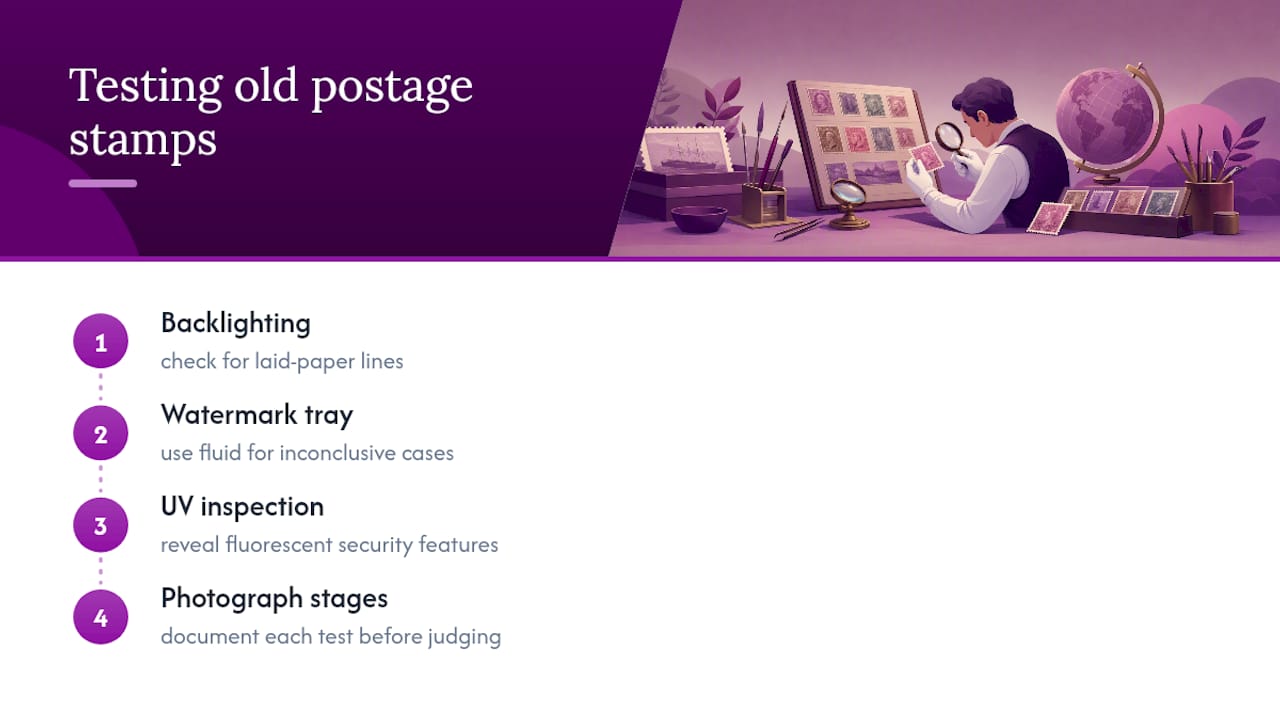
How do I test old postage stamps to find out their paper type? Start with backlighting to check for laid-paper lines, then use a watermark tray with fluid for anything inconclusive, followed by UV inspection for fluorescent security features. Document each stage photographically before making a final judgement.
Where can I find reliable references for stamp paper varieties? Philatelic catalogues such as Scott’s Standard Postage Stamp Catalog and Stanley Gibbons list paper types alongside design details, and are the standard references collectors use to distinguish valuable variants from common printings.
This article is general information, not a substitute for advice from a qualified lawyer. Consult a qualified legal professional about your own circumstances before acting on anything here.