

TL;DR:
- The notarial stamp serves as an official mark of authority that confirms a notary’s capacity and legitimacy. It plays a crucial role in international recognition, especially when combined with an FCDO apostille, and must include key details like the notary’s name and jurisdiction. Proper application and storage of the stamp ensure documents remain valid and verifiable in legal and cross-border contexts.
The notarial stamp is defined as the official mark of authority applied by a notary public to authenticate documents and confirm their legal validity. Without it, a notarised document carries no formal standing in foreign jurisdictions. The FCDO apostille service confirms the notary’s signature, capacity, and seal for legal recognition in over 120 Hague Convention countries. That single fact explains why the role of stamps in notarial acts extends far beyond a formality. The stamp is the mechanism through which a notary’s authority becomes internationally legible, and its absence or misapplication can render an entire transaction void.
What is the role of stamps in notarial acts?
The notarial stamp serves a distinct function from every other mark on a legal document. It is the official emblem of the notary’s office, not merely a personal identifier. Where a signature confirms that a specific individual acted, the stamp confirms that the individual held the authority of a notary public at the time of execution.

The stamp typically includes the notary’s name, jurisdiction, and qualification details. These elements allow foreign officials, courts, and government bodies to verify the notary’s standing without direct contact with the issuing office. The physical appearance of the stamp enhances document credibility to foreign officials, a point the Law Society of Scotland identifies as good practice.
Three marks commonly appear on a notarised document: the notary’s signature, the notarial stamp or seal, and, where required, the FCDO apostille. Each serves a separate purpose. The signature is personal authentication. The stamp is institutional authority. The apostille is international verification.
Understanding this distinction matters for every legal practitioner who instructs a notary or reviews notarised documents. Treating the stamp as decorative, or assuming the signature alone suffices, leads to document rejection.
How does the notarial stamp differ from the notary’s signature?
The signature and the stamp are complementary but legally separate instruments. Neither replaces the other, and both must appear on a valid notarial act.
The signature confirms the notary’s personal involvement. It is the notary’s declaration that they witnessed the execution, verified the signer’s identity, and satisfied themselves as to the document’s purpose. The stamp, by contrast, confirms the notary’s official capacity. It is the mark of the office, not the individual.
Several distinctions are worth noting:
- Notarial stamp or seal: Carries the notary’s name, jurisdiction, and professional details. Recognised by foreign authorities as proof of official capacity.
- Embosser: A raised impression sometimes used alongside or instead of an ink stamp. Carries the same legal function but is less visible on photocopies.
- Signature: Personal authentication of the notary’s involvement. Necessary but insufficient alone for international recognition.
- Commissioner for Oaths stamp: Lacks the internationally recognised seal that a notary public holds. Confusion between the two causes rejection of documents in cross-border transactions.
The Commissioner for Oaths distinction is the most common source of error in practice. A Commissioner for Oaths can witness signatures and administer oaths, but their mark carries no weight in foreign jurisdictions. Clients who present a Commissioner for Oaths certified document for use abroad will find it rejected.
Pro Tip: Always confirm whether the destination country requires a notary public specifically. A Commissioner for Oaths certification is not a substitute for a notarial act when the document will be used internationally.
What legal weight does a stamped notarial act carry?
The evidential status of a stamped notarial act differs depending on whether it is used domestically or abroad. That difference is significant and frequently misunderstood.
Within the UK, Part 32.20 of the Civil Procedure Rules grants notarial acts a rebuttable presumption of authenticity. This means a court accepts the document as authentic unless a party produces evidence to the contrary. The presumption is strong but not absolute.
Internationally, the position is stronger. Under the Hague Apostille Convention, a stamped notarial act combined with an FCDO apostille carries a higher evidential weight in signatory countries. The apostille does not verify the content of the document. It verifies the notary’s authority and the authenticity of the seal.
The FCDO apostille is a stamp of professional trust and authority, not a validation of document truth. The notary’s seal is the critical link that allows the FCDO to issue the apostille in the first place.
This distinction matters in litigation. A party seeking to rely on a foreign notarised document in English proceedings must produce a document that satisfies both the notarial and apostille requirements. An unstamped document, or one where the stamp is illegible, will face challenge.
The notarisation and apostille process involves two distinct steps: the notary authenticates the document and applies the seal, then the FCDO verifies the notary’s authority and issues the apostille certificate. Clients frequently conflate these steps, assuming notarisation alone is sufficient for international use. It is not.
What are the practical requirements for stamping notarial acts?
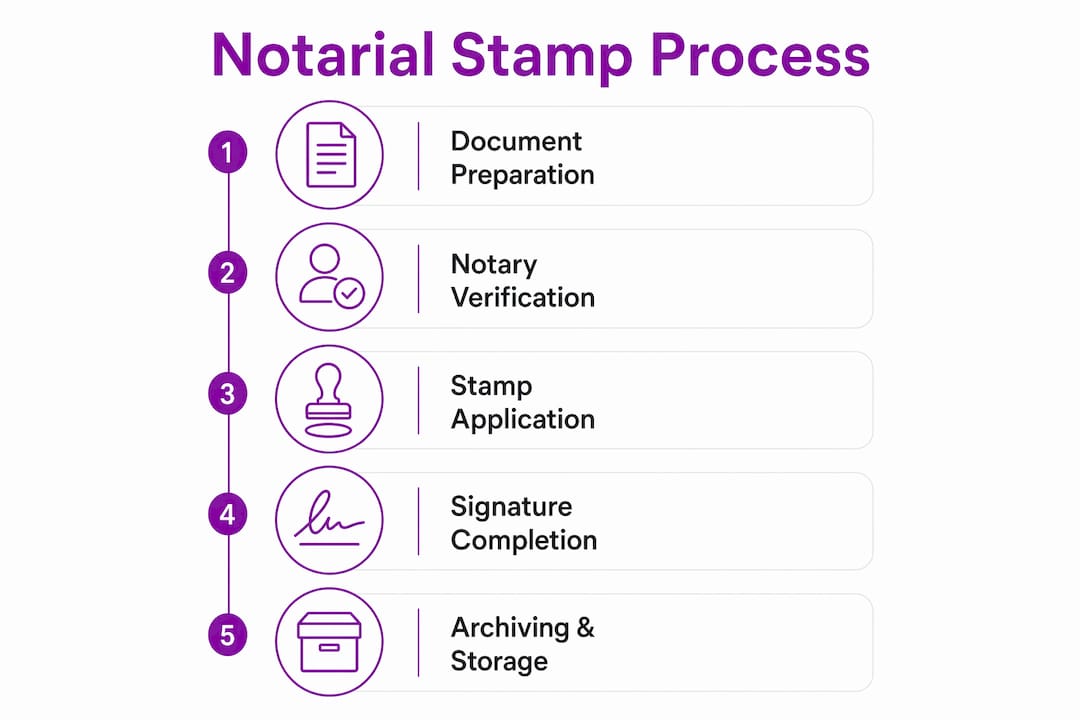
The standard procedure for a notarial act follows a defined sequence. Each step is procedurally required, and the stamp appears at the conclusion of the process.
- Identity verification: The notary confirms the client’s identity using original documents such as a passport or driving licence.
- Witnessing execution: The notary observes the client sign the document, or confirms an existing signature was made freely.
- Preparation of the notarial certificate: The notary drafts and appends a formal certificate confirming the acts performed.
- Application of signature and seal: The notary signs the certificate and applies the official stamp or seal.
- Register entry: The notary records the transaction in a formal register, including copies of the stamped document and identity evidence.
Notaries maintain formal registers that include certified documents and identity evidence. The stamp serves as the procedural signature of the office at each stage. Failure to stamp documents intended for international use results in rejection by foreign authorities.
Different notarial tasks call for different stamp formats. A certification stamp confirms a copy is a true copy of an original. An execution stamp confirms a signature was witnessed. Some notaries use pre-printed stamps for common journal entries, which reduces transcription errors and speeds up the recording process.
| Stamp type | Primary function | Typical use |
|---|---|---|
| Certification stamp | Confirms copy accuracy | Certified true copies of passports, degrees |
| Execution stamp | Confirms witnessed signature | Powers of attorney, deeds |
| Apostille-ready seal | Links notary to FCDO verification | International commercial documents |
| Journal entry stamp | Records procedural steps | Notarial register entries |
Pro Tip: Keep a spare ink pad and check stamp clarity on every impression before releasing a document. A faint or smudged stamp is grounds for rejection abroad, even when the notarial act itself is procedurally correct.
Misapplication of the stamp carries real consequences. A stamp applied to the wrong page, or one that obscures critical text, can invalidate the notarial act. The stamp must appear on the notarial certificate itself, not merely on the underlying document.
How do stamps support archiving and litigation in legal practice?
The role of stamps in archiving legal records and in litigation is as significant as their role at the point of execution. A stamped notarial act creates a verifiable chain of custody that supports both long-term record keeping and courtroom use.
For archiving purposes, the stamp serves several functions:
- Authentication of the record: The stamp confirms the document was processed by a qualified notary at a specific point in time.
- Chain of custody: A clearly stamped and registered document provides an unbroken record from execution to archive.
- Retrieval and verification: Archivists and legal teams can cross-reference stamped documents against notarial registers to confirm authenticity.
- Resistance to challenge: A document with a clear, legible stamp is far harder to dispute in proceedings than one with an absent or degraded impression.
In litigation, the role of stamps in affidavit validation and other sworn documents is direct. Courts expect stamped notarial acts to carry the presumption of authenticity established under Part 32.20 of the Civil Procedure Rules. An unstamped affidavit or declaration may be admitted, but it will not carry the same evidential weight and will face greater scrutiny.
Archival storage presents a practical challenge. Ink stamps can fade over time, particularly on documents stored in variable temperature or humidity conditions. Notaries should use archival-quality ink and consider embossed seals for documents intended for long-term retention. Legibility at the point of retrieval is as important as legibility at the point of execution.
The importance of stamps in notarisation extends to the notary’s own register. Copies held in the register must carry the same stamp as the original. This ensures that if the original is lost or disputed, the register copy carries equivalent evidential standing.
Key takeaways
The notarial stamp is the single most important mark of official authority on a notarised document, and its correct application determines whether that document will be accepted domestically, internationally, and in litigation.
| Point | Details |
|---|---|
| Stamp confirms official capacity | The stamp identifies the notary’s office and authority, not merely their personal involvement. |
| Domestic and international weight differ | UK courts grant rebuttable presumption; international use under the Hague Convention carries stronger evidential force. |
| Commissioner for Oaths is not equivalent | Their mark carries no international recognition and will result in document rejection abroad. |
| Stamp must appear on the notarial certificate | Applying the stamp to the underlying document rather than the certificate invalidates the act. |
| Archival legibility is a legal requirement | Faded or smudged stamps undermine chain of custody and expose documents to challenge in litigation. |
The stamp is the office, not the person: a practitioner’s view
The most persistent error I see in practice is treating the notarial stamp as an afterthought. Notaries who have been in practice for years sometimes apply the stamp with less care than they gave it in their first year. That is a mistake with real consequences.
The stamp is not decoration. It is the mark that transforms a witnessed signature into a notarial act. Foreign officials do not read the notarial certificate in detail. They look at the stamp. Its clarity, completeness, and placement tell them whether the document merits acceptance before they read a single word.
The confusion between notary public and Commissioner for Oaths continues to cause problems, particularly for clients handling cross-border property transactions or international powers of attorney. Legal professionals who advise clients on document preparation have a responsibility to clarify this distinction before the client incurs the cost of a Commissioner for Oaths appointment that will not serve their purpose.
Digital notarisation and electronic stamps are coming. Several jurisdictions already accept them. The UK is moving cautiously, and rightly so. The physical stamp carries a weight of institutional trust that a digital equivalent has not yet replicated in the minds of foreign officials. Until international standards for electronic notarial seals are harmonised, physical stamps remain the safer choice for documents intended for use abroad.
My practical advice: invest in a quality stamp, check every impression before releasing a document, and keep your register copies stamped to the same standard as your originals. The stamp is the office. Treat it accordingly.
— Steven
Custom notary stamps for legal professionals
Legal professionals who understand the importance of stamps in notarisation also understand that stamp quality is not a minor detail.

Stampdesign4u offers personalised legal stamps designed to meet the practical requirements of notarial practice, including clear impression quality, durable ink, and layouts that accommodate the name, jurisdiction, and qualification details required on a valid notarial seal. The Trodat 4927 rubber stamp supports up to nine lines of text across a 60 x 40mm impression area, making it well suited to the information density required on a notarial stamp. For notaries reviewing their current stamp or sourcing one for the first time, Stampdesign4u’s range of stamps for solicitors provides a practical starting point.
FAQ
What must a notarial stamp include?
A notarial stamp must include the notary’s name, jurisdiction, and professional capacity. These details allow foreign authorities and courts to verify the notary’s standing and link the document to the FCDO apostille process.
Does a stamped notarial act need an apostille for international use?
Yes. The notary’s stamp authenticates the document, but the FCDO apostille is required for recognition in Hague Convention countries. The two steps are separate and both are necessary for international legal use.
Can a Commissioner for Oaths stamp replace a notarial seal?
No. A Commissioner for Oaths lacks an internationally recognised seal, and their certification will be rejected in cross-border transactions. Only a notary public’s stamp satisfies international requirements.
What happens if a notarial stamp is missing or illegible?
Foreign authorities will reject the document. Domestically, the document may still be admitted in evidence but will not carry the rebuttable presumption of authenticity granted under Part 32.20 of the Civil Procedure Rules.
How should stamped notarial documents be stored for archival purposes?
Use archival-quality ink and store documents in stable temperature and humidity conditions. Embossed seals provide greater longevity than ink impressions for long-term retention, and register copies must carry the same stamp as the original document.
Recommended
- Your Guide To Legal Stamps for True Copy and True Likeness Paperwork. – Stamp Design 4U
- Explaining signature stamps: uses, law, and design – Stamp Design 4U
- Role of Stamps in Business – Branding, Compliance, Trust – Stamp Design 4U
- Legal uses for rubber stamps: a guide for professionals – Stamp Design 4U