

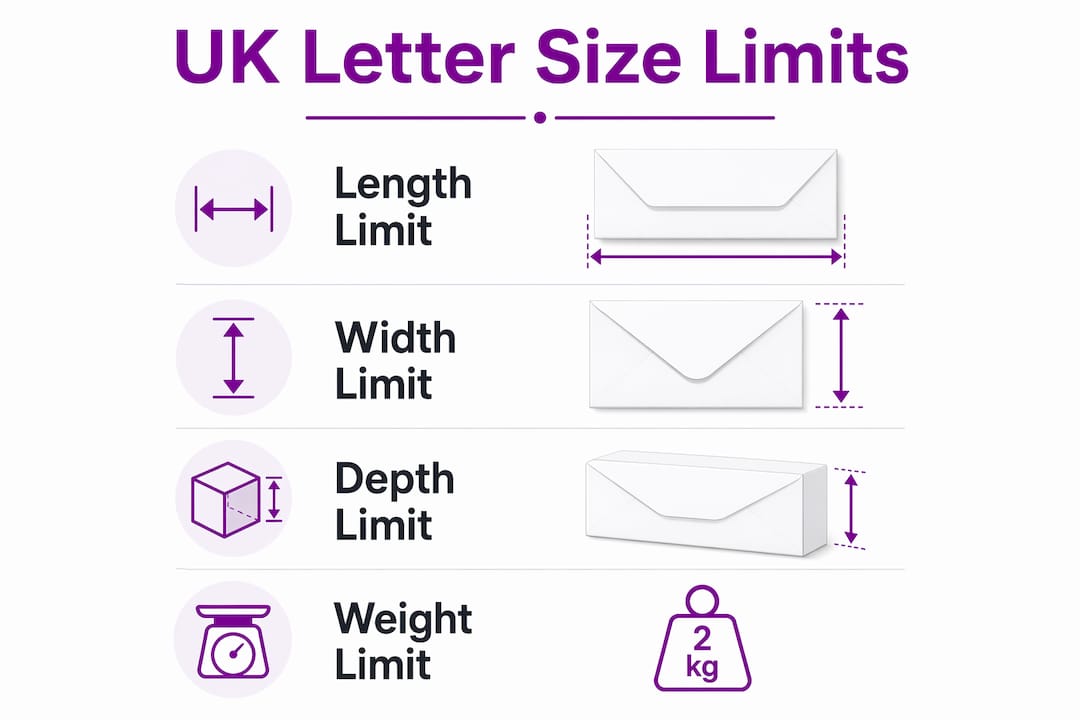
A Royal Mail 2nd Class letter qualifies when it measures no more than 24cm long, 16.5cm wide and 0.5cm deep, and weighs up to 100g. Those three dimensions and that weight limit are the complete pass/fail test for the standard letter format. Royal Mail targets 2–3 working days delivery for 2nd Class items, including Saturdays. For anyone using personalised rubber address stamps from Stampdesign4u, getting the size of letter for a 2nd class stamp right before printing a large run avoids costly reclassification and returned mail.
Quick pass/fail checks before you seal the envelope:
- Length: no more than 24cm
- Width: no more than 16.5cm
- Thickness (depth): no more than 0.5cm (5mm)
- Weight: no more than 100g
Pro Tip: The 5mm thickness limit is the most common failure point. A standard C5 envelope with a folded A4 sheet, a business card and a branded insert can exceed 5mm before you notice. Always check thickness last, after all enclosures are inside.
Table of Contents
- What are the official Royal Mail size limits for a letter?
- How does reclassification change what you pay?
- How to measure your letter correctly before posting
- What compensation cover does 2nd Class post include?
- How to place a personalised rubber stamp on a UK letter
- How to choose a custom stamp for mailing use
- Key takeaways
- Why thickness catches most senders out
- Stampdesign4u: custom stamps sized for UK postal use
- Useful sources
What are the official Royal Mail size limits for a letter?
Royal Mail classifies mail into three formats: Letter, Large Letter and Small Parcel. Each has fixed dimension and weight thresholds. Exceeding any single measurement moves the item into the next category and a higher postage band.
| Format | Max length | Max width | Max depth | Max weight |
|---|---|---|---|---|
| Letter | 24cm | 16.5cm | 0.5cm | 100g |
| Large Letter | — | 25cm | — | 750g |
| Small Parcel | — | — | 16cm | 2kg |
Source: Royal Mail online price guide
Machine-readable Large Letters have tighter limits: 345mm x 245mm x 10mm, compared with the standard Large Letter maximum of 353mm x 250mm x 25mm. If your mailing needs to pass through automated sorting, design to the machine-readable limits rather than the larger manual figures.
Key boundaries to watch:
- 5mm: the depth limit for a standard Letter. Cross it and the item becomes a Large Letter.
- 10mm: the depth limit for a machine-readable Large Letter.
- 25mm: the depth limit for a standard Large Letter. Beyond this, the item enters parcel territory.
- 100g: the weight ceiling for a single 2nd Class stamp on a letter.
- 750g: the weight ceiling for a Large Letter.
For cylinders or rolled items, the calculation changes: length plus twice the diameter must not exceed 104cm, and the longest side must not exceed 90cm.
How does reclassification change what you pay?
When a letter exceeds any single limit, Royal Mail moves it to the next format band and charges accordingly. A 2nd Class stamp covers a standard letter. Once the item becomes a Large Letter, a higher rate applies. Parcels attract a higher rate still. Underpaid items are either returned or delivered with a surcharge payable by the recipient, which creates a poor experience for any branded mailing.
Current postage prices are published on the Royal Mail website. The Mailmark franking wallchart lists rates per format and weight band for business customers using franking machines. Retail counter prices and business account rates differ, so always verify in the channel you actually use. Royal Mail Click & Drop includes a built-in postage calculator that reflects the correct rate for your account type.
Common triggers for reclassification:
- Enclosures thicker than a single folded sheet (brochures, card samples, USB drives)
- Rigid inserts that prevent the envelope from compressing below 5mm
- Extra layers of tape or padding that add depth
- Oversized printed pieces folded to fit but still creating bulk at the fold
Pro Tip: Before a large branded mailing, weigh and measure one complete sealed sample. If it sits at 4mm, you have a 1mm margin. If it sits at 4.8mm, reduce the insert weight before printing the full run.
How to measure your letter correctly before posting
Getting the measurement right requires more than a ruler on a flat surface.
- Measure length and width with the envelope sealed and all contents inside. Measure the longest and widest points.
- Measure thickness at the thickest point, usually where contents overlap or where a fold creates a ridge. Press the envelope flat and measure across the thickest section.
- Weigh the sealed envelope on digital scales accurate to 1g. Kitchen scales often lack the precision needed; postal scales reading to 1g are preferable.
- Check shape. Standard rectangular envelopes are straightforward. Cylinders and rolls require the length-plus-diameter calculation noted above.
- Use a Post Office sizer. Royal Mail recommends a sizer/slot guide at Post Office branches to confirm both dimension and thickness together. A ruler alone does not test whether the item physically passes through the slot.
Packing tips to keep thickness under 5mm: use thin card rather than board for enclosures, avoid rigid promotional items, trim printed pieces to remove excess margins, and fold inserts along the grain of the paper to reduce bulk at the fold.
Pro Tip: For high-volume runs, produce and archive a weighed and measured sample for each job. Set an internal maximum envelope specification that sits 1–2mm under Royal Mail limits to reduce rejects and staff error.
What compensation cover does 2nd Class post include?
Standard 2nd Class items carry compensation cover up to £20. For most promotional mailings, that is sufficient. For anything with a higher replacement value, the standard service is not appropriate.
Practical implications for businesses:
- Branded samples, printed catalogues and standard correspondence are generally within the £20 cover threshold.
- Items containing gift cards, vouchers or products worth more than £20 should use Royal Mail Signed For or a Tracked service with declared value.
- Businesses sometimes assume all mail is covered for its full value. It is not. The £20 ceiling applies regardless of what is inside a standard 2nd Class letter.
- Check the Royal Mail compensation rules page before each campaign type, as terms can change.
Pro Tip: If you are including a high-value insert in a branded envelope, post it separately using a tracked service rather than combining it with a standard 2nd Class mailing.
How to place a personalised rubber stamp on a UK letter
Stamp placement on a mailed envelope follows Royal Mail’s processing zones. Getting it wrong can obscure the address, block the barcode area or interfere with the postage mark.
Recommended placement rules:
- Keep personalised address stamps and logo stamps clear of the top-right corner, which is reserved for the postage stamp or franking mark.
- The address block should sit in the lower-centre of the envelope face, clear of all four edges by at least 15mm.
- The barcode zone runs along the bottom edge of the envelope. Leave at least 15mm clear at the bottom.
- Logos and branding stamps work best in the top-left corner or on the reverse flap, where they do not compete with address legibility or sorting marks.
For ink, black or dark navy gives the highest contrast for machine readability. Avoid pale colours or metallic inks for address text. Decorative logo stamps in the top-left corner can use brand colours, provided they do not bleed into the address field.
Stampdesign4u provides stamp size guidance and templates to help position address and logo stamps correctly before committing to a full run.

Pro Tip: Produce a test impression on a blank envelope and hold it up to the light against a printed Royal Mail addressing guide. Any overlap with the address field or barcode zone will be immediately visible.
How to choose a custom stamp for mailing use
Selecting the right stamp for postal use involves matching the imprint area to the space available on the envelope, not simply choosing the largest stamp that fits.
Functional selection checklist:
- Imprint size: for a standard DL or C5 envelope, an address stamp of roughly 60mm x 40mm accommodates a six-line address block at a legible font size. Larger stamps risk encroaching on the postage or barcode zones.
- Line count: a typical UK address runs five to six lines. Confirm the stamp’s line capacity before ordering.
- Font size: at small imprint sizes, sans-serif fonts at 8pt or above remain legible after stamping. Decorative fonts compress poorly.
- Ink type: self-inking stamps are faster and more consistent for high-volume use. Traditional rubber stamps with a separate pad suit lower volumes or where ink colour changes frequently.
- Pad/ink durability: oil-based inks adhere better to coated envelopes; water-based inks suit uncoated stock.
For branding stamps placed in the top-left corner, a larger imprint area (up to 70mm x 50mm) is workable without interfering with postal zones. For address stamps, keep the imprint within the address field dimensions. The stamp sizing guide from Stampdesign4u covers imprint area and line counts in detail.
Royal Mail’s size rules and Click & Drop’s postage calculator both inform stamp placement decisions. Stampdesign4u supplies address and logo stamps in sizes suited to standard UK letter envelopes, with proof approval before production.
Key takeaways
A Royal Mail 2nd Class letter must not exceed 24cm x 16.5cm x 0.5cm and 100g; thickness is the most common cause of reclassification.
| Point | Details |
|---|---|
| Letter size limits | Maximum 24cm long, 16.5cm wide, 0.5cm deep, and no more than 100g. |
| Thickness is the risk | Even thin inserts can push an envelope past the 5mm letter threshold into Large Letter rates. |
| Verify postage by channel | Retail, Click & Drop and franking rates differ; always check in the channel you use before a large run. |
| Compensation cover | Standard 2nd Class cover is up to £20; use Signed For or Tracked for higher-value inserts. |
| Stampdesign4u stamp sizing | Stampdesign4u supplies address and logo stamps sized for standard UK letter envelopes, with templates and proof approval. |
Why thickness catches most senders out
The conventional wisdom is that letter size is a dimension problem, something you solve with a ruler. In practice, the failure almost always happens on the third axis: depth. A C5 envelope with a folded A4 sheet measures well within the 24cm x 16.5cm limits. Add a business card, a folded insert and a branded sticker, and the depth climbs past 5mm without any single item being obviously oversized.
The deeper issue for businesses using personalised stamps is that the stamp itself is not the problem. The problem is the envelope spec being set without accounting for the full contents. A well-designed address stamp from Stampdesign4u, correctly placed, adds no measurable depth. What adds depth is the decision to include one more insert, or to use a heavier card stock, made after the envelope spec was approved.
The fix is procedural, not creative. Set a maximum internal spec, test a sealed sample before the run, and use the Post Office sizer rather than a desk ruler. Those three steps remove the majority of reclassification risk for any custom address stamp mailing.
Stampdesign4u: custom stamps sized for UK postal use
Businesses that send branded mail regularly need stamps that fit within Royal Mail’s address and barcode zones without guesswork. Stampdesign4u supplies personalised logo stamps and address stamps in dimensions matched to standard UK letter and large letter envelopes, with proof approval before any order goes to production.
The Trodat 4927 60 x 40mm self-inking stamp suits a six-to-nine line address block on a DL or C5 envelope and leaves the postage corner and barcode zone clear. For packaging and larger envelopes, the personalised packaging stamp range covers broader imprint areas. Every order includes a digital proof so placement and sizing can be confirmed against your envelope before the stamp is made. Visit Stampdesign4u to request a proof or check stamp dimensions for your next mailing run.
Useful sources
Key references for verifying current Royal Mail rules and prices:
- Royal Mail 2nd Class service page: delivery aims, size limits and compensation cover.
- Royal Mail current postage prices: retail price tables for letters, large letters and parcels.
- Royal Mail online price guide (July 2024): format dimension tables and weight band prices.
- Royal Mail business mail guidance: machine-readable large letter dimensions and business mail specifications.
- Royal Mail measuring and size advice: sizer/slot guide advice and irregular item rules.
- Royal Mail Click & Drop: online postage calculator reflecting account-specific rates.
Prices and machine-readability specifications update periodically. Check these pages directly before any large mailing run rather than relying on figures from secondary sources.