

TL;DR:
- Rubber stamps have a heritage rooted in ancient seals and Chinese woodblock printing.
- The invention of vulcanised rubber in the 1840s enabled durable, highly detailed stamps.
- Today, rubber stamps are valued for their tactile, artistic, and branding qualities across many fields.
Rubber stamps are rarely the first thing that springs to mind when considering tools with genuine historical weight or artistic merit. Most people associate them with office admin: a quick thud on an invoice, a red “PAID” across a document, and nothing more. Yet these compact objects carry a lineage stretching back thousands of years, connect governments to citizens through official documentation, and provide artists and crafters with one of the most tactile creative tools available. Whether you are a collector, an artist, or a small business owner seeking a distinctive branding solution, understanding where rubber stamps came from changes how you see what they can do.
Table of Contents
- Tracing the origins: before rubber stamps
- The invention and evolution of rubber stamps
- How rubber stamps shaped society and business
- Modern applications and creative evolution
- What most people miss about rubber stamps
- Find the perfect rubber stamp for your needs
- Frequently asked questions
Key Takeaways
| Point | Details |
|---|---|
| Ancient roots | Stamping technology began millennia before rubber stamps using carved seals and wood blocks. |
| 19th-century breakthrough | Rubber stamps emerged after several inventors filed patents in the mid-1860s. |
| Societal impact | Rubber stamps revolutionised official, creative, and commercial processes across the globe. |
| Creative resurgence | Today, rubber stamps are a favoured tool for branding, artistic expression, and collectors. |
| Practical value | The tactile nature of rubber stamps offers a unique, hands-on branding and creative experience. |
Tracing the origins: before rubber stamps
To appreciate rubber stamps fully, it helps to look far back beyond the industrial era. The impulse to press a marked surface onto another to leave a repeatable impression is ancient. Humans have always sought reliable, consistent ways to identify themselves, authenticate objects, and communicate through image and symbol.
Stamp seals date back to the 6th millennium BC, with early examples found across Mesopotamia, the Indus Valley, and Egypt. These seals, carved from stone or clay, were pressed into soft materials to leave identifying marks. They served as signatures for merchants, rulers, and priests. Ownership of goods, authenticity of messages, and authority of commands were all conveyed through the impression of a seal. The concept was deceptively simple: carve a design in reverse, press it into a receiving material, retrieve a consistent image.
Woodblock printing, developed in China from around 220 AD, extended this logic into text and artistic reproduction. Woodblocks allowed repeated application of an image or script to paper or fabric, making them functional ancestors of the modern stamp. This technology spread across Asia and eventually into Europe, where it evolved into Gutenberg’s moveable type press. Each of these milestones shares a core principle with the rubber stamp you might use today.
The key developments that led to rubber stamps include:
- Ancient cylinder and stamp seals used for commercial and legal identification
- Egyptian cartouche stamps communicating royal authority
- Chinese woodblock printing enabling mass reproduction of text and image
- European woodcut printing techniques applied to fabric and paper
- Early postal marking systems in 17th and 18th century Europe
You can trace this entire rubber stamp history in greater detail to understand how each era contributed specific innovations that shaped what eventually became the rubber stamp. Understanding the types of rubber stamps available today also makes more sense once you appreciate these historical layers.
The invention and evolution of rubber stamps
Building on the ancient foundations, we now examine the breakthrough that led to rubber stamps as we know them.
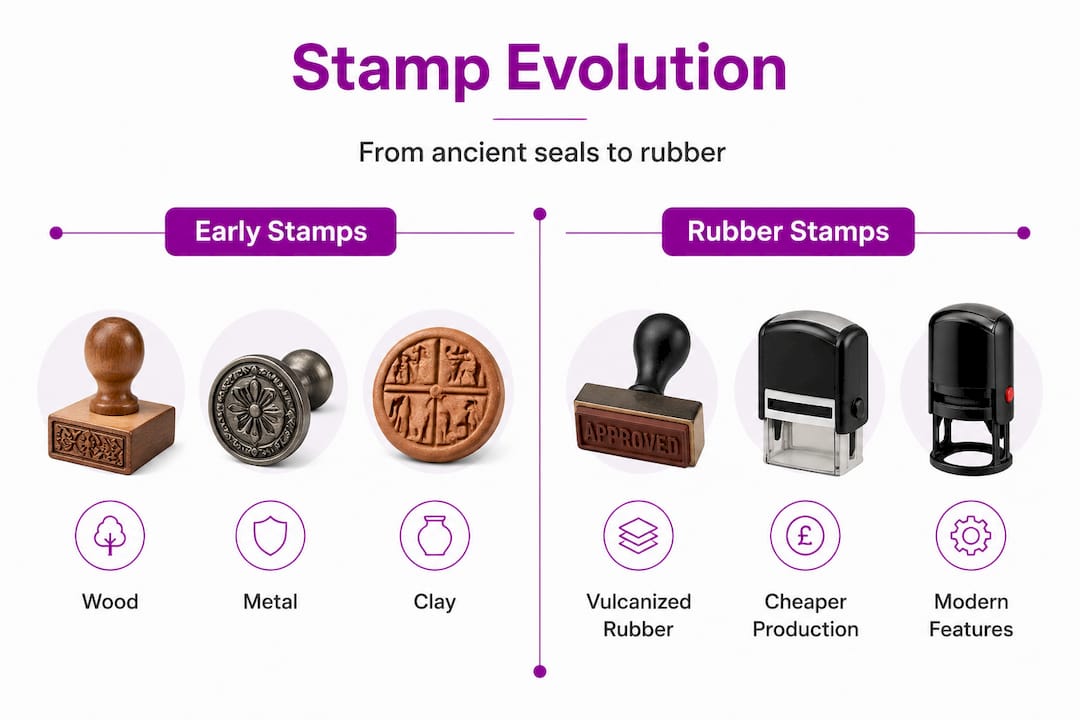
The rubber stamp as a distinct object emerged in the mid-19th century, and its precise origin is a matter of ongoing debate. Multiple inventors filed patents for rubber stamps in the mid-1860s, and no single individual holds uncontested credit for the invention. What is clear is that vulcanised rubber, developed by Charles Goodyear in the 1840s, provided the critical material that made it possible. Vulcanisation transformed natural rubber from a brittle or sticky substance into something durable, flexible, and capable of holding detailed carved designs while bouncing back into shape after repeated use.
The mid-1860s saw inventors in both the United States and Europe recognising the commercial potential of rubber for stamping. Their patents reflected a range of approaches, from hand-carved rubber dies to early mechanical methods for producing stamp designs. The timing was not accidental. Industrialisation had created enormous demand for faster, more consistent administrative tools. Businesses needed to mark invoices, crates, and correspondence quickly. Governments needed to authenticate documents at scale. Rubber stamps answered both needs efficiently.
| Feature | Early wooden/metal stamps | Rubber stamps (from 1860s) |
|---|---|---|
| Material | Wood, metal, clay | Vulcanised rubber |
| Durability | Limited; prone to cracking | High; long-lasting impression |
| Detail level | Moderate | Fine detail achievable |
| Ink compatibility | Oil-based inks only | Compatible with varied inks |
| Cost to produce | Relatively expensive | Lower cost at scale |
| Customisation | Difficult and slow | Faster, more accessible |
The comparison above illustrates why rubber stamps overtook their predecessors so quickly. They were cheaper to produce, easier to customise, and far more practical for everyday use across commerce, government, and eventually craft.
Pro Tip: If you are researching the rubber stamp origins for a collection or educational purpose, focus on patents filed between 1864 and 1876, as this period contains the most significant documented innovations. Comparing custom stamps advances against historical pre-made methods also reveals just how far personalisation has come.
How rubber stamps shaped society and business
Having established their invention, it is important to consider how rubber stamps spread into all areas of society and commerce.
The adoption of rubber stamps was rapid and far-reaching. By the late 19th and early 20th centuries, rubber stamps appeared across government offices, postal services, commercial warehouses, children’s toy sets, and artists’ studios. The range of uses was extraordinary for an object that looks, at first glance, entirely unremarkable.

| Sector | Primary use of rubber stamps |
|---|---|
| Government | Document authentication, official approvals |
| Postal services | Date and location cancellation marks |
| Commerce | Marking invoices, packaging, and stock |
| Education | Grading symbols, motivational marks |
| Arts and craft | Pattern creation, printmaking |
| Children’s play | Educational toy kits |
The societal reach of rubber stamps across these sectors developed for identifiable reasons:
- Postal services used rubber stamps to cancel postage and mark dates, creating a permanent record of transit. This function became so standardised that postal cancellation stamps are now collected as historical artefacts in their own right.
- Legal and government offices relied on rubber stamps to authenticate documents rapidly. A rubber stamp approval carried authority precisely because it was consistent and difficult to replicate without the original die.
- Businesses and warehouses used stamps to mark freight, confirm payments, and label correspondence. The speed advantage over handwriting was significant in busy commercial environments.
- Schools and educators adopted rubber stamps for marking student work, applying symbols of achievement or correction quickly and consistently across large volumes of material.
- Artists and crafters recognised early that rubber stamps offered a repeatable, versatile printmaking tool accessible to people without formal printmaking training.
“The rubber stamp became one of the most democratising tools in print history, placing the power of repeatable image-making in the hands of anyone who could afford an ink pad.”
The stamp uses for organisations reflect this diverse legacy directly. Branding stamps in particular carry on a tradition that connects modern small businesses to the commercial practicality of 19th-century trade. Exploring the full range of business and hobby stamps shows just how completely rubber stamps saturated both professional and personal life.
Modern applications and creative evolution
With stamps firmly rooted in society, let us examine their relevance and creativity in today’s world.
Rubber stamps have not faded with the arrival of digital tools. If anything, their appeal has sharpened in contrast to screens and software. The tactile quality of a stamped impression, the slight variation in pressure and ink distribution, and the handmade feel of a stamped surface carry qualities that no printer or digital template can replicate. This is not nostalgia. It is a functional distinction that collectors, artists, and business owners actively seek.
Modern uses of rubber stamps include:
- Brand identity and packaging. Small businesses use custom rubber stamps to mark packaging, label products, and add a personal mark to handmade goods. A stamped logo on kraft paper wrapping communicates craft and care in a way that a printed sticker rarely achieves.
- Artists and printmakers. The rubber stamp functions as a portable, low-cost printmaking tool. Artists layer stamps to build complex compositions, combine stamped images with paint or watercolour washes, and use stamps to create repeating patterns across fabric, paper, or wood.
- Scrapbooking and paper craft. The craft industry has built an entire commercial category around decorative rubber stamps. Collectors amass sets spanning hundreds of designs, from botanical illustrations to typography.
- Event stationery and invitations. Stamped wedding invitations, thank-you cards, and event programmes offer a personalised quality that printed alternatives rarely match.
- Heritage and collecting. Vintage stamp collecting encompasses both postage stamps and rubber stamp dies, with some rare early examples commanding significant prices at specialist auctions.
Choosing a business rubber stamp involves decisions about size, ink type, mount style, and die material that are worth understanding before purchasing. A professional design guide helps ensure the final stamp performs as expected across different surfaces and use cases. For businesses specifically, custom logo stamps connect directly to brand recognition in ways that are consistent, repeatable, and genuinely distinctive.
Pro Tip: When designing a rubber stamp for branding, keep the design bold and relatively simple. Fine lines and small text lose clarity with repeated use, particularly on textured surfaces like kraft paper or fabric. A clean, high-contrast design maintains legibility across thousands of impressions.
The continuing use of rubber stamps in official and creative contexts confirms that these objects occupy a permanent place in material culture, not as relics but as active tools.
What most people miss about rubber stamps
Most conversations about rubber stamps default to the practical. Office use. Document authentication. Craft hobbies. These are accurate but incomplete. What gets consistently underestimated is the branding and artistic power that rubber stamps deliver in environments saturated with digital output.
Consider the context a small business operates in today. Every email looks broadly similar. Every printed label uses the same fonts from the same templates. Every digital interaction follows predictable visual patterns. A rubber stamp breaks that pattern immediately. It introduces physical texture, slight imperfection, and a mark that is visibly handmade. That distinction is not trivial. Customers notice it, remember it, and associate it with care and individuality.
For artists, the rubber stamp deserves more serious recognition than the craft industry typically grants it. Stamp-based printmaking has been used by significant artists throughout the 20th century, and the accessibility of the medium means that technically sophisticated work is achievable without specialist equipment or studio space. The limitation of working with a fixed design actually encourages creative problem-solving in composition and colour.
The stamp branding impact for businesses in the UK is measurable in customer perception, not just logo visibility. Packaging that carries a stamped mark signals something about the producer’s approach to their work. That signal has real commercial value.
The uncomfortable truth for those dismissing rubber stamps as outdated is this: physical marks carry authority that digital marks simply do not. A stamped document feels more official than a digitally signed one in everyday interactions. A stamped package feels more intentional than a printed label. That gap in perception is not closing as technology advances. It is widening.
Find the perfect rubber stamp for your needs
The history of rubber stamps, from ancient Mesopotamian seals to modern custom branding tools, demonstrates their enduring utility and creative potential. If you are ready to apply that knowledge practically, whether for business, art, or collecting, the right starting point is a reliable source for custom stamp design.
At Stamp Design 4U, you will find a wide range of customisable rubber stamps designed to meet professional and creative requirements. From logo stamps for small business packaging to detailed artistic dies for printmakers and collectors, the platform offers tailored options supported by clear ordering processes and customer assistance. Whether you need a single bespoke stamp or a consistent supply for organisational use, the options are practical, accessible, and grounded in the craft tradition that makes rubber stamps worth using in the first place.
Frequently asked questions
Who invented the rubber stamp?
Multiple inventors filed patents for rubber stamps in the mid-1860s, and no single individual holds uncontested credit. The invention draws on the development of vulcanised rubber by Charles Goodyear in the 1840s.
How were rubber stamps used in the early years?
Rubber stamps were quickly adopted across government, commerce, and creative fields, with documented uses including official document authentication, postal cancellation marks, children’s toy sets, and early artistic applications by the late 19th century.
What came before rubber stamps?
Stamp seals dating to the 6th millennium BC and woodblock printing in China from approximately 220 AD established the foundational concept of pressing a marked surface to leave a repeatable impression, directly preceding the rubber stamp.
How are rubber stamps used today?
Rubber stamps are actively used in business branding, custom packaging, creative printmaking, paper craft, event stationery, and specialist collecting, serving both practical and artistic purposes across a wide range of sectors.
Recommended
- Ultimate Guide to Rubber Stamps | StampDesign4U UK – Stamp Design 4U
- Complete Guide to Rubber Stamp Design – Stamp Design 4U
- History of Rubber Stamps – Stamp Design 4U
- 7 Essential Types of Rubber Stamps for Business and Hobbies – Stamp Design 4U
- Create a Successful Stamp-Based Loyalty Program: A | BonusQR