

Budget between £15 and £45 for a self-inking address or logo stamp, or affordable pricing per batch of personalised labels, depending on size and colours. For repeat postcard runs, a self-inking stamp like the Trodat 4927 beats labels on cost-per-use once you pass a few hundred impressions. For one-off jobs with full-colour artwork, printed labels usually work out cheaper and faster.
Here’s the quick version before the maths:
- Trodat 4927 self-inking stamp (60 x 40 mm, 9 lines): a solid mid-range choice for logo and address use, sold via Stamp Design 4U.
- SD4U Imprint 11 POSTED Word Stamp (38 x 14 mm): a compact, text-only stamp available in multiple ink colours, good for marking mail without a full redesign.
- Personalised printed labels: better suited to short runs needing full-colour branding, no reusable die required.
The right pick depends less on how the postcard looks and more on how many you’re sending, how often, and whether the design changes each time.
Table of Contents
- How much does it cost to mail a postcard with a custom stamp or label?
- What actually changes the price of a stamp or label order?
- Stamp, pre-inked, or printed label: how do you choose?
- Practical ways to cut your per-postcard cost
- Ordering from Stamp Design 4U: products, prices and steps
- What to expect for turnaround, shipping and returns
- Getting the address and stamp placement right on postcards
- Why self-inking stamps make sense for repeat postcard campaigns
- Get a proof and order your stamp or labels today
- Key takeaways for budgeting your postcard stamp or label order
- Where to check specs, prices and ordering steps
How much does it cost to mail a postcard with a custom stamp or label?
Costs split cleanly by product type, and the gap between the cheapest and priciest option is wider than most first-time buyers expect.
| Product type | Typical UK price | Best for |
|---|---|---|
| Wood-mounted hand stamp | £15 to £25 | Occasional use, simple single-line text |
| Self-inking stamp (e.g. Trodat 4927) | £15 to £45 | Repeat runs, logo plus address |
| Pre-inked stamp | £15 to £40 | Cleaner impressions, lower ink mess |
| Personalised printed labels (per 100) | £8 to £30 | One-off jobs, full-colour artwork |
Two worked examples show how this plays out in practice.
- Small run, 50 postcards. A Trodat 4927 self-inking stamp costs around about £28 including VAT, plus UK delivery costs. Total spend: £31.95. Spread across 50 postcards, that’s roughly 64p per card. Order 500 more with the same stamp next quarter and the per-card cost drops to under 6p, because the stamp itself is a one-off purchase.
- Larger run, 1,000 postcards. Printed labels at around £22 per 100 labels for an order of 1,000 labels, plus VAT and delivery fees, totalling roughly £269.95. Divide by 1,000 and you land at 27p per postcard, cheaper per unit than a stamp bought fresh for a single campaign, but with no reuse value once the labels run out.
The maths that matters is simple: total order cost ÷ number of postcards = per-card cost. For stamps, factor in a replacement ink pad every few thousand impressions, typically £4 to £8, and amortise that across the impressions it delivers rather than treating it as a one-off cost.
What actually changes the price of a stamp or label order?
Six factors do most of the work in moving your total up or down, and they don’t all move it by the same amount.
- Stamp type: wood-mounted is cheapest to buy, self-inking costs more upfront but needs less mess and lasts longer per use.
- Size and line count: a compact stamp like the SD4U Imprint 11 at 38 x 14 mm costs less than a 9-line logo stamp because there’s simply less die area to produce.
- Ink colour: single-colour ink is the default price; multiple colours or two-tone impressions usually add a fee.
- Quantity ordered: buying two or three stamps at once, or ordering labels in bulk, typically unlocks a lower unit price.
- Turnaround speed: standard production is included in the base price; expedited dispatch usually carries a premium.
- VAT and delivery: both apply at checkout and can add 10% to 20% to the headline product price.
Beyond those six, a few secondary costs catch buyers off guard. Custom artwork set-up (turning a logo file into a die-ready image) sometimes carries a small fee if your file needs cleaning up. Proofing is usually free but a second or third round of changes after approval can add turnaround time, if not cost. Replacement ink pads are a recurring consumable rather than a one-off. Choosing labels over stamps introduces a further decision: paper labels are cheaper but tear or smudge on damp mail, while plastic or waterproof labels cost more and hold up better outdoors.
Pro Tip: *If budget is tight, drop to a single ink colour and choose the smallest die size that keeps your logo legible.
Stamp, pre-inked, or printed label: how do you choose?
Ask yourself four questions before you order anything, and the right product usually becomes obvious.
How many postcards will you send, and how often? A one-off run of 100 to 200 favours printed labels. Anything recurring, monthly mailers, seasonal promotions, repeat client outreach, favours a self-inking stamp because you’re spreading one purchase across many uses.
How complex is the artwork? Simple text or a single-line logo works well as a stamp. Multi-colour graphics, photography, or gradient branding are far easier and cheaper to reproduce as printed labels than as a die-cut stamp.
Does the design need to stay the same, or will it change? Stamps lock you into one design until you buy a replacement die. Labels let you update artwork between print runs at no extra setup cost.
Are you applying by hand or by machine? Hand-stamping suits low volumes. High-volume label runs often need a dispenser or applicator, which is worth factoring into your budget if you’re scaling past a few hundred a month.
Watch for two common mistakes: squeezing a dense, multi-line logo onto a stamp too small to render it clearly, and using standard paper labels on postcards headed for damp postboxes or outdoor collection points.
A stamp die that runs edge-to-edge on a postcard often smudges against sorting machinery and loses legibility at the corners.*
Practical ways to cut your per-postcard cost
Small changes to how you order, not what you order, tend to save the most money.
- Order in bulk where you can. Buying two stamps or 500 labels instead of 100 usually drops the unit price noticeably.
- Stick to one ink colour. Multi-colour impressions cost more and rarely add clarity on a postcard-sized design.
- Choose the smallest workable die size. Bigger stamps cost more to manufacture and ship no faster.
- Switch to roll or sheet labels for very large runs. Once you’re past a few thousand units, labels typically beat stamps on raw per-unit cost.
Reuse strategy matters just as much as the initial purchase. A self-inking stamp bought once for a repeat campaign spreads its cost across every future mailing, and a replacement ink pad, usually £4 to £8, refreshes thousands more impressions rather than forcing a full repurchase. That amortisation is where stamps genuinely win against labels for anyone mailing regularly.
Pro Tip: Batch your print runs around your busiest mailing months rather than ordering little and often. Rush or expedited dispatch fees can add up fast if you’re placing many small orders a year instead of fewer large ones.
Ordering from Stamp Design 4U: products, prices and steps
Three product categories cover almost every postcard mailing scenario a UK small business runs into.
| Product | Spec | Best use |
|---|---|---|
| Trodat 4927 | 60 x 40 mm, 9 lines, self-inking | Logo and address combined |
| SD4U Imprint 11 POSTED | 38 x 14 mm, multiple ink colours | Text-only marking, low cost |
| Personalised labels | Roll or sheet, multiple materials | Full-colour, one-off branding |
Ordering follows a straightforward path: choose the product page, upload your artwork or request a design proof, approve the PDF proof once it’s sent back, then move to production and dispatch. Nothing goes to print until you’ve signed off the proof, which avoids the classic mistake of discovering a typo after 1,000 impressions have already gone out.
Pro Tip: If you’re ordering a stamp for the first time, check the personalised packaging stamps collection alongside the address-stamp range. Packaging-grade dies are often built for higher-volume, repeated impressions, which suits regular postcard mailers better than a stamp designed for occasional letterhead use.
What to expect for turnaround, shipping and returns
Production timelines and delivery windows shape when your postcards actually go out, so plan backwards from your mailing date rather than forwards from your order date.
- Production typically begins once you’ve approved the PDF proof, not the moment you place the order.
- Standard UK delivery is the default option; faster dispatch may be available at checkout for time-sensitive campaigns.
- VAT is applied automatically at checkout on the product price.
- If artwork needs correcting after the first proof, a quick reproof round is standard practice before anything goes to production, following the mailing stamp checklist most stamp suppliers, including Stamp Design 4U, recommend.
- Returns generally apply to faulty items rather than approved custom artwork, since a personalised die can’t be resold once it’s been cut to your specification.
Getting the address and stamp placement right on postcards
A stamped or labelled postcard only works if sorting machinery and postal staff can read it cleanly, so presentation isn’t just cosmetic.
Keep the address block clear of the card’s edges, and leave a dedicated space free of decorative ink for any postmark or franking. Contrast matters more than most people assume: dark ink on light card stock reads far better through automated sorting than pale ink on a similarly pale background, even if it looks fine to the naked eye up close.
Finish choice affects legibility too. Matt card stock takes stamp ink more evenly than gloss, which can cause smudging or patchy coverage. If you’re using labels outdoors or in damp conditions, a waterproof label material holds its print far longer than standard paper stock.
Pro Tip: Always run a test impression on your actual postcard stock before committing to a full print run, as the best-practices guide recommends. Ink behaves differently on coated versus uncoated card, and a test stamp costs nothing compared with reprinting 500 postcards with a blurred logo.
Why self-inking stamps make sense for repeat postcard campaigns
Most small businesses overthink the stamp-versus-label decision by treating it as a one-time cost comparison. It isn’t. The real question is how many times you’ll use the same design over the coming year, and self-inking stamps only make financial sense once you’ve answered that honestly.
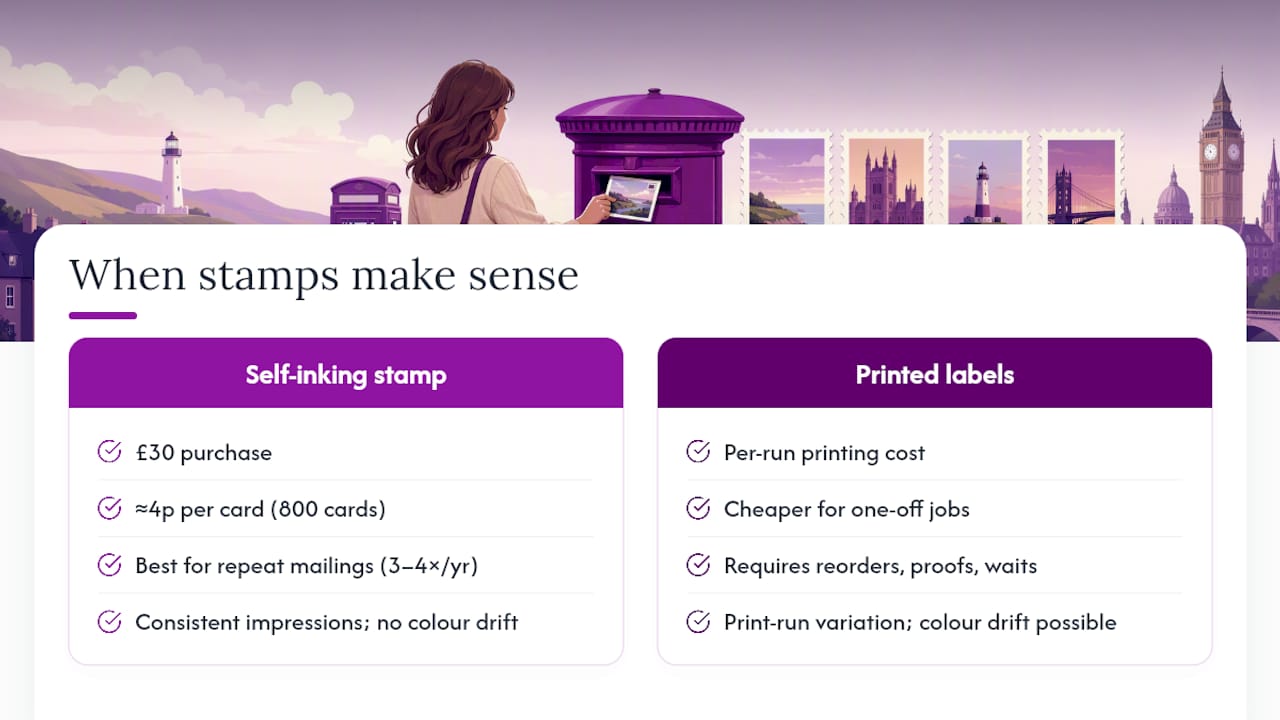
A stamp bought for £30 and used across four seasonal postcard drops of 200 cards each works out to roughly 4p per card once the ink pad is amortised in, comfortably cheaper than reordering labels four separate times. The consistency matters too: every impression comes out the same, with no colour drift or print-run variation you sometimes get from batch to batch with printed labels. For a business sending the same “thank you for your order” or “we’ve moved” message repeatedly, that reliability is worth more than the marginal saving labels offer on a single run.
Where I’d push back on the conventional advice is the assumption that labels are always the cheaper, safer default for small businesses. That’s only true for genuinely one-off jobs. The moment a mailing becomes a repeat activity, even loosely repeated three or four times a year, the stamp usually wins on both cost and simplicity, because you’re not reordering artwork, checking proofs, or waiting on a new print run each time.
Get a proof and order your stamp or labels today
Stamp Design 4U handles the two things that usually slow down a postcard project: getting artwork proof-ready and getting it to your door without a fuss. Every order includes a PDF proof before production starts, a choice of ink colours where the product supports it, and UK dispatch options that fit most campaign timelines.
If you’re weighing up stamps against printed labels, the fastest way to settle it is to compare the Trodat 4927 against the personalised logo stamps collection and see which spec matches your postcard layout. Upload your artwork, request a proof, and you’ll typically have a production-ready design confirmed within a day or two of approval. For repeat mailers, that one-off setup step is the last piece of admin you’ll need to do before the stamp pays for itself.
Key takeaways for budgeting your postcard stamp or label order
Self-inking stamps cost more upfront but drop below 10p per postcard for repeat campaigns, while printed labels suit one-off, full-colour runs at £8 to £30 per 100.
| Point | Details |
|---|---|
| Typical stamp budget | Expect a moderate upfront cost for self-inking stamps like the Trodat 4927, VAT and delivery included. |
| Typical label budget | Printed labels run £8 to £30 per 100, cheaper per unit at high volumes but with no reuse value. |
| Stamps win on repeats | Choose a stamp for any design used three or more times a year; per-card cost drops sharply with reuse. |
| Labels win on one-offs | Choose printed labels for single-run, full-colour, or frequently changing artwork. |
| Order path with Stamp Design 4U | Pick a product, upload artwork, approve the PDF proof, then production and UK dispatch follow. |
Where to check specs, prices and ordering steps
- Visit the Trodat 4927 product page for exact dimensions and current pricing.
- Check the SD4U Imprint 11 POSTED Word Stamp page for ink colour options and specs.
- Browse the personalised stamps collection for label and material alternatives.
- Read the mailing stamp checklist before placing an order to understand proofing and lead times.
- Use the best-practices guide for pad replacement timing and test-impression advice.