

TL;DR:
- Multi-colour stamps produce vivid impressions with multiple colors in a single motion, enhancing brand recognition. They save time, improve communication clarity, and create a professional appearance for packaging and marketing. Modern tools like self-inking stamps and alignment platforms make layered multi-colour stamping accessible and repeatable.
Multi-colour stamps are stamping tools that create impressions in two or more colours simultaneously, giving businesses and individuals a direct way to produce vivid, professional marks in a single motion. The question of why use multi-colour stamps has a clear answer: they deliver brand-accurate, visually distinctive results that single-colour stamps simply cannot match. The Trodat Multi Colour Impression line, for example, offers a palette of 15 standard colours that users combine into one impression. Stampdesign4u supplies custom multi-colour stamps to small businesses and individuals across the UK and beyond, making this capability accessible without specialist print equipment.
What are the main benefits of multi-colour stamps?
Multi-colour stamps create stronger brand recognition than single-colour alternatives because they reproduce logos and symbols in their actual corporate colours. A single-colour stamp forces a compromise: your brand mark appears in black or red, stripped of the visual identity you have built. A multi-colour impression restores that identity instantly.
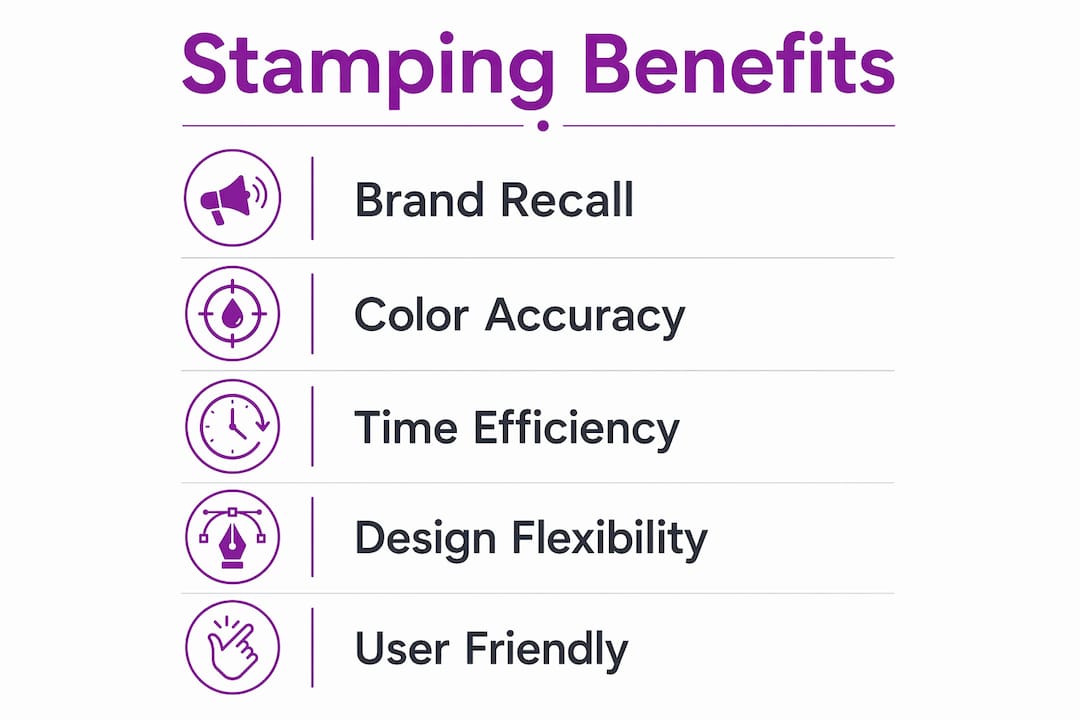
The efficiency gain is equally significant. Modern self-inking systems produce a complete multi-colour mark in one downward motion, eliminating the separate stamping steps that manual multi-colour methods require. For high-volume branding tasks such as packaging runs or marketing collateral, that time saving adds up quickly.
Multi-colour stamps also improve communication clarity. In education, 8-piece multi-colour teacher stamp sets allow teachers to differentiate praise from corrective feedback at a glance, using colour coding that pupils understand immediately. The same principle applies to business: colour-coded stamps on invoices, order forms, or parcels communicate status without a word of explanation.
Key advantages at a glance:
- Brand accuracy: Reproduce logos in correct corporate colours rather than a single-tone approximation.
- Speed: One motion delivers the full multi-colour impression, cutting repetitive steps.
- Visual differentiation: Colour-coded marks stand out on packaging, paperwork, and marketing materials.
- Communication efficiency: Colour signals meaning faster than text alone.
- Professional appearance: Multi-colour impressions signal premium positioning, conveying attention to detail that justifies the investment.
Pro Tip: Choose ink colours that match your brand’s primary and secondary palette exactly. Mismatched shades undermine the consistency that makes multi-colour stamping worthwhile.
Which practical uses make multi-colour stamps valuable?
The range of applications for multi-colour stamps is wider than most people expect. Below are the most productive uses for small businesses and individuals.
-
Product packaging and fulfilment. Stamping your logo in brand colours directly onto kraft boxes, tissue paper, or mailing bags gives handmade and small-batch products a polished, retail-ready finish without the cost of pre-printed packaging. Personalised packaging stamps from Stampdesign4u make this straightforward to order and repeat.
-
Marketing collateral. Stamping promotional flyers, thank-you cards, or event programmes with a multi-colour logo mark adds a tactile, handcrafted quality that digital print cannot replicate. Recipients notice and remember it.
-
Educational feedback. Teachers use personalised teacher stamps with bright coloured ink designs to save marking time and reinforce positive behaviour. A green star for excellent work and a red prompt for revision communicates more quickly than a written comment.
-
Creative projects and crafting. Card makers, scrapbookers, and invitation designers use multi-colour stamps to layer colours and build complex designs in fewer steps. The results are consistent across a batch, which matters when making sets of wedding invitations or seasonal cards.
-
Customer engagement. Stamping loyalty cards, gift wrapping, or receipts with a distinctive multi-colour mark creates a memorable brand touchpoint. Customers associate the visual with your business long after the transaction.
-
Event branding. Market traders, pop-up shops, and event organisers use multi-colour stamps on bags, programmes, and signage to create a cohesive visual identity without commissioning expensive printed materials.
How do modern tools simplify multi-colour stamping?
The technical barrier to multi-colour stamping has dropped considerably. Self-inking multi-colour stamp models handle ink distribution internally, so users press once and lift. There is no separate inking step, no risk of smudging a wet pad, and no colour bleed between zones when the mechanism is correctly maintained.

For crafters working with unmounted stamps, hinge-mounted positioning platforms such as the Stamparatus solve the alignment problem that makes layered multi-colour work difficult. The platform holds the stamp in a fixed hinge position, so you can ink one colour, return the stamp to exactly the same position, and add a second colour without misalignment. Two plates on the platform also allow bulk card making, producing consistent multi-colour layered impressions across a full batch.
Colour application methods vary by project type:
| Method | Best for | Key advantage |
|---|---|---|
| Self-inking multi-colour stamp | High-volume branding tasks | Single-motion impression, no separate inking |
| Stamp positioning platform | Layered craft designs | Perfect alignment across multiple colour passes |
| Individual ink pads with markers | Custom colour mixing | Maximum colour flexibility per impression |
| Pre-inked multi-zone pads | Office and packaging use | Consistent colour output, low maintenance |
The most common mistake is pressing unevenly, which causes one colour zone to print darker than another. Apply firm, even pressure straight down and lift cleanly. Rocking the stamp smears the impression and mixes ink between colour zones.
Pro Tip: When using a positioning platform for layered designs, ink the lightest colour first. Darker inks applied over light ones produce cleaner, more vibrant results than the reverse order.
What should you consider when designing a multi-colour stamp?
Colour selection is the first decision and the most consequential. Choose colours that appear in your existing brand identity or project palette. Colours that look good on screen do not always translate well to ink on paper, so test a sample impression before committing to a full order.
Design complexity requires honest assessment. Multi-colour stamps work best when each colour zone is clearly separated in the artwork. Fine lines between two colour areas risk bleed at the boundary. Bolder, simpler designs reproduce more cleanly and remain legible at smaller sizes.
Consider these factors before placing your order:
- Size and placement: The stamp must fit the surface it will mark. A 60 x 40mm stamp suits A5 cards and packaging boxes; a smaller format suits loyalty cards or envelope flaps.
- Material durability: Rubber stamps with replaceable ink cartridges last longer than pre-inked pads with fixed ink supplies. Reordering ink cartridges online is straightforward with the Trodat system, keeping running costs predictable.
- Intended volume: High-volume users benefit from self-inking mechanisms. Low-volume crafters can manage with a positioning platform and individual ink pads.
- Brand consistency: Every impression should look identical. Test the stamp on the actual substrate, whether cardboard, paper, or fabric, before using it on finished products.
- Maintenance: Clean the stamp face after each session with a damp cloth. Dried ink between colour zones degrades impression quality over time.
For small businesses, the practical steps for business branding with stamps are worth reviewing before finalising a design. Getting the brief right before ordering saves time and cost.
Key takeaways
Multi-colour stamps are the most efficient way for small businesses and individuals to produce brand-accurate, visually distinctive impressions across packaging, marketing materials, and creative projects.
| Point | Details |
|---|---|
| Brand accuracy matters | Multi-colour stamps reproduce logos in correct corporate colours, which single-colour options cannot do. |
| Single-motion efficiency | Modern self-inking systems deliver a full multi-colour impression in one press, saving time on volume tasks. |
| Alignment tools are essential | Hinge-mounted platforms like the Stamparatus enable precise layered impressions for complex designs. |
| Design simplicity improves results | Bold, well-separated colour zones reproduce more cleanly than fine-line multi-colour artwork. |
| Maintenance extends stamp life | Cleaning the stamp face after each session and reordering ink cartridges keeps impressions consistent. |
Multi-colour stamps: what 15 years of watching brands get it wrong taught me
Most small businesses underestimate how much a single-colour stamp limits them. I have seen well-designed logos reduced to a flat black mark on a parcel, and the brand recognition that the owner worked hard to build simply disappears. The colour is not decoration. It is information.
What surprises people most is how little effort modern multi-colour stamping requires. The assumption that you need multiple stamps, multiple passes, and a steady hand is outdated. Self-inking multi-colour mechanisms handle the complexity internally. You press, lift, and the full-colour mark is there. The alignment precision of positioning platforms has made layered craft work genuinely repeatable, not just possible in theory.
My honest view is that the cost argument against multi-colour stamps is weaker than it appears. The premium over a single-colour stamp is real, but so is the return. A parcel that arrives with a colour-accurate logo stamp looks like it came from a considered, professional operation. That perception has value, particularly for small businesses competing with larger brands on presentation.
Start with two colours if three feels like too much. Even a two-tone impression is a significant step up from monochrome, and it keeps design complexity manageable. Experiment with your brand’s primary and secondary colours before committing to a full palette. The results will tell you quickly whether you need more.
— Steven
Custom multi-colour stamps from Stampdesign4u
Stampdesign4u offers a range of personalised logo stamps designed for businesses that need colour-accurate, repeatable impressions on packaging, marketing materials, and correspondence.
The ordering process is straightforward: upload your artwork, select your stamp size and ink colours, and receive a finished stamp ready to use. The Trodat 4927 logo and text stamp is a popular choice for businesses needing a larger format impression across packaging and collateral. Replacement ink cartridges are available to order online, keeping running costs low. Browse the full range at Stampdesign4u to find the format that fits your project.
FAQ
What is a multi-colour stamp?
A multi-colour stamp is a stamping tool that applies two or more ink colours in a single impression. Self-inking versions handle colour distribution internally, requiring no separate inking step.
Why choose multi-colour stamps over single-colour options?
Multi-colour stamps reproduce logos and designs in their actual colours, creating stronger brand recognition and more visually distinctive marks than single-colour alternatives can achieve.
How do I get consistent results with multi-colour stamps?
Use a hinge-mounted positioning platform for layered designs to maintain alignment across colour passes. For self-inking stamps, apply firm, even downward pressure and clean the stamp face after each session.
Are multi-colour stamps suitable for crafting and personal projects?
Multi-colour stamps are widely used for card making, scrapbooking, and invitation design. Stamp positioning platforms allow crafters to layer colours precisely, producing effects that single-colour stamps cannot replicate.
How do I maintain a multi-colour stamp?
Wipe the stamp face with a damp cloth after each use to prevent dried ink from mixing between colour zones. For self-inking models, replace ink cartridges when impressions begin to fade rather than pressing harder, which distorts the design.
Recommended
- Multi-purpose stamps: 5 smart uses for branding & beyond – Stamp Design 4U
- Multi-design stamping: boost your branding today – Stamp Design 4U
- 7 Practical Personalised Stamp Uses for Businesses and Hobbyists – Stamp Design 4U
- Enhance your branding with custom stamps: a practical guide – Stamp Design 4U