

TL;DR:
- Educational stamps save teachers time by providing quick, consistent feedback and visual Rewards for students. They support hands-on learning across subjects and reinforce positive behaviors through immediate, tactile recognition. Despite digital advancements, physical stamps remain essential for effective classroom communication and motivation.
Educational stamps are defined as purpose-made rubber or self-inking stamps used in classrooms and home learning to deliver feedback, reinforce behaviour, and teach core skills. The question of why use educational stamps has a clear answer: they save teachers measurable time, provide children with immediate visual rewards, and support hands-on learning across literacy, numeracy, and the arts. Unlike digital feedback tools, stamps produce a physical mark that children can see, touch, and collect. For educators and parents seeking practical ways to boost engagement without adding to their workload, stamps remain one of the most direct tools available.
Why use educational stamps to save teaching time
Every minute a teacher spends writing the same comment by hand is a minute taken from planning, supporting pupils, or rest. Each stamp application takes about 1 second compared to writing a manual comment. Across a class of 30 pupils marked five days a week, that difference adds up to hours recovered each term.
The most common functional stamps used in classrooms fall into three categories:
- Feedback stamps: “Great Work,” “Please Correct,” and “See Me” stamps deliver consistent, legible messages without variation in tone or handwriting quality.
- Date and name stamps: These handle administrative repetition instantly, removing the need to write the same information across dozens of exercise books.
- Tick and check stamps: A personalised teacher stamp with a tick and two lines confirms completion and signals where a pupil should write their correction.
Colourful ink designs on feedback stamps also improve visibility on the page. Stamps with positive messages like “Great Work” or “Please Correct” create clear, consistent communication between teachers, learners, and parents. That consistency matters: a parent reading a stamped comment understands it immediately, without deciphering rushed handwriting.
Organisation is the factor most educators overlook. A cluttered stamp drawer leads to ink smears, wrong stamps applied to the wrong books, and wasted time searching mid-lesson. A dedicated stamp station that separates functional stamps from motivational ones solves all three problems at once.
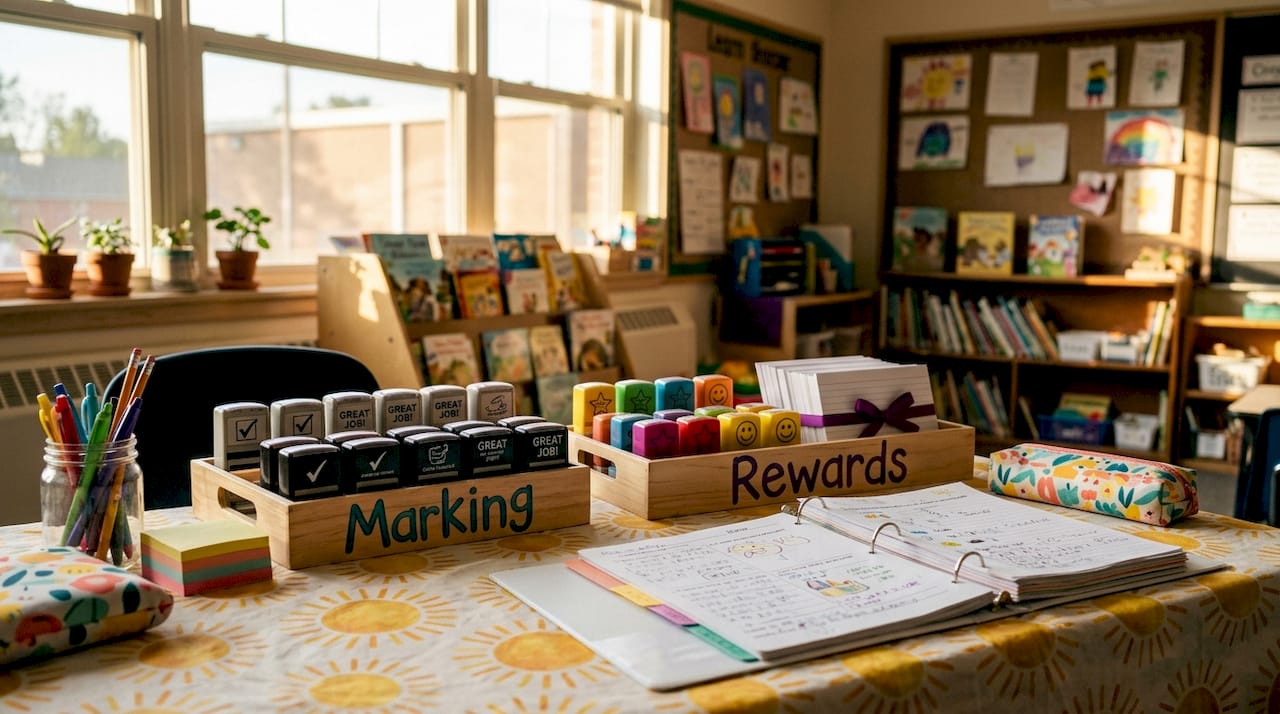
Pro Tip: Arrange stamps in two labelled trays: one for marking and one for rewards. Keep the marking tray on your desk during grading sessions and store the rewards tray at the front of the classroom where pupils can see it.
How do stamps motivate students in the classroom?
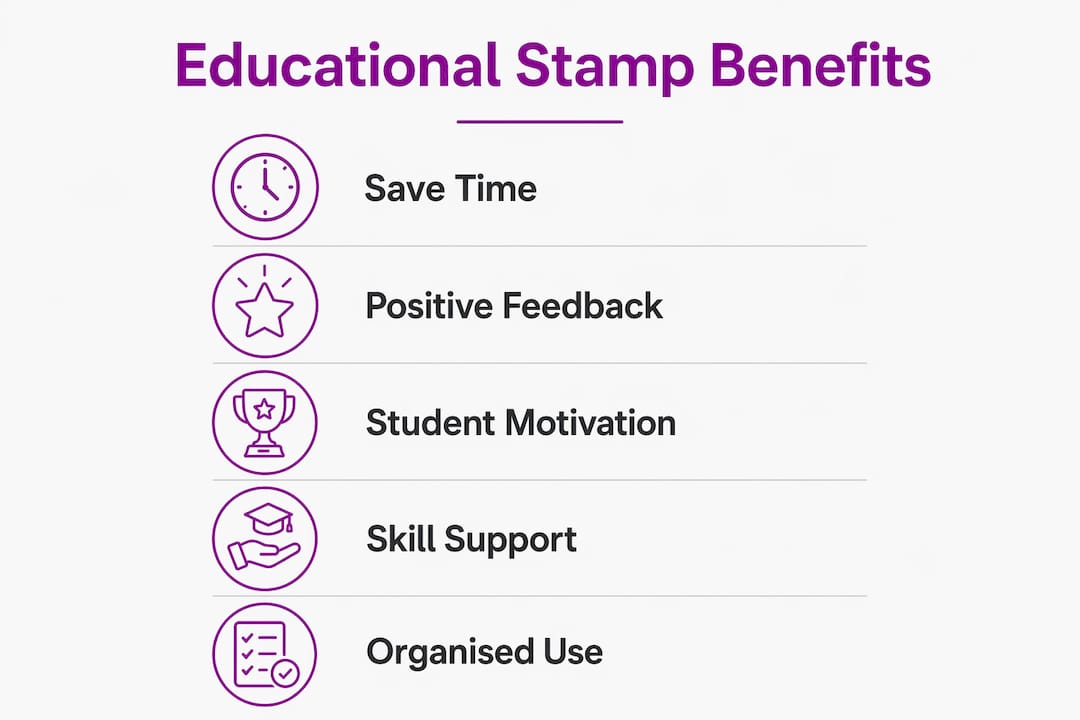
The psychological basis for using stamps as rewards is positive reinforcement, a principle established in behavioural psychology and applied widely in classroom management frameworks. When a child receives a visible, tangible reward immediately after a desired behaviour, the brain associates effort with recognition. Stamps deliver that recognition faster than any written comment.
Visual rewards from stamps create a positive reinforcement loop that motivates pupils to complete homework and improve performance. The effect is not superficial. Children feel pride when they receive a star or smiley face stamp, and that pride drives repeated effort.
The most effective motivational stamps used in primary classrooms include:
- Star and smiley face stamps: Immediate, universal signals of approval that even very young children understand.
- Encouraging message stamps: Phrases like “Brilliant Effort” or “You Can Do It” reinforce growth mindset language without requiring the teacher to write anything.
- Progress tracker stamps: Small stamps used on reward charts to mark milestones, such as ten stamps earning a certificate or a classroom privilege.
“Stamps act as a visual reinforcement loop that powerfully motivates children, encouraging repeated desired behaviours such as homework completion and classroom participation.” — Rubber Stamps Motivational Effects in Education
Structured reward programmes amplify this effect. Combining motivational stamps with progress tracking charts fosters continuous engagement and improves behavioural outcomes across the class. A pupil who can see their chart filling up has a concrete, daily reason to participate. That visibility is something a verbal “well done” cannot replicate.
What subjects and skills do educational stamps support?
The role of stamps in learning extends well beyond marking. Stamps are hands-on teaching tools that develop fine motor skills, letter recognition, number sense, and spatial awareness through direct physical activity.
- Literacy and letter recognition: Alphabet stamps let early learners press each letter, say its sound, and see the result. This multisensory approach converts rote memorisation into active play.
- Numeracy: Number and shape stamps support counting, pattern recognition, and basic arithmetic when used in sequencing activities.
- Creative arts: Pattern and image stamps develop spatial awareness and composition skills. Pupils arrange stamps to create scenes, borders, and repeating designs.
- History and geography: Philatelic learning uses postage stamps to teach cultural identity, geography, and historical events through the images and text printed on them.
Educational stamp kits for children aged 4–7 aid fine motor skills, letter and number recognition, and transform rote memorisation into engaging, play-based learning. The physical act of pressing a stamp requires grip strength, hand-eye coordination, and controlled pressure. These are the same motor skills children need for writing.
The philatelic dimension of stamp-based learning is particularly underused in British schools. Young Philatelists Club programmes use postage stamps to teach history, geography, and cultural identity, integrating stamp-based learning into school curricula for children aged 8–9. A stamp depicting a historical figure opens a conversation about that person’s era. A stamp from another country prompts questions about geography, language, and culture.
| Subject area | Stamp type | Core skill developed |
|---|---|---|
| Literacy | Alphabet stamps | Letter recognition, phonics |
| Numeracy | Number and shape stamps | Counting, pattern recognition |
| Creative arts | Pattern and image stamps | Spatial awareness, composition |
| History and geography | Postage stamps (philately) | Cultural identity, research skills |
| Fine motor development | Any hand stamp | Grip strength, hand-eye coordination |
Stamps open meaningful learning experiences by connecting pupils to the stories behind images, fostering curiosity and global awareness beyond mere collecting. That curiosity is the foundation of independent learning.
Best practices for using stamps in classrooms and at home
Selecting the right stamp for the right purpose is the first decision educators and parents need to make. Age and learning goal determine everything else.
- For early years (ages 3–6): Choose large, chunky stamps with simple images or single letters. Small stamps require fine motor control that young children are still developing.
- For primary years (ages 7–11): Alphabet sets, number stamps, and motivational feedback stamps all work well. Pupils at this stage can also begin philatelic activities with proper guidance.
- For secondary and home learning: Functional feedback stamps, date stamps, and custom message stamps save the most time at this level. Personalisation matters more as pupils get older.
Organisation prevents the most common stamp problems. Store stamps upright in labelled holders to protect the rubber surface and prevent ink transfer between stamps. Keep ink pads in a separate tray and replace them before they dry out, as a faint stamp impression loses its motivational impact entirely.
Combining stamps with other tools multiplies their effect. A stamp on a reward chart works better than a stamp on a loose sheet of paper because the chart provides context and tracks progress over time. Stamps used alongside reading logs, spelling lists, or maths practice sheets give pupils a reason to complete each section.
Pro Tip: When using philatelic materials with pupils, store postage stamps in archival sleeves or acetate film rather than tape or glue. This protects the stamps from damage and teaches pupils to handle historical artefacts with care.
Stamps for education cover a wide range of classroom needs, from simple tick stamps to fully customised feedback sets. Matching the stamp to the task keeps the tool purposeful rather than decorative.
Physical stamps still matter in a digital classroom
The assumption that digital tools have made physical stamps redundant does not hold up to scrutiny. Traditional stamping remains deeply embedded in administrative and communication processes in education because of its reliability and formal recognition. In Japan, physical seals handle over 91% of school document processing despite widespread digital adoption. That figure reflects something real: a physical mark carries authority that a digital notification does not.
My view, after years of observing classroom practice, is that stamps and digital tools serve different functions rather than competing ones. A teacher using a tablet to track grades and a rubber stamp to mark effort is not being inconsistent. The stamp does something the tablet cannot: it lands on the pupil’s page, in the pupil’s hand, at the moment the work is returned. That immediacy is the point.
The tactile quality of stamps also matters more than most educators acknowledge. Children who receive a stamped page interact with it differently from children who receive a typed comment on a screen. They show it to classmates. They show it to parents. The physical object travels in a way that a digital notification does not.
My practical advice is this: do not wait for the perfect digital system before using stamps. A well-chosen set of stamps by use costs less than most classroom subscriptions and requires no login, no battery, and no update. Start with three stamps: one for approval, one for correction, and one for effort. Build from there based on what your pupils respond to.
— Steven
Stampdesign4u’s range of educational and teacher stamps
Stampdesign4u offers a practical range of personalised stamps designed for classroom and home learning use, from motivational reward stamps to fully customised feedback sets.
The Trodat Printy 4927 multiline stamp handles up to nine lines of text, making it well suited for detailed feedback messages that teachers would otherwise write by hand. For simpler daily marking, the tick and lines teacher stamp delivers consistent, legible results in under a second. Every stamp is customisable, so the message, layout, and ink colour match the specific needs of the classroom or home learning setting. Browse the full range at Stampdesign4u to find the right stamp for your teaching context.
FAQ
What are the main benefits of educational stamps for teachers?
Educational stamps save teachers significant time by replacing handwritten comments with a single stamp application. They also deliver consistent, legible feedback that pupils and parents can read clearly.
Why use teacher stamps instead of written comments?
Each stamp takes about 1 second to apply, compared to several seconds for a handwritten note. Across a full class set of books, that difference adds up to hours saved each term.
How do stamps support student motivation?
Visual rewards from stamps create a positive reinforcement loop that encourages pupils to repeat desired behaviours such as completing homework and participating in class.
What age group benefits most from educational stamps?
Children aged 4–11 benefit most from hands-on stamp activities. Early learners develop fine motor skills and letter recognition, while older primary pupils use stamps for reward programmes and philatelic learning.
Can stamps be used effectively in home learning settings?
Stamps work well at home for reward charts, reading logs, and spelling practice. A small set of motivational and feedback stamps gives parents a quick, consistent way to acknowledge effort and guide improvement.
Key takeaways
Educational stamps are the most direct tool available for combining time-saving feedback, positive reinforcement, and hands-on learning in a single, low-cost classroom resource.
| Point | Details |
|---|---|
| Time saving for teachers | Each stamp takes about 1 second, saving hours of handwriting across a school term. |
| Motivational impact | Visual rewards create a positive reinforcement loop that increases homework completion and class participation. |
| Cross-subject learning | Stamps support literacy, numeracy, creative arts, and history through tactile, play-based activities. |
| Organisation matters | A dedicated stamp station with separated functional and motivational stamps prevents ink smears and saves time mid-lesson. |
| Physical stamps complement digital tools | Stamps deliver immediate, tangible feedback that digital notifications cannot replicate, making them relevant in 2026 classrooms. |