

TL;DR:
- Ordering stamps internationally offers lower prices, wider customization, and diverse design options. UK buyers must consider import VAT, correct customs codes, and total landed costs to avoid unexpected expenses. Choosing qualified suppliers and preparing clear orders help ensure quality and smooth fulfillment.
Ordering stamps internationally is defined as purchasing custom or standard stamps from manufacturers or suppliers based outside your home country, typically to access lower prices, superior customisation, or specialist designs unavailable domestically. For UK buyers, this practice has grown considerably as global trade agreements and digital ordering platforms have made cross-border purchasing far more accessible. The RCEP trade agreement enables manufacturers in Southeast Asia to source raw materials tariff-free, which directly reduces the cost of custom stamps exported to markets like the UK. Stampdesign4u serves customers across dozens of countries, reflecting exactly this shift towards international sourcing for personalised stamp products.
Why order stamps internationally: key benefits explained
The primary reason to order stamps internationally is cost. Supply chain efficiencies under agreements like RCEP allow manufacturers to produce custom stamps at a lower unit cost than many domestic suppliers can match. The UK accounts for a notable share of global custom stamp demand, which means international manufacturers actively compete for British customers with competitive pricing and fast turnaround.

Beyond price, international ordering opens access to advanced customisation that standard high-street suppliers simply do not offer. CNC machining allows bespoke dimensions, ergonomic handle configurations, and mounting options tailored to specific applications. A business needing a stamp with an unusual footprint or a collector seeking a hand-finished design will find far more options by looking beyond domestic catalogues.
The third major advantage is design variety. Businesses and hobbyists order internationally to source premium artistic styles that enhance tactile branding effects missing from standard domestic offerings. A wax-seal style stamp for luxury packaging, or a multi-colour logo stamp for corporate stationery, is far more likely to be available from a specialist international manufacturer than from a general office supply retailer.
- Cost competitiveness: International manufacturers using tariff-free raw materials can offer lower prices per unit, particularly on bulk or repeat orders.
- Bespoke dimensions: CNC and laser engraving technology allows sizes and shapes that domestic suppliers rarely stock.
- Specialist design styles: Artistic, niche, or tactile designs for branding, packaging, and personal use are far more widely available internationally.
- Small-batch flexibility: Digital production platforms enable small-batch custom orders without the minimum quantities that some domestic suppliers require.
Pro Tip: When comparing international quotes, always request a sample or digital proof before committing to a full order. This protects you from design errors that are costly to correct once manufacturing begins.
How do UK customs and import VAT affect international stamp purchases?
UK import VAT of 20% applies to goods valued over £135, calculated on the total landed cost including the price of goods, shipping, and insurance. This is the single most common source of unexpected expense for buyers ordering stamps from overseas for the first time. A stamp order priced at £120 from a supplier may cost considerably more once shipping and VAT are added.
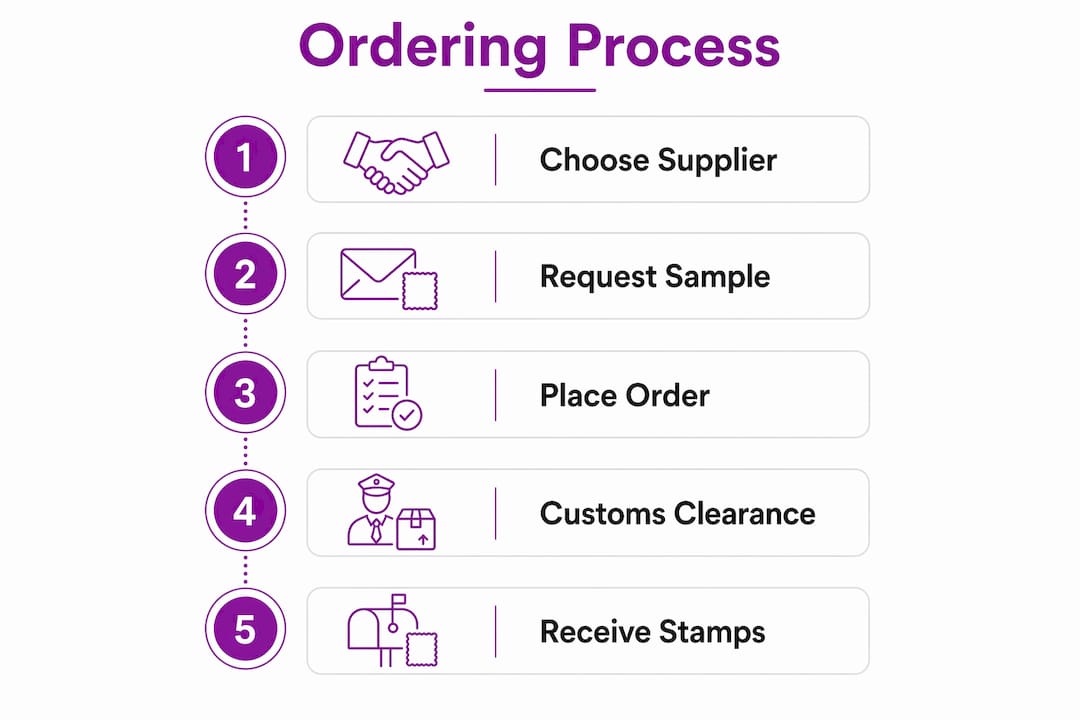
Understanding landed cost before you place an order is not optional. Calculation errors on landed cost lead to higher actual costs than the purchase price suggests, and HMRC will not waive import VAT because a buyer was unaware of it. Budget for the full landed cost from the outset.
Customs clearance requires accurate documentation. UK importers must use correct 10-digit commodity codes to classify their goods. Using the wrong code can cause delays, fines, or seizure of the shipment. The importer, not the overseas supplier, is legally responsible for compliance with UK import regulations.
- Calculate your landed cost first. Add the goods price, international shipping, insurance, and any applicable customs duty before comparing international and domestic prices.
- Obtain a GB EORI number. Any UK business importing goods commercially needs a GB-prefixed Economic Operator Registration and Identification number for customs clearance.
- Find the correct commodity code. Use the UK Trade Tariff to identify the 10-digit code for rubber or metal stamps before your shipment arrives.
- Confirm the supplier’s declared value. Ensure the commercial invoice reflects the true transaction value. Under-declaration is a compliance risk for the importer.
- Factor in clearance time. Customs processing adds days to delivery. Build this into your project timeline, particularly for time-sensitive branding or mailing campaigns.
Pro Tip: Ask your international supplier to include a detailed commercial invoice with the correct commodity code already listed. Many experienced exporters will do this as standard, which speeds up UK customs clearance significantly.
What to consider when choosing an international stamp supplier?
Quality is the first filter. Top metal stamp makers balance skilled craftsmanship with advanced technology, including laser engraving and CNC machining, to produce consistent, precise impressions. A supplier who cannot demonstrate their manufacturing process or show examples of finished work is a risk not worth taking.
Service matters as much as price. Reputable stamp manufacturers provide consultation, customisation options, and after-sales support, including warranties and educational resources. A supplier who disappears after payment is a common problem with low-cost international orders, and it is one that a quick check of reviews and response times can usually prevent.
“Professional consultation during the design phase helps optimise ergonomics, striking force, and durability before manufacturing begins. Getting these details right at the proof stage is far cheaper than correcting them after production.”
The design consultation stage is where international orders either succeed or fail. Bespoke stamp manufacturers who offer a structured consultation process will ask about your intended use, the surface you are stamping on, and the frequency of use. These questions directly affect the stamp’s construction and longevity.
- Craftsmanship and technology: Look for suppliers who use laser engraving or CNC machining and can show finished product samples.
- Design proofing: A reputable supplier will provide a digital proof for approval before manufacturing. Reject any supplier who skips this step.
- Certifications and reviews: Third-party reviews, industry certifications, and clear return policies are reliable indicators of a trustworthy supplier.
- Responsiveness: Test communication before ordering. A supplier who takes days to answer a pre-sale query will not improve after you have paid.
- After-sales support: Warranties and clear processes for handling defective goods protect your investment, particularly on bespoke orders.
For UK businesses comparing international options with domestic alternatives, the cost efficiency of custom stamps is a useful reference point when building a business case for international sourcing.
How to navigate the ordering process for international stamps effectively
Placing an international stamp order efficiently requires preparation before you contact a supplier. The more clearly you define your requirements upfront, the faster the process moves and the fewer costly revisions arise. A well-prepared brief covers the stamp’s dimensions, intended use, material preference, ink type, and quantity.
Shipping options vary significantly in cost and speed. Express courier services like DHL or FedEx offer tracked, insured delivery with faster customs clearance, while standard postal services are cheaper but slower and harder to track. For bespoke or high-value orders, express shipping is worth the additional cost.
- Prepare a detailed design brief. Include dimensions, logo files in vector format (such as .AI or .EPS), preferred materials, and quantity. Vague briefs produce vague quotes and slow the process.
- Confirm shipping terms. Clarify whether the quoted price is EXW (ex-works, meaning you arrange shipping) or DDP (delivered duty paid, meaning the supplier handles import costs). DDP is simpler for first-time importers.
- Request a digital proof. Never approve production without a proof. Check every detail, including text alignment, logo proportions, and stamp dimensions.
- Track your shipment. Use the tracking number provided by the courier and monitor customs status through the carrier’s portal. Early visibility of customs holds allows you to respond quickly with additional documentation.
- Plan for lead times. International custom orders typically take longer than domestic ones. Add buffer time for customs clearance, particularly around peak periods such as december and january.
The essential guide to ordering custom stamps online covers additional practical steps for managing the ordering process, including how to communicate design requirements clearly to suppliers working in different languages.
Key takeaways
Ordering stamps internationally delivers real cost and design advantages, but UK buyers must account for import VAT at 20%, correct commodity codes, and total landed cost before comparing international prices with domestic alternatives.
| Point | Details |
|---|---|
| Cost advantage is real but conditional | International pricing benefits depend on landed cost, including VAT, shipping, and duties. |
| Customisation options are wider internationally | CNC machining and laser engraving give international suppliers design flexibility domestic retailers rarely match. |
| Customs compliance is the buyer’s responsibility | UK importers must use correct commodity codes and hold a GB EORI number for clearance. |
| Supplier quality varies significantly | Choose manufacturers who offer design proofs, consultation, and after-sales support as standard. |
| Preparation reduces risk | A detailed design brief and confirmed shipping terms prevent the most common ordering problems. |
Steven’s view on sourcing stamps across borders
The biggest mistake I see buyers make is treating international stamp ordering as a simple price comparison. They find a quote that looks 30% cheaper than a domestic supplier, place the order, and then discover that import VAT, express shipping, and a customs delay have erased most of that saving. The landed cost calculation is not optional. It is the only number that matters.
That said, the design advantages of ordering internationally are genuine and often underestimated. I have seen businesses use bespoke wax-effect stamps on packaging that genuinely elevated their brand perception, and those stamps simply were not available from any UK high-street supplier. The best practices for custom stamps guide is worth reading before you brief any supplier, domestic or international, because the design consultation stage is where most orders go wrong.
My practical advice: use international suppliers for specialist or high-volume orders where the design requirements exceed what domestic suppliers offer. For standard logo stamps or address stamps, a reliable domestic supplier with no import complexity is often the better choice. Know what you are optimising for before you start.
— Steven
Stampdesign4u: custom stamps designed for your needs
Stampdesign4u offers a full range of personalised logo stamps and custom designs for businesses and individuals who want quality without the complexity of international import processes. Whether you need a compact address stamp or a detailed multi-line logo stamp, the ordering process is straightforward and fully online.
For businesses focused on packaging and branding, the personalised packaging stamps range covers a wide variety of sizes and formats. The Trodat 4927 is a popular choice for businesses needing a 9-line logo and text stamp at 60 x 40mm, combining a large print area with a reliable self-inking mechanism. Stampdesign4u handles design, proofing, and delivery without the customs paperwork.
FAQ
Do I need a special licence to import stamps into the UK?
No special licence is required to import rubber or metal stamps into the UK. You do need a GB EORI number for commercial imports and must use the correct 10-digit commodity code for customs clearance.
What is the import VAT threshold for stamps ordered from abroad?
UK import VAT at 20% applies to goods valued over £135, calculated on the total landed cost including shipping and insurance, not just the purchase price.
How long does an international custom stamp order typically take?
Lead times vary by supplier and shipping method, but international custom orders generally take between one and three weeks from proof approval to delivery, with additional time for UK customs clearance.
What file format should I send to an international stamp supplier?
Vector files in .AI or .EPS format are the standard for stamp manufacturing. These formats preserve sharp edges and allow the manufacturer to scale your design without quality loss.
Are international stamps better quality than domestic ones?
Quality depends on the manufacturer, not the country of origin. Suppliers using laser engraving and CNC machining produce consistent, high-quality results regardless of location. Always request samples or a digital proof before committing to production.