

TL;DR:
- International mail requires correct stamps, addressing, and customs documentation to avoid delays or returns. The USPS Global Forever stamp covers only one ounce and requires additional postage for heavier items, while size and country name formatting significantly impact delivery. Accurate weighing, proper formatting, and updated rates are essential for successful international shipping.
International stamp requirements define the postage, addressing, and documentation standards that must be met for mail to cross borders and reach its destination. Get any one of these wrong and your letter or parcel faces delays, customs holds, or a return to sender. The rules come from national postal authorities such as USPS and Royal Mail, coordinated internationally through the Universal Postal Union (UPU). Whether you are posting a single letter to France or shipping merchandise to Japan, the same core principles apply: correct postage for the weight and size, accurate addressing, and the right customs paperwork.
What stamps are accepted for international mail?
The USPS Global Forever stamp is the most widely recognised tool for postage for international mail from the United States. As of june 2026, it covers a 1-ounce letter to approximately 180 countries at a fixed cost of $1.70. That fixed price makes it convenient, but it creates a common and costly misunderstanding.

The word “Global” refers to destination coverage, not weight coverage. Many senders apply a single Global Forever stamp to a heavier letter or a small parcel and expect it to arrive. It does not. Heavier items require additional postage, typically by combining the Global Forever stamp with domestic stamps to meet the exact rate. Large envelopes start at $3.15, which means a single $1.70 stamp falls well short.
Size matters as much as weight. International standard letters must fall within specific dimensions: length between 5½ and 11½ inches, height between 3½ and 6⅛ inches, and thickness between 0.007 and 0.25 inches. Anything outside those measurements is classified as a flat or a package, each carrying its own separate postage rate.
In the United Kingdom, Royal Mail updates international postage rates periodically. As of april 2026, rates vary by destination, mail class, and the item’s dimensions and weight. There is no single universal stamp that covers all international destinations at all weights from the UK either.
Key facts about stamp acceptance for international mail:
- The USPS Global Forever stamp covers letters up to 1 oz only.
- Items heavier than 1 oz need additional postage on top of the Global Forever stamp.
- Royal Mail international tariffs vary by destination and item weight.
- Flats and parcels require separate postage calculations from standard letters.
- No single stamp covers all weights, sizes, and destinations universally.
Pro Tip: Weigh your letter or parcel before applying any postage. A kitchen scale accurate to 1 gram is sufficient for most items and prevents underpayment.
How should you address international mail correctly?
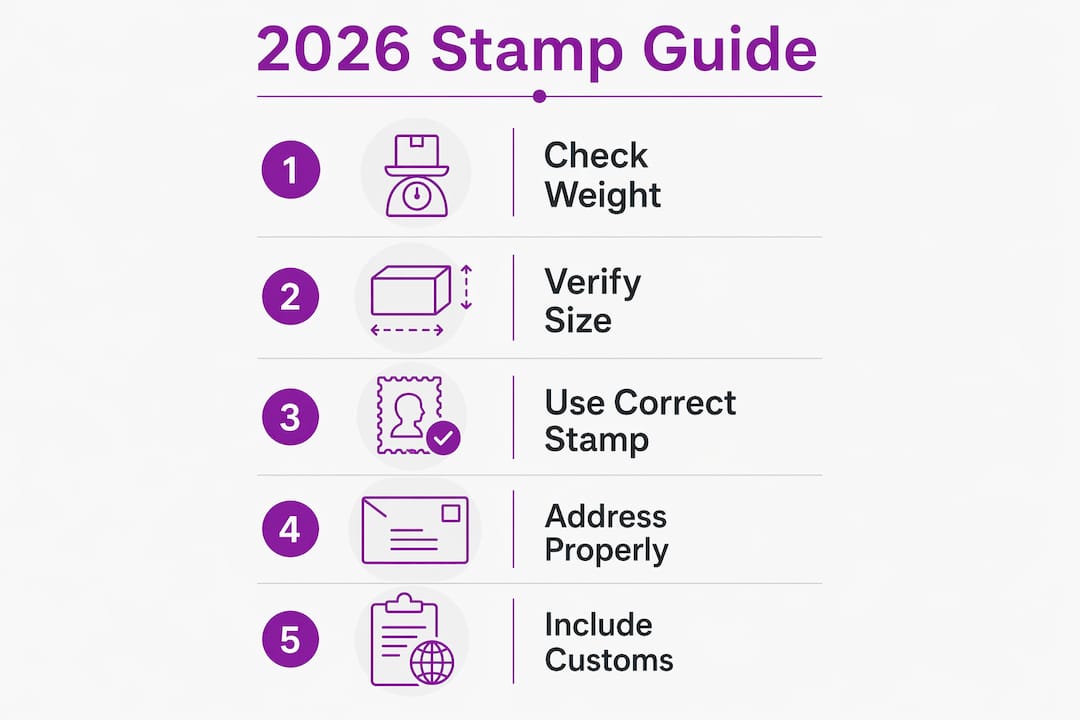
Accurate addressing is the single most important factor in successful international delivery. Errors in address format or language frequently result in delivery failures, because mail passes through multiple transit points where both automated machines and human sorters must read the address clearly.
USPS international addressing standards require the following:
- Write the recipient’s name on the first line, exactly as they use it.
- Place the street address or post office box on the second line.
- Add the city, region, and postal code on the third line, formatted as the destination country uses them.
- Write the full country name in capital letters on the final line, with no abbreviations. Write “UNITED KINGDOM”, not “UK”. Write “UNITED STATES”, not “USA”.
- For countries using non-Roman scripts such as Arabic, Chinese, or Cyrillic, include an interline English translation directly below each line.
- Place your return address in the top left corner of the envelope, legible and complete.
The requirement for uppercase lettering and full country names is not optional. Postal sorting systems in many countries are calibrated to read standardised formats. A lowercase country name or an abbreviation can cause a letter to be misrouted or returned.
Pro Tip: For countries with non-Roman scripts, ask the recipient to write their address in their local script and in English. Paste both versions onto the envelope to cover all sorting scenarios.
Address accuracy also matters for minimising delivery failures on international shipments. A missing postcode or an incorrect district name is enough to strand a parcel at a sorting facility.
When do customs declarations apply to international mail?
Customs declarations are required for any international item that contains goods with commercial value. This includes merchandise, gifts, and samples. Letters and documents that contain no physical goods are generally exempt, but the distinction matters.
For USPS, PS Form 2976 is the standard customs form for merchandise valued up to approximately $400. Higher values require additional documentation. The form must describe the contents accurately, state the value, and identify whether the item is a gift, a sale, or a sample. Inaccurate descriptions cause customs holds, which can delay delivery by weeks.
Key points on customs requirements:
- Letters and documents with no physical goods do not require a customs form.
- Gifts require a customs declaration, even if they have no commercial intent.
- Merchandise and samples always require a customs form regardless of value.
- Omitting or falsifying a customs declaration can result in the item being seized or destroyed.
- PS Form 2976 covers USPS items up to approximately $400 in declared value.
International Reply Coupons (IRCs) are a separate but related tool. An IRC, identified by UPU number CN01, allows a sender to pre-pay the return postage for a reply from a foreign recipient. The recipient exchanges the coupon at their local post office for stamps covering a standard letter. Not all postal services sell IRCs, but member countries of the UPU are obliged to accept them for exchange when presented. IRCs are most useful for formal correspondence where a reply is expected and the recipient should not bear the cost.
Practical tips for meeting global shipping stamp regulations
The most common reason international mail fails is insufficient postage. Relying on a single global stamp for heavier or larger items is the error postal staff see most often. The fix is straightforward: weigh accurately, calculate correctly, and apply the right combination of stamps or a printed postage label.
Practical steps to stay compliant:
- Use the USPS postage price calculator at usps.com or the Royal Mail price finder at royalmail.com before posting any international item.
- Weigh your item on a calibrated scale. Do not estimate.
- Choose between physical stamps and printed digital postage labels. Digital labels from services such as Royal Mail Click & Drop or USPS Click-N-Ship calculate postage automatically and reduce human error.
- Check the destination country’s specific restrictions. Some countries prohibit certain goods entirely, regardless of postage paid.
- Verify current rates before posting. Both USPS and Royal Mail adjust international tariffs periodically, and a rate that was correct in january may be wrong by april.
Pro Tip: If you post internationally on a regular basis, keep a printed rate card for your top five destination countries. Update it each time either USPS or Royal Mail announces a rate change.
For businesses, consistency in labelling and addressing reduces processing time at customs and at the destination post office. A personalised rubber stamp with your return address, company name, and any required handling instructions speeds up preparation and reduces the risk of missing information on high-volume despatch days.
The UPU’s standardisation framework means that stamps remain a universally accepted postal method across member countries, provided weight and addressing standards are followed. That interoperability is the foundation of international mail, but it depends entirely on senders meeting the rules at the point of origin.
Key takeaways
International stamp requirements cover postage rates, addressing standards, and customs documentation. Meeting all three is the only way to guarantee delivery across borders.
| Point | Details |
|---|---|
| Postage covers weight, not just destination | The USPS Global Forever stamp covers 1 oz only; heavier items need additional postage. |
| Size determines mail category | Letters outside standard dimensions are classed as flats or parcels with different rates. |
| Addressing must be uppercase and unabbreviated | Write the full country name in capitals; use English translations for non-Roman scripts. |
| Customs forms are mandatory for goods | Gifts, merchandise, and samples all require a customs declaration, even at low values. |
| Rates change periodically | Check USPS and Royal Mail rate finders before every posting cycle to avoid underpayment. |
What I have learned from years of watching international mail go wrong
The single biggest mistake I see is the assumption that one stamp solves everything. The Global Forever stamp is a genuinely useful product, but its name does real damage. People read “Global” and conclude the job is done. It is not. The weight limit is 1 oz, and most business letters with enclosures exceed that before you have added a second sheet of paper.
The second issue is addressing. I have watched well-packaged, correctly stamped parcels come back because the sender wrote “UK” instead of “UNITED KINGDOM” on the final address line. That one abbreviation was enough to confuse an automated sorting system in a transit country. The USPS addressing standards exist for a reason, and they apply even when you are posting from outside the United States to a US address.
What actually works is a simple pre-posting checklist: weigh the item, calculate the postage, write the address in the correct format, attach the customs form if needed, and verify the destination country’s current restrictions. That process takes three minutes. Recovering a returned parcel takes three weeks.
Businesses that post internationally at volume benefit most from consistent physical tools. A logo stamp for return addresses and a packaging stamp for handling instructions remove two of the most common sources of error: illegible handwriting and missing information. The investment is small. The reduction in failed deliveries is not.
— Steven
Consistent international mailing starts with the right tools
Getting postage and addressing right is one part of the equation. The other is making sure every item you send looks professional and carries all the information a postal system needs to process it without delay.
Stampdesign4u offers a range of customisable rubber stamps built for exactly this purpose. The Trodat 4927 logo and text stamp prints up to nine lines of text and a logo on a 60 x 40mm impression, making it ideal for return addresses, company names, and handling instructions on international mail. For businesses managing packaging at volume, the personalised packaging stamp range covers consistent labelling across box sizes and formats. Both options reduce preparation time and eliminate the risk of missing information that causes customs delays or failed deliveries.
FAQ
What is the USPS Global Forever stamp and what does it cover?
The USPS Global Forever stamp covers postage for a 1-ounce letter or postcard to approximately 180 countries, priced at $1.70 as of june 2026. Items heavier than 1 oz require additional postage on top of the Global Forever stamp.
Do I need a customs form for an international letter?
Letters and documents containing no physical goods do not require a customs declaration. Any item containing merchandise, gifts, or samples requires a customs form such as PS Form 2976.
How should I write the country name on an international envelope?
Write the full country name in capital letters on the last line of the address, with no abbreviations. Write “UNITED KINGDOM” rather than “UK” and “GERMANY” rather than “DE”.
What happens if my international letter is the wrong size?
Letters outside the standard dimensions of 5½ to 11½ inches in length and 3½ to 6⅛ inches in height are reclassified as flats or parcels. Each category carries a different postage rate, so underpayment is likely if you apply standard letter stamps.
How do I find the correct postage rate for my destination?
Use the USPS postage price calculator at usps.com or the Royal Mail price finder at royalmail.com. Both tools calculate rates based on destination, weight, and item dimensions, and reflect current tariffs.