

TL;DR:
- Mobile stamp ordering allows users to buy postage and manage loyalty stamps through smartphones, eliminating the need for physical cards or trips to the post office. It involves quick online payments for printable labels or codes and digital loyalty cards stored in phone wallets, with staff-controlled scanner apps ensuring security. Small businesses can easily implement these systems without expensive hardware, gaining efficiency, security, and better customer retention.
Mobile stamp ordering is the act of purchasing and managing postage or loyalty stamps directly from a smartphone, without visiting a post office or carrying paper punch cards. The term covers two distinct digital processes: postal services that generate printable postage in seconds, and digital loyalty stamp cards that replace physical punch cards via Apple Wallet and Google Wallet. Stampdesign4u serves customers across both categories, offering custom stamp solutions that complement mobile ordering workflows. Understanding what is mobile stamp ordering matters because it changes how individuals send post and how small businesses retain customers, with measurable gains in speed, security, and convenience.
What is mobile stamp ordering and how does it work?
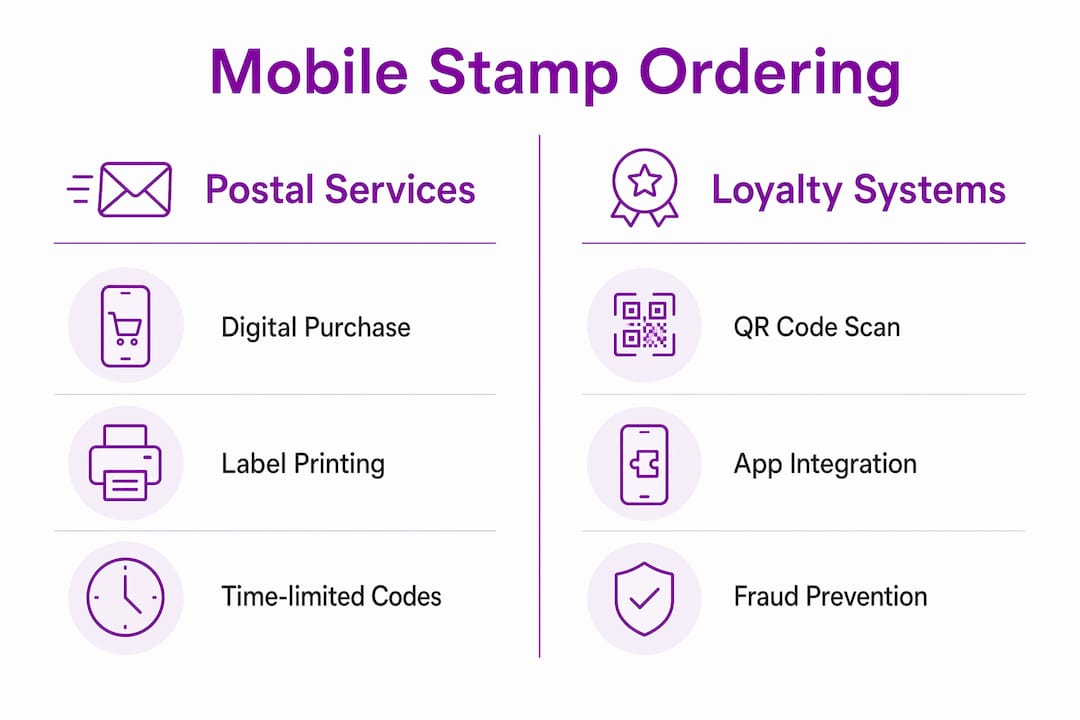
Mobile stamp ordering covers two separate systems that share one common trait: they remove the need for physical stamps or cards. The first system handles postal postage. The second handles loyalty programmes for cafés, retailers, and service businesses. Both rely on smartphones, QR codes, and wallet apps to function.

Postal apps and websites let customers purchase postage and print shipping labels without leaving home. Loyalty stamp systems let businesses issue digital punch cards that customers store in their phone wallets. Neither system requires a dedicated app download for the end customer, which removes the biggest barrier to adoption.
The mobile stamp ordering system for postal services works through a straightforward digital checkout. You select your postage class, pay online, and receive a printable label or a scannable code. The mobile app for stamp orders on the loyalty side works differently: a QR code at the till adds the card to your wallet, and staff scan your phone each visit to add a stamp.
How does mobile stamp ordering work for postal services?
The postal side of the digital stamp ordering process is built for speed. Users complete stamp ordering and printing in under 3 minutes, and voice-activated methods can reduce that to as little as 22 seconds. That speed matters for small business owners who send parcels daily and cannot afford time at a post office queue.
The typical process follows these steps:
- Open a postal app or website on your smartphone
- Select the postage class and enter the recipient’s address
- Pay by card or saved payment method
- Receive a printable label or a QR code for scanning at a self-service kiosk
- Print the label via WiFi to a compatible printer, or scan the QR code at a participating outlet
Printing requirements are specific. USPS-approved paper or label stock is required for valid postage; standard office paper does not meet the specification. This applies to equivalent postal standards in the UK and other markets. Using the wrong paper risks your item being rejected at the sorting office.
One feature that catches new customers off guard is code expiry. Postal stamp codes are time-limited, with some markets setting a 14-day validity window. Buying in bulk and leaving codes unused wastes money. Plan your purchases around actual sending volumes.
Pro Tip: Print your label immediately after purchase, or save the QR code screenshot to your phone’s camera roll so you can access it offline if your connection drops before you reach the post point.
What are digital loyalty stamp systems and how do they work on mobile?
Digital loyalty stamp cards are the mobile replacement for paper punch cards. They live inside Apple Wallet or Google Wallet on a customer’s phone, and customers add cards in 10–15 seconds by scanning a QR code displayed at the point of sale. No app download is required. That single fact removes the friction that kills most loyalty programme sign-ups.
The process for earning stamps works as follows:
- The business displays a QR code at the till or on a table card
- The customer scans the code to add the digital card to their wallet
- At each qualifying visit or purchase, a staff member opens a scanner app on a tablet or smartphone
- The staff member scans the customer’s wallet card to add a stamp
- When the card is complete, the reward is issued automatically
Security is built into the system by design. Staff-operated scanner apps control stamp issuance, which prevents customers from stamping their own cards. This closes the fraud gap that paper punch cards leave wide open. Anyone who has run a coffee shop loyalty scheme knows how easy it is to forge a paper stamp.
“Digital stamp cards stored in mobile wallets back up automatically, so customers never lose their progress when they get a new phone or misplace their wallet.”
Pricing for small businesses is accessible. Loyalty stamp systems start at around €120 per year, which typically includes roughly 600 stamps. Additional stamps beyond that quota incur a small per-stamp fee. For a café issuing ten stamps a day, the annual cost is modest against the retention value gained.
What are the key benefits of mobile stamp ordering?
The benefits of mobile stamp ordering split neatly between postal users and loyalty programme operators, though both groups gain the same core advantage: time back in their day.
For postal users, the gains are direct. Mobile postal solutions eliminate trips to post offices and automate postage generation entirely. You can print a label, schedule a collection, and track a parcel without leaving your desk. For a small business owner dispatching ten orders a day, that saving compounds quickly across a working week.
For loyalty programme operators, the gains are about retention and data integrity:
- Six out of ten customers lose physical loyalty cards, which means lost progress and lost motivation to return
- Digital wallet cards back up automatically, so a new phone does not wipe a customer’s stamp history
- Fraud through self-stamping or forged cards is eliminated by staff-controlled scanner apps
- Customer sign-up takes seconds at the till, not minutes filling in paper forms
- Businesses gain visibility into redemption rates without manual card counting
The fraud prevention point deserves emphasis. Paper punch cards are trivially easy to forge with a cheap rubber stamp. A digital loyalty stamp system removes that vulnerability entirely because every stamp requires staff action through a verified app.
Pro Tip: Display your loyalty QR code in at least two locations: at the till and on your receipt. Customers who miss it at the counter often notice it when reviewing their purchase.
How can individuals and small businesses implement mobile stamp ordering?
Implementation is simpler than most small business owners expect. Wallet-based loyalty programmes work on any standard tablet or smartphone without expensive point-of-sale system integration. That means a sole trader with a basic iPad can run the same quality loyalty programme as a chain retailer.
The practical steps differ depending on which system you need:
| Need | What to set up | Key requirement |
|---|---|---|
| Postal stamp ordering | Account with a postal app or approved online postage service | Compatible printer and approved label stock |
| Digital loyalty stamps | Wallet-based loyalty platform subscription | QR code display at point of sale and staff scanner app |
| Both systems combined | Separate postal and loyalty accounts | Consistent staff training on scanner app use |
Staff training is the one area where businesses underinvest. The scanner app itself takes minutes to learn, but staff need to understand why they must scan the customer’s card rather than letting the customer do it themselves. That single habit is the fraud prevention mechanism. A five-minute briefing at the start of a shift covers it.
Customer communication is equally straightforward. Print your loyalty QR code on a small card stand, add it to your receipts, and mention it verbally at the till for the first few weeks. Adoption builds quickly once the first customers redeem a reward and tell others. For postal ordering, the main task is optimising your stamp ordering workflow so that label printing becomes a routine step in your dispatch process rather than an afterthought.
Pro Tip: Test your loyalty QR code on both an iPhone and an Android device before going live. Apple Wallet and Google Wallet render cards slightly differently, and catching display issues early saves customer confusion.
Key takeaways
Mobile stamp ordering covers both postal and loyalty stamp systems, and the most effective implementations combine staff-controlled digital validation with wallet-based customer access to remove fraud and card loss entirely.
| Point | Details |
|---|---|
| Two distinct systems | Mobile stamp ordering covers postal postage and digital loyalty cards; each serves a different purpose. |
| Speed of postal ordering | Postal stamp orders complete in under 3 minutes; voice methods can reduce this to 22 seconds. |
| Loyalty card security | Staff-operated scanner apps prevent self-stamping, closing the fraud gap left by paper punch cards. |
| Card loss prevention | Six in ten customers lose physical loyalty cards; digital wallet cards back up automatically. |
| Low setup barrier | Wallet-based loyalty systems run on standard smartphones with no costly POS integration required. |
Mobile stamp ordering in practice: what I have observed
The adoption curve for mobile stamp ordering is steeper than the technology warrants. The systems are genuinely simple. The hesitation comes from business owners who assume “digital” means expensive hardware or complex software contracts. That assumption is wrong, and it costs them customer retention every week they delay.
What I find most telling is the loyalty card loss statistic. Six in ten customers losing their paper cards is not a minor inconvenience. It is a structural failure in the loyalty model. Every lost card is a customer whose progress resets to zero, and whose motivation to return drops with it. Digital wallet cards solve this completely, and they do so without asking the customer to download anything.
The postal side is less dramatic but equally practical. The productivity gain from removing post office trips is real and cumulative. A business owner who sends parcels daily reclaims hours each month. That time has a direct value.
My one caution is on code expiry for postal stamps. The 14-day window on some digital stamp codes catches people out. Buy only what you will use within the validity period. Treat mobile postage like a perishable, not a stockpile.
The businesses that will benefit most from mobile stamp ordering are the ones that commit to it fully rather than running it alongside paper systems. Parallel systems create confusion for staff and customers alike. Pick the digital route and follow it through.
— Steven
Custom stamps from Stampdesign4u to complement your mobile system
Physical and digital stamp solutions work best together. A mobile loyalty programme builds customer habit, but a well-branded physical stamp on your packaging, receipts, or correspondence reinforces your identity at every touchpoint.
Stampdesign4u offers a full range of personalised logo stamps and custom packaging stamps designed for small businesses that want consistent branding across every format. From the Trodat Printy 4927 for multi-line text and logo use to bespoke rubber stamps for packaging, the catalogue covers the practical needs of businesses running both physical and digital stamp systems. Browse the full range at Stampdesign4u to find the stamp that fits your workflow.
FAQ
What is mobile stamp ordering in simple terms?
Mobile stamp ordering is the process of buying postage or managing loyalty stamp cards using a smartphone, without visiting a post office or carrying paper cards.
How does mobile stamp ordering work for loyalty programmes?
Customers scan a QR code at the point of sale to add a digital stamp card to Apple Wallet or Google Wallet, and staff scan the card on each visit to add stamps via a dedicated scanner app.
Are digital loyalty stamp cards secure?
Digital loyalty cards are more secure than paper punch cards because staff-controlled scanner apps handle every stamp, preventing customers from issuing stamps themselves.
Do postal stamp codes expire on mobile?
Some digital postal stamp codes carry a validity window, with certain markets setting a 14-day expiry period. Purchase only what you plan to use within that window.
Can a small business set up mobile stamp ordering without expensive equipment?
A wallet-based loyalty stamp system runs on any standard smartphone or tablet and requires no costly POS integration, making it accessible for sole traders and small businesses.