

TL;DR:
- A vertical stamp has a design aligned from top to bottom along its long axis. It plays a vital role in philately, document management, and craftsmanship due to its orientation. Proper technique and orientation understanding improve the effectiveness and visual appeal of vertical stamps across applications.
A vertical stamp is defined as an imprint, mark, or tool oriented along the vertical axis, where the design’s long dimension runs top to bottom rather than side to side. This orientation applies across postage collecting, office document management, leathercraft, and digital PDF workflows. The term covers both physical rubber stamps and digital overlays, making it relevant for collectors, small businesses, and artisans alike. Stampdesign4u supplies a broad range of custom stamps in vertical formats, serving customers across these distinct fields.
What is a vertical stamp in philately?
In philately, a vertical coil stamp is one where the long axis of the stamp aligns with the roll’s feed direction. That means the stamp is taller than it is wide when peeled from the roll, and the design reads from top to bottom. This is the standard classification used by collectors and postal authorities to distinguish vertical coils from their horizontal counterparts.
The distinction matters practically. Coil stamps are produced specifically for vending machines and bulk mail, with perforations appearing on two opposite edges only. On a vertical coil, those perforations run along the left and right sides. On a horizontal coil, they run along the top and bottom. The perforation placement is the clearest way to identify orientation when the design itself is ambiguous.
Collectors use orientation as a key classification criterion. A stamp catalogue entry will specify “vertical coil” or “horizontal coil” as a distinct variety, and the two are not interchangeable for completeness purposes. Misidentifying orientation is one of the most common errors among newer collectors.
Key identification features for vertical coil stamps
- Feed direction: The long axis runs parallel to the roll’s travel through the machine.
- Perforations: Appear on the left and right edges only, not top and bottom.
- Design axis: The primary image or text reads vertically, top to bottom.
- Roll format: Stamps are dispensed one at a time from the narrow end of the roll.
| Feature | Vertical coil | Horizontal coil |
|---|---|---|
| Perforation edges | Left and right | Top and bottom |
| Design orientation | Portrait (tall) | Landscape (wide) |
| Feed direction | Long axis with roll | Short axis with roll |
| Common use | Vending machines | Bulk mail equipment |
Postcards and printed ephemera often feature vertical stamp placements as well. If you are interested in how vertical orientation interacts with postcard printing techniques, the relationship between image format and stamp placement becomes particularly clear in art print production.
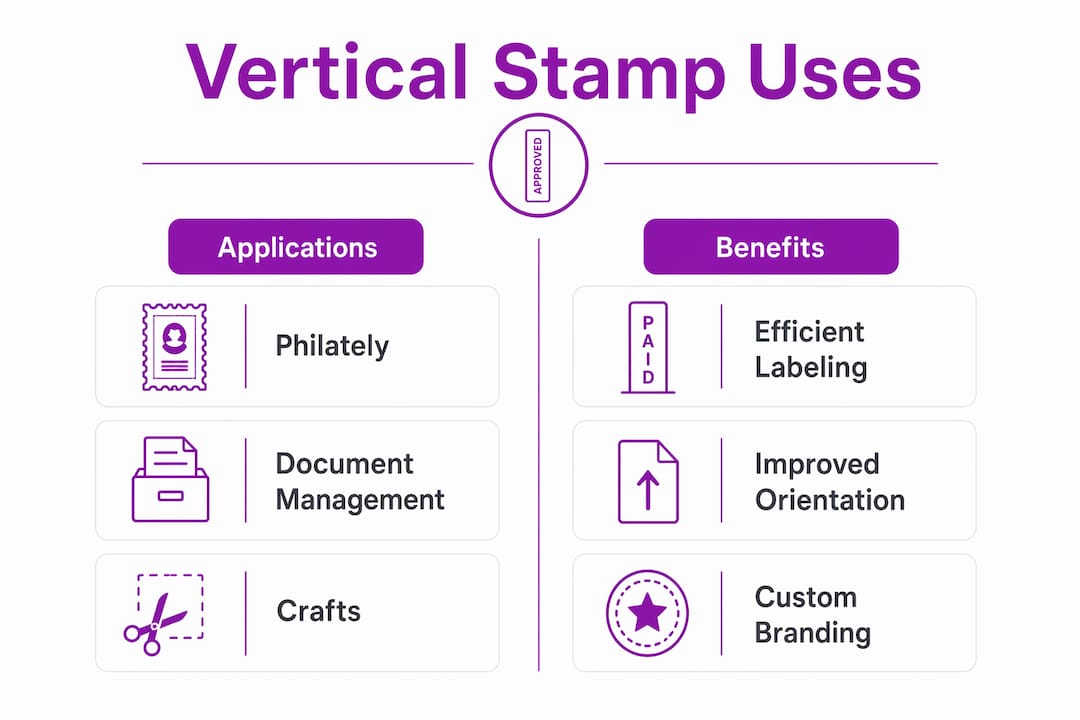
What roles do vertical stamps play in document management?
Physical vertical stamps in offices serve a clear function: they mark a document’s status in a format that is immediately legible. Common examples include “Approved,” “Received,” “Confidential,” and “Certified Copy” stamps. The vertical orientation of the text within the stamp die determines how the mark reads on the page, and a well-designed stamp places that text so it reads naturally without rotating the document.
Digital stamps in PDFs serve as authoritative graphical overlays indicating document status, distinct from watermarks. A watermark is typically semi-transparent and embedded in the background. A digital stamp sits on top of the content, clearly visible, and carries legal weight in many document workflows. The vertical alignment of a digital stamp refers to its position on the Y-axis of the page: top, centre, or bottom.
Vertical alignment parameters in PDF APIs control exactly where a text stamp sits relative to the page height. This is not a cosmetic choice. Placing a “Confidential” stamp at the top centre of a page ensures it is the first thing a reader sees. Placing it at the bottom risks it being missed on a printed copy.
The following steps describe a standard document stamping workflow for physical stamps:
- Position the document flat on a firm surface, aligned to a guide or jig if stamping multiple pages.
- Check the stamp face for even ink coverage before applying to the final document.
- Apply the stamp using the Rock and Press technique: place the stamp face down, apply firm downward pressure, and lift cleanly without sliding.
- Inspect the impression for completeness before moving to the next page.
- Store the stamp face down or capped to prevent ink drying on the die.
Pro Tip: Use an L-shaped jig to hold documents in a fixed position. This produces consistent vertical stamp placement across a batch of pages without measuring each one individually.
How are vertical stamps used in crafts and specialised industries?
Vertical stamps in leathercraft are tools with a working face oriented in portrait format, designed to press a specific pattern into the leather surface. The vertical thumbprint stamp creates a distinct texture that differs from the impression left by a horizontal tool of the same design. The orientation changes the direction of the pattern repeat and the visual rhythm it produces across a panel of leather.

This is not purely aesthetic. In leatherwork, the direction of a stamp impression affects how the leather fibres compress. A vertical tool applied along the length of a strap produces a different structural result than the same tool applied across the width. Experienced artisans choose orientation deliberately based on the finished piece’s intended use and appearance.
Vertical orientation in craft stamps facilitates unique texturing in materials such as leather, clay, and wax. The same principle applies in rubber stamp craft, where a tall, narrow stamp die produces a column of pattern rather than a row. This makes vertical stamps particularly useful for borders, bookmarks, and card designs where the composition runs top to bottom.
Key benefits of vertical stamps in craft applications:
- Pattern direction control: Vertical tools create column-based repeats rather than row-based ones.
- Structural impact: In leather, vertical compression follows the grain differently from horizontal pressure.
- Composition fit: Portrait-format designs suit tall surfaces such as bookmarks, tags, and card panels.
- Branding stamps: A business logo in vertical format fits neatly on packaging tape, hang tags, and narrow labels.
Pro Tip: When stamping leather, dampen the surface slightly with a sponge before applying a vertical tool. Damp leather takes impressions more cleanly and holds the pattern more permanently than dry leather.
What are the best practices for using vertical stamps effectively?
The single most important technique for physical vertical stamps is the Rock and Press method. Place the stamp face down on the surface, apply firm downward pressure distributed evenly across the handle, and lift straight up. Any lateral movement during pressing will smear the impression. This applies equally to rubber stamps on paper and metal tools on leather.
Self-inking stamps include alignment windows as engineering features, not decorative ones. These small transparent panels let you see exactly where the stamp face will land before you press. For vertical stamps used on pre-printed forms, this precision prevents the impression from overlapping printed lines or fields. Professionals use alignment windows to achieve sub-millimetre accuracy across large batches.
Consistency is the practical goal. A vertical stamp used for business purposes, such as a custom address stamp or an approval mark, must produce the same impression every time. Variation in placement or pressure undermines the stamp’s authority and creates problems in document filing systems that rely on consistent mark positions.
Common mistakes to avoid:
- Rolling the stamp: Any rocking motion beyond a controlled press creates a double impression.
- Under-inking: A dry stamp face produces a faint, incomplete mark that may not be legible.
- Over-inking: Excess ink bleeds beyond the die edges, making fine text unreadable.
- Stamping on uneven surfaces: Always use a firm, flat backing to prevent partial impressions.
- Ignoring drying time: Allow ink to dry fully before stacking documents to prevent transfer.
Key takeaways
Vertical stamps are defined by orientation, not size, and that single characteristic determines their function across philately, document management, and craft applications.
| Point | Details |
|---|---|
| Vertical stamp definition | The design’s long axis runs top to bottom, distinguishing it from horizontal formats. |
| Philately identification | Perforations on left and right edges confirm vertical coil orientation for collectors. |
| Document management use | Vertical alignment in digital stamps controls Y-axis placement for legal and formal documents. |
| Craft applications | Vertical tool orientation changes pattern direction and material compression in leatherwork. |
| Best practice technique | The Rock and Press method prevents smudging by eliminating lateral movement during stamping. |
Why vertical orientation matters more than most people realise
Working across stamp applications for years, I have noticed that most buyers focus on size and ink colour when choosing a stamp. Orientation gets treated as an afterthought. That is a mistake, and it shows up quickly in practice.
A business using a logo stamp in landscape format on a portrait-oriented label will always look slightly off. The proportions fight each other. Switch to a vertical format and the same logo sits naturally within the space, with room for contact details below it. The stamp does not just fit. It looks intentional.
The same logic applies in document workflows. A vertical “Approved” stamp placed in the top right corner of a page communicates authority immediately. A horizontal stamp in the same position looks like an afterthought. Orientation carries meaning beyond the words it contains.
My practical advice: before ordering any custom stamp, hold a printed version of the design against the surface you intend to stamp. Check whether the proportions read naturally in vertical or horizontal format. That five-second test saves a lot of wasted orders.
— Steven
Custom vertical stamps from Stampdesign4u
Stampdesign4u offers a wide selection of personalised rubber stamps in vertical formats, covering address stamps, logo stamps, and multi-line text dies for business and personal use.
The Trodat 4927 nine-line logo stamp at 60 x 40mm is a strong choice for businesses needing a vertical imprint that combines a logo with contact details. The 60mm height gives the design room to breathe, and the self-inking mechanism delivers consistent results across high-volume use. Stampdesign4u handles the design and production, so you receive a finished stamp ready to use. Browse the full range at stampdesign4u.co.uk to find the format that fits your workflow.
FAQ
What is the vertical stamp definition in simple terms?
A vertical stamp is any stamp where the design or imprint runs taller than it is wide, with the long axis oriented top to bottom. This applies to postage stamps, rubber office stamps, and digital PDF overlays.
How do I identify a vertical coil stamp in a collection?
Check the perforations. A vertical coil stamp has perforations on the left and right edges only, with the design reading from top to bottom along the roll’s feed direction.
What are the main vertical stamp uses in an office?
Vertical stamps mark document status with labels such as “Approved,” “Received,” or “Confidential.” They are used on contracts, invoices, and correspondence to indicate authorisation or processing stage.
How do I get a clean impression from a vertical rubber stamp?
Use the Rock and Press technique: place the stamp face down, apply firm downward pressure evenly across the handle, and lift straight up without any sideways movement. This prevents smudging and produces a complete impression.
Can vertical stamps be customised for a business logo?
Yes. Custom vertical stamps can incorporate a logo, business name, address, and contact details within a portrait-format die. Stampdesign4u produces custom logo stamps in vertical layouts suited to packaging, correspondence, and branding applications.