

TL;DR:
- Heavy-duty stamps are engineered for high-volume use, featuring reinforced steel frames and high-capacity ink systems.
- They are ideal for industrial, logistics, legal, and office environments requiring thousands of clear impressions without degradation.
A heavy-duty stamp is a stamping tool engineered for high-volume, repeated use in demanding environments, delivering sharp, clear impressions consistently across thousands of applications. The term “heavy-duty” is not a brand designation. It describes a functional specification: a stamp built to handle the throughput and clarity needs of busy offices, warehouses, and industrial settings without degrading in quality or structure. Brands such as Shiny and Trodat manufacture products explicitly to this standard, using reinforced frames, high-capacity ink systems, and hardened components. Understanding what separates these tools from standard stamps helps you choose the right one and avoid costly replacements.
What features distinguish heavy-duty stamps from standard stamps?
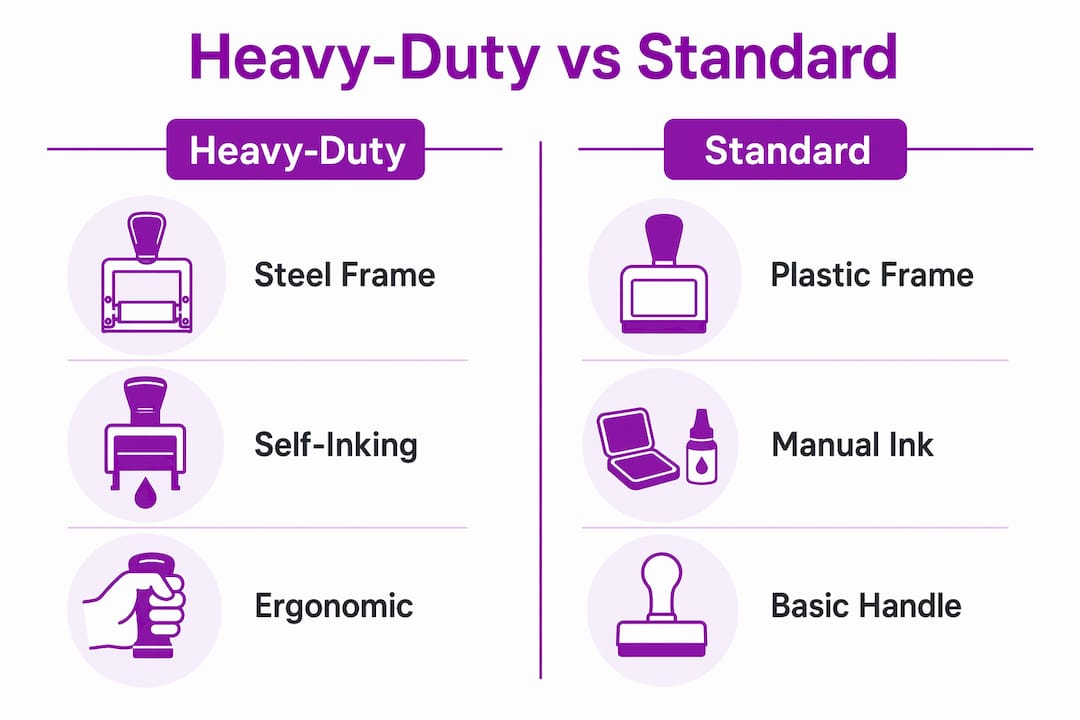
The most significant difference between a heavy-duty stamp and a standard one is construction. Reinforced metal or steel frames are tested for over 100,000 impressions, compared to plastic-framed consumer stamps that typically degrade after a fraction of that figure. This matters in any setting where a stamp is used dozens or hundreds of times per day.

| Feature | Heavy-duty stamp | Standard stamp |
|---|---|---|
| Frame material | Steel or reinforced metal | Plastic |
| Impression lifespan | 100,000+ impressions | 5,000–20,000 impressions |
| Ink system | High-capacity, self-inking or pre-inked | Basic pad or pre-inked |
| Ergonomics | Contoured grip, reduced fatigue | Minimal handle design |
| Typical use | Industrial, logistics, legal, office | Occasional personal use |
Self-inking mechanisms are standard on most heavy-duty office stamps. The ink pad re-inks the die automatically after each impression, which removes the need for a separate pad and keeps the workflow moving without interruption. High-capacity ink reservoirs extend the time between refills, which reduces downtime on busy production lines or in high-volume document processing.
Industrial variants take construction further. Steel hand stamps from manufacturers such as C.H. Hanson feature tempered shanks and crowned striking surfaces that direct the full force of a hammer blow to the centre of the impression. This engineering preserves clarity even when marking hard surfaces such as metal, leather, or wood. The crowned surface is a specific design choice, not a cosmetic one. It compensates for uneven striking angles and maintains consistent depth across the impression.
Ergonomic handles are another distinguishing feature. In a warehouse or fulfilment centre where staff may stamp hundreds of parcels per shift, grip design directly affects fatigue and accuracy. Heavy-duty stamps from Trodat and Shiny are designed with this in mind, using contoured grips and balanced weight distribution.
Pro Tip: When comparing stamps by impression count, check whether the figure refers to the frame lifespan or the ink pad lifespan. These are different numbers, and confusing them leads to underestimating maintenance frequency.
What types of heavy-duty stamps are available?
Heavy-duty stamps come in several types, each suited to a different workflow. Knowing the distinctions prevents you from buying a stamp optimised for fine logo reproduction when you actually need rapid date-marking on incoming stock.
Self-inking stamps are the most common type in office and logistics environments. The built-in ink pad re-inks automatically after each impression, making them ideal for repetitive, high-speed stamping. They suit text-heavy designs such as “RECEIVED,” “APPROVED,” or “CONFIDENTIAL” where speed matters more than fine detail.
Pre-inked stamps use a different mechanism. Ink is stored within the die itself and released gradually with each impression. This produces finer line detail, making pre-inked stamps the better choice for logos, signatures, or designs with thin strokes. The trade-off is stamping speed. Pre-inked stamps are slower to use in rapid succession and require more care during re-inking.
Date and numbering stamps are a specialised category within the heavy-duty range. A self-inking heavy-duty dater can deliver up to 5,000 crisp impressions before needing re-inking, with smooth date-adjustment mechanisms that allow quick changes between days. Numbering stamps work similarly, advancing automatically with each impression to produce sequential records on invoices, parcels, or legal documents.
Industrial steel hand stamps are a separate category entirely. These are not office tools. They are hammer-struck devices used to mark permanent impressions on metal components, timber, or leather goods. C.H. Hanson and similar manufacturers produce sets with individual letter and number dies, each with a crowned striking surface for consistent depth under impact.
| Type | Best use | Impression detail | Speed |
|---|---|---|---|
| Self-inking | High-volume office, logistics | Good for text | Fast |
| Pre-inked | Logos, fine detail | Excellent | Moderate |
| Date/numbering | Document tracking, invoicing | Good for text/numbers | Fast |
| Steel hand stamp | Industrial marking on hard surfaces | Permanent, deep | Slow (hammer-struck) |
For businesses selecting between self-inking and pre-inked, the guidance from stamp type comparisons is consistent: self-inking for volume, pre-inked for detail.
How to choose the best heavy-duty stamp for your needs
Selecting the right stamp comes down to four practical questions. Answer these before looking at any product listing.
-
What is your daily stamping volume? A team processing 50 documents per day has different requirements from a warehouse stamping 500 parcels per shift. For high-volume use, a self-inking stamp with a large ink reservoir is the practical choice. For occasional but precise use, pre-inked is more appropriate.
-
What level of impression detail do you need? Text-only designs such as dates, reference numbers, or status labels work well with self-inking mechanisms. Logos, signatures, or designs with fine lines require a pre-inked stamp to reproduce accurately.
-
What surface are you stamping on? Paper and card are compatible with all types. Packaging materials, textiles, or hard surfaces such as metal require specific ink formulations and, in some cases, industrial steel stamps rather than rubber-die tools.
-
What is your maintenance capacity? The practical limit of a heavy-duty dater or numberer is often ink capacity rather than frame durability. Forecast your daily impression count, calculate how often you will need to re-ink, and check whether replacement ink or pads are readily available for the model you choose. Selecting a stamp with a proprietary ink system that is difficult to source locally creates unnecessary operational risk.
Budget is a secondary consideration, not the primary one. A cheaper stamp that requires replacement after three months costs more over a year than a Trodat or Shiny model with a steel frame and a two-year service life. For guidance on durable stamp materials, the construction differences between metal and plastic frames are worth reviewing before committing to a purchase.
Pro Tip: Order a test impression before committing to a large batch of custom stamps. Most reputable suppliers, including Stampdesign4u, can provide a proof so you can verify impression quality before the stamp goes into daily use.
What are the common uses and benefits of heavy-duty stamps in business?
Heavy-duty stamps serve a direct operational function across multiple industries. The benefits are measurable: fewer errors, faster processing, and lower replacement costs compared to standard consumer stamps.
Common applications include:
- Logistics and shipping: Date-stamping incoming and outgoing parcels, marking packages with handling instructions such as “FRAGILE” or “THIS WAY UP,” and applying return address details at volume.
- Quality control: Marking inspected components or batches with approval or rejection status in manufacturing and food production environments.
- Legal and compliance: Stamping documents with “RECEIVED,” “CERTIFIED,” or “VOID” in legal offices, accountancy practices, and government departments where audit trails are required.
- Inventory management: Numbering stock items sequentially, marking storage locations, and date-coding perishable goods in warehouses and retail stockrooms.
- Craft and design: Pre-inked heavy-duty stamps are used in bookbinding, printmaking, and paper crafts where repeated fine-detail impressions are needed. Craft suppliers such as Craftsuprint stock compatible ink refills and accessories for these applications.
The efficiency gains are straightforward. A staff member stamping 200 documents per day with a reliable self-inking stamp completes the task in a fraction of the time it would take to write or print the same information manually. Consistency also improves. Every impression from a well-maintained heavy-duty stamp looks identical, which matters for professional correspondence, compliance records, and branded materials.
Key takeaways
Heavy-duty stamps are defined by construction and capacity, not by marketing language. The right choice depends on volume, surface, and impression detail requirements.
| Point | Details |
|---|---|
| Definition and standard | Heavy-duty stamps are built for 100,000+ impressions using steel frames and high-capacity ink systems. |
| Self-inking vs pre-inked | Self-inking suits high-volume text stamping; pre-inked delivers finer detail for logos and signatures. |
| Industrial variants | Steel hand stamps with tempered shanks are for permanent marking on metal, wood, and leather. |
| Maintenance bottleneck | Ink capacity limits output before frame durability does; plan re-inking cycles based on daily volume. |
| Selection criteria | Match stamp type to volume, surface material, impression detail, and ink availability. |
Why stamp selection deserves more thought than most businesses give it
Most businesses treat stamp purchasing as an afterthought. They order the cheapest option, it degrades within months, and they repeat the cycle. I have seen this pattern repeatedly, and the cost is not just financial. A stamp that produces inconsistent impressions on legal documents or compliance records creates real operational problems, not just aesthetic ones.
The distinction between self-inking and pre-inked is where most selection errors happen. Teams reach for self-inking because it is faster, then complain that their logo looks blurred on correspondence. The mechanism is not at fault. The choice of mechanism for the wrong application is. Pre-inked stamps exist precisely because fine-line reproduction requires a different ink delivery system.
The other mistake I see regularly is ignoring ink sourcing before purchase. A Trodat or Shiny stamp with a steel frame will outlast most businesses’ expectations, but only if you can source the correct replacement ink pads. Some models use proprietary cartridges that are straightforward to order. Others use generic pads that are available from any office supplier. Knowing which category your stamp falls into before you buy it saves a significant amount of frustration later.
One more point worth making: heavy-duty does not mean indestructible. Dropping a self-inking stamp repeatedly on a hard floor will eventually damage the alignment mechanism, regardless of frame material. Treat the stamp as a precision tool, store it cap-down to prevent ink drying, and it will perform to specification for years.
— Steven
Get a heavy-duty stamp built for your business from Stampdesign4u
Stampdesign4u stocks a range of durable, professional stamps suited to high-volume business use. The Trodat Printy 4927 is a nine-line logo and text rubber stamp measuring 60 x 40mm, built on Trodat’s steel-reinforced frame and designed for repeated daily use in office and commercial environments. It accepts custom text and logo designs, making it practical for branding, compliance marking, and document processing. Stampdesign4u also offers personalised stamp design across a wide range of formats, with ordering available to customers across the UK and internationally. Browse the full collection to find the right stamp for your volume and impression requirements.
FAQ
What is a heavy-duty stamp used for?
A heavy-duty stamp is used for high-volume marking tasks in offices, warehouses, logistics operations, and industrial settings. Common applications include date-stamping documents, marking parcels, quality control approvals, and sequential numbering of invoices or stock items.
How many impressions can a heavy-duty stamp produce?
Steel-framed heavy-duty stamps are tested for over 100,000 impressions. Self-inking dater models typically deliver up to 5,000 impressions per ink refill before re-inking is required.
What is the difference between self-inking and pre-inked heavy-duty stamps?
Self-inking stamps re-ink automatically after each impression and are best for fast, repetitive text stamping. Pre-inked stamps store ink within the die and produce finer line detail, making them better suited to logos and signatures but at a slower stamping pace.
Can heavy-duty stamps mark surfaces other than paper?
Yes. Industrial steel hand stamps are designed for hammer-struck marking on metal, wood, leather, and similar hard surfaces. Standard self-inking or pre-inked heavy-duty stamps are optimised for paper, card, and packaging materials.
Where can you buy heavy-duty stamps in the UK?
Heavy-duty stamps are available from specialist online suppliers such as Stampdesign4u, which offers custom-designed options including the Trodat Printy 4927 for business and commercial use. Most models can be ordered with bespoke text or logo designs to suit specific operational requirements.