

TL;DR:
- A dater stamp is a mechanical or self-inking device that physically presses a visible date onto documents, creating a permanent record. It differs from digital timestamps by providing immediate, tactile proof of when a document was processed, which is often required for legal and compliance reasons. Using dater stamps enhances organizational consistency, brand visibility, and safeguards against record disputes across various business operations.
Many people assume a dater stamp is just a digital timestamp in physical form. It is not. A dater stamp is a dedicated office tool that prints a date directly onto a document, creating an immediate, visible, physical record. Confusing the two matters because compliance, legal admissibility and workflow efficiency can all hinge on the difference. Whether you run a small retail shop, manage incoming contracts at home, or need to track food safety logs, understanding exactly what a dater stamp does and how it works will save you time and help you avoid costly administrative errors.
Table of Contents
- What is a dater stamp?
- Key types of dater stamps and their functions
- Dater stamps versus digital methods: When is the stamp better?
- Practical benefits of dater stamps for business and personal use
- Choosing the right dater stamp: Features to consider
- A fresh perspective: Why dater stamps are overlooked but indispensable
- Find your ideal dater stamp with Stamp Design 4U
- Frequently asked questions
Key Takeaways
| Point | Details |
|---|---|
| Clear definition | A dater stamp physically marks a date on documents for reliable tracking and compliance. |
| Practical advantages | Stamps offer instant, auditable proof on paper, beating digital systems for many real-world needs. |
| Customisation options | Dater stamps can be tailored for branding with unique text, logos or designs. |
| Right tool selection | Choosing a dater stamp involves considering use case, surface, and required custom features. |
What is a dater stamp?
A dater stamp is a mechanical or self-inking device used to mark the current date, and sometimes a short action word such as “RECEIVED” or “PAID”, onto paper documents. It remains one of the most reliable tools in office administration and records management.
A dater stamp imprints the receipt date and time on a document, which is vital for tracking when something was received or processed, and can include user identification for added traceability.
This is very different from a digital timestamp. Digital timestamps are generated automatically by software systems and refer to a machine-readable record of the precise moment an event occurred. A dater stamp, by contrast, is a human-operated, office-based practice. You physically press the stamp to a document. The mark is visible, tactile and permanent.
Understanding this distinction is the first step. Our expert guide to date stamps goes further into their history and application across different industries.
A standard dater stamp consists of several components:
- Date bands: Rotating wheels or bands that you adjust to show the correct day, month and year. Some models include the time.
- Ink pad or ink reservoir: Either a built-in self-inking mechanism or a separate ink pad the stamp is pressed onto before use.
- Handle or body: The casing that holds the mechanism, usually made from plastic or metal for durability.
- Optional text: Pre-set text such as “RECEIVED”, “APPROVED” or “INSPECTED” printed alongside the date.
Typical uses include marking incoming invoices with the receipt date, logging the date a contract was signed, time-stamping correspondence in a busy office, and recording when stock arrived in a stockroom or warehouse.
Key types of dater stamps and their functions
After clarifying what dater stamps are, it is useful to explore the main types available and how each serves a different workflow.
Date stamps are widely used in business offices for efficiently marking receipt or action dates on paper documents. The right type depends on your volume of use, your preferred date format and whether you need additional text or branding.
| Type | Key features | Best for |
|---|---|---|
| Self-inking dater | Built-in ink pad, re-inks automatically | High-volume office use |
| Manual/traditional dater | Requires separate ink pad | Low-volume or occasional use |
| Dater with text band | Includes action words (RECEIVED, PAID, etc.) | Receipts, invoices, filing |
| Custom dater stamp | Includes logo, brand name or custom text | Branded business documents |
| Date-only stamp | Prints date with no additional text | Minimalist filing systems |
Self-inking daters are the most popular choice for busy offices. They can produce thousands of clean impressions before needing a re-ink, making them cost-effective and quick. Manual daters are more affordable upfront but require more effort per use.
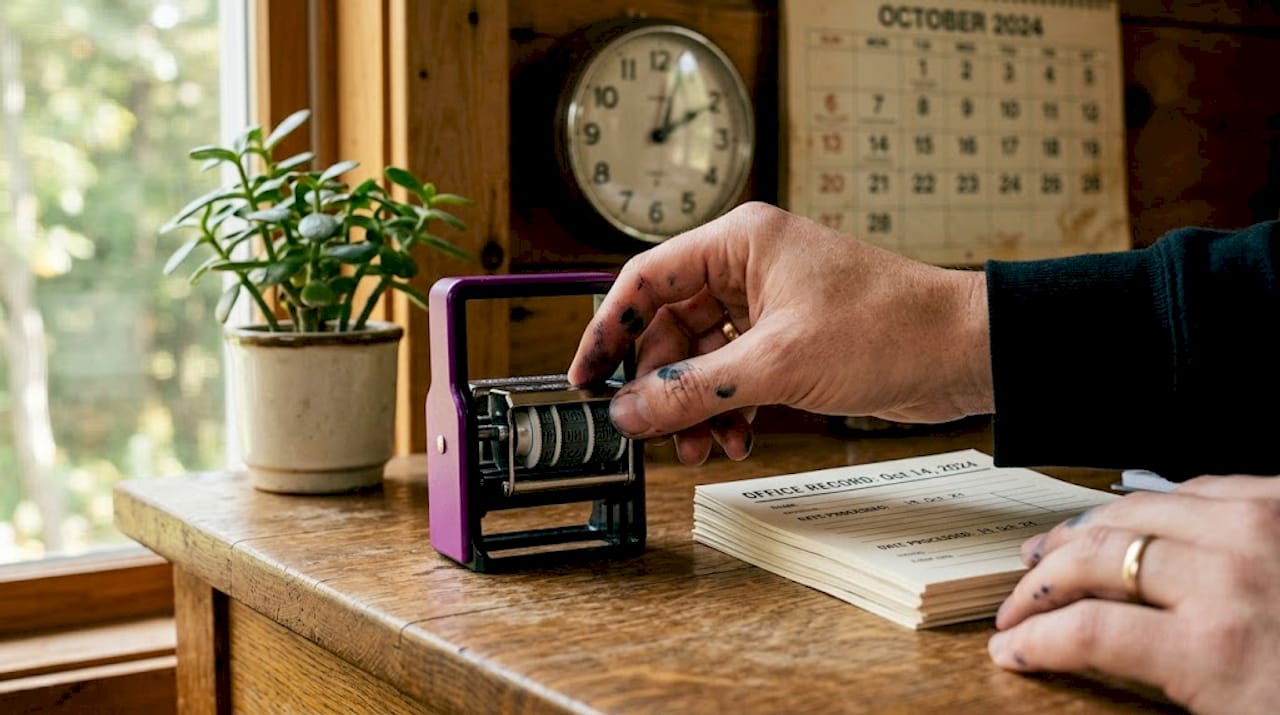
Explore the full range of types of business stamps to see which category fits your operation best. If you want something that reflects your brand, a personalised date stamp lets you include a business name, logo or custom wording.
Custom dater stamps are particularly popular with small businesses that want their paperwork to look professional. Instead of a generic “RECEIVED” mark, your stamp can read “Received by [Business Name]” with your logo alongside the date. This is a subtle but powerful branding touch, and you can read more about the date stamp’s role in UK branding to see why this matters.
Businesses looking for complementary visual identity tools can also look at custom signage solutions to reinforce their brand across physical touchpoints.
Pro Tip: If you stamp documents every day, invest in a self-inking model with adjustable date bands that click firmly into place. Loose bands lead to unclear impressions, which can cause real problems when dates are queried later.
Dater stamps versus digital methods: When is the stamp better?
Understanding the types leads naturally to comparing dater stamps to modern digital alternatives and identifying situations where a physical stamp makes all the difference.
Date stamps are associated with physical office practices of marking receipt or transaction dates, whereas digital timestamps track time within software systems. Both have genuine uses. The question is which method is appropriate for your specific context.
Here is a direct comparison of the two approaches:
| Factor | Dater stamp | Digital timestamp |
|---|---|---|
| Visibility | Immediately visible on document | Requires software access |
| Legal acceptance | Widely accepted for physical records | Accepted for digital records |
| Audit trail | Permanent, physical mark | Logged in software database |
| Cost | Low one-off cost | Ongoing software subscription |
| Failure risk | Ink can run dry; bands can stick | System errors, software failure |
| Training needed | Minimal | Variable depending on platform |
There are situations where a physical stamp is clearly the better option:
- Legal documents and contracts: Courts and solicitors frequently require physical evidence of when a document was received. A dater stamp provides this instantly.
- Invoices and payment records: Stamping an invoice with the receipt date protects both parties in a payment dispute. It creates a clear starting point for payment terms.
- Food safety and hygiene logs: Food businesses must record preparation and use-by dates on physical labels and documents. A date marking stamp for food safety is a practical, compliant solution.
- Libraries and public records: Physical loan and return stamps remain standard in many libraries and archives.
- Postal and delivery handling: Marking the date a parcel or letter was received provides evidence for disputes over delivery timescales.
Digital systems fail silently. A software glitch might cause a timestamp to not record, or a system update might alter how records are stored. A dater stamp leaves a mark that cannot be accidentally overwritten.
Key fact: Small businesses that handle physical documents as part of their compliance obligations cannot simply replace physical date marking with software alone. Many regulatory frameworks still require physical records.
Practical benefits of dater stamps for business and personal use
With the comparison in mind, it is clear why dater stamps still offer unique benefits. Here is how using them can streamline your admin and support your business image.
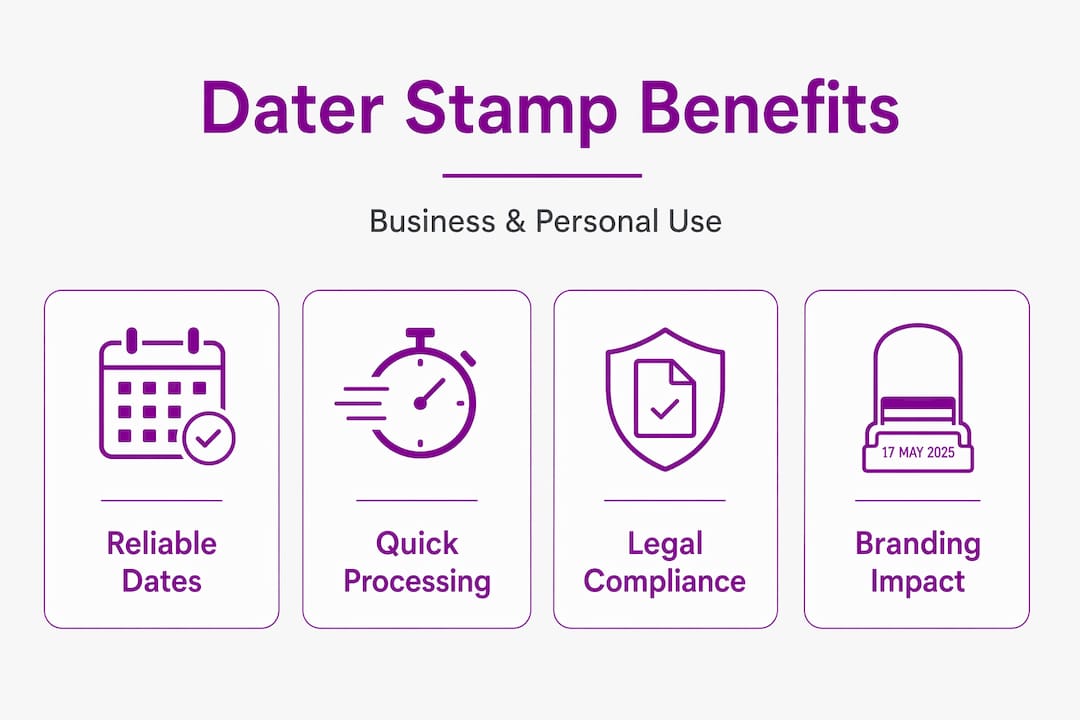
Dater stamps are essential for documenting when paperwork was handled, creating an auditable physical record that can be referenced in disputes, audits or compliance checks.
The practical advantages break down into several categories:
- Dispute prevention: When a supplier claims you never received their invoice, or a client argues you missed a deadline, the date on the document speaks for itself. There is no ambiguity.
- Time saving: A self-inking dater marks a document in under a second. Over a week of processing dozens of documents, this adds up to a meaningful saving in time and effort.
- Workflow consistency: Everyone on your team uses the same stamp in the same way. There is no variation in how dates are recorded, which matters when you are sorting through a backlog of paperwork.
- Brand reinforcement: A custom dater stamp with your business name or logo on every outgoing document subtly reinforces your brand. Every invoice, order confirmation or letter becomes a small advertisement.
- Personal and home use: Dater stamps are not just for offices. Home administrators, event organisers and hobbyists use them to date correspondence, organise archives and label craft projects.
- Cost-effectiveness: A quality dater stamp costs far less than even a basic software subscription, and it does not require internet access, updates or technical support.
For guidance on selecting the right tool for your documents, the resource on choosing the best document stamp offers a clear breakdown of what suits different document types.
Retail businesses, particularly those managing returns, stock arrivals and point-of-sale paperwork, can also look at point of sale systems and retail stamps as part of a broader physical records strategy.
Pro Tip: Use a two-colour ink pad on your custom dater stamp. The date in blue and your business name in red, for example, makes your stamped documents easy to scan at a glance during filing or audits.
Choosing the right dater stamp: Features to consider
Now that you understand the key benefits, making the right choice means paying attention to design details and practical features.
The format and custom features of a date stamp determine its effectiveness in a workplace. A stamp that looks good but fails after three months of daily use is a poor investment.
Start by asking yourself these questions:
- How many documents will you stamp per day? High volume requires a self-inking model.
- What date format do you need? Day/Month/Year is standard in the UK, but some international businesses require Month/Day/Year.
- Do you need additional text, such as “RECEIVED”, “APPROVED” or your business name?
- Will you stamp on standard paper or occasionally on cards, labels or textured surfaces?
- How important is brand consistency? If your documents go to clients, a custom stamp matters.
Feature checklist when buying a dater stamp:
- Clearly adjustable date bands with tactile, firm clicking
- Durable casing that resists cracking or warping with heavy use
- Re-inkable with standard ink to reduce running costs
- Customisation options for text and logos
- Clear impression quality with consistent ink spread
- Compact enough to store easily on a desk or in a drawer
Pitfalls to avoid:
- Ink bleed: Cheap stamps can over-ink, resulting in smudged, illegible dates. Test on a spare sheet before using on important documents.
- Flimsily built date bands: Bands that slip out of alignment mid-use produce unclear dates that undermine the whole purpose of using a stamp.
- Strong chemical odour: Some low-quality inks have a heavy solvent smell. Look for water-based inks if the stamp will be used in a small enclosed space.
- Non-standard ink colours: Black or blue inks scan and photocopy clearly. Novelty colours may look appealing but can cause problems when documents are digitised.
Buying from a specialist provider rather than a generic stationery supplier means you get access to customisation options, quality materials and proper guidance. The types of business stamps guide is a helpful reference for comparing models. If your business has a shopfront or signage, coordinating your stamp with your visual identity is easier than you might think, and resources on designing your shop sign offer useful principles that apply equally to stamp design.
A fresh perspective: Why dater stamps are overlooked but indispensable
It is tempting to dismiss a dater stamp as old-fashioned. Software does so much now. But this view misses something important about how trust actually works in business.
When you receive a document stamped with a clear date and business name, you immediately have information you can rely on. There is no login required, no system to query, no uncertainty about whether the record was saved correctly. The date is right there, permanent, on the paper in front of you.
Small businesses often invest heavily in digital tools while overlooking the impression that physical documents make. A neatly stamped invoice or delivery note signals organisation and professionalism. It tells your clients and suppliers that your admin process is reliable. That matters, especially when you are building a client base and every interaction counts.
There is also a compliance dimension that too many small business owners discover too late. When a dispute arises over an invoice, a delivery or a contract, physical evidence carries significant weight. A digital record buried in a software platform can be questioned, altered or simply difficult to produce quickly. A stamped document is immediate, legible and hard to dispute.
The date stamp’s role in business branding is genuinely underappreciated. Even technology-forward workplaces keep dater stamps on hand because there are always situations where physical proof is simply the clearest answer. The businesses that understand this are the ones that never get caught out in a dispute or audit.
Dater stamps create trust. They are a small tool with a large impact on how your operation is perceived, both internally and externally.
Find your ideal dater stamp with Stamp Design 4U
If you are ready to put the right dater stamp to work in your business, Stamp Design 4U offers a wide selection of options designed for exactly this purpose.
Whether you need a straightforward self-inking model for daily document processing or a fully branded stamp that incorporates your logo and custom text, the range covers individual, retail, and business needs. The logo and text dater stamps are ideal for businesses that want professional-looking marked documents. For a more compact branding option, the custom logo rubber stamps deliver clean, consistent impressions on everyday paperwork. Ordering is straightforward, with support available for custom design uploads and workflow-specific requirements.
Frequently asked questions
How does a dater stamp differ from a timestamp?
A dater stamp marks the date physically on a document, while a timestamp records digitally within software or online platforms, typically without any physical output.
Can dater stamps be customised for branding?
Yes, dater stamps can be ordered with custom text, logos, business names and preferred date formats, making them a practical and professional branding tool.
Are dater stamps still relevant for paperless offices?
Yes. Many legal, compliance and audit requirements still call for physical date marking on documents, since physical records document when paperwork was handled in a way that digital systems cannot always replicate.
What surfaces can you use a dater stamp on?
Most dater stamps work well on standard paper and card. Results may vary on glossy, textured or very thin materials, so test on a sample before stamping important documents.