

TL;DR:
- Date marking stamps are essential tools for food safety compliance and inventory management.
- Regulations require marking ready-to-eat foods with accurate dates within specific timeframes.
- Correctly choosing and applying stamps helps prevent food waste, recalls, and regulatory issues.
Most people assume date marking is simply about scribbling a date on a container. It is far more than that. Date marking stamps are a frontline compliance tool, directly tied to food safety law, stock management, and customer protection. Used incorrectly, or not at all, they can expose your business to serious regulatory risk. This guide covers what date marking stamps are, why they matter legally, how to choose the right one for your operation, and how to handle the tricky edge cases that catch businesses off guard. Whether you run a deli counter, a food production site, or a small retail unit, this is information you need.
Table of Contents
- Understanding date marking stamps
- Compliance and safety: Why date marking matters
- Choosing the right date marking stamp for your business
- Edge cases and advanced date marking scenarios
- A fresh perspective: What most businesses miss about date marking
- Get compliant and efficient with the right stamp solution
- Frequently asked questions
Key Takeaways
| Point | Details |
|---|---|
| Core compliance tool | A date marking stamp is essential for legal compliance and food safety when handling perishable goods. |
| Regulations drive action | Proper date marking prevents health risks and hefty penalties for businesses. |
| Stamp choice matters | The right date marking stamp streamlines operations and helps staff avoid costly mistakes. |
| Edge cases need care | Complex scenarios require special attention to combine or freeze products correctly. |
Understanding date marking stamps
A date marking stamp is a physical tool used to imprint a specific date onto product packaging, containers, or labels. The date identifies when a product was prepared, when it should be used by, or when it must be discarded. This is not a bureaucratic formality. It is a practical safety mechanism that sits at the heart of time-sensitive product management.
The role of date stamps in UK business extends well beyond food retail. Pharmacies, archives, legal offices, and logistics operations all use them. But food handling remains the area of highest stakes, because incorrect or absent date marking directly affects public health.
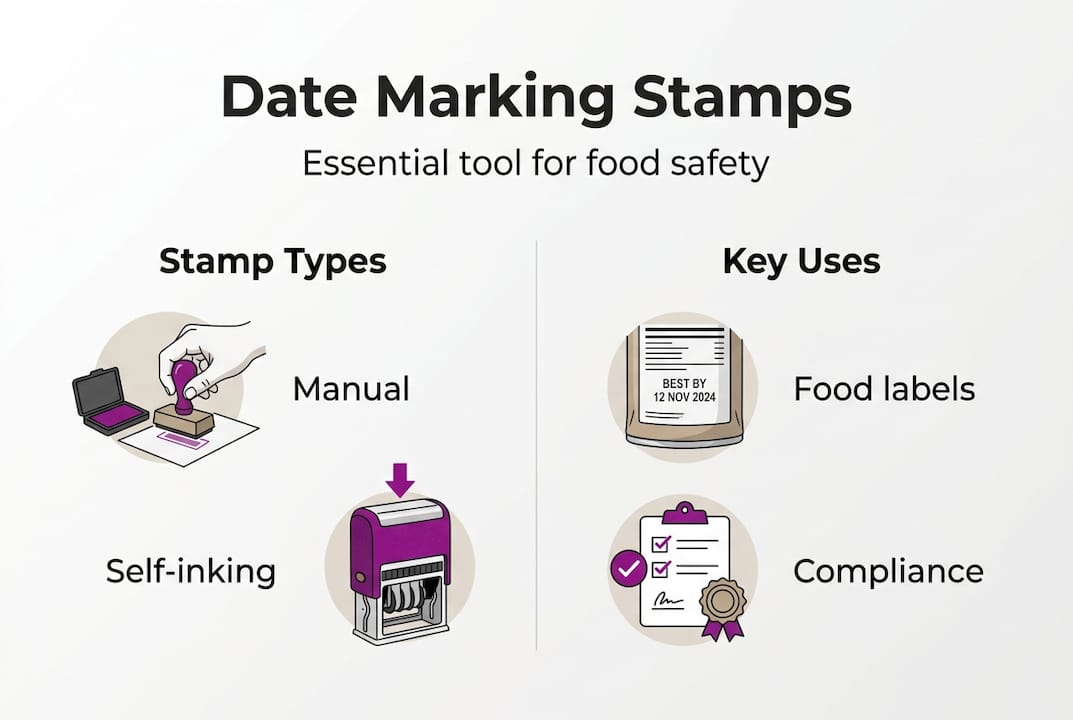
Date marking is central to controlling the growth of Listeria in retail food safety, specifically for refrigerated, ready-to-eat foods classified as time and temperature controlled for safety, commonly referred to as TCS foods. These include deli meats, prepared salads, cooked proteins, and soft cheeses. Without a visible date mark, staff have no reliable way to determine whether a product is safe to serve.
Common ways businesses use date marking stamps include:
- Marking preparation or cook dates on batch-produced foods
- Recording open dates on multi-use ingredients
- Flagging discard dates on perishable items in display cases
- Tracking stock rotation in walk-in refrigerators
- Documenting receipt dates on delivered goods
- Supporting traceability during product recalls
The stamp itself can take several forms: a simple manual band dater, a self-inking roller stamp, or a fully customised stamp with your business name and date field combined. Each has a different place in different operations.
Pro Tip: Check whether your regulatory environment requires a preparation date, a use-by date, or a discard date. Some food safety frameworks accept any of these, but your staff must apply whichever system you choose consistently across every product.
Compliance and safety: Why date marking matters
Date marking is not optional for most food businesses. Regulations in many countries, including the UK and the United States, mandate date marking for refrigerated, ready-to-eat TCS foods. The consequences of non-compliance range from formal warnings to business closure.
The core rule in most frameworks is clear: retail food establishments must consume, sell, or discard refrigerated, ready-to-eat TCS foods within seven days of preparation or opening. Either the start date or the end date must be marked. This seven-day window is not arbitrary. It reflects the rate at which harmful bacteria, including Listeria monocytogenes, can multiply to dangerous levels in refrigerated conditions.
“Retail food establishments must consume, sell, or discard ready-to-eat TCS foods within seven days, marking either the start or end date on the container.” (Wisconsin DATCP Date Marking Fact Sheet)
For businesses mixing ingredients with different preparation dates, the rule is straightforward: the date mark must reflect whichever ingredient was processed earliest. Review the expert guide to date stamps for a detailed breakdown of how this applies across different product types.
| Food type | Date mark required | Maximum refrigerated shelf life |
|---|---|---|
| Deli meats (opened) | Yes | 7 days from opening |
| Prepared salads | Yes | 7 days from preparation |
| Cooked proteins | Yes | 7 days from cooking |
| Soft cheeses (opened) | Yes | 7 days from opening |
| Frozen ready-to-eat | No (while frozen) | Clock starts on thawing |
Compliance steps for small food businesses:
- Identify every product in your operation that qualifies as a refrigerated, ready-to-eat TCS food.
- Decide whether you will mark preparation dates, discard dates, or both.
- Select a stamp tool appropriate for your environment (see next section).
- Train all staff on the system before they handle any time-sensitive products.
- Audit your date marking regularly, at minimum once per shift.
- Document your system in writing so inspectors can verify your process.
For businesses wanting to add branding or operational information alongside the date, a personalised date stamp can combine product identification with date fields in a single impression.
Choosing the right date marking stamp for your business
Understanding regulations is half the equation. Now, it is vital to choose the right tool to implement sound date marking practices.
The main stamp types available to food businesses are manual band daters, self-inking stamps, and customisable rubber stamps. Each suits a different scale of operation and level of complexity.

| Stamp type | Key features | Best for | Compliance fit | Cost consideration |
|---|---|---|---|---|
| Manual band dater | Adjustable date bands, no ink pad needed | Small kitchens, low volume | Good for basic requirements | Low upfront cost |
| Self-inking stamp | Built-in ink pad, consistent impression | Busy retail counters | Reliable and legible | Mid-range |
| Custom rubber stamp | Branded design, multiple fields | Multi-product operations | Highest flexibility | Higher initial investment |
Business scenarios and recommended stamp types:
- Single-location deli or café: A self-inking date stamp provides speed and legibility for high turnover environments.
- Catering operation with batch production: A customisable stamp with product name and date field reduces labelling time significantly.
- Retail food outlet with varied stock: A manual band dater offers flexibility when product categories change frequently.
- Multi-site food business: Standardised self-inking stamps across all sites keep compliance uniform.
For food environments specifically, containers can be marked with either a start and preparation date or a discard date, but whichever system is chosen must be clearly understood and followed by all employees. This is where the stamp type matters. A stamp that produces a faint or smeared impression creates ambiguity, and ambiguity is a compliance risk.
Pro Tip: In food environments, prioritise food-safe ink, legibility on plastic and foil surfaces, and stamp size relative to your container labels. The Trodat 4850 stock date stamp is a popular choice for exactly these reasons.
When selecting a tool, also think about who will be using it. If you have a high staff turnover or a multilingual team, a stamp with clear pre-printed fields reduces errors. For broader guidance on stamp selection, choosing the right rubber stamp for your business covers the practical factors in detail.
Edge cases and advanced date marking scenarios
Beyond the standard cases, real-world businesses face tricky scenarios that demand extra attention.
One of the most common points of confusion involves frozen products. Time only counts when a product is refrigerated, not frozen. If you prepare a batch of food, freeze it, and then thaw it for service, the seven-day clock begins from the point of thawing, not from the original preparation date. This distinction is critical. Businesses that mark only a preparation date without accounting for freezing periods can inadvertently serve products that are technically within a window but practically compromised.
For foods combined from different preparation batches, the date mark must reflect the earliest processed ingredient. If you add yesterday’s cooked chicken to today’s fresh salad, the whole dish takes yesterday’s date. Many businesses miss this rule entirely, which creates a gap between apparent compliance and actual food safety practice.
A notable proportion of food product recalls are linked to labelling and dating errors rather than contamination issues, underscoring that documentation failures carry real-world consequences. Reviewing expert advice on date stamps can help you close these gaps before an inspection does it for you.
Advanced scenarios that require careful planning:
- Multi-location operations: Inconsistent date marking systems across sites create audit vulnerabilities. Standardise stamps and procedures centrally.
- Seasonal or rotating menus: When product lines change frequently, ensure stamps can adapt without requiring new equipment each time.
- Cross-contamination of dates: If a container is refilled with fresh product without being re-marked, the old date still applies. Train staff never to assume.
- Thawing protocols: Always mark a secondary thaw date alongside the original preparation date to track the actual refrigerated window accurately.
- Outsourced preparation: If part of your product is prepared off-site, you are responsible for verifying and re-marking dates on receipt.
Checklist for avoiding common pitfalls:
- Confirm that all staff understand whether you mark start or discard dates
- Verify that ink is legible on every surface type used in your operation
- Never combine ingredients without checking and applying the earliest date
- Record thawing dates separately from preparation dates
- Conduct weekly audits of all date-marked items in cold storage
A fresh perspective: What most businesses miss about date marking
Most businesses treat date marking as a box to tick before an inspection. That mindset costs money. When you build a genuinely consistent date marking system, you reduce product waste, because staff can make informed rotation decisions rather than guessing. You also reduce training time, because a clear stamp system removes ambiguity from the process.
Businesses that invest in well-planned stamps report noticeably smoother audit outcomes. Inspectors are not just checking for dates. They are assessing whether your team understands the system. A clear, consistent stamp impression signals operational discipline in a way that a handwritten label never quite does.
The expert reflection on date marking makes a point worth repeating: overlooking edge cases such as combined ingredients or thawing protocols is where most compliance failures originate. These are not unusual situations. They happen in every busy kitchen, every day. The businesses that treat date marking as a genuine operational tool rather than an administrative chore are the ones that avoid costly recalls and failed inspections.
Get compliant and efficient with the right stamp solution
Ready to move from understanding the rules to putting the right tool in your team’s hands?
At Stamp Design 4U, we offer a range of date marking stamps built for real business use, from food retail to stock management. Whether you need a straightforward self-inking dater or a fully customised stamp with your product fields and branding, we have options to match your compliance needs and your budget. The Trodat 4927 date stamp offers generous imprint space for multi-field labelling, while the compact SD4U Imprint 12 stamp is ideal for smaller containers. Order online with full customisation support.
Frequently asked questions
What is a date marking stamp used for?
A date marking stamp is used to clearly display preparation, use-by, or discard dates on products, ensuring food safety and regulatory compliance. It directly supports control of Listeria growth in refrigerated, ready-to-eat food environments.
Are date marking stamps required by law for food businesses?
Yes, most food safety regulations require date marking for refrigerated, ready-to-eat TCS foods to manage safe consumption timelines. Retail food establishments must consume, sell, or discard such foods within set windows and mark them accordingly.
What happens if ingredients with different dates are combined?
The final product must carry the earliest preparation or use-by date from any ingredient used in it. The date mark must reflect the earliest processed ingredient when different processing dates are combined.
Should you mark a start or discard date?
Either is acceptable provided your staff clearly understand and consistently apply the chosen system. Containers can be marked with a start or discard date, as long as employees follow the system without deviation.
Does freezing stop the date marking countdown?
Yes. Only the time spent refrigerated counts toward the permitted window. For frozen ready-to-eat foods, only refrigerated time counts toward the seven-day limit, so the clock pauses during any frozen period.