

Most British small business owners struggle to find branding tools that offer true distinction in a competitive marketplace. The search for custom rubber stamps often reveals limited design options, leaving companies unable to showcase their personality on everyday documents and products. With over 60 percent of businesses citing branding as a top priority, it is essential to understand how versatile stamping solutions can elevate marketing and operational workflows while meeting unique creative needs.
Table of Contents
- Core Definition And Common Misconceptions
- Types Of Date Stamps For Business Use
- How Date Stamps Work And Key Features
- Operational Advantages For Small Businesses
- Legal Requirements And Compliance For Uk Businesses
- Mistakes To Avoid When Using Date Stamps
Key Takeaways
| Point | Details |
|---|---|
| Date Stamps are Versatile Tools | They serve various functions, including documentation, branding, and legal verification, going beyond their traditional postal origins. |
| Choose the Right Type for Your Business | Selecting an appropriate date stamp type based on business size and specific needs is crucial for operational efficiency. |
| Compliance is Essential | UK businesses must ensure date stamp usage aligns with data protection regulations and record-keeping standards for legal adherence. |
| Avoid Common Pitfalls | Regular maintenance and standardisation of date stamping practices are vital to prevent errors and maintain professionalism in documentation. |
Core definition and common misconceptions
A date stamp represents an official marking that records the precise date and time an item, document, or product was processed, mailed, or authenticated. In the United Kingdom, these stamps play a crucial role across business and administrative contexts, serving as more than simple chronological markers.
Historically, date stamps emerged from postal systems, where they were primarily used to validate postage payments and track mail movements. However, their functionality has dramatically expanded beyond postal applications. Modern date stamps now serve multiple purposes in business branding, documentation, and record-keeping, helping organisations maintain precise temporal records.
The most prevalent misconceptions surrounding date stamps include:
- Believing they are exclusively postal tools
- Assuming all stamps automatically include date information
- Thinking date stamps lack significant business utility
In reality, professional date stamps offer extensive applications for UK businesses, ranging from legal document verification to inventory tracking and brand authentication. They provide a tangible, physical method of recording precise moments in organisational processes, offering transparency and accountability.
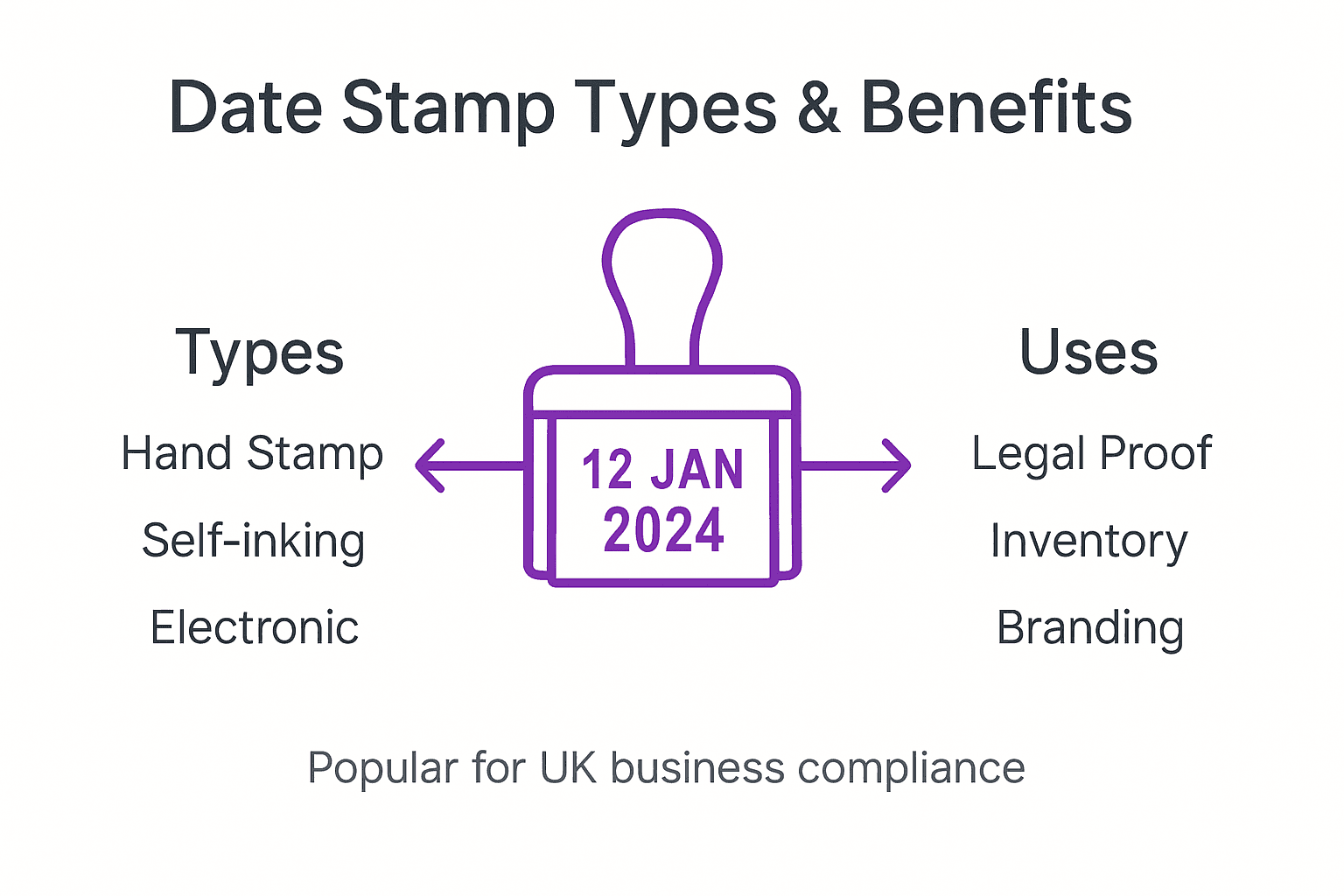
Pro tip: Always select a date stamp design that reflects your brand’s professional image and includes clear, legible typography to ensure maximum readability and impact.
Some Popular Date Stamps for Everyday Use


Types of date stamps for business use
Businesses in the United Kingdom utilise several distinct types of date stamps, each designed to meet specific operational requirements and branding objectives. These stamp varieties range from traditional manual tools to advanced electronic systems, providing organisations with flexible solutions for document authentication and record-keeping.
The primary categories of date stamps include:
- Hand Stamps: Traditional rubber stamps requiring manual ink application
- Pre-Inked Stamps: Self-contained stamps with integrated ink reservoir
- Self-Inking Stamps: Automatic re-inking mechanism after each impression
- Electronic Date Coding Machines: Digital systems for high-volume document processing
Each stamp type offers unique advantages depending on business scale and specific documentation needs. Professional organisations select date stamps based on precise requirements for authenticity and traceability, ensuring consistent and professional document management across different operational contexts.
Hand stamps remain popular among smaller businesses for their flexibility and cost-effectiveness, while larger corporations often invest in electronic date coding machines that can process hundreds of documents rapidly. The choice depends on factors like document volume, required precision, and budgetary constraints.

Here is a concise comparison of date stamp types and their recommended business uses:
| Date Stamp Type | Best for Business Size | Main Benefit |
|---|---|---|
| Hand Stamp | Sole traders, micro | Low-cost flexibility |
| Pre-Inked Stamp | Small to medium | Clean, consistent mark |
| Self-Inking Stamp | Medium | Speed, convenience |
| Electronic Coding Machine | Large enterprises | High-volume efficiency |
Pro tip: Consider your business’s specific documentation volume and frequency when selecting a date stamp, ensuring the chosen type matches your operational complexity and branding requirements.
How date stamps work and key features
Date stamps function through a precise mechanism of transferring chronological information onto documents with exceptional accuracy, enabling businesses to establish clear temporal records for their documentation and branding processes.
The fundamental operational features of date stamps include:
- Ink Transfer: Applying a clear, legible impression of date and time
- Customisation: Ability to adjust date format and additional text
- Precision: Capturing exact moment of document processing
- Traceability: Creating permanent, verifiable records
Modern date stamps support standardised documentation formats like ISO 8601, ensuring consistency across different business systems. This standardisation helps organisations maintain professional documentation practices and supports legal compliance requirements.
Mechanically, date stamps operate through several key methods. Manual hand stamps require physical pressing onto an ink pad and then onto the document. Self-inking stamps incorporate an internal ink reservoir, automatically re-inking between impressions. Electronic date coding machines represent the most advanced option, allowing digital programming of date formats and seamless integration with existing administrative systems.
Pro tip: Select a date stamp that offers flexible formatting options to match your specific organisational documentation standards and workflow requirements.
Operational advantages for small businesses
Small businesses can leverage strategic documentation tools like date stamps to streamline their operational efficiency, addressing critical challenges associated with record-keeping and compliance management.
The key operational advantages for small businesses include:
- Quality Control: Ensuring consistent documentation standards
- Regulatory Compliance: Creating verifiable audit trails
- Error Reduction: Minimising manual documentation mistakes
- Process Standardisation: Implementing uniform tracking mechanisms
Enterprise research demonstrates that systematic documentation supports sustainable business growth, particularly for organisations managing limited resources. Date stamps provide a cost-effective solution for maintaining professional documentation practices without requiring complex technological infrastructure.
By implementing date stamps, small businesses can effectively manage product batches, track inventory movements, and create transparent records that enhance both internal processes and customer trust. The ability to quickly and accurately timestamp documents reduces administrative burden and supports more strategic use of limited organisational resources.
Pro tip: Invest in a versatile date stamp that can be easily customised to match your specific business documentation requirements and workflow processes.
Legal requirements and compliance for UK businesses
Compliance represents a critical consideration for UK businesses utilising date stamps, with multiple regulatory frameworks governing their implementation and usage. Organisations must navigate complex data protection requirements when documenting and processing information, ensuring transparency and legal adherence.
Key legal compliance considerations include:
- Data Protection: Alignment with UK GDPR regulations
- Record Retention: Maintaining accurate documentation timelines
- Authenticity: Ensuring verifiable document timestamps
- Privacy Standards: Protecting sensitive information
Companies House mandates stringent record-keeping standards for businesses, which directly impacts how organisations manage and document their operational processes. Date stamps serve as crucial tools in meeting these regulatory requirements, providing a clear and legally recognised method of tracking document creation and processing times.
Businesses must develop comprehensive strategies that integrate date stamp usage with broader compliance frameworks. This involves establishing clear protocols for document handling, ensuring that timestamp practices meet legal standards for accuracy, confidentiality, and traceability. Proper implementation helps organisations demonstrate due diligence and maintain robust administrative practices.
Below is a summary outlining the primary compliance risks and practical safeguards for UK businesses using date stamps:
| Compliance Risk | Common Cause | Recommended Safeguard |
|---|---|---|
| Data inaccuracy | Inconsistent formatting | Use standardised date layouts |
| Privacy breach | Poor document handling | Secure document storage |
| Regulatory non-compliance | Missed record retention | Schedule regular compliance checks |
| Invalid authentication | Outdated stamp equipment | Inspect and update regularly |
Pro tip: Regularly review your date stamping procedures to ensure they align with current UK data protection and record-keeping regulations.
Mistakes to avoid when using date stamps
Navigating the complexities of date stamp usage requires careful attention to prevent potential operational and legal pitfalls. Businesses must be vigilant about common mistakes that can compromise document integrity and organisational credibility, understanding the nuanced challenges associated with precise record-keeping.
The most critical mistakes organisations frequently encounter include:
- Inconsistent Date Formatting: Using multiple incompatible date styles
- Illegible Impressions: Creating unclear or faded stamp marks
- Outdated Equipment: Continuing to use worn or damaged stamps
- Irregular Maintenance: Neglecting regular stamp inspection and replacement
Standardisation remains crucial in avoiding potential documentation errors, with businesses needing to implement consistent practices across their administrative processes. Proper date stamp usage requires meticulous attention to detail, ensuring that every impression provides clear, accurate, and legally compliant documentation.
Organisations must develop robust protocols for date stamp management, including regular equipment checks, staff training on correct usage, and establishing clear guidelines for document timestamping. This approach helps mitigate risks associated with improper record-keeping and maintains the professional standard of business documentation.
Pro tip: Implement a quarterly review process to assess the condition and accuracy of your date stamping equipment and documentation practices.
Enhance Your UK Business Branding with Custom Date Stamps
Understanding the critical role of date stamps in UK branding reveals a pressing need for accuracy, professionalism, and compliance in your documentation. Whether your business struggles with inconsistent date formatting, illegible impressions, or outdated equipment, choosing the right customised date stamp can transform your record-keeping and elevate your brand image. With options ranging from manual to self-inking designs, every organisation can find a suitable solution to match its unique operational demands.
Experience the power of professional customised stamps by exploring the diverse selection available at StampDesign4u. Our easy-to-navigate platform empowers you to create precise and legible date stamps that reinforce authenticity and legal compliance. Take control of your business documentation today and enjoy streamlined processes, enhanced traceability, and a consistent visual identity. Discover tailored solutions for your business needs now at https://stampdesign4u.co.uk.
Frequently Asked Questions
What is a date stamp?
A date stamp is an official marking that records the precise date and time an item, document, or product was processed, mailed, or authenticated, serving crucial roles in business and administrative contexts.
What types of date stamps are available for businesses?
Businesses can choose from several types of date stamps including hand stamps, pre-inked stamps, self-inking stamps, and electronic date coding machines, each designed for different operational needs and document processing volumes.
How do date stamps enhance operational efficiency in small businesses?
Date stamps help small businesses streamline operations by ensuring consistent documentation, meeting regulatory compliance, reducing errors, and standardising processes. This leads to improved record-keeping and transparency in business practices.
What are the legal compliance considerations for using date stamps?
When using date stamps, businesses must adhere to data protection regulations, maintain accurate record retention timelines, ensure the authenticity of document timestamps, and protect sensitive information, especially in contexts that require legal documentation.
Recommended
- Personalised Date Stamps – Stamp Design 4U
- Custom Logo Stamps: Why They Matter for your Brand Identity – Stamp Design 4U
- Complete Guide to Branding With Custom Stamps – Stamp Design 4U
- Why Design Your Own Custom Stamp: A Complete Guide – Stamp Design 4U