

TL;DR:
- Postal stamps are official payment tools used for mailing, while office stamps serve internal document marking purposes. Using the wrong type can cause surcharges, delays, and operational issues, especially with new barcoded postal stamps since July 2023. Businesses should swap outdated stamps and choose their stamps based on mailing volume and document processing needs.
Postal stamps are payment instruments for postage, issued and regulated by postal authorities such as Royal Mail, whereas office stamps are physical marking tools used by businesses to endorse, brand, or track documents. The distinction matters because confusing the two leads to real financial consequences: using the wrong stamp type on mail can result in surcharges, delays, and returned items. This guide covers the difference between stamps in both categories, their practical uses, regulatory requirements, and how to choose the right option for your mailing and organisational needs.
What are postal stamps and how are they used?
Postal stamps are the official payment method for sending mail through a national postal service. Royal Mail issues them in several formats, including 1st class, 2nd class, and special delivery variants. Each stamp carries a monetary value that covers the cost of transporting a letter or parcel to its destination.
Since july 2023, non-barcoded stamps are no longer valid for postage. Royal Mail introduced barcoded stamps as the new standard, and any mail bearing an old non-barcoded stamp now incurs a surcharge of £2.50 per letter or large letter, and £3.50 per small parcel. That penalty falls on the recipient, not the sender, which creates friction and reputational risk for businesses posting to customers.
Royal Mail provides a practical remedy through its Stamp Swap Out scheme. You can exchange non-barcoded stamps for valid barcoded ones at no cost, using forms available online or at Post Office branches. Businesses with more than £200 worth of old stamps to exchange can request a separate form for bulk swaps.
A common misconception is that any adhesive label or sticker can substitute for a postage stamp. It cannot. Postal stamps carry security features that ordinary labels lack entirely.
Pro Tip: Check your existing stamp stock before posting. Any non-barcoded stamps in your drawer are invalid and will trigger a surcharge for your recipient.
Security features that prevent stamp fraud
Royal Mail uses phosphor bands and unique barcodes on every valid stamp to detect counterfeits and reused postage. These features are invisible to the naked eye but readable by automated sorting machines. Attempting to reuse a cancelled stamp or remove a postmark is highly likely to be caught, resulting in forfeiture and additional charges.
What are office stamps and their practical uses?
Office stamps are physical or self-inking tools designed to mark documents, packaging, or surfaces with text, logos, or symbols. They serve no postage function. Their purpose is entirely operational: approving invoices, branding outgoing parcels, dating received correspondence, or marking documents as confidential.
The main types of office stamp include:
- Rubber stamps: The traditional option, requiring a separate ink pad. Suitable for low-volume use and easy to customise.
- Self-inking stamps: Re-ink automatically after each impression. Faster and cleaner for high-volume tasks such as date-stamping incoming post.
- Logo stamps: Carry a business’s logo or brand mark. Widely used on packaging, letters, and promotional materials.
- Approval stamps: Pre-printed with words such as “Approved,” “Received,” or “Paid.” Common in accounts departments and administrative teams.
- Address stamps: Print a return address in one impression. Useful for businesses posting large volumes of correspondence.
No modern UK law requires a company to hold a formal company seal for routine business. Office stamps serve operational roles in document endorsement, approval workflows, and brand consistency without any legal mandate. That said, many businesses treat them as indispensable for efficiency.
Self-inking and digital stamps improve speed, reduce mess, and support audit trails in business processes. Digital stamps extend this further by enabling remote workflows with verifiable electronic seals. For most small businesses, a self-inking stamp covers the majority of daily stamping needs at a low cost.

Pro Tip: For high-volume document processing, choose a self-inking stamp over a traditional rubber stamp. The automatic re-inking mechanism saves time and produces more consistent impressions across hundreds of uses.
What are the key differences between postal and office stamps?
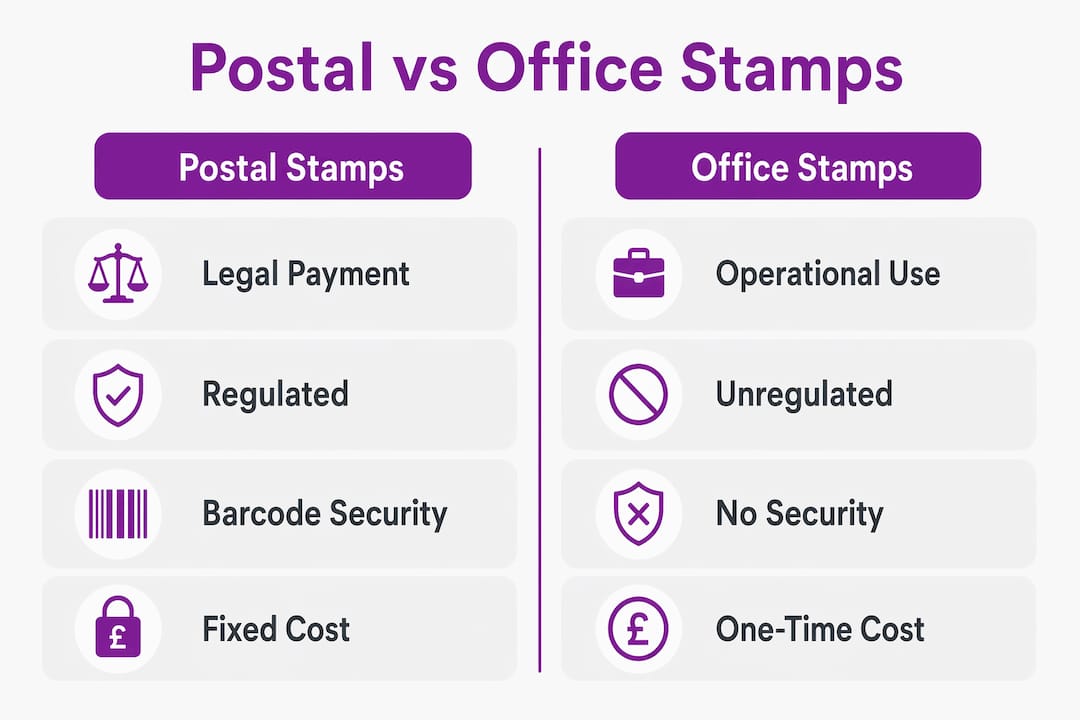
Postal stamps and office stamps differ across four main dimensions: legal function, regulation, security, and cost.
Legal function: A postal stamp is a legally required payment instrument for mail. An office stamp is an internal tool with no postage value. Using an office stamp on an envelope in place of a postal stamp will result in the item being returned or the recipient being charged a surcharge.
Regulation: Royal Mail governs postal stamps strictly. Barcoded stamps are the only valid format since july 2023, and invalid stamps cause processing errors and delivery delays in addition to financial penalties. Office stamps face no equivalent regulatory framework.
Security features: Postal stamps carry phosphor bands and machine-readable barcodes. Office stamps carry no security features beyond the design itself.
Cost: Postal stamps carry a fixed face value set by Royal Mail. Office stamps require an upfront purchase cost but then produce unlimited impressions at no additional cost per use.
| Feature | Postal stamp | Office stamp |
|---|---|---|
| Purpose | Pays for mail delivery | Marks or endorses documents |
| Issued by | Royal Mail or national postal authority | Any supplier or manufacturer |
| Legal requirement | Yes, for sending mail | No legal mandate in most UK cases |
| Security features | Phosphor bands, barcodes | None |
| Cost model | Per-stamp face value | One-off purchase, unlimited use |
| Valid for postage | Yes | No |
Businesses posting mail at volume have a third option: online postage printing via Royal Mail Click & Drop, which offers tracking and discounts compared to counter posting. Counter posting carries higher costs and greater surcharge risk. Online printed labels bypass the stamp question entirely for high-volume senders.
How do you choose the right stamp for your needs?
The right choice depends on what you are actually trying to do. Postal stamps and office stamps are not interchangeable, but many businesses need both.
For mailing needs, ask these questions:
- Do you post letters or parcels regularly? If yes, buy barcoded Royal Mail stamps or set up an account with Royal Mail Click & Drop for tracked, discounted postage.
- Do you have old non-barcoded stamps in stock? Swap them immediately through the Royal Mail Stamp Swap Out scheme before they cost your recipients money.
- Do you post in high volumes? Online postage printing is more cost-effective and reduces the risk of using invalid stamps.
For organisational needs, consider:
- How often do you stamp documents? Daily use justifies a self-inking stamp. Occasional use suits a traditional rubber stamp with an ink pad.
- Do you need branded impressions on packaging or correspondence? A logo stamp produces consistent branding at a fraction of the cost of printed stationery.
- Do you process approvals, invoices, or received items? Administrative stamps for words like “Paid” or “Received” reduce manual writing and speed up document handling.
Pro Tip: Audit your stamping tasks before buying. Separate your mailing requirements from your document-marking requirements. Each category has a different solution, and conflating them leads to wasted spend.
The cost trade-off is straightforward. Postal stamps are a recurring expense tied directly to volume. Office stamps are a one-off investment that pays for itself quickly in time saved. A business that stamps 50 invoices a day with a self-inking stamp recovers the purchase cost within days.
Key takeaways
Postal stamps pay for mail delivery and are legally regulated by Royal Mail, while office stamps are operational tools for marking documents and carry no postage value.
| Point | Details |
|---|---|
| Postal stamps are regulated | Only barcoded stamps are valid since july 2023; non-barcoded stamps incur surcharges of £2.50 per letter. |
| Office stamps serve internal functions | They handle approvals, branding, and document tracking without any legal postage role. |
| Security features differ entirely | Postal stamps carry phosphor bands and barcodes; office stamps carry no equivalent security. |
| Swap old stamps immediately | The Royal Mail Stamp Swap Out scheme exchanges non-barcoded stamps for valid ones at no cost. |
| Choose by task, not by preference | Mailing needs require postal stamps or online postage; organisational needs require office stamps. |
Steven’s view: stamps still matter more than most businesses realise
The shift to barcoded stamps caught a surprising number of businesses off guard. I have spoken with small business owners who discovered a drawer full of non-barcoded stamps months after the july 2023 deadline. The financial exposure was real: every letter sent with an invalid stamp risked a £2.50 charge landing on a customer’s doorstep. That is not a minor administrative oversight. It is a customer experience problem.
What strikes me about office stamps is how underused they are in businesses that would benefit most. A sole trader or small accounts team spending time hand-writing “Received” or “Approved” on dozens of documents each week is losing hours that a £20 self-inking stamp would recover in a fortnight. The benefits of rubber stamps for small businesses are not glamorous, but they are concrete and immediate.
The broader pattern I see is that businesses treat stamps as an afterthought until something goes wrong. A returned parcel, a surcharge complaint from a customer, or a branding inconsistency on outgoing post. Getting the right stamp for each task upfront costs very little. Getting it wrong costs more than the stamp ever would have.
— Steven
Stampdesign4u: stamps for every business need
Stampdesign4u offers a wide range of office stamps suited to businesses of all sizes, from compact logo stamps to pre-inked administrative tools.
Whether you need a personalised logo stamp for consistent branding on outgoing correspondence, or a ready-made stock stamp for document approvals, Stampdesign4u carries options across both categories. The Trodat Printy 4912 is a particularly practical choice for businesses needing a compact, self-inking logo stamp at 48 x 18mm. Browse the full personalised rubber stamps range to find a stamp that fits your workflow and brand requirements.
FAQ
What is the difference between a postal stamp and an office stamp?
A postal stamp is a payment instrument issued by a postal authority such as Royal Mail, used to pay for mail delivery. An office stamp is a physical marking tool used to endorse, brand, or track documents within a business.
Are non-barcoded stamps still valid in 2026?
Non-barcoded stamps have been invalid since july 2023. Using one on mail now results in a surcharge of £2.50 per letter or large letter, and £3.50 per small parcel, charged to the recipient.
Can I use an office stamp instead of a postage stamp?
No. Office stamps carry no postage value and are not recognised by Royal Mail as payment for mail delivery. Mail bearing only an office stamp will be returned or the recipient will be charged a surcharge.
How do I swap my old non-barcoded stamps?
Royal Mail’s Stamp Swap Out scheme allows you to exchange non-barcoded stamps for valid barcoded ones at no cost. Forms are available to download online or collect at Post Office branches, with a separate process for exchanges exceeding £200 in value.
What types of office stamps are most useful for small businesses?
Self-inking stamps for high-volume tasks, logo stamps for branding, and approval stamps for document processing are the most practical choices for small UK businesses. A guide to must-have office stamps covers the seven most common types used by small businesses in the UK.